Help us get this right
Does this portrait look right for Dai?
Nobody has judged this one yet. You would be the first.
Dai Erotic
Southern Yunnan, China, chiefly Xishuangbanna and Dehong prefectures and the Red River valley, with closely related Tai peoples across the borders in Myanmar, Laos, Vietnam and Thailand
Tai Lue, Tai Nuea and related Dai languages (Kra-Dai, Southwestern Tai branch)
Theravada Buddhism alongside village and household spirit worship; the Huayao Dai keep a traditional spirit religion
Tai Lue (Shui Dai), Tai Nuea (Han Dai), Huayao Dai including Tai Ya; part of the wider Tai peoples with the Shan, Lao and Thai
About Dai People
Dai is a category the Chinese state drew around several Tai-speaking peoples of southern Yunnan, and the people inside it usually name themselves more precisely: Tai Lue in Xishuangbanna, Tai Nuea in Dehong on the Burmese border, Tai Ya and smaller groups along the Red River farther east. What holds the label together is a way of life that does not stop at the frontier. It runs on into Myanmar, Laos, Thailand and Vietnam: flat valley basins worked as rice paddies, houses of bamboo and timber raised on stilts, a Buddhist temple at the center of the village, and speech far closer to Lao and Thai than to the Mandarin of Kunming.
Their languages sit in the Southwestern branch of the Tai family, and the main branches have long had writing of their own. Xishuangbanna uses the Tai Tham script, which it shares with the old Lanna kingdom of northern Thailand, and Dehong uses the Tai Le script. Chinese linguists simplified both in the 1950s, but the older letters survive in the temples. The name Xishuangbanna is itself a Chinese rendering of Sipsong Panna, a Tai name usually glossed as "twelve thousand rice fields." For centuries it was a small kingdom under a hereditary ruler that sent tribute to both Chinese and Burmese courts. In Dehong, the Tai principality of Mong Mao was a real regional power until Ming armies campaigned against it in the fifteenth century.
Most Dai are Theravada Buddhists, following the same school as Thailand and Myanmar. Boys traditionally spent a stretch as novices in the village temple, which for generations was where a Dai man learned to read, and scripture was copied onto palm-leaf manuscripts. Buddhism never pushed out the older spirits of village, field and household, and they still get their offerings. The three-month rains retreat opens with a Door-Closing festival and ends with a Door-Opening one, and weddings traditionally wait until it is over. The Huayao, or "flowery-waist," Dai of the Red River valley, named for the bright sashes in the women's dress, stand apart: they never took up Buddhism and keep to their older spirit religion.
The mid-April Water-Splashing Festival, which is the Dai New Year, is the picture most of China has of the Dai, along with the peacock dance. The picture leaves out how much the past seventy years have changed. Temples closed during the Cultural Revolution and reopened in the 1980s, often with help from monks across the southern border. Rubber plantations and a heavy tourist trade have since remade much of Xishuangbanna's lowland forest and its towns.
Related ethnic groups
Groups that share Dai's homeland, region, language, or religious tradition. These are likely candidates for comparative phenotype reference.

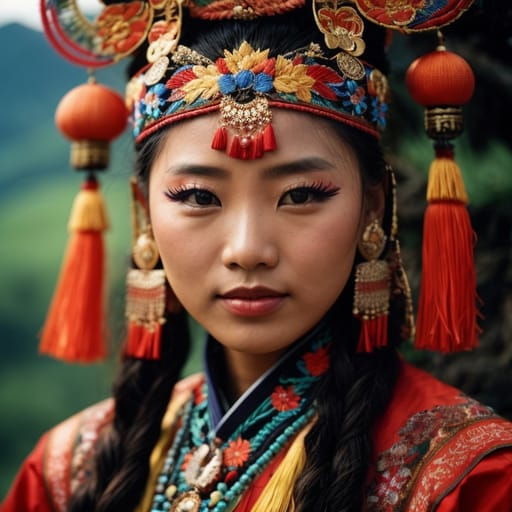
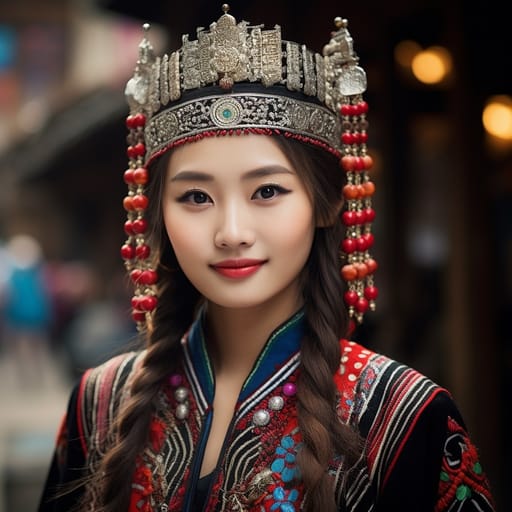
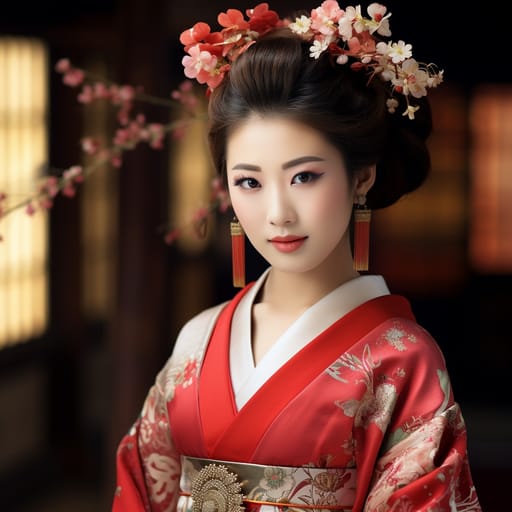
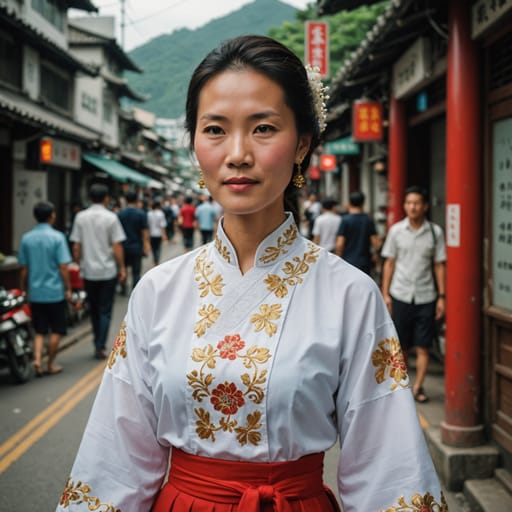
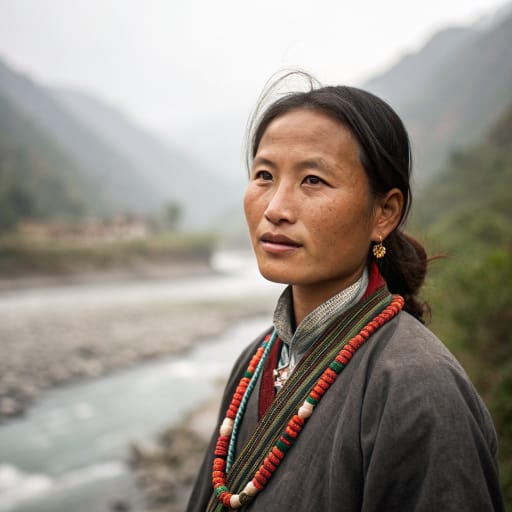
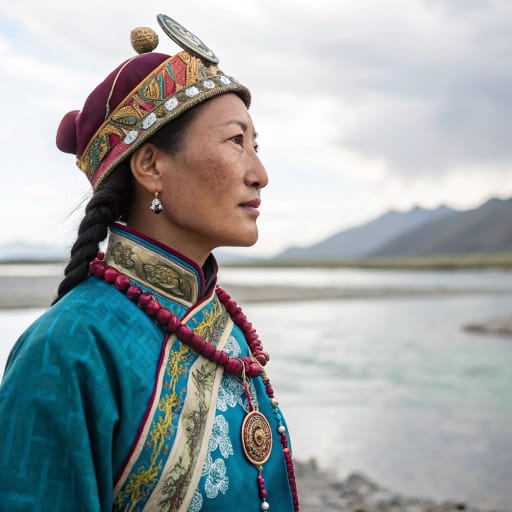
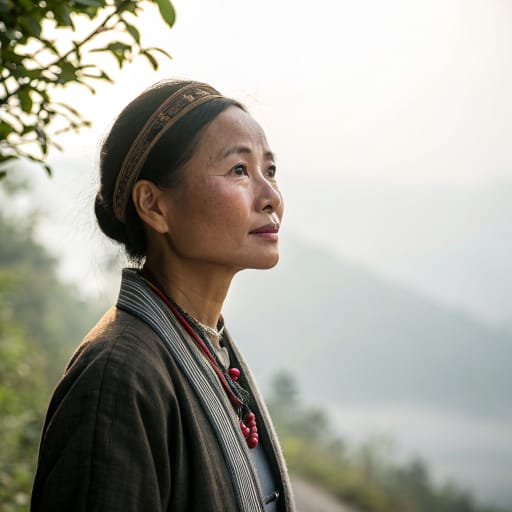
Typical Dai Phenotypes
Reference for AI generation: hair, eyes, skin, facial structure, build
Dai Body & Anatomy Reference
East Asian Sinitic / Mongoloid phenotype: anatomy reference for AI nude generation
Dai Boobs & Breasts
Dai boobs follow the East Asian Sinitic / Mongoloid profile: small-to-medium cup, modest projection. Areolar diameter is usually 26-36mm, and the coloring is light-pink to medium-brown areolar pigmentation against the light-to-medium skin tone. Breast shape tracks body composition (ectomorph-to-mesomorph, lean frame, mean adult female BMI 20-23), so Dai breasts tend to be firm and modestly projecting; smaller cup size than the South Asian or Western Asian average. Expect a forward-set shape, not the fuller South Asian or Levantine bust profile.
Dai Ass & Hips
Dai ass and hip morphology presents as small-to-medium, modest projection, narrower hip profile, distinctly different from the fuller projected glutes of the West African or Polynesian phenotype. The Dai pelvic profile shows narrower iliac crests, less gluteal-femoral fat deposition, anchored in the East Asian Sinitic / Mongoloid skeletal pattern. Dai butt shots in adult AI imagery should render the small-to-medium, modest projection, narrower hip profile silhouette with the overall build (ectomorph-to-mesomorph, lean frame) and the fat distribution typical of the East Asian Sinitic / Mongoloid phenotype.
Dai Vagina & Pussy
Dai pussy anatomy typically shows light-pink to medium-brown labial pigmentation, smaller labia minora. Pubic hair is usually straight fine texture, sparser distribution than the South Asian norm. In AI-generated Dai nudes, labial color should blend into the light to medium skin with a gradual transition, and the hair should keep its straight fine texture.
Dai Dicks & Penis
Penis reference for Dai men: regional mean ~11-12cm erect, moderate girth. Coloring: light-brown shaft pigmentation. An accurate Dai cock in AI imagery matches the surrounding light to medium skin rather than a generic porn default. Circumcision depends on religion and custom, not ancestry.
Dai Body, Curves & Build
The Dai figure is generally ectomorph-to-mesomorph, lean frame, with mean adult female BMI 20-23, characteristic of East Asian Sinitic / Mongoloid ancestry. AI image tools tend to flatten regional body types into a few stock shapes; here the Dai build is kept as its own reference.
Dai Skin Tone & Hair Texture
Skin: light to medium (Fitzpatrick II-IV). Hair: straight 1A, fine-to-medium, predominantly black. Both are typical of East Asian Sinitic / Mongoloid ancestry. The most common mistake in AI nudes of Dai women is a body rendered lighter than the face.
Explore phenotype categories
Structured taxonomy with peer-reviewed scales · 22 anatomical categories
Erotic Poses & Sex Positions
From the pose catalog: 219 named positions with reference skeletons
Frequently asked questions about Dai people
Where is the Dai homeland?
The Dai homeland is Southern Yunnan, China, chiefly Xishuangbanna and Dehong prefectures and the Red River valley, with closely related Tai peoples across the borders in Myanmar, Laos, Vietnam and Thailand in East Asia.
What language do Dai people speak?
Dai people primarily speak Tai Lue, Tai Nuea and related Dai languages (Kra-Dai, Southwestern Tai branch).
What religion do Dai people practice?
The predominant religion among Dai people is Theravada Buddhism alongside village and household spirit worship; the Huayao Dai keep a traditional spirit religion.






Make your own Dai images
Five a day, free, no credits to buy. The studio starts from this group's phenotype data, so you can set body type, pose and style and keep the traits accurate.
Start with Dai