Help us get this right
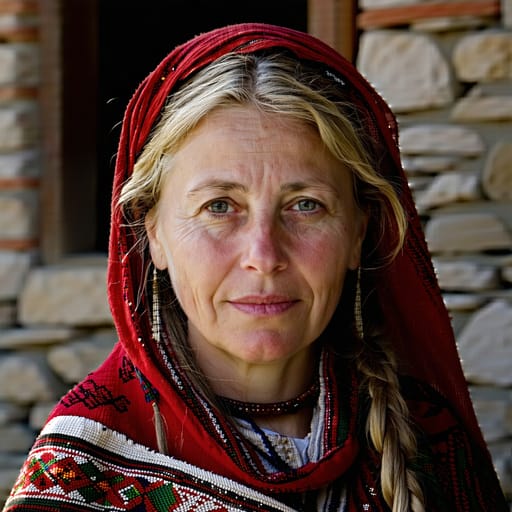
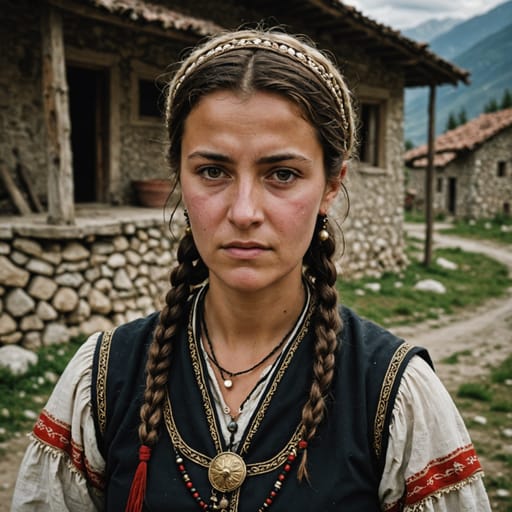
Does this portrait look right for Albanians?
One tap. It takes a second and it is recorded.
8 say it looks right, 4 say it looks off.
How 6 image generators render Albanians
The same documentary prompt sent to each generator; one render each, alphabetical by generator. The comparison page has every render, the match to documented photographs and the reader pairs.
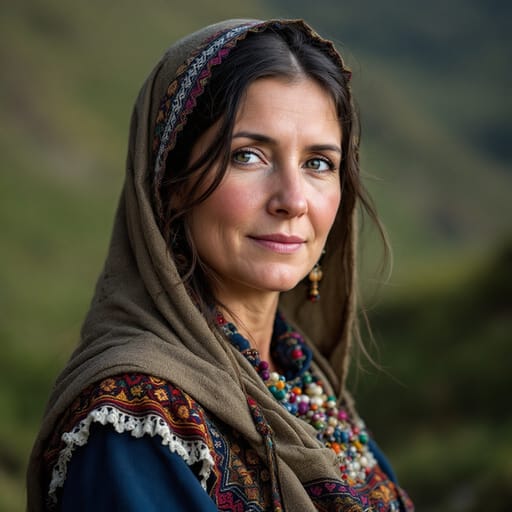
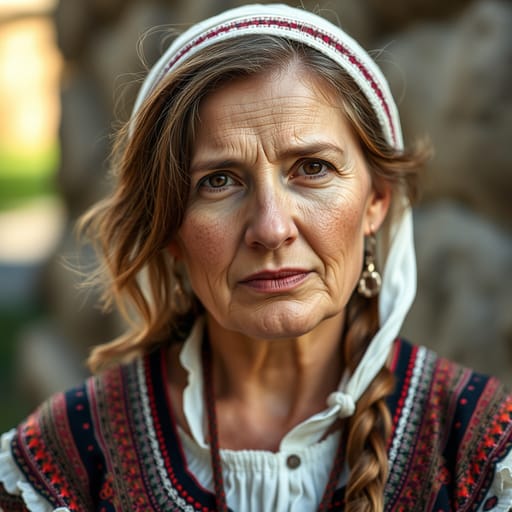
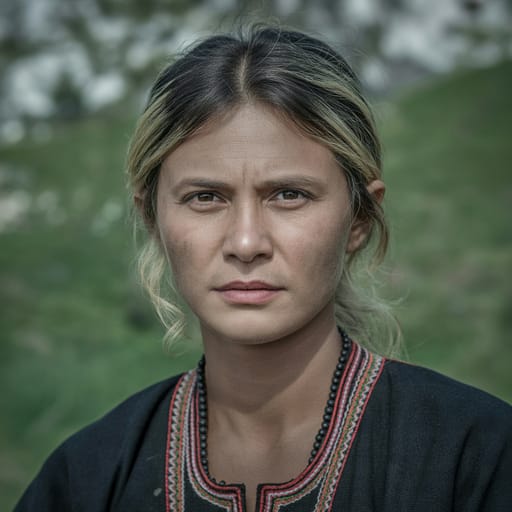
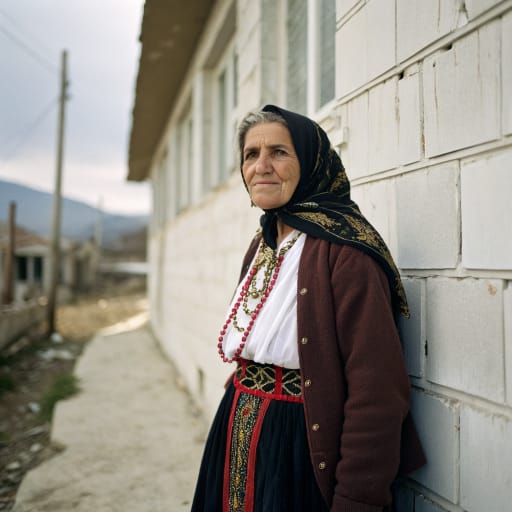
Albanians Erotic
Also known as: Albanian
Islam and Christianity
Ghegs, Tosks (including Arbëreshë and Arvanites), Kosovars, Cham Albanians, Macedonian Albanians, along with significant populations in Turkey, Germany, Switzerland and the United States
About Albanians People
Albanians are one of the older puzzles of European linguistics: their language sits inside the Indo-European family but on its own branch, with no close living relatives. Whatever Albanian descends from (Illyrian is the usual candidate, Thracian the alternative), the line has been running parallel to Greek, Latin, and the Slavic languages for so long that it answers to none of them. The two main dialect blocks, Gheg in the north and Tosk in the south, split roughly along the Shkumbin river and remain mutually intelligible but distinct in vowel and verb. Standard Albanian, codified in 1972, leans heavily on Tosk; northerners have been quietly resenting that fact ever since.
The homeland runs along the eastern Adriatic coast and inland into the Balkan highlands, with the bulk of speakers in Albania and Kosovo and significant populations in North Macedonia, southern Serbia's Preševo Valley, and parts of Montenegro and northwestern Greece. Centuries-old diaspora communities (the Arbëreshë in southern Italy and Sicily, descended from refugees who left after the death of Skanderbeg in 1468, and the Arvanites of central Greece) preserve archaic forms of the language that linguists still travel to study. More recent migration after 1991 produced large communities in Italy, Germany, Switzerland, and the United States.
Religiously, Albanians are unusual in Europe for being roughly split between Sunni Islam (with a notable Bektashi Sufi presence whose world headquarters is in Tirana), Catholicism in the north, and Orthodox Christianity in the south. The mix is a legacy of Ottoman rule layered over older Byzantine and Roman boundaries, but the operative cultural fact is that confession tends to sit lightly. The nineteenth-century writer Pashko Vasa's line, the faith of the Albanian is Albanianism, has a long second life precisely because intermarriage and shared villages made it true on the ground.
The northern highlands carry the Kanun, an oral customary code attributed to the fifteenth-century chieftain Lekë Dukagjini, which governed honor, hospitality, property, and blood feud well into the twentieth century and which still casts a shadow in remote districts. Two related institutions are worth knowing: besa, the absolute pledge of one's word, sometimes used to extend protection to strangers, most famously when Albanian families sheltered Jews during the Nazi occupation, and the burrnesha, the sworn virgins who took on a male social role to head households where no men remained. Both are recognizably Albanian answers to the problem of how a small society holds itself together.
Related ethnic groups
Groups that share Albanians's homeland, region, language, or religious tradition. These are likely candidates for comparative phenotype reference.
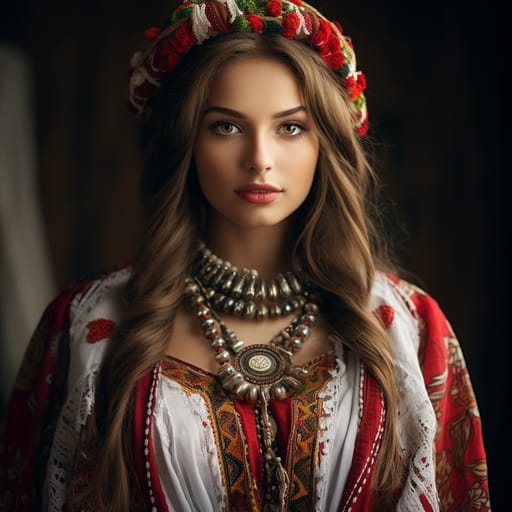
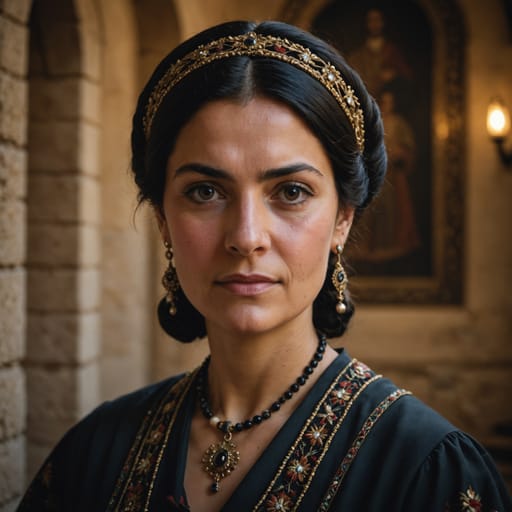
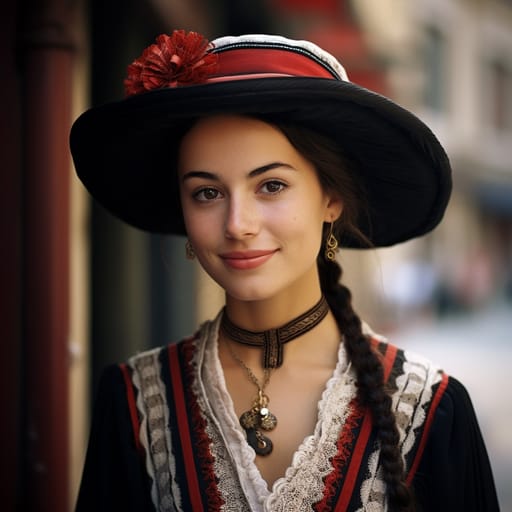
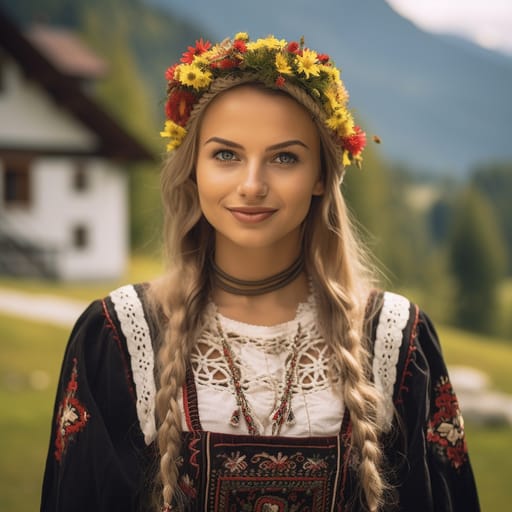
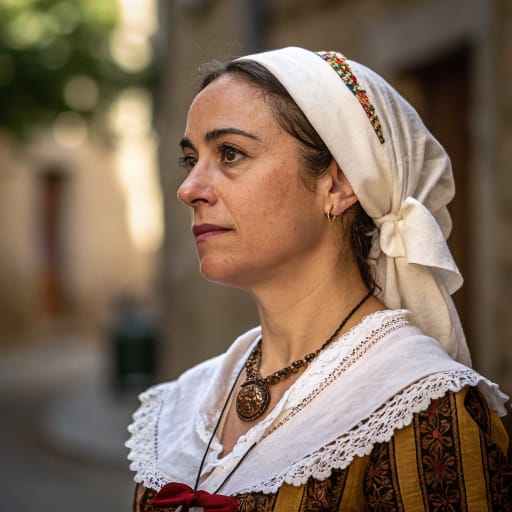
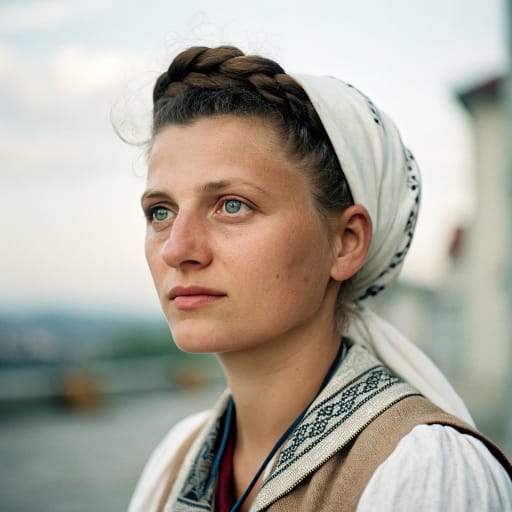
Typical Albanians Phenotypes
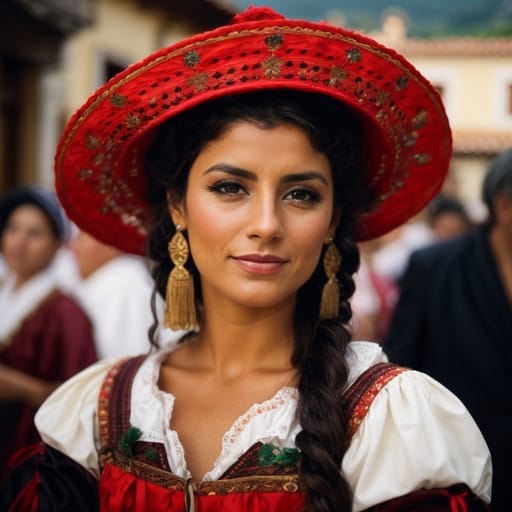
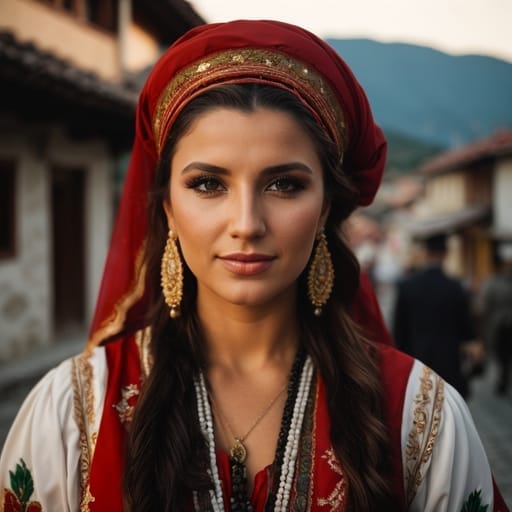
Reference for AI generation: hair, eyes, skin, facial structure, build
Albanians sit at the genetic crossroads of the Adriatic, the Balkans, and the eastern Mediterranean, and the phenotype reads accordingly: predominantly Southern European with a stronger Dinaric signature than most of their neighbors. Hair runs dark by default: deep brown to near-black covers the majority, with chestnut and warm mid-brown common in the northern highlands. Texture is typically straight to loosely wavy; tight curls are uncommon. Light hair is a real but minority presence: sandy and dirty-blond children who darken with age, occasional natural blondes among Ghegs in the northern mountains, and red hair as a rare recessive rather than a regional cluster.
Eyes show more variation than hair. Brown of every depth predominates, but light eyes (green, hazel, and gray-blue) appear at meaningfully higher rates than in southern Italy or Greece, again concentrated in the Gheg north and parts of Kosovo. Eye shape is almond to slightly deep-set, with no epicanthic fold and often a defined, slightly hooded upper lid. Skin spans Fitzpatrick II through IV: an olive-leaning ivory in the highlands that tans to bronze, shifting to warmer Mediterranean olive among Tosks, Arbëreshë, and Cham populations further south.
The facial structure is where Albanians read as distinct. Noses tend to be long and straight or with a subtle convex bridge, the classic Dinaric profile, set in a narrow midface with prominent cheekbones and a strong, often square jaw. Lips are medium in fullness, browbones pronounced in men. Build is the other anthropometric standout: Albanian and Kosovar men average roughly 178-181 cm, placing them among the tallest populations in Europe, with broad shoulders, long limbs, and a lean-to-mesomorphic frame. Women are correspondingly tall and tend toward an hourglass silhouette in younger adulthood.
Sub-group differences are gradient rather than sharp. Ghegs skew taller, lighter-eyed, and more angular; Tosks and Arbëreshë run a touch shorter, darker-eyed, and warmer-toned, closer to a Calabrian or Epirote read than to the highland north.
Data depth
51/100Coverage of image-grounded phenotype observations · drives AI generation diversity
- Sample size
- 40/40· 70 images
- Image quality
- 6/30· 13% high
- Confidence
- 5/20· mean 0.52
- Source diversity
- 0/10· wikipedia
- ·Low overall confidence
- ·Mostly low-quality source images
- ·Wikipedia-only source, not population-representative
Observed Distribution: Image Sample
Empirical observations from analyzed photographs · supplementary signal, not population truth
Sample: 70 images analyzed (70 wikipedia). Quality: 9 high, 32 medium, 22 low, 7 very_low. Avg analyzer confidence: 0.52.
Skin tone (Fitzpatrick): II (47%), III (20%), IV (11%), V (3%), unclear (19%)
Hair color: black (44%), gray/white (31%), dark brown (4%), brown (1%), light/medium brown (1%), unclear (17%)
Hair texture: straight (41%), wavy (24%), curly (3%), coily (4%), bald (1%), shaved (1%), covered (14%), unclear (10%)
Eye color: dark brown (34%), blue (9%), brown (7%), hazel (3%), unclear (47%)
Epicanthic fold: 0% present, 84% absent, 16% unclear
Caveats: Quality skews toward older or low-resolution photos; phenotype detail may be lossy. Low average analyzer confidence: many photos partially obscured or historical. Sample is 100% Wikipedia notable people, which skews toward male, public-life, and modern figures, not population-representative.
Last aggregated: May 7, 2026
Explore phenotype categories
Structured taxonomy with peer-reviewed scales · 22 anatomical categories
- SkinFitzpatrick I to VI, undertone, pigmentation
- EyesColor, shape, eyelid, epicanthic fold
- Head hairColor, Andre Walker texture, hairline
- Body shapeHeath-Carter somatotype, WHR, frame
- NoseBridge, tip, nostril, alar width
- Lips & mouthVolume, Cupid’s bow, philtrum
Measured in Albanians portraits
Notable Albanians People
100 reference figures, sourced from Wikipedia
- Dhimitër Frëngu, 1443 to 1525), friar and scholar of a noble family, treasurer and councilor o…
- Marin Barleti, Father Marin Barleti (1450 to 1513), Catholic ecclesiastic and writer, author…
- Gjon Buzuku, 1499 to 1577), bishop Catholic, author of the oldest known document in Albani…
- Pjetër Budi, 1565 to 1622), Catholic priest and writer, published three books in Albanian …
- Luca Matranga, Papa Luca Matranga (1567 to 1619), priest and scholar, author of the first li…
- Frang Bardhi, 1606 to 1644), Catholic bishop, lexicographer, folklorist and ethnographer, a…
- Pjetër Bogdani, 1630 to 1689), Catholic bishop and writer, author of the first Albanian work …
- Nikollë Filja, Papa Nikollë Filja (1691 to 1769), priest and writer.
- Giuseppe Crispi, Mons. Giuseppe Crispi (1781 to 1859), one of the major figures of the Arbëres…
- Francesco Antonio Santori, Papa Francesco Antonio Santori (1819 to 1894), writer, poet and playwright.
- Nikoll Kaçorri, 1862 to 1917), Catholic religious, politician and patriot, deputy prime minis…
- Gjergj Fishta, 1871 to 1940), Franciscan friar, poet, politician and translator.
- Theofan Stilian Noli, Mons. Theofan Stilian Noli (1882 to 1965), bishop and intellectual, writer, s…
- Marco La Piana, Papa Marco La Piana (1883 to 1958), priest and scholar, gave his contribute t…
- Anton Harapi, 1888 to 1946), Franciscan friar, teacher, writer and politician.
- Zef Valentini, 1900 to 1979), Italian Jesuit, albanologist, byzantinist and historian, natur…
- Cyril of Bulgaria, 1901 to 1971), the first Patriarch of the Bulgarian Patriarchate, born of an …
- Zef Pllumi, Father Zef Pllumi (1924 to 2007), Franciscan priest and writer, author of the…
- Ercole Lupinacci, Mons. Ercole Lupinacci (1933 to 2016), Bishop of Italo-Albanian Catholic Epar…
- Sotir Ferrara, Mons. Sotir Ferrara (1937 to 2017), the Bishop of the Eparchy of Piana degli …
- Eleuterio Francesco Fortino, Papa Eleuterio Francesco Fortino (1938 to 2010), priest of the Italo-Albanian…
- Rrok Kola Mirdita, Arch. Rrok Kola Mirdita (1939 to 2015), Catholic archbishop.
- Angelo Massafra, Mons. Angelo Massafra (born 1949), metropolitan archbishop of Scutari-Pult an…
- Donato Oliverio, Mons. Donato Oliverio (born 1956), Bishop of the Eparchy of Lungro.
- Muhammad Nasiruddin al-Albani, Islamic scholar (specialising in the field of Hadith sciences) and Muslim rev…
- Kristo Negovani, Papa Kristo Negovani (1875 to 1905), religious leader and writer for the Alba…
- Daniel Dajani, Father Daniel Dajani (1906 to 1946), Jesuit religious and martyr, of the Cath…
- Stath Melani, 1858-1917) was an Albanian Orthodox priest who participated in the Congress o…
- Pope Clement XI, 1649 to 1721), Pope of the Catholic Church.
- Josif Papamihali, Saint Papa Josif Papamihali (1912 to 1948), priest of Byzantine rite, formed …
- Mother Teresa, Saint Mother Teresa (1910 to 1997), Roman Catholic religious and missionary.
- Astius, Saint Astius (2nd century AD), bishop of Dyrrhachium, martyr and saint venera…
- Pelinus, Saint Pelinus (c. 620 to 5 December 662), native of Dyrrhachium and later Bis…
- Angelina of Serbia, Saint Angelina of Serbia (1440-1520), the Albanian Despotess consort of Serbi…
- John Koukouzelis, Saint John Koukouzelis (1300-c. 1350) recognized as a saint by the Eastern Or…
- Eleutherius and Antia, Saints Eleutherius and Antia venerated as Christian saints and martyrs in Gre…
- Therinus, Albanian: Terin, Greek: Θερινός), also known as Therius of Buthrotum, was a C…
- Nicodemus of Elbasan, The new martyr Nicodems also known as Nicodemus of Berat (Albanian: Shën Niko…
- Shtjefën Kurti, 24 December 1898 to 20 October 1971) was an Albanian Roman Catholic priest ki…
- Çiprian Nika, OFM (Shkodër, 19 July 1900 to 11 March 1948) was an Albanian Catholic priest,…
- Saint Laura of Constantinople, died 1453) was a Christian who lived in Constantinople during the 15th centur…
- Bernardin Palaj, 20 October 1894 to 8 December 1947) was an Albanian Franciscan friar, folklor…
- Qerim Sadiku, 12 February 1919 to 4 March 1946) was a Catholic Albanian blessed who had con…
- Lazër Shantoja, 7 July 1891 to 5 March 1945) was an Albanian blessed, publicist, poet, satiri…
- Alfons Tracki, 2 December 1896 to 18 July 1946) was an Albanian Catholic priest of German or…
- Maria Tuci, was an Albanian laywoman and Roman Catholic martyr from Lezhë who was impriso…
- Dritëro Agolli, 1931-2017)
- Thoma Avrami, 1869-1943)
- Mimoza Ahmeti, born 1963)
- Nasiruddin al-Albani, 1914-1999)
- Ylljet Aliçka, born 1951)
- Fatos Arapi, 1930-2018)
- Asdreni, 1872-1947)
- Mario Bellizzi, born 1957)
- Dhimitër Beratti, 1888-1970)
- Anton Berisha, born 1946)
- Gëzim Boçari, born 1949)
- Besim Bokshi, 1930-2014)
- Flora Brovina, born 1949)
- Eqrem Çabej, 1908-1980)
- Aleks Çaçi, 1916-1989)
- Nicola Chetta, 1740-1803)
- Gabriele Dara, 1826-1885)
- Adem Demaçi, 1936-2018)
- Musa Demi, 1878-1971)
- Spiro Dine, 1846-1922)
- Visar Dodani, 1857-1939)
- Pal Dushmani, died 1457)
- Nezim Frakulla, 1680-1760)
- Abdyl Frashëri, 1839-1892)
- Midhat Frashëri, 1880-1949)
- Naim Frashëri, 1846-1900)
- Sami Frashëri, 1850-1904)
- Llazar Fundo, 1899-1944)
- Mirko Gashi, 1939-1995)
- Gjon Gazulli, 1400-1465)
- Sabri Godo, 1929-2011)
- Mihal Grameno, 1871-1931)
- Gregory IV of Athens, 1871-1931)
- Luigj Gurakuqi, 1879-1925)
- Sinan Hasani, 1922-2010)
- Qemal Haxhihasani, 1916-1991)
- Ukshin Hoti, 1943-1999)
- Shefki Hysa, born 1957)
- Vera Isaku, 1955-2021)
- Dora d'Istria, 1828-1888)
- Zef Jubani, 1818-1880)
- Irhan Jubica, born 1973)
- Helena Kadare, born 1943)
- Ismail Kadare, 1936-2024)
- Ilir Kadia, born 1957)
- Hasan Zyko Kamberi, 18th century)
- Veli Karahoda, born 1968)
- Amik Kasoruho, 1932-2014)
- Teodor Keko, 1958-2002)
- Jeton Kelmendi, born 1978)
- Ardian Klosi, 1957-2012)
- Musine Kokalari, 1917-1983)
- Vedat Kokona, 1913-1998)
- Ernest Koliqi, 1903-1975)
Erotic Poses & Sex Positions
From the pose catalog: 219 named positions with reference skeletons
Frequently asked questions about Albanians people
Where is the Albanians homeland?
The Albanians homeland is Albania, Kosovo, Ilirida (North Macedonia), Chameria (Greece), Presevo Valley (Serbia) in Southern Europe.
What language do Albanians people speak?
Albanians people primarily speak Indo-European / Albanian.
What religion do Albanians people practice?
The predominant religion among Albanians people is Islam and Christianity.
What does a typical Albanians woman look like?
Albanian women usually have deep brown to near-black hair, straight to loosely wavy, with chestnut shades common in the northern highlands. Eyes are mostly brown, though green, hazel and gray-blue appear more often than in southern Italy or Greece, and skin ranges from Fitzpatrick II to IV, from olive-leaning ivory to warm Mediterranean olive. Faces tend to have a long, straight nose, prominent cheekbones and medium lips, and women are tall, often with an hourglass figure in younger adulthood.
What are other names for Albanians people?
Albanians people are also known as Albanian.






Make your own Albanians images
Five a day, free, no credits to buy. The studio starts from this group's phenotype data, so you can set body type, pose and style and keep the traits accurate.
Start with Albanians