Help us get this right
Does this portrait look right for Maasai?
One tap. It takes a second and it is recorded.
41 say it looks right, 7 say it looks off.
Maasai Erotic
Maasailand (Tanzania, Kenya)
Traditional African religions
Samburu, Arusha, Kwavi
About Maasai People
The Maasai are recognized almost anywhere in the world by silhouette alone: the tall figure wrapped in red shúkà, the beaded collar, the long staff or spear, the cattle moving somewhere nearby. That image has been flattened by a century of postcards, but the substance underneath is intact: a pastoralist people whose identity is bound, fundamentally and unsentimentally, to cattle. Wealth, marriage, social standing, ritual obligation: all of it routes through the herd. The semi-arid savanna of southern Kenya and northern Tanzania is not a backdrop for Maasai life; it is the working surface of an economy that has resisted enclosure better than almost any other in East Africa.
Linguistically, the Maasai are outliers in their own neighborhood. Maa belongs to the Eastern Nilotic branch, kin to Samburu and the languages of the Turkana basin, not to the Bantu languages that surround Maasailand on most sides. The Samburu, often called the "northern cousins," speak a closely related dialect and share the age-set system; the Arusha are settled cultivators on the slopes of Mount Meru who shifted toward farming generations ago without surrendering Maasai identity; the Kwavi (Iloikop) sit at the historical edges of the Maasai expansion. That expansion peaked in the nineteenth century, when Maasai war parties ranged from Lake Turkana to central Tanzania, and was halted abruptly by the catastrophic 1880s: rinderpest wiped out the cattle, smallpox followed, and colonial powers arrived just in time to redraw the map at Maasai expense.
Society is organized around age-sets rather than lineage in the way outsiders usually expect. A boy enters the warrior grade, the moran, through circumcision; he leaves it, years later, through a collective ceremony that promotes an entire cohort of men into elderhood. Decisions about grazing, marriage, and ritual run through these horizontal bands. Religion is monotheistic in its own register: Enkai is sky and rain and the source of cattle, addressed without intermediary clergy, with the laibon functioning as diviner and ritual specialist rather than priest. Christianity and Islam have made inroads at the edges, particularly in towns, but the working theology of the manyatta has not been displaced.
What's distinctive, and easy to miss, is how deliberately the Maasai have negotiated modernity. Schooling, mobile phones, conservancy partnerships, and tourism revenue have been absorbed where useful and refused where they threaten the herd-based core. The result is a people who appear traditional from the outside and are, from the inside, running a long argument with the twenty-first century on their own terms.
Related ethnic groups
Groups that share Maasai's homeland, region, language, or religious tradition. These are likely candidates for comparative phenotype reference.
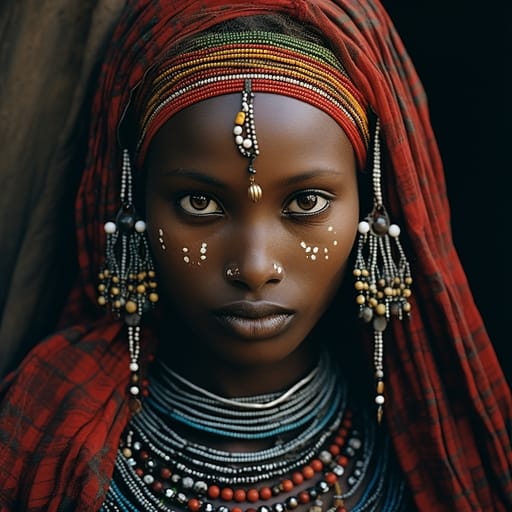
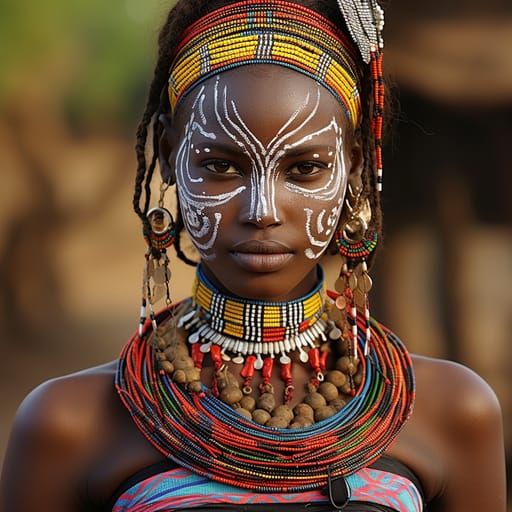
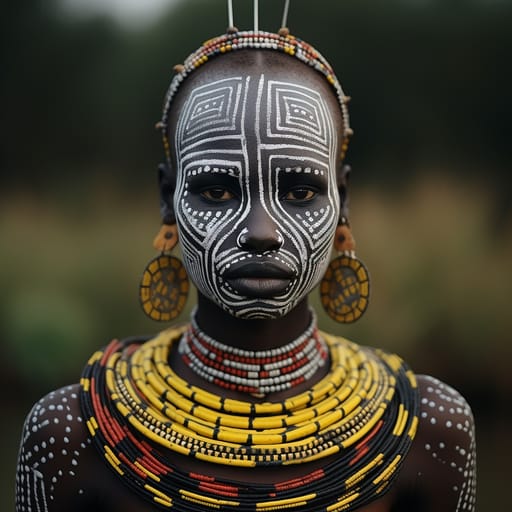
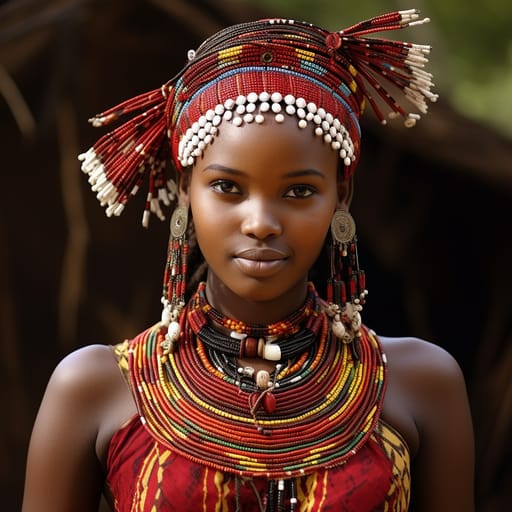
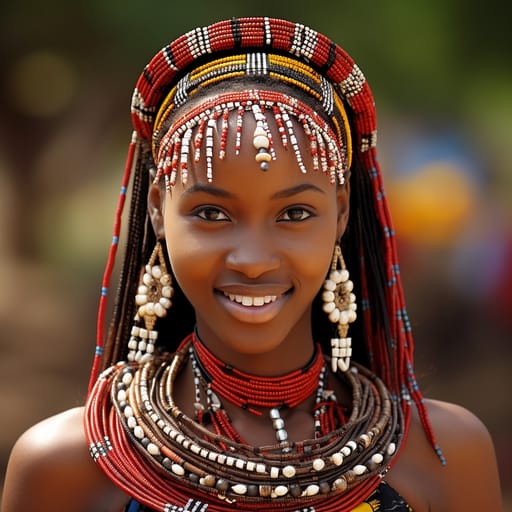
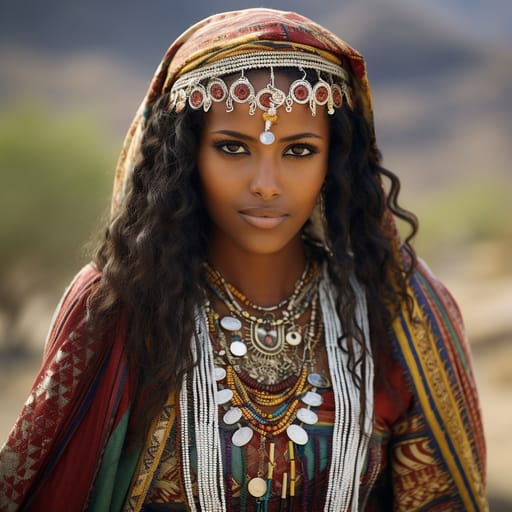
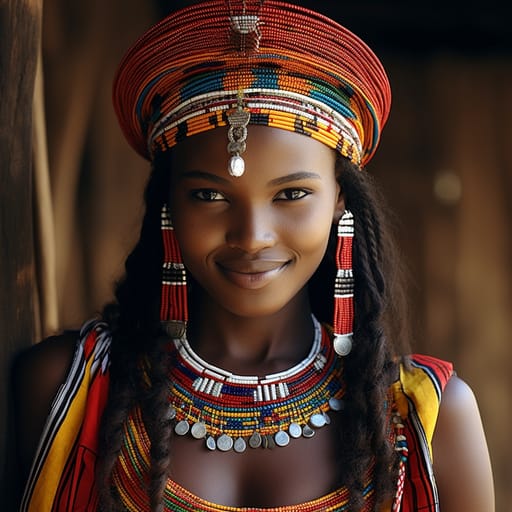
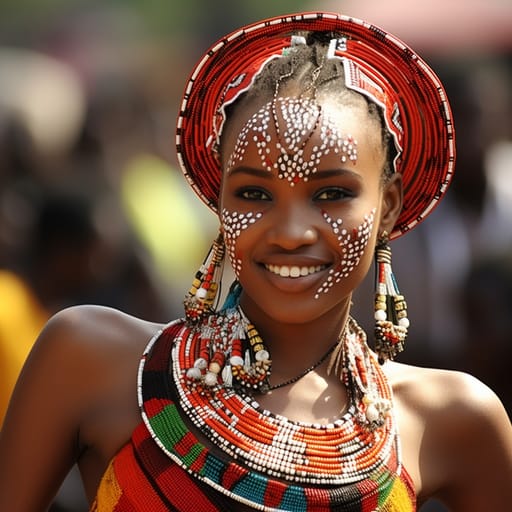
Geographic Distribution: Maasai populations across 1 country
Each row is ranked by the group's share of that country's population, with the source citation drawn from published census and demographic surveys. Click through for the full per-country phenotype profile.
| Country | Share | Source |
|---|---|---|
| Kenya | 2.5% | Kenya 2019 Census; Maasai (~2.5%); Nilotic source population. Cross-border with Tanzanian Maasai |
Typical Maasai Phenotypes
Reference for AI generation: hair, eyes, skin, facial structure, build
The Maasai phenotype is one of the most structurally distinctive in East Africa: a Nilotic build layered onto deeply pigmented skin, producing a silhouette readable at distance long before facial features resolve. Hair is uniformly Type 4 coily, typically kept very short or shaved on men and women alike; natural color sits in true black, occasionally with a reddish cast where ochre is worked into the scalp ceremonially. Premature graying is common in elders and tends toward bright white against the skin rather than salt-and-pepper.
Eyes are dark brown to near-black, with no epicanthic fold and a relatively wide interorbital distance. The eye opening reads as long and slightly almond-shaped, set under a smooth, low-projecting brow ridge. Skin tone is Fitzpatrick VI across nearly the whole population: a deep, cool-toned brown-black with blue undertones rather than the warmer reddish or olive casts seen in West African or Cushitic neighbors. Facial structure is the clearest Nilotic signature: a narrow, high nasal bridge with a tall but moderately narrow alar base, distinctly less broad than typical West African noses, paired with full but well-defined lips, high cheekbones, and a long, narrow mandible. The face overall is vertically elongated.
Build is the other unmistakable marker. Maasai men commonly stand 180-190 cm with extraordinarily long limbs relative to torso, narrow shoulders and hips, low body fat, and lean musculature optimized for endurance; David Rudisha's frame is a fair anchor for the male phenotype. Women share the elongated proportions, slim through the torso, with the same long neck and small joints; stretched earlobes from traditional ornamentation are near-universal in older generations and still common in younger.
The Samburu read as a slightly more gracile northern variant, the Arusha somewhat shorter and stockier from generations of settled agriculture, and the Kwavi closer to the pastoral Maasai baseline. The combination of very tall, very lean, very dark, and narrow-featured is the consistent through-line.
Maasai Body & Anatomy Reference
Per-feature anatomical profile for AI nude generation: Cushitic / Nilo-Cushitic East African phenotype
Maasai Boobs & Breasts
Maasai boobs follow the Cushitic / Nilo-Cushitic East African profile: small-to-medium-cup, high-set, conical. Areolar diameter is usually 28-38mm, and the coloring is moderate-to-high areolar pigmentation against the brown-to-deep-brown skin tone. Breast shape tracks body composition (lean ectomorph-to-mesomorph, mean adult female BMI 19-22), so Maasai breasts tend to be firmer and less projecting than the African-American or West African norm. Expect a forward-set shape, not the lateral spread of the West African phenotype.
Maasai Ass & Hips
Maasai ass and hip morphology presents as small-to-medium, high-set, rounded, distinctly different from the wide-set heavy-projection West African or African-American norm. The Maasai pelvic profile shows narrow-to-medium iliac crests, longer torso-to-leg ratio, anchored in the Cushitic / Nilo-Cushitic East African skeletal pattern. Maasai butt shots in adult AI imagery should render the small-to-medium, high-set, rounded silhouette with the overall build (lean ectomorph-to-mesomorph) and the fat distribution typical of the Cushitic / Nilo-Cushitic East African phenotype.
Maasai Vagina & Pussy
Maasai pussy anatomy typically shows brown-to-deep-brown labial pigmentation, narrow-to-medium labia minora projection. Pubic hair is usually tightly-coiled coarse texture, densely distributed. In AI-generated Maasai nudes, labial color should blend into the brown to deep brown skin with a gradual transition, and the hair should keep its tightly-coiled coarse texture.
Maasai Dicks & Penis
Penis reference for Maasai men: regional mean ~13.5cm erect, moderate girth, ~12cm circumference. Coloring: deeper-pigmented than the West African norm. An accurate Maasai cock in AI imagery matches the surrounding brown to deep brown skin rather than a generic porn default. Circumcision depends on religion and custom, not ancestry.
Maasai Body, Curves & Build
The Maasai figure is generally lean ectomorph-to-mesomorph, with mean adult female BMI 19-22, characteristic of Cushitic / Nilo-Cushitic East African ancestry. AI image tools tend to flatten regional body types into a few stock shapes; here the Maasai build is kept as its own reference.
Maasai Skin Tone & Hair Texture
Skin: brown to deep brown (Fitzpatrick V-VI). Hair: tight 4A-4C coil, often worn natural or in braided/twisted protective styles. Both are typical of Cushitic / Nilo-Cushitic East African ancestry. The most common mistake in AI nudes of Maasai women is a body rendered lighter than the face.
Data depth
61/100Coverage of image-grounded phenotype observations · drives AI generation diversity
- Sample size
- 11/40· 4 images
- Image quality
- 30/30· 100% high
- Confidence
- 20/20· mean 0.86
- Source diversity
- 0/10· wikipedia
- ·Small sample (n<10)
- ·Wikipedia-only source, not population-representative
Observed Distribution: Image Sample
Empirical observations from analyzed photographs · supplementary signal, not population truth
Sample: 4 images analyzed (4 wikipedia). Quality: 4 high, 0 medium, 0 low, 0 very_low. Avg analyzer confidence: 0.86.
Skin tone (Fitzpatrick): V (50%), VI (50%)
Hair color: black (75%), gray/white (25%)
Hair texture: coily (100%)
Eye color: dark brown (100%)
Epicanthic fold: 0% present, 100% absent, 0% unclear
Caveats: Sample size 4 is small, so the observed distribution should be treated as suggestive, not definitive. Sample is 100% Wikipedia notable people, which skews toward male, public-life, and modern figures, not population-representative.
Last aggregated: May 7, 2026
Explore phenotype categories
Structured taxonomy with peer-reviewed scales · 22 anatomical categories
Notable Maasai People
19 reference figures, sourced from Wikipedia
- Linus Kaikai, Kenyan journalist and Chair of the Kenya Editors Guild
- Francis Ole Kaparo, Former Speaker of the National Assembly of Kenya
- James Ole Kiyiapi, associate professor at Moi University and permanent secretary in the Ministri…
- Olekina Ledama, Founder, Maasai Education Discovery
- Stanley Shapashina Oloitiptip, Former Kenya politician and cabinet minister
- Josephine Lemoyan, social scientist, Tanzanian member of the 2017-2022 East African Legislative …
- Nice Nailantei Lengete, First woman to address the Maasai elders council at Mount Kilimanjaro, and pe…
- Joseph Ole Lenku, Cabinet Secretary of Kenya for Interior and Coordination of National Governme…
- Mbatian, Prophet after whom Batian Peak, the highest peak of Mount Kenya, is named
- Katoo Ole Metito, Member of Parliament for Kajiado South sub county
- Joseph Nkaissery, Former Cabinet Secretary of Kenya for Interior and Coordination of National G…
- William Ole Ntimama, Former Kenyan politician and leader of the Maa community
- Damaris Parsitau, gender equality advocate, feminist, and scholar
- David Rudisha, Middle-distance runner and 800-meter world record holder
- George Saitoti, former Vice-president of Kenya
- Moses ole Sakuda, Kenyan politician
- Jackson Ole Sapit, Sixth Archbishop and Primate of the Anglican Church of Kenya
- Edward Sokoine, Prime Minister of Tanzania from 1977 to 1980 and again from 1983 to 1984
- Sanaipei Tande, Kenyan musical artist
Erotic Poses & Sex Positions
From the pose catalog: 219 named positions with reference skeletons
Frequently asked questions about Maasai people
Where is the Maasai homeland?
The Maasai homeland is Maasailand (Tanzania, Kenya) in Eastern Africa.
What countries do Maasai people live in?
Maasai populations are documented across 1 country: Kenya.
What language do Maasai people speak?
Maasai people primarily speak Nilo-Saharan / Nilotic / Maasai.
What religion do Maasai people practice?
The predominant religion among Maasai people is Traditional African religions.
What does a typical Maasai woman look like?
Maasai women are typically tall and slender, with long limbs, a long neck and narrow hips. Skin is very dark (Fitzpatrick VI) with cool undertones, and hair is tightly coiled, black and usually kept very short or shaved. Faces tend to be long and narrow, with a high, narrow nasal bridge, high cheekbones and full, well-defined lips, and stretched earlobes from traditional ornaments are common.






Make your own Maasai images
Five a day, free, no credits to buy. The studio starts from this group's phenotype data, so you can set body type, pose and style and keep the traits accurate.
Start with Maasai