Help us get this right
Does this portrait look right for Ajuran?
Nobody has judged this one yet. You would be the first.
Ajuran Erotic
Somalia, the Somali Region of Ethiopia, and northern Kenya, especially Wajir County
Somali (Cushitic, Afroasiatic); Borana Oromo (Cushitic, Afroasiatic) spoken by some Kenyan sections
Sunni Islam
A Somali clan usually counted within the Hawiye clan family; the Garen lineage supplied the rulers of the Ajuran Sultanate
About Ajuran People
Ask a Somali elder about the Ajuran and the story usually turns to water. From roughly the 13th century to the late 17th, an Ajuran sultanate ruled the Shabelle and Jubba river valleys of southern Somalia, and its power ran through wells as much as through armies. Its rulers came from the Garen lineage. They built and maintained limestone wells and cisterns across the dry interior, some of which are still in use, and they took tribute from the farms along the rivers and from the herds that came to drink. Their reach extended to the Benadir coast, where Mogadishu traded across the Indian Ocean, and in the 16th century Ajuran forces fought Portuguese raiders along that shore. Over time, the same control of water became a grievance. Oral tradition remembers the last Ajuran rulers as harsh, and by the end of the 17th century revolts had broken the state apart.
The fall of the sultanate did not end the clan. Today Ajuran people are herders, traders and townspeople in Somalia, in Ethiopia's Somali Region and in northern Kenya, where Wajir County has one of the largest communities. Somali genealogies usually place them within the Hawiye clan family. Somali, a Cushitic language, is the everyday tongue, but the picture in Kenya is more complicated. There, Ajuran herders lived for generations alongside Borana Oromo pastoralists and allied with them, and some Ajuran sections spoke Borana at home. In this borderland, clan identity has followed alliances and ways of making a living as much as language.
Sunni Islam shapes the day, from prayer times and the Ramadan fast to marriage contracts. Much of what courts handle elsewhere still falls to xeer, Somali customary law: elders negotiate settlements, and blood compensation, called mag, passes between lineages rather than individuals. Camels, cattle and goats remain the measure of wealth in the countryside. In Kenya, Ajuran families lived through the Shifta War of the 1960s and the long emergency rule that followed across the old Northern Frontier District. In recent decades, competition with Degodia neighbors over pasture, wells and electoral boundaries has turned deadly more than once. Centuries after the sultanate, Ajuran politics still comes down to water and grazing.
Related ethnic groups
Groups that share Ajuran's homeland, region, language, or religious tradition. These are likely candidates for comparative phenotype reference.
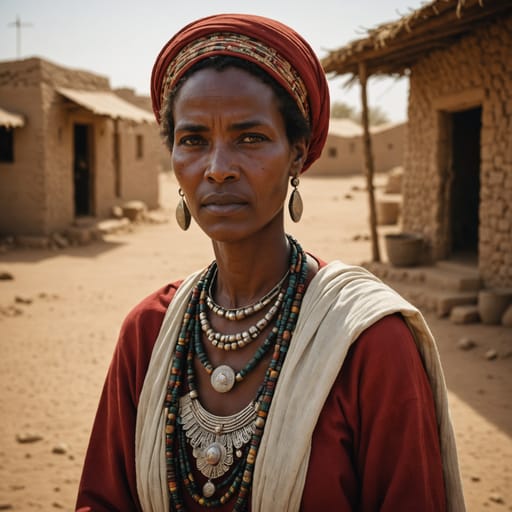
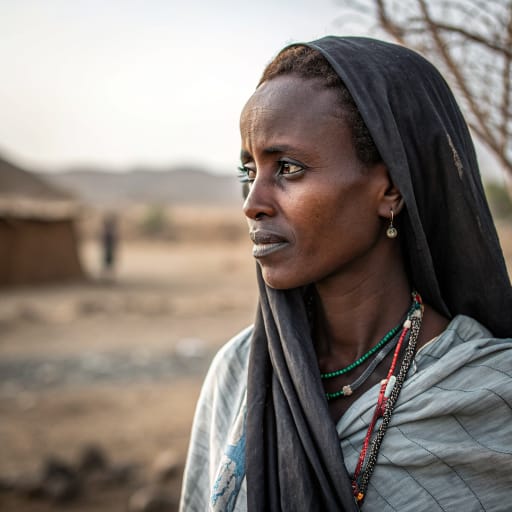
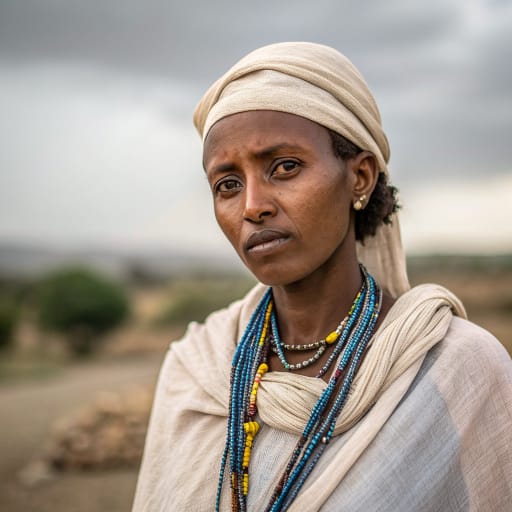
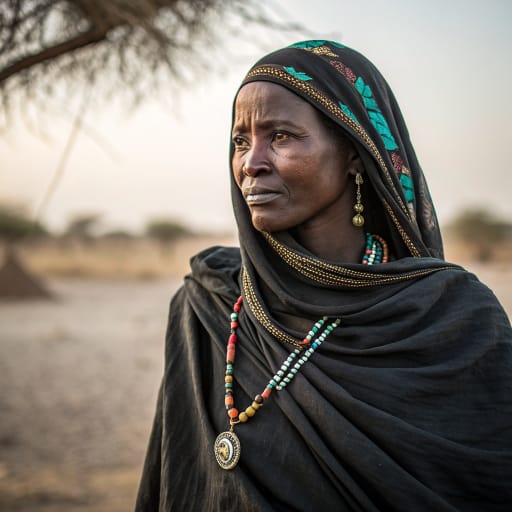
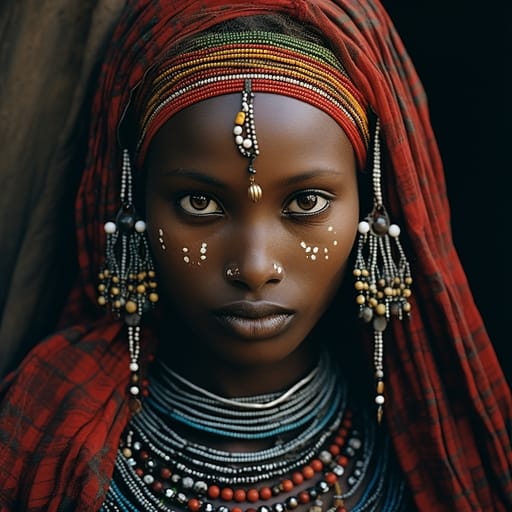
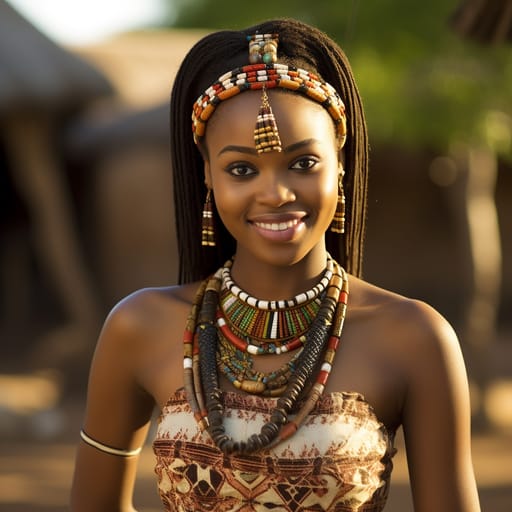
Typical Ajuran Phenotypes
Reference for AI generation: hair, eyes, skin, facial structure, build
Ajuran Body & Anatomy Reference
Cushitic / Nilo-Cushitic East African phenotype: anatomy reference for AI nude generation
Ajuran Boobs & Breasts
The typical Ajuran bust is small-to-medium-cup, high-set, conical, in line with the wider Cushitic / Nilo-Cushitic East African pattern. Areolas usually fall in the 28-38mm range, with moderate-to-high areolar pigmentation against the brown-to-deep-brown skin tone. Compared with the lateral spread of the West African phenotype, Ajuran breasts sit forward and are generally firmer and less projecting than the African-American or West African norm. A faithful AI render of Ajuran tits keeps that shape and areola size.
Ajuran Ass & Hips
Butt shape among Ajuran women: small-to-medium, high-set, rounded, over narrow-to-medium iliac crests, longer torso-to-leg ratio. This follows Cushitic / Nilo-Cushitic East African ancestry and looks quite unlike the wide-set heavy-projection West African or African-American norm. An accurate Ajuran ass in adult AI imagery keeps both the silhouette and the overall build (lean ectomorph-to-mesomorph) instead of a generic average.
Ajuran Vagina & Pussy
Vulvar anatomy among Ajuran women: brown-to-deep-brown labial pigmentation, narrow-to-medium labia minora projection. Pubic hair tends to be tightly-coiled coarse texture, densely distributed, in the usual inverted-triangle pattern. Both follow Cushitic / Nilo-Cushitic East African pigmentation, which is why Ajuran pussy renders should not fall back on a pale, sparse Western template.
Ajuran Dicks & Penis
The Ajuran cock profile, from Cushitic / Nilo-Cushitic East African anthropometric data: regional mean ~13.5cm erect; moderate girth, ~12cm circumference; deeper-pigmented than the West African norm. Pubic hair has a tightly-coiled coarse texture and forms the usual inverted-V pattern. Whether Ajuran men are circumcised follows religious and cultural practice rather than phenotype.
Ajuran Body, Curves & Build
Build and curves among Ajuran women follow the Cushitic / Nilo-Cushitic East African pattern: lean ectomorph-to-mesomorph, mean adult female BMI 19-22. Proportions matter as much as skin tone, so Ajuran figures should keep their regional height and limb ratios.
Ajuran Skin Tone & Hair Texture
The Ajuran skin range is brown to deep brown (Fitzpatrick V-VI), and hair tends to be tight 4A-4C coil, often worn natural or in braided/twisted protective styles. That combination marks the Cushitic / Nilo-Cushitic East African phenotype, and skin tone is the trait AI generators most often get wrong for Ajuran women.
Explore phenotype categories
Structured taxonomy with peer-reviewed scales · 22 anatomical categories
Erotic Poses & Sex Positions
From the pose catalog: 219 named positions with reference skeletons
Frequently asked questions about Ajuran people
Where is the Ajuran homeland?
The Ajuran homeland is Somalia, the Somali Region of Ethiopia, and northern Kenya, especially Wajir County in Eastern Africa.
What language do Ajuran people speak?
Ajuran people primarily speak Somali (Cushitic, Afroasiatic); Borana Oromo (Cushitic, Afroasiatic) spoken by some Kenyan sections.
What religion do Ajuran people practice?
The predominant religion among Ajuran people is Sunni Islam.






Make your own Ajuran images
Five a day, free, no credits to buy. The studio starts from this group's phenotype data, so you can set body type, pose and style and keep the traits accurate.
Start with Ajuran