Help us get this right
Does this portrait look right for Jeberti?
Nobody has judged this one yet. You would be the first.
Jeberti Erotic
Highlands of Eritrea (Asmara and the central and southern plateau) and northern Ethiopia (Tigray, with communities in Gondar and Addis Ababa); diaspora in Sudan, Saudi Arabia, Europe and North America
Tigrinya (Afroasiatic, Semitic); Amharic (Afroasiatic, Semitic) in parts of Ethiopia; Arabic for religion and trade
Sunni Islam
Tigrinya-speaking Muslims of Eritrea and Tigray; Amharic-speaking highland Muslims of Ethiopia are often included under the same name. Part of the wider Habesha highland population.
About Jeberti People
The Jeberti are the Muslims of the Christian highlands. On the plateau of Eritrea and northern Ethiopia, where the Orthodox church has shaped life since the fourth century, they speak the same Tigrinya as their neighbors, eat the same injera, trade in the same markets, and pray toward Mecca. That combination is the whole of their identity: not a separate language or a territory of their own, but a faith held for a very long time in country defined by another.
The name comes from Jabara, or Jabart, an old term for the Muslim country around Zeila and Ifat on the routes down to the sea, and over time it came to cover highland Muslims generally. Community tradition reaches back further, to the companions of the Prophet who took refuge with the king of Aksum in the seventh century. The mosque at Negash in Tigray marks that story and still draws pilgrims. Some families claim descent from those first arrivals or from later Arab settlers; historians tend to see a mix of migrants and local converts. Either way, Jeberti like to point out that there were Muslims in their highlands before there were Muslims in Medina.
Under the Christian monarchy, Muslims were generally shut out of hereditary land rights, the basis of highland standing. The Jeberti turned to what was left: long-distance trade, weaving, tailoring, metalwork. They ran caravans between the plateau and the port of Massawa, and the region's towns still carry the imprint, with Jeberti families prominent in markets from Asmara to Adwa, Mekelle and Gondar. The low point came in the late 1870s, when Emperor Yohannes IV ordered Muslims to convert or leave. Some accepted baptism in name only, some fled toward Sudan and the coast, and the memory has not faded. Abroad, a student lodge called the riwaq al-Jabartiyya stood for centuries at al-Azhar in Cairo, and the Egyptian chronicler Abd al-Rahman al-Jabarti descended from a family attached to it.
Daily life runs parallel to that of Christian neighbors, with a few firm lines. The best known concerns meat: by old custom neither community eats animals slaughtered by the other, so a shared wedding means two butchers and two pots. Arabic serves for prayer and religious schooling, Tigrinya or Amharic for everything else. In Eritrea the state counts the Jeberti within the Tigrinya nationality rather than as one of the country's nine recognized groups, a classification that many Jeberti, particularly in the diaspora in Saudi Arabia, Sudan, Europe and North America, continue to contest.
Related ethnic groups
Groups that share Jeberti's homeland, region, language, or religious tradition. These are likely candidates for comparative phenotype reference.
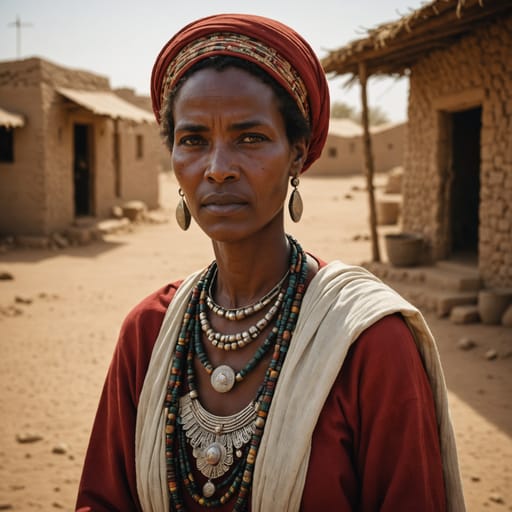
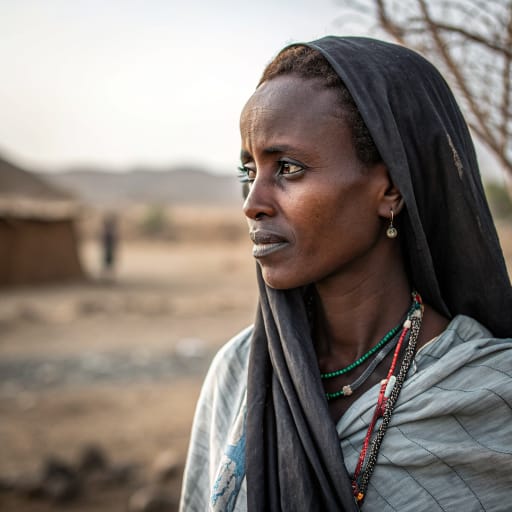
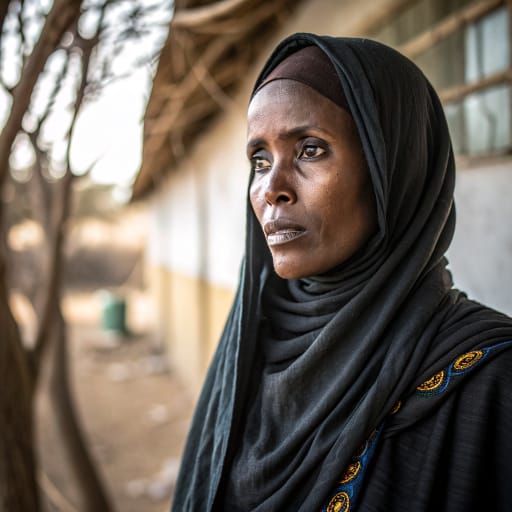
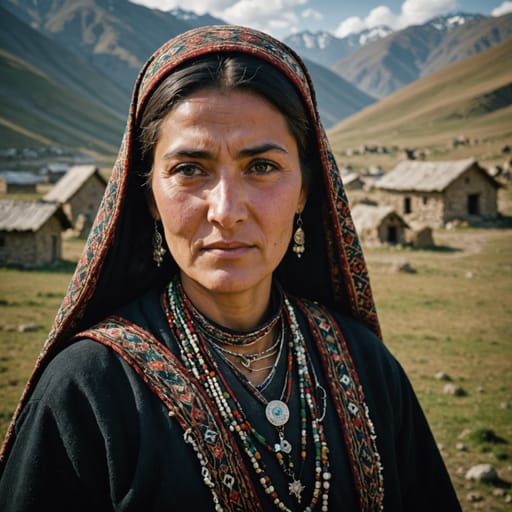
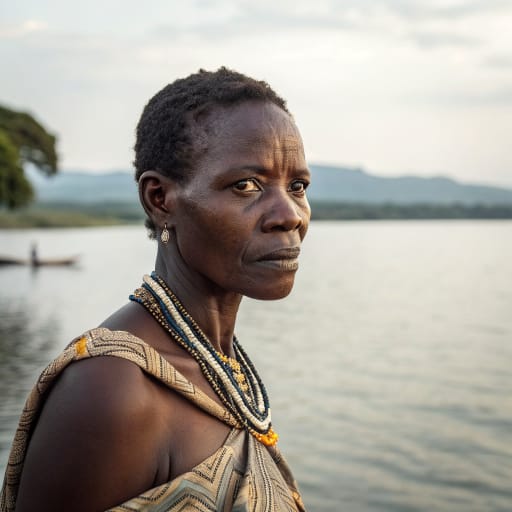
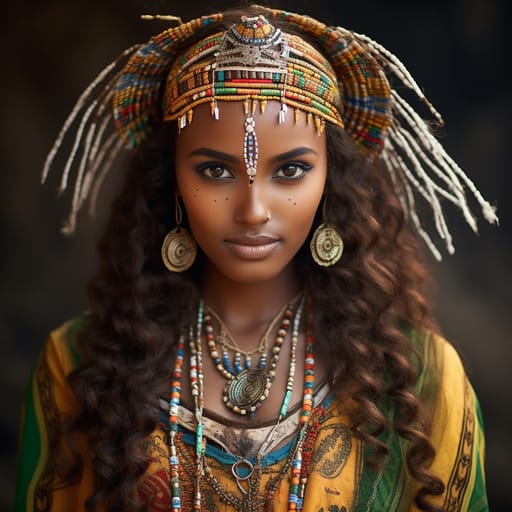
Typical Jeberti Phenotypes
Reference for AI generation: hair, eyes, skin, facial structure, build
Jeberti Body & Anatomy Reference
Per-feature anatomical profile for AI nude generation: Cushitic / Nilo-Cushitic East African phenotype
Jeberti Boobs & Breasts
The typical Jeberti bust is small-to-medium-cup, high-set, conical, in line with the wider Cushitic / Nilo-Cushitic East African pattern. Areolas usually fall in the 28-38mm range, with moderate-to-high areolar pigmentation against the brown-to-deep-brown skin tone. Compared with the lateral spread of the West African phenotype, Jeberti breasts sit forward and are generally firmer and less projecting than the African-American or West African norm. A faithful AI render of Jeberti tits keeps that shape and areola size.
Jeberti Ass & Hips
Butt shape among Jeberti women: small-to-medium, high-set, rounded, over narrow-to-medium iliac crests, longer torso-to-leg ratio. This follows Cushitic / Nilo-Cushitic East African ancestry and looks quite unlike the wide-set heavy-projection West African or African-American norm. An accurate Jeberti ass in adult AI imagery keeps both the silhouette and the overall build (lean ectomorph-to-mesomorph) instead of a generic average.
Jeberti Vagina & Pussy
Vulvar anatomy among Jeberti women: brown-to-deep-brown labial pigmentation, narrow-to-medium labia minora projection. Pubic hair tends to be tightly-coiled coarse texture, densely distributed, in the usual inverted-triangle pattern. Both follow Cushitic / Nilo-Cushitic East African pigmentation, which is why Jeberti pussy renders should not fall back on a pale, sparse Western template.
Jeberti Dicks & Penis
The Jeberti cock profile, from Cushitic / Nilo-Cushitic East African anthropometric data: regional mean ~13.5cm erect; moderate girth, ~12cm circumference; deeper-pigmented than the West African norm. Pubic hair has a tightly-coiled coarse texture and forms the usual inverted-V pattern. Whether Jeberti men are circumcised follows religious and cultural practice rather than phenotype.
Jeberti Body, Curves & Build
Build and curves among Jeberti women follow the Cushitic / Nilo-Cushitic East African pattern: lean ectomorph-to-mesomorph, mean adult female BMI 19-22. Proportions matter as much as skin tone, so Jeberti figures should keep their regional height and limb ratios.
Jeberti Skin Tone & Hair Texture
The Jeberti skin range is brown to deep brown (Fitzpatrick V-VI), and hair tends to be tight 4A-4C coil, often worn natural or in braided/twisted protective styles. That combination marks the Cushitic / Nilo-Cushitic East African phenotype, and skin tone is the trait AI generators most often get wrong for Jeberti women.
Explore phenotype categories
Structured taxonomy with peer-reviewed scales · 22 anatomical categories
Erotic Poses & Sex Positions
From the pose catalog: 219 named positions with reference skeletons
Frequently asked questions about Jeberti people
Where is the Jeberti homeland?
The Jeberti homeland is Highlands of Eritrea (Asmara and the central and southern plateau) and northern Ethiopia (Tigray, with communities in Gondar and Addis Ababa); diaspora in Sudan, Saudi Arabia, Europe and North America in Eastern Africa.
What language do Jeberti people speak?
Jeberti people primarily speak Tigrinya (Afroasiatic, Semitic); Amharic (Afroasiatic, Semitic) in parts of Ethiopia; Arabic for religion and trade.
What religion do Jeberti people practice?
The predominant religion among Jeberti people is Sunni Islam.






Make your own Jeberti images
Five a day, free, no credits to buy. The studio starts from this group's phenotype data, so you can set body type, pose and style and keep the traits accurate.
Start with Jeberti