Help us get this right
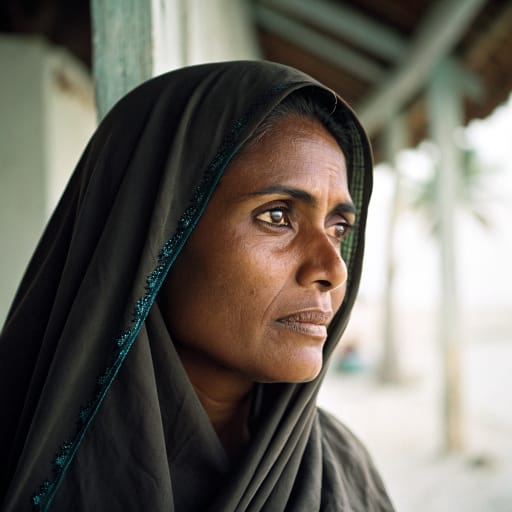
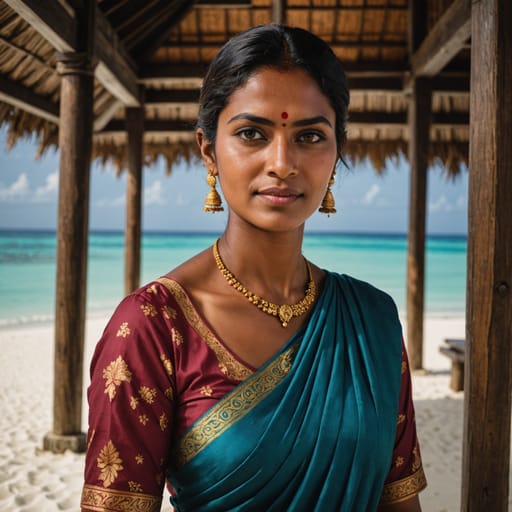
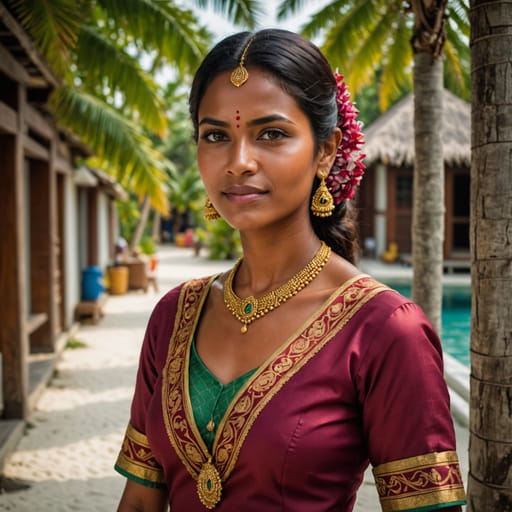
Does this portrait look right for Maldivian?
One tap. It takes a second and it is recorded.
0 say it looks right, 2 say it looks off.
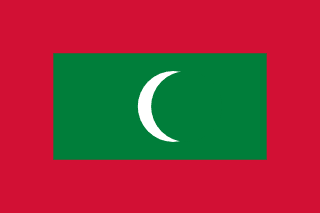

Maldives
MVSouth Asia
Maldives is home to 3 documented ethnic groups in South Asia, led by Maldivian (~99%), South Asian Maldives (~1%), Other Maldives (~0%). This page blends their phenotype and demographic data into one weighted reference: skin tone, facial features, hair texture and build, drawn from published census and ancestry sources.
Demographic Composition
Composition weights are derived from self-identification in published census and demographic surveys. Each row links to the source ethnic-group atlas page.
| Ethnic group | Weight | Source |
|---|---|---|
 Maldivian Maldivian | 98.5% | National Bureau of Statistics Maldives 2022 Census; ethnic Maldivians (Dhivehi-speakers) comprise approximately 98.5% of the resident population (~382,000 of ~388,000 total citizen population). Maldives is among the most demographically homogeneous national populations globally |
 South Asian Maldives South Asian Maldives | 1.2% | Maldives 2022 Census plus Ministry of Foreign Affairs immigration data; resident foreign nationals from South Asian source countries (predominantly Indian, Sri Lankan, Bangladeshi, Pakistani — predominantly engaged in resort, construction, and broader service-sector labor migration). Approximately 4,500+ foreign-resident workers |
 Other Maldives Other Maldives | 0.3% | Maldives 2022 Census residual; foreign-resident populations from other source countries (Filipino, Nepali, Ethiopian, plus tourism-sector and broader expatriate communities) |
Maldives Phenotype Profile
Maldives is among the most demographically homogeneous national populations in South Asia and globally — approximately 98.5% ethnic Maldivian (Dhivehi-speaking) per the 2022 Census, with smaller South Asian (~1.2%) and other foreign-resident (~0.3%) communities. The country's demographic structure reflects approximately 2,500+ years of population processes: the foundational South Indian Dravidian substrate, substantial Sri Lankan Sinhalese / Indo-Aryan migration, and the Indian Ocean trade-period admixture with Arab, Persian, East African, and Southeast Asian source populations. The 12th-c. CE conversion to Sunni Islam established the contemporary religious structure (~99.6% Sunni Muslim per official statistics).
Genome-wide patterns place Maldivians as showing primarily South Asian / Sri Lankan source ancestry with smaller Arab / East African / Southeast Asian admixture detectable in some sub-populations. Skin tone across the population spans Fitzpatrick III-VI with IV-V the modal value nationally — somewhat darker than Sri Lankan Sinhalese populations on average. Hair is predominantly straight to wavy (Andre Walker 1A-2B) and uniformly black or very dark brown. Eye color is uniformly brown to dark brown. Facial features track South Asian source populations with subtle distinguishing features. Build is intermediate; adult Maldivian male mean stature is approximately 165-168 cm.
Maldives faces an existential geopolitical challenge as the lowest-elevation country in the world (mean elevation ~1.5 meters above sea level) — sea-level rise associated with climate change is documented to threaten the territorial integrity and habitability of the country over the 21st-22nd c., with substantial demographic and political implications for the long-term survival of the Maldivian ethnic community.
Maldives Body & Anatomy Reference
Per-feature anatomical profile for AI nude generation: Indo-Aryan / Dravidian South Asian phenotype dominant in Maldives
Maldives Women: Boobs & Breasts
Maldives women's tits and boobs reflect the medium-to-large cup, moderate-to-full projection Indo-Aryan / Dravidian South Asian bust profile dominant in the Maldives demographic composition. Maldives nipples and areolas show medium-brown to dark-brown areolar pigmentation against the wheatish-to-brown skin tone, with areolar diameter typically in the 32-46mm range, distinct from the the smaller East Asian bust profile. Maldives breast morphology trends full and soft, generally fuller than the East Asian norm, a function of the endomorph-to-mesomorph with fuller hip deposition body habitus and mean adult female BMI 22-25. For anatomically-accurate AI-generated Maldives nude women the render should preserve: medium-to-large cup, moderate-to-full projection shape, 32-46mm areolas with regional pigmentation, and the torso proportions of the Indo-Aryan / Dravidian South Asian phenotype.
Maldives Women: Ass & Hips
Maldives women's ass and hip morphology presents as medium-to-full, moderate-to-high projection, classic curvy hip profile, distinctly different from the slim hip profile of East Asian women. Maldives pelvic profile shows medium-to-wide iliac crests, full gluteal-femoral fat distribution, anchored in the Indo-Aryan / Dravidian South Asian skeletal pattern that dominates the Maldives ethnic composition. Maldives butt shots in adult AI imagery should render the medium-to-full, moderate-to-high projection, classic curvy hip profile silhouette with the endomorph-to-mesomorph with fuller hip deposition build and the gluteal-femoral fat distribution typical of the Indo-Aryan / Dravidian South Asian phenotype rather than defaulting to a globally-averaged shape that generic AI generators produce.
Maldives Women: Vagina & Pussy
Maldives women's pussy and vulvar anatomy presents medium-brown to dark-brown labial pigmentation, fuller labia minora projection, consistent with the Indo-Aryan / Dravidian South Asian phenotype's pigmentation pattern dominant in Maldives. Maldives pubic hair is typically straight-to-wavy coarse texture, dense distribution, distributed in the inverted-triangle pattern with regional-typical density. AI-generated Maldives nude imagery should preserve the medium-brown to dark-brown labial pigmentation and the straight-to-wavy coarse texture hair texture rather than defaulting to a Western-European pink-and-sparse template. For anatomically-accurate Maldives pussy renders the labial pigmentation should match the surrounding wheatish to brown skin tone of the Indo-Aryan / Dravidian South Asian phenotype.
Maldives Men: Dicks & Penis
Maldives men's dick and penile anatomy in adult AI generation should anchor on the regional reference data: regional mean ~13cm erect, moderate girth, and medium-brown shaft pigmentation. Maldives cock profile reflects the Indo-Aryan / Dravidian South Asian ancestral population's anthropometric measurements rather than a globally-averaged Western-pornography default. For anatomically-accurate Maldives nude male imagery the shaft pigmentation should track the surrounding wheatish to brown skin tone, with continuous glans-to-shaft pigmentation transition and the straight-to-wavy coarse texture pubic-hair texture distributed in the typical inverted-V escutcheon. Circumcision status across Maldives men varies by religious and cultural tradition rather than ancestral phenotype.
Maldives People: Body, Curves & Build
Maldives body type and overall build presents as endomorph-to-mesomorph with fuller hip deposition, with mean adult female BMI 22-25: the characteristic Indo-Aryan / Dravidian South Asian habitus dominant in the Maldives demographic composition. Maldives curves and proportions in adult AI imagery should preserve the regional skeletal frame (height, shoulder-to-hip ratio, limb proportions) rather than scaling to a Western-European mesomorph default. The Maldives nude female form, when rendered with anatomical fidelity, shows the height range, frame width, and adipose distribution pattern typical of the Indo-Aryan / Dravidian South Asian phenotype. Generic AI image generators tend to collapse regional body types into a few default shapes; the Ethnic Erotic phenotype-anchored approach preserves the Maldives build as its own reference category.
Maldives People: Skin Tone & Hair Texture
Maldives skin tone falls in the wheatish to brown (Fitzpatrick III-V) band, the surface signal most often miscalibrated by generic AI nude generators trained on Western-photographic datasets. Maldives hair texture is typically straight-to-wavy 1A-2B, dense, dark-brown to black, characteristic of the Indo-Aryan / Dravidian South Asian phenotype. For anatomically-accurate Maldives nude renders the skin should hold the Fitzpatrick band consistently across body surface rather than showing the lighter-than-face body shading that AI generators default to. Maldives hair pigmentation and texture on body, pubic, and head should match across the figure rather than mixing textures (a common AI artefact).
A descriptive view, not a claim about individuals
This page shows a weighted aggregate of phenotype observations across the Maldives population, based on demographic composition from published census and ancestry sources. Phenotypes within any country are far more varied than the aggregate suggests; this is a descriptive reference, not a deterministic claim about any individual. For source-level detail on individual ethnic groups, see the constituent atlas pages linked below.
Methodology Notes
Composition weights are derived from the National Bureau of Statistics Maldives 2022 Census plus Ministry of Foreign Affairs immigration data. Maldives has a small population (~388,000 citizens plus ~50,000+ resident foreign workers) that produces composition estimates with high statistical confidence given the country's demographic homogeneity. Caveats: (1) the resident foreign-worker population (predominantly South Asian) is partially captured in the composition but the precise distribution shifts seasonally with tourism-and-construction labor demand; (2) the country's small population and unique atoll-island geography produce some demographic distinctness from neighboring South Asian populations; (3) climate change-driven sea-level rise represents a long-term existential threat to the Maldivian demographic continuity that no other major national population faces in comparable severity.
Primary Sources
- 1.National Bureau of Statistics Maldives. Population and Housing Census of Maldives 2022. Malé: NBS; 2023.
- 2.Maloney C. People of the Maldive Islands. Bombay: Orient Longman; 1980.
- 3.Romero-Frías X. The Maldive Islanders: A Study of the Popular Culture of an Ancient Ocean Kingdom. Barcelona: Nova Ethnographia Indica; 1999.
- 4.Reich D, Thangaraj K, Patterson N, et al. Reconstructing Indian population history. Nature. 2009;461(7263):489-494 (with broader South Asian context).
- 5.Forbes ADW. Archives and Resources for Maldivian History. South Asia. 1980;3(1):70-82.
Other countries in South Asia
Aggregate phenotype references for neighbouring South Asia nations, weighted by demographic composition.