Help us get this right
Does this portrait look right for Atayal?
Nobody has judged this one yet. You would be the first.
Atayal Erotic
Animism, Christianity
About Atayal People
The Atayal are one of the largest Indigenous peoples of Taiwan, settled across the steep, fog-soaked ridges of the island's northern central mountains — roughly the watersheds of the Tachia, Dahan, and Lanyang rivers. Linguistically they sit near the root of the Austronesian family tree: their language is Formosan, not Malayo-Polynesian, which makes Atayal and its sister tongues part of the deepest branches of the family that eventually carried speakers as far as Madagascar and Easter Island. Within Atayal itself there are two main varieties, Squliq and Tsʼoleʼ (Cʼuliʼ), and the people historically split into the Atayal proper and the Sediq–Truku, who are now officially recognized as separate groups but share the same cultural backbone.
What identified an Atayal adult, until well into the twentieth century, was a face — specifically, the indigo facial tattoo called ptasan. A young man earned the broad chin band by taking a head; a young woman earned the cheek-spanning marks by mastering the loom. Without those marks, you could not marry, and you could not, after death, cross the rainbow bridge hongu utux to join the ancestors. Japanese colonial authorities banned the practice in the 1910s and 1920s, and the last fully tattooed elders died in the 2010s, but the design vocabulary survives in weaving, tourism revival, and a younger generation that has begun to take the marks again as cultural assertion rather than rite of passage.
Atayal social life runs on a concept called gaga (or gaya among the Sediq) — a binding code of ancestral law that regulates hunting, sharing, marriage, and dispute. To break gaga is to bring sickness or misfortune onto the lineage group that shares it, which makes ritual restitution a communal rather than individual matter. Religion today is overwhelmingly Christian — Presbyterian and Catholic missions arrived after 1945 and now claim most of the population — but the older animist framework of utux, ancestral spirits who watch and judge, has not so much been replaced as folded into the new theology. The 1930 Wushe Incident, in which Sediq leader Mona Rudao led an armed uprising against Japanese rule and was crushed at terrible cost, remains the defining historical memory of the highland peoples and is taught in Taiwanese schools as a national rather than merely tribal event.
Related ethnic groups
Groups that share Atayal's homeland, region, language, or religious tradition. These are likely candidates for comparative phenotype reference.

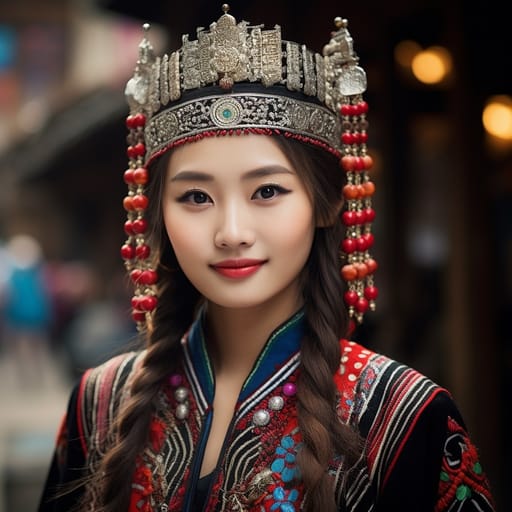

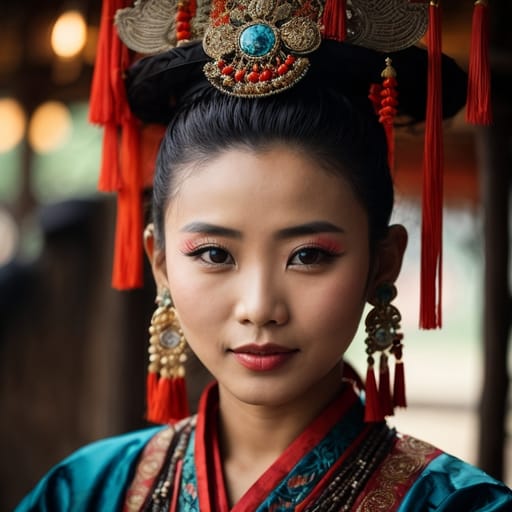
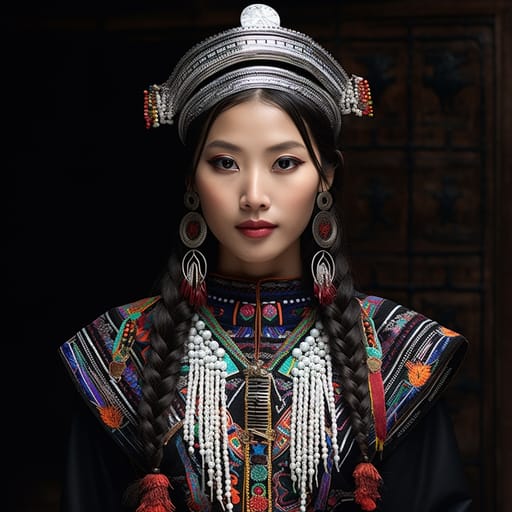
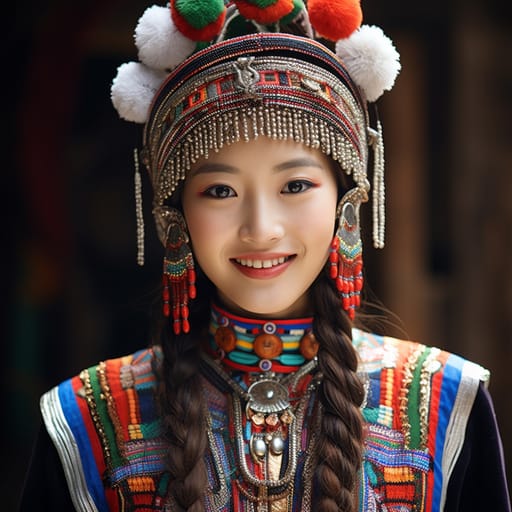
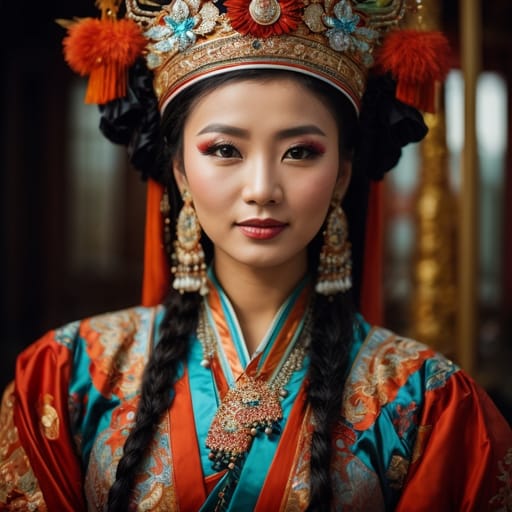
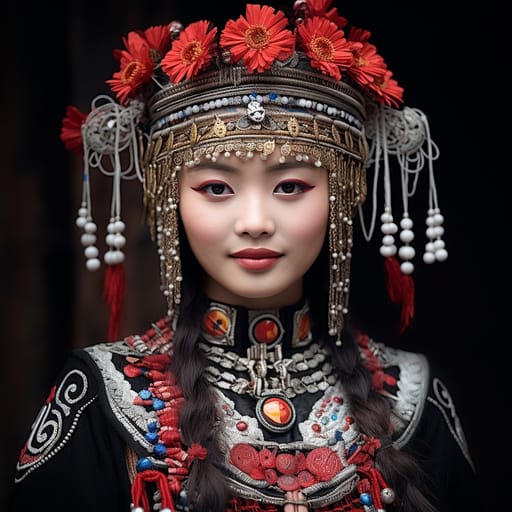
Typical Atayal Phenotypes
Reference for AI generation: hair, eyes, skin, facial structure, build
The Atayal are one of Taiwan's Austronesian indigenous peoples, and their phenotype reads as distinct from the Han majority around them — closer in some respects to other Formosan and Island Southeast Asian populations than to mainland East Asian groups. Hair is uniformly dark, ranging from true black to a softer black-brown, and texture skews straight to gently wavy rather than the pin-straight profile common in Han Chinese populations. Some individuals show a slight natural wave at the temples and crown that holds even when hair is grown long. Premature greying patterns are unremarkable.
Eyes are dark brown to near-black. Epicanthic folds are present but less consistently dominant than in northern Han or Korean populations — many Atayal show a partial or shallow fold, and a meaningful minority have an open, almost double-lidded eye shape. The eye opening tends to be slightly rounder and more horizontal than the upward-tilted almond common further north.
Skin sits in the Fitzpatrick III–IV range, with warm golden and olive undertones rather than the cooler porcelain or yellow-ivory casts seen in Han populations. Mountain-village ancestry and outdoor labor produce a deeper, sun-weathered tan in older generations. Facial structure is the most distinctive marker: noses are notably broader at the bridge and alar base than Han norms, with a straight or slightly convex profile. Lips are medium to full, fuller than Han average. Cheekbones are high and laterally projected, and jawlines are squarer in men, softer and rounder in women — actor Vic Chou shows the more refined end of this structural template.
Builds run shorter and more compactly muscled than Han Taiwanese, with proportionally longer torsos and shorter limbs — adaptations to mountain terrain. Women tend toward petite, narrow-shouldered frames; men are stocky rather than tall. Sub-group variation between northern Squliq and southern Ts'ole branches is minor and mostly linguistic rather than visibly phenotypic.
Atayal Body & Anatomy Reference
Per-feature anatomical profile for AI nude generation: East Asian Sinitic / Mongoloid phenotype
Atayal Boobs & Breasts
Atayal tits and boobs run small-to-medium cup, modest projection, the classic East Asian Sinitic / Mongoloid bust profile. Atayal nipples and areolas show light-pink to medium-brown areolar pigmentation against the light-to-medium skin tone, with areolar diameter typically in the 26-36mm range and forward-set positioning rather than the fuller South Asian or Levantine bust profile. Atayal breasts trend firm and modestly projecting; smaller cup size than the South Asian or Western Asian average, a function of the ectomorph-to-mesomorph, lean frame body habitus and the mean adult female BMI 20-23. For anatomically accurate AI-generated Atayal nudes the render preserves the small-to-medium cup, modest projection shape, 26-36mm areolas with light-pink to medium-brown pigmentation, and the torso proportions of the East Asian Sinitic / Mongoloid phenotype.
Atayal Ass & Hips
Atayal hips and butt usually read as small-to-medium, modest projection, narrower hip profile. The skeletal base is narrower iliac crests, less gluteal-femoral fat deposition, the East Asian Sinitic / Mongoloid pattern. Set against the fuller projected glutes of the West African or Polynesian phenotype, the difference is easy to see, and the hip-to-waist ratio is often what identifies Atayal women in photos.
Atayal Vagina & Pussy
Expect light-pink to medium-brown labial pigmentation, smaller labia minora on Atayal women, in keeping with East Asian Sinitic / Mongoloid ancestry. The pubic hair is straight fine texture, sparser distribution than the South Asian norm. Coloring should run evenly from the light to medium skin of the thighs to the labia, and Atayal nude imagery should keep the hair's straight fine texture.
Atayal Dicks & Penis
Atayal dick and penile anatomy in adult AI generation should anchor on the regional reference data: regional mean ~11-12cm erect, moderate girth, and light-brown shaft pigmentation. The Atayal cock profile reflects the East Asian Sinitic / Mongoloid population's anthropometric measurements. The shaft pigmentation should track the surrounding light to medium skin tone, and the pubic hair should keep its straight fine texture in the typical inverted-V escutcheon.
Atayal Body, Curves & Build
Atayal body type: ectomorph-to-mesomorph, lean frame, with mean adult female BMI 20-23. This is the typical East Asian Sinitic / Mongoloid build. Height range, shoulder-to-hip ratio and fat distribution all follow from it, which is what an accurate Atayal nude body should show.
Atayal Skin Tone & Hair Texture
Atayal skin tone falls in the light to medium (Fitzpatrick II-IV) band, the surface signal most often miscalibrated by generic AI nude generators. Atayal hair texture is typically straight 1A, fine-to-medium, predominantly black, characteristic of the East Asian Sinitic / Mongoloid phenotype. In Atayal nude renders the skin should hold that band consistently across the body.
Data depth
62/100Coverage of image-grounded phenotype observations · drives AI generation diversity
- Sample size
- 20/40· 11 images
- Image quality
- 27/30· 55% high
- Confidence
- 15/20· mean 0.82
- Source diversity
- 0/10· wikipedia
- ·Modest sample (n<25)
- ·Wikipedia-only source, not population-representative
Observed Distribution: Image Sample
Empirical observations from analyzed photographs · supplementary signal, not population truth
Sample: 11 images analyzed (11 wikipedia). Quality: 6 high, 3 medium, 2 low, 0 very_low. Avg analyzer confidence: 0.82.
Skin tone (Fitzpatrick): II (36%), III (45%), IV (18%)
Hair color: black (82%), red/auburn (18%)
Hair texture: straight (91%), wavy (9%)
Eye color: dark brown (100%)
Epicanthic fold: 91% present, 9% absent, 0% unclear
Caveats: Sample size 11 is modest, so secondary patterns may not be reliable. Sample is 100% Wikipedia notable people, which skews toward male, public-life, and modern figures, not population-representative.
Last aggregated: May 7, 2026
Explore phenotype categories
Structured taxonomy with peer-reviewed scales · 22 anatomical categories
Notable Atayal People
13 reference figures, sourced from Wikipedia
- Esther Huang, actress and singer
- Jane Huang, singer of rock duo Y2J
- Joanne Tseng, actress and member of pop duo Sweety
- Kao Chin Su-mei, actress, singer and politician
- Laha Mebow, director, screenwriter, TV producer
- Lo Chih-an, football player
- Lo Chih-en, football player
- Payen Talu, member of Legislative Yuan (1996-2002)
- Vic Chou, actor and member of pop group F4
- Yuming Lai, singer of rock duo Y2J
- Yeh Shuhua, singer of K-pop group (G)I-DLE - Half Tayal on maternal side
- Jerry Yan, actor and member of pop group F4
- Yuma Taru, weaver and dyer
Erotic Poses & Sex Positions
From the pose catalog: 219 named positions with reference skeletons
Frequently asked questions about Atayal people
Where is the Atayal homeland?
The Atayal homeland is Taiwan in East Asia.
What language do Atayal people speak?
Atayal people primarily speak Austronesian / Formosan / Atayal.
What religion do Atayal people practice?
The predominant religion among Atayal people is Animism, Christianity.






Make your own Atayal images
Five a day, free, no credits to buy. The studio starts from this group's phenotype data, so you can set body type, pose and style and keep the traits accurate.
Start with Atayal