Help us get this right
Does this portrait look right for A-Hmao?
Nobody has judged this one yet. You would be the first.
A-Hmao Erotic
The Wumeng highlands of northeastern Yunnan and northwestern Guizhou, China, especially around Weining, Zhaotong, Wuding and Luquan
A-Hmao, also called Northeastern Yunnan Miao (Hmongic, Hmong-Mien); Southwestern Mandarin widely spoken as a second language
Largely Protestant Christian since the early twentieth century, alongside traditional ancestral and household spirit practice
A branch of China's officially recognized Miao nationality, within the wider Hmongic-speaking peoples; also known as the Big Flowery Miao
About A-Hmao People
Across the high plateau where northeastern Yunnan meets northwestern Guizhou, the A-Hmao have long been known to their neighbors as the Da Hua Miao, the Big Flowery Miao. The name comes from the dense geometric embroidery on women's capes and skirts. China counts them as part of its Miao nationality, but they have their own name for themselves and speak their own Hmongic language. Their history also sets them apart from most Miao communities: in the early twentieth century a large part of the people became Protestant and learned to read in a script made for their own language. Their villages sit on steep slopes around Weining, Zhaotong, Wuding and Luquan, where people grow maize, potatoes and buckwheat in thin mountain soil. For generations many A-Hmao worked land owned by Yi landlords, a life of rent and debt with little schooling. That hard position helps explain why so many listened when missionaries came in the first years of the 1900s.
The turning point was Shimenkan, the Stone Gateway, a hamlet in Weining county where the English Methodist missionary Samuel Pollard based his work. With local helpers he created what is now called the Pollard script, whose letter shapes were inspired by the writing system missionaries had made for the Cree language in Canada. Scripture, hymnals and schoolbooks followed. Shimenkan grew into a school town that sent A-Hmao students on to further education at a time when few highland farmers in the region could read. Pollard died there of typhoid in 1915. A revised form of his script is still printed today and has its own block in Unicode. Churches were closed during the Cultural Revolution and reopened in the 1980s. Choral hymn singing is now one of the best-known features of A-Hmao Christian life, while in villages that never converted, older rites for ancestors and household spirits continue. The language belongs to the Hmongic branch of the Hmong-Mien family. It is related to the Hmong spoken farther south and across Southeast Asia, but it is a separate language, and most speakers also use the local Southwestern Mandarin. Women's festival dress is still the clearest sign that someone is A-Hmao: a square cape and pleated skirt covered in bold stitched patterns. Many wearers read these patterns as a record of old migrations, with rivers, fields and walled towns worked into the cloth.
Related ethnic groups
Groups that share A-Hmao's homeland, region, language, or religious tradition. These are likely candidates for comparative phenotype reference.

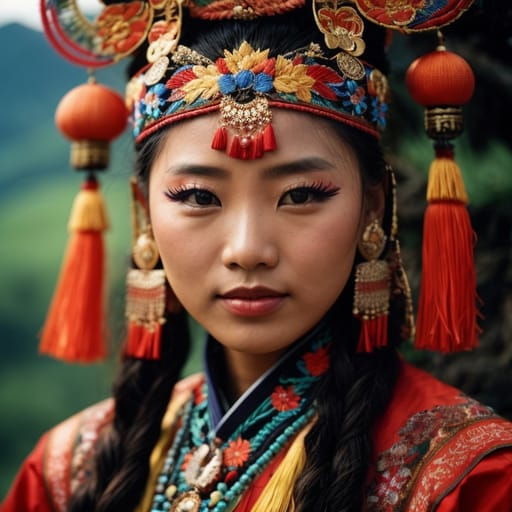
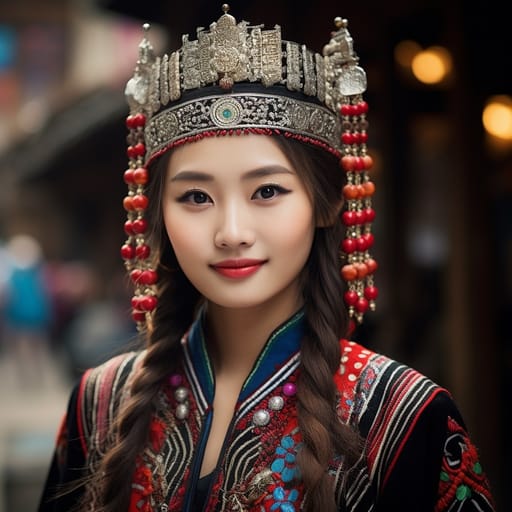

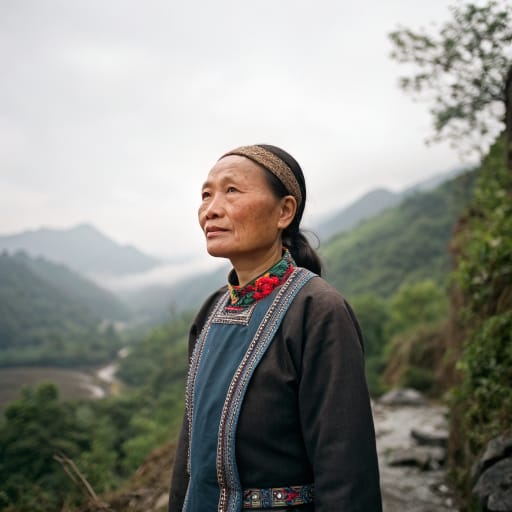

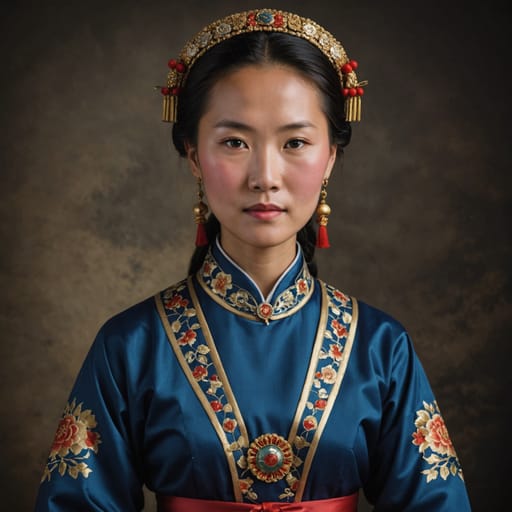
Typical A-Hmao Phenotypes
Reference for AI generation: hair, eyes, skin, facial structure, build
A-Hmao Body & Anatomy Reference
Per-feature anatomical profile for AI nude generation: East Asian Sinitic / Mongoloid phenotype
A-Hmao Boobs & Breasts
Bust reference for A-Hmao women: small-to-medium cup, modest projection, which is typical of East Asian Sinitic / Mongoloid ancestry. Areolas measure about 26-36mm across, with light-pink to medium-brown pigmentation. Body type (ectomorph-to-mesomorph, lean frame) shapes the bust as well, so A-Hmao tits are usually firm and modestly projecting; smaller cup size than the South Asian or Western Asian average. In AI imagery, keep the forward-set shape rather than drifting toward the fuller South Asian or Levantine bust profile.
A-Hmao Ass & Hips
The A-Hmao ass is typically small-to-medium, modest projection, narrower hip profile, which sets it apart from the fuller projected glutes of the West African or Polynesian phenotype. Underneath, the pelvis shows narrower iliac crests, less gluteal-femoral fat deposition, part of the East Asian Sinitic / Mongoloid skeletal pattern. For A-Hmao butt pics and AI renders, match that silhouette and the overall build (ectomorph-to-mesomorph, lean frame).
A-Hmao Vagina & Pussy
A-Hmao pussy and vulvar anatomy presents light-pink to medium-brown labial pigmentation, smaller labia minora, consistent with the East Asian Sinitic / Mongoloid phenotype's pigmentation pattern. A-Hmao pubic hair is typically straight fine texture, sparser distribution than the South Asian norm, in the inverted-triangle pattern. For anatomically accurate A-Hmao pussy renders the labial coloration should match the surrounding light to medium skin tone with a continuous gradient, and the hair should keep its straight fine texture.
A-Hmao Dicks & Penis
A-Hmao dicks follow the East Asian Sinitic / Mongoloid reference data: regional mean ~11-12cm erect; moderate girth; light-brown shaft pigmentation. Shaft color should track the light to medium skin tone with a smooth change toward the glans, and A-Hmao pubic hair keeps its straight fine texture.
A-Hmao Body, Curves & Build
A-Hmao body type and overall build presents as ectomorph-to-mesomorph, lean frame, with mean adult female BMI 20-23: the characteristic East Asian Sinitic / Mongoloid habitus. A-Hmao curves and proportions should keep the regional skeletal frame (height, shoulder-to-hip ratio, limb proportions) rather than a generic mesomorph default.
A-Hmao Skin Tone & Hair Texture
A-Hmao skin sits in the light to medium (Fitzpatrick II-IV) band. Hair is typically straight 1A, fine-to-medium, predominantly black, in keeping with the East Asian Sinitic / Mongoloid phenotype. In nude renders the skin should stay one even tone from face to body, and body, pubic and head hair should match.
Explore phenotype categories
Structured taxonomy with peer-reviewed scales · 22 anatomical categories
Erotic Poses & Sex Positions
From the pose catalog: 219 named positions with reference skeletons
Frequently asked questions about A-Hmao people
Where is the A-Hmao homeland?
The A-Hmao homeland is The Wumeng highlands of northeastern Yunnan and northwestern Guizhou, China, especially around Weining, Zhaotong, Wuding and Luquan in East Asia.
What language do A-Hmao people speak?
A-Hmao people primarily speak A-Hmao, also called Northeastern Yunnan Miao (Hmongic, Hmong-Mien); Southwestern Mandarin widely spoken as a second language.
What religion do A-Hmao people practice?
The predominant religion among A-Hmao people is Largely Protestant Christian since the early twentieth century, alongside traditional ancestral and household spirit practice.






Make your own A-Hmao images
Five a day, free, no credits to buy. The studio starts from this group's phenotype data, so you can set body type, pose and style and keep the traits accurate.
Start with A-Hmao