Help us get this right
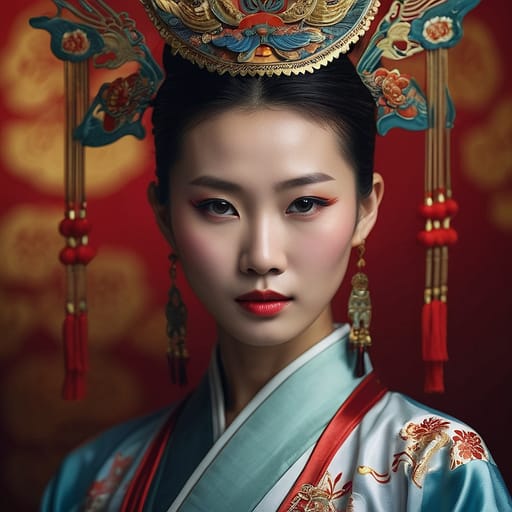
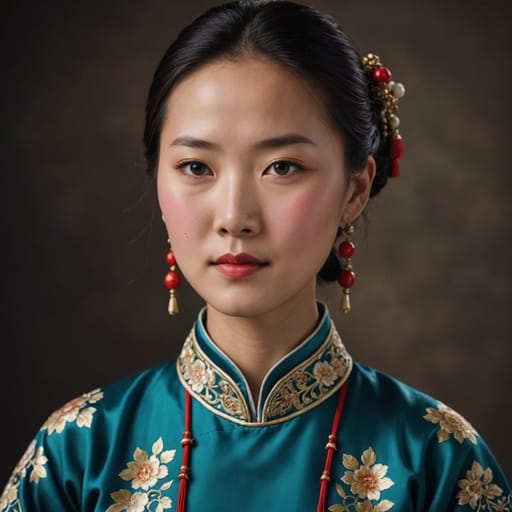
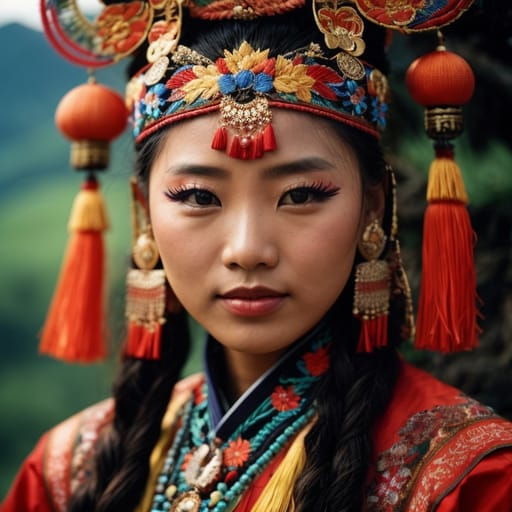
Does this portrait look right for Hui?
Nobody has judged this one yet. You would be the first.
Hui Erotic
About Hui People
Historical formation
The Hui community emerged through a layered process of Muslim immigration into Han Chinese society across nine centuries. The Tang-dynasty stratum (618–907) brought Arab and Persian Sea-Silk-Road merchants to the southeastern coastal ports — Guangzhou's Huaisheng Mosque, traditionally dated to 627, is the oldest continuously operating mosque in China and the institutional anchor of the southeastern coastal Muslim community. The Song-dynasty stratum (960–1279) expanded the merchant communities at Quanzhou and Hangzhou, where the bilingual Persian-Arabic-Chinese tombstones of the Yuan-era cemetery document a substantial, settled, mercantile Muslim population by the thirteenth century.
The decisive expansion was the Mongol-Yuan dynasty (1271–1368), under which Persian, Central Asian Turkic, and Arab Muslims arrived as semu (the second-tier administrative class above the Han Chinese in the Mongol racial hierarchy) and were settled across north China as garrison soldiers, fiscal officials, and merchants. The Ming-dynasty consolidation (1368–1644) replaced Mongol patronage with Han Chinese patronage but retained the Muslim administrative class, gradually Sinicising the population through Han-Chinese-language adoption, Han-style surname adoption (Ma from Muhammad being the most-attested example, plus Ha, Sai, Sha, Su, Ding, and others), and intermarriage with Han women. By the early Qing dynasty (1644–1912) the Hui were a Mandarin-speaking, Han-surnamed, Muslim community recognisable as the modern category.
Regional differentiation
The Hui are not a uniform population. The northwestern Hui — concentrated in Ningxia, Gansu, and Qinghai — descend predominantly from the Mongol-Yuan and Ming Central Asian strata, retain stronger Sufi institutional links to Central Asia (the Naqshbandi, Qadiri, and Kubrawi menhuan brotherhoods that organised the northwest religious life from the seventeenth century forward), and produced the principal nineteenth-century Muslim rebellions against Qing rule. The Henan and Hebei Hui — concentrated in the central plain — descend from the earlier Tang-Song stratum, follow a more Sunni-orthodox Gedimu ("old teaching") tradition without the Sufi brotherhood structure, and have historically been more agriculturally integrated into Han village life. The Yunnan Hui — descended from the Mongol-era settlement of the Yunnan plateau under Sayyid Ajall Shams al-Din Omar (the Bukhara-born Yuan governor of Yunnan, d. 1279) — speak the Yunnanese Mandarin dialect and were the demographic base of the 1856–1873 Panthay Rebellion under Du Wenxiu, whose short-lived Pingnan Guo state at Dali represented the most successful nineteenth-century Hui political project. The coastal Hui at Quanzhou and Guangzhou retain the oldest mosque architecture and the densest documentary archive but are demographically the smallest of the regional clusters.
Education and religious institutions
The Jingtang Jiaoyu ("Mosque Education") tradition — founded in late-Ming Shaanxi by Hu Dengzhou (d. c. 1597) — is the institutional core of Hui Islamic learning. It established a network of jingxue (Quranic schools) attached to local mosques that taught Arabic and Persian alongside Chinese, produced a corpus of Han Kitab texts that translated Islamic theology into Confucian-philosophical vocabulary, and trained the ahong (imam, from Persian akhund) class that runs Hui community religious life. The seventeenth- and eighteenth-century Han Kitab authors — Wang Daiyu, Liu Zhi, Ma Zhu, Ma Dexin — produced the most elaborate sustained encounter between Islamic theology and the Confucian-Neo-Confucian tradition that exists in any world literature, and remain part of the Hui intellectual self-identification today.
Modern history and the PRC era
The nineteenth-century Hui rebellions — the Panthay Rebellion in Yunnan (1856–1873) and the much larger Dungan Revolt in the northwest (1862–1877) — ended in heavy demographic loss and forced migration: the surviving northwestern population that fled into Russian Turkestan became the modern Dungan community of Kazakhstan and Kyrgyzstan, whose Gansu-Mandarin-derived speech and Hui religious tradition remain documented in Central Asian Sinology. The Republican period (1912–1949) produced the major Hui warlord political bloc — the Ma Clique of Ma Bufang, Ma Hongkui, and Ma Hongbin — that controlled Qinghai, Ningxia, and Gansu through the 1930s and 1940s and was the last major non-Han regional political formation absorbed into the People's Republic.
The PRC established the Ningxia Hui Autonomous Region in 1958, creating a province-level administrative unit organised around Hui ethnic identity (though the Hui are a 35% minority within Ningxia itself; the autonomous status is institutional rather than demographic-majority). The Cultural Revolution (1966–1976) closed mosques, banned Jingtang Jiaoyu, and persecuted the ahong class — the most severe period of religious-cultural disruption in Hui history. The post-1980 reform period saw a substantial religious revival, the re-opening of mosques and Quranic schools, and the construction of new mosque infrastructure across the northwest. The post-2017 "Sinicisation of religion" policy has tightened mosque architecture rules (removal of green domes and Arabic signage in many regions), restricted Quranic education for under-18s, and produced a measurable reversal of the 1980s-2010s religious-revival arc — though the impact has been substantially less severe than the parallel campaign against the Uyghur Muslim community in Xinjiang.
Distinguishing the Hui from the Uyghurs
The Hui and the Uyghurs are sometimes conflated in foreign reporting as "Chinese Muslims," but they are distinct ethnic categories with different languages, ancestries, and political histories. The Uyghurs are a Turkic-speaking population whose homeland is the Tarim Basin oases of Xinjiang and whose ancestry derives from the Mongol-era Turkic population of Central Asia; the Hui are Sinophone, distributed across the Chinese interior, and ancestrally Arab/Persian/Central Asian merchants assimilated to Han Chinese culture over a millennium. The Hui are subject to substantially less state pressure than the Uyghurs, and the two communities have at times in the modern period been at sharp odds — the Hui were used as auxiliary troops in several Qing-era campaigns against Uyghur uprisings, and the modern memory of those campaigns continues to colour the relationship.
Related ethnic groups
Groups that share Hui's homeland, region, language, or religious tradition. These are likely candidates for comparative phenotype reference.
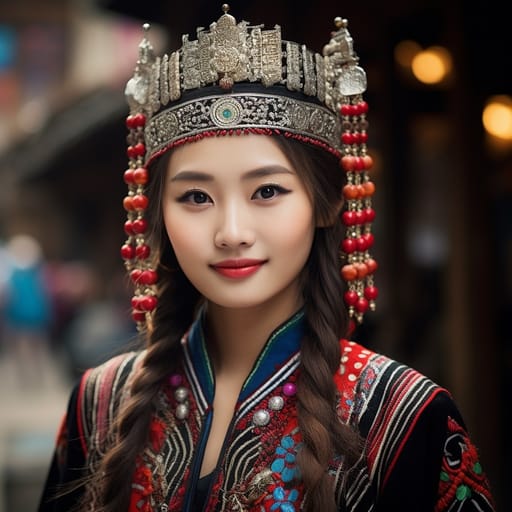
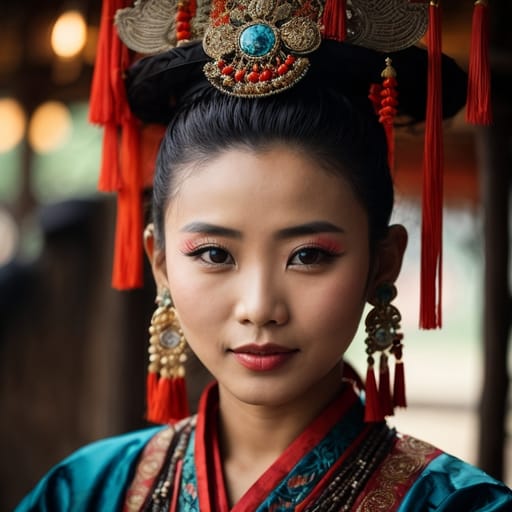
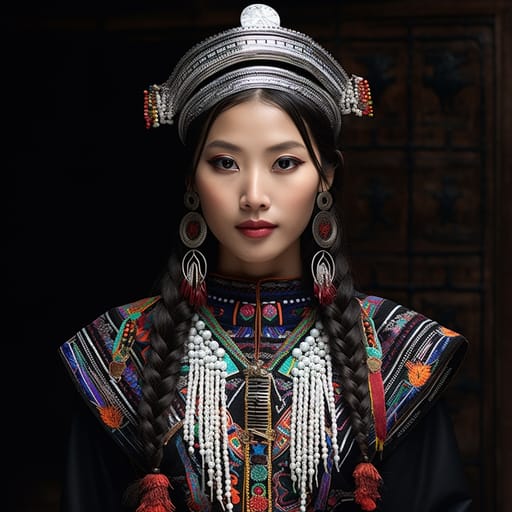
Geographic Distribution: Hui populations across 1 country
Each row is ranked by the group's share of that country's population, with the source citation drawn from published census and demographic surveys. Click through for the full per-country phenotype profile.
| Country | Share | Source |
|---|---|---|
| China | 0.8% | China 2020 Census, self-identified Hui (~11.4M); the Sinophone Muslim ethnic group, distributed across China with concentrations in Ningxia Hui Autonomous Region, Gansu, Henan, Xinjiang, and Yunnan. Han Chinese-language-speaking but distinct in religion (Sunni Islam) and culinary tradition |
Typical Hui Phenotypes
Reference for AI generation: hair, eyes, skin, facial structure, build
Hui Body & Anatomy Reference
Per-feature anatomical profile for AI nude generation: East Asian Sinitic / Mongoloid phenotype
Hui Boobs & Breasts
Hui boobs follow the East Asian Sinitic / Mongoloid profile: small-to-medium cup, modest projection. Areolar diameter is usually 26-36mm, and the coloring is light-pink to medium-brown areolar pigmentation against the light-to-medium skin tone. Breast shape tracks body composition (ectomorph-to-mesomorph, lean frame, mean adult female BMI 20-23), so Hui breasts tend to be firm and modestly projecting; smaller cup size than the South Asian or Western Asian average. Expect a forward-set shape, not the fuller South Asian or Levantine bust profile.
Hui Ass & Hips
Hui ass and hip morphology presents as small-to-medium, modest projection, narrower hip profile, distinctly different from the fuller projected glutes of the West African or Polynesian phenotype. The Hui pelvic profile shows narrower iliac crests, less gluteal-femoral fat deposition, anchored in the East Asian Sinitic / Mongoloid skeletal pattern. Hui butt shots in adult AI imagery should render the small-to-medium, modest projection, narrower hip profile silhouette with the overall build (ectomorph-to-mesomorph, lean frame) and the fat distribution typical of the East Asian Sinitic / Mongoloid phenotype.
Hui Vagina & Pussy
Hui pussy anatomy typically shows light-pink to medium-brown labial pigmentation, smaller labia minora. Pubic hair is usually straight fine texture, sparser distribution than the South Asian norm. In AI-generated Hui nudes, labial color should blend into the light to medium skin with a gradual transition, and the hair should keep its straight fine texture.
Hui Dicks & Penis
Penis reference for Hui men: regional mean ~11-12cm erect, moderate girth. Coloring: light-brown shaft pigmentation. An accurate Hui cock in AI imagery matches the surrounding light to medium skin rather than a generic porn default. Circumcision depends on religion and custom, not ancestry.
Hui Body, Curves & Build
The Hui figure is generally ectomorph-to-mesomorph, lean frame, with mean adult female BMI 20-23, characteristic of East Asian Sinitic / Mongoloid ancestry. AI image tools tend to flatten regional body types into a few stock shapes; here the Hui build is kept as its own reference.
Hui Skin Tone & Hair Texture
Skin: light to medium (Fitzpatrick II-IV). Hair: straight 1A, fine-to-medium, predominantly black. Both are typical of East Asian Sinitic / Mongoloid ancestry. The most common mistake in AI nudes of Hui women is a body rendered lighter than the face.
Explore phenotype categories
Structured taxonomy with peer-reviewed scales · 22 anatomical categories
Notable Hui People
16 reference figures, sourced from Wikipedia
- Gedimu, Old Sect): This is the oldest and most widely followed sect in China. Members…
- Yihewani, New Sect): This sect focuses exclusively on the Quran, without establishing a…
- Salafi, New New Sect): Influenced by Wahhabi thought, this sect aims to reform the Ne…
- Xidaotang, Chinese Learning Sect): This sect, founded on the Chinese translations of Isl…
- Ma, for Muhammad
- Mu, for Muhammad
- Hu, for Hussein
- Zheng, for Shams
- Guo, Koay) for Kamaruddin
- Cai, Chuah) for Osman
- Hai, for Haydar
- Esposito, John, 6 April 2000). The Oxford History of Islam. Oxford University Press. ISBN 0-1…
- Gladney, Dru C., 1996). Muslim Chinese: Ethnic Nationalism in the People's Republic (2nd ed.).…
- Oi, Jean C., ; Walder, Andrew George (1999). Property rights and economic reform in China.…
- Trigault, Nicolas, 1953). China in the Sixteenth Century: The Journals of Matthew Ricci, 1583-16…
- Berlie, Jean, 2004). Islam in China, Hui and Uyghurs: between modernization and sinicizatio…
Erotic Poses & Sex Positions
From the pose catalog: 219 named positions with reference skeletons
Frequently asked questions about Hui people
Where is the Hui homeland?
The Hui homeland is China in East Asia.
What countries do Hui people live in?
Hui populations are documented across 1 country: China.






Make your own Hui images
Five a day, free, no credits to buy. The studio starts from this group's phenotype data, so you can set body type, pose and style and keep the traits accurate.
Start with Hui