Help us get this right
Does this portrait look right for Akha?
Nobody has judged this one yet. You would be the first.
Akha Erotic
Yunnan (Pu'er and Xishuangbanna)
Animism
Akeu
About Akha People
The Akha live across a single contiguous upland that politics has cut into five pieces — the ridges where Yunnan, Myanmar's Shan State, northern Laos, northern Thailand, and a sliver of northeastern Vietnam meet. They are mountain people by preference, not displacement: villages sit deliberately above the wet rice belt, on shoulders between 1,000 and 1,500 meters, where the soil suits dry rice, maize, and the tea bushes that have lately tied parts of Pu'er and Xishuangbanna into the global specialty market. The Akeu, recognized in some classifications as a distinct branch and in others as a dialect community, sit at the edge of this group and illustrate the wider point — Akha identity is a federation of closely related lineages rather than a single bloc.
The language is Loloish, inside the larger Tibeto-Burman family, and shares its closest kinship with Hani — close enough that Chinese ethnology has long classed the Akha as a Hani sub-nationality, an administrative decision the Akha themselves have variable feelings about. Across the border in Thailand and Laos they are simply Akha. The traditional script is recent and contested; a Latin-based orthography developed by missionaries competes with later systems, and most Akha grow up bilingual or trilingual out of practical necessity, picking up Mandarin, Thai, Lao, or Shan depending on which valley town they trade in.
What organizes Akha life is Akhazang — usually translated as "the Akha way," a body of customary law, ritual practice, and ancestral genealogy that functions as religion, ethics, and constitution at once. Every Akha man can in principle recite his patrilineal genealogy back through dozens of generations to the founding ancestor; this recitation is not folklore but the literal mechanism by which marriages are checked for prohibited degrees. Ancestor offerings, the spirit gates at village entrances carved with male and female figures, the tall swing erected for the August new-year festival — these are the visible joints of a worldview that classifies the human village and the spirit forest as two domains that must remain ritually separated. Christian missions, mostly Baptist and Catholic, have made significant inroads since the mid-twentieth century, and a meaningful minority of Akha now navigate a double inheritance, observing church on Sunday and ancestor rites at the appropriate junctures of the agricultural year. The headdresses Akha women wear, dense with silver coins and beadwork and stratified by age and marital stage, are perhaps the most photographed Akha thing; they are also one of the few elements of dress that have survived the pressure to assimilate intact.
Related ethnic groups
Groups that share Akha's homeland, region, language, or religious tradition. These are likely candidates for comparative phenotype reference.
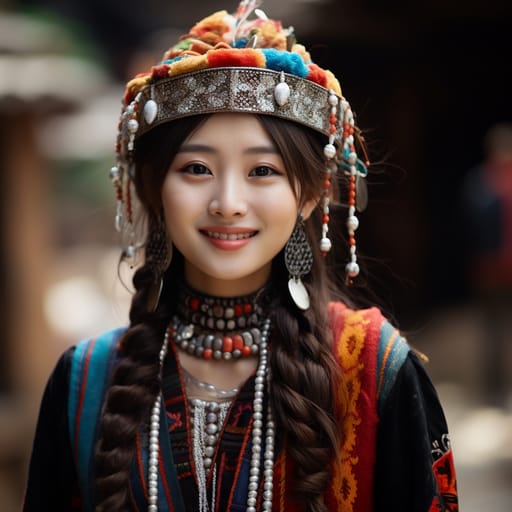
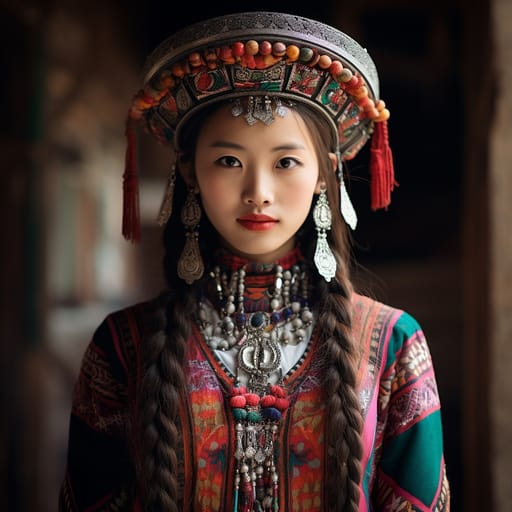

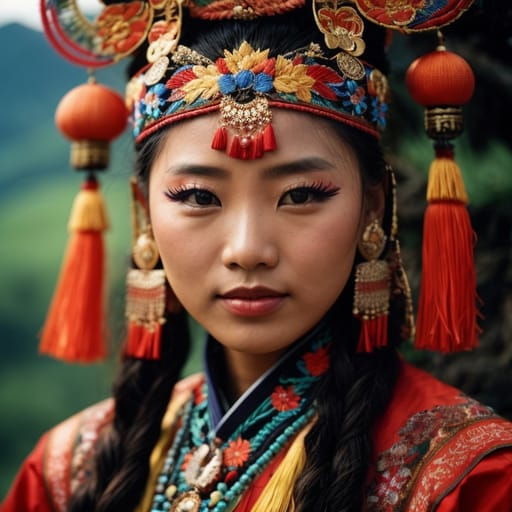
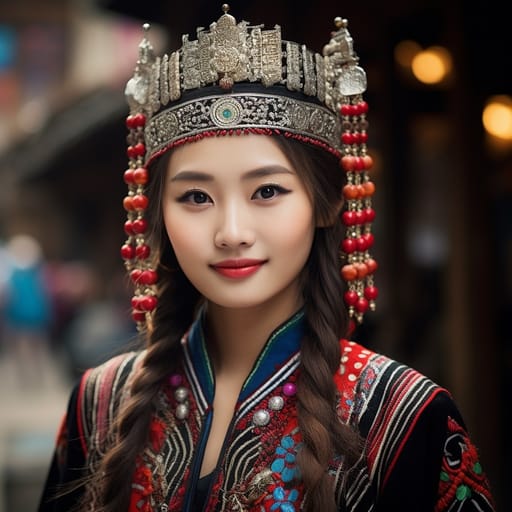
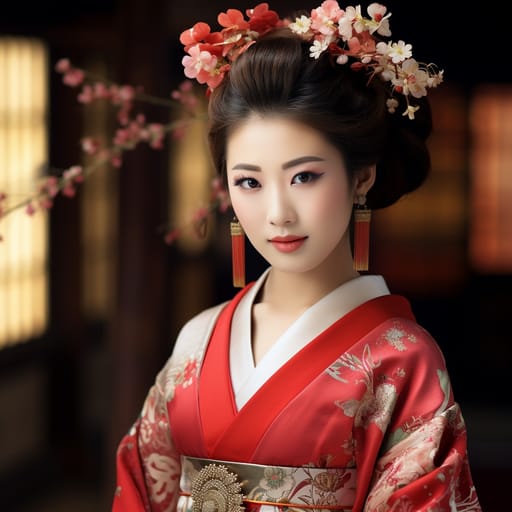
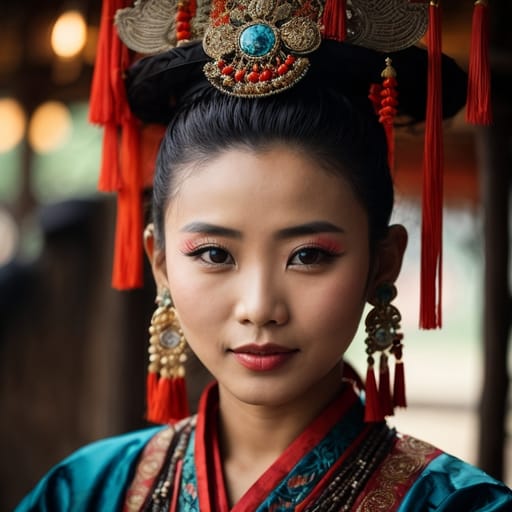
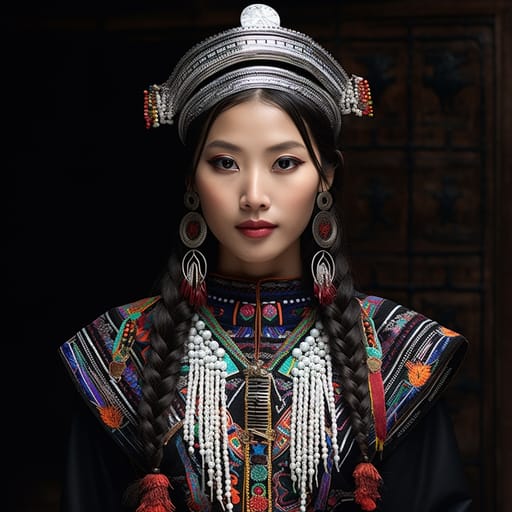
Typical Akha Phenotypes
Reference for AI generation: hair, eyes, skin, facial structure, build
The Akha sit at the southern edge of the Tibeto-Burman phenotype cluster, and their look reflects that hill-country Yunnan and northern mainland Southeast Asia ancestry rather than the Han majority around them. Hair is uniformly black to blue-black, coarse and straight, with very low rates of natural waves; greying tends to come late and stays salt-and-pepper rather than going fully white. Traditional women shave the hairline back under the silver headdress, which exaggerates a high, flat forehead that's already characteristic.
Eyes are dark brown to near-black, almond-shaped, set on a relatively flat orbital plane. The epicanthic fold is near-universal and tends to be heavier at the inner corner than in Han populations, giving a softer, rounded eye opening rather than a long tapered one. Brows are sparse and low-arched. Skin runs Fitzpatrick III to IV, warm golden-tan undertones rather than the cooler porcelain register seen in lowland Tai or northern Han groups; sustained sun exposure from upland farming pushes many older Akha visibly darker, into a weathered copper.
The facial structure is the most distinctive feature. Cheekbones are wide and high but the midface is shorter than in Tibetan or Yi populations, producing a compact, almost square face. Noses are short with a low, soft bridge and moderately wide alar base — broader than Han, narrower than Lahu or Wa neighbors. Lips are medium-full, with a defined cupid's bow. Jaws are gracile and the chin is small and slightly receding.
Build is small and wiry. Adult women typically fall around 150 cm, men around 160 cm, with low body fat, narrow shoulders, and proportionally long torsos relative to leg length — a build shaped by generations of mountain agriculture. The Akeu branch, settled further into Xishuangbanna and northern Laos, trends very slightly taller and shows more admixture-driven variation in nose bridge height and skin tone, but the core Akha facial template holds across both.
Akha Body & Anatomy Reference
East Asian Sinitic / Mongoloid phenotype: anatomy reference for AI nude generation
Akha Boobs & Breasts
The typical Akha bust is small-to-medium cup, modest projection, in line with the wider East Asian Sinitic / Mongoloid pattern. Areolas usually fall in the 26-36mm range, with light-pink to medium-brown areolar pigmentation against the light-to-medium skin tone. Compared with the fuller South Asian or Levantine bust profile, Akha breasts sit forward and are generally firm and modestly projecting; smaller cup size than the South Asian or Western Asian average. A faithful AI render of Akha tits keeps that shape and areola size.
Akha Ass & Hips
Butt shape among Akha women: small-to-medium, modest projection, narrower hip profile, over narrower iliac crests, less gluteal-femoral fat deposition. This follows East Asian Sinitic / Mongoloid ancestry and looks quite unlike the fuller projected glutes of the West African or Polynesian phenotype. An accurate Akha ass in adult AI imagery keeps both the silhouette and the overall build (ectomorph-to-mesomorph, lean frame) instead of a generic average.
Akha Vagina & Pussy
Vulvar anatomy among Akha women: light-pink to medium-brown labial pigmentation, smaller labia minora. Pubic hair tends to be straight fine texture, sparser distribution than the South Asian norm, in the usual inverted-triangle pattern. Both follow East Asian Sinitic / Mongoloid pigmentation, which is why Akha pussy renders should not fall back on a pale, sparse Western template.
Akha Dicks & Penis
The Akha cock profile, from East Asian Sinitic / Mongoloid anthropometric data: regional mean ~11-12cm erect; moderate girth; light-brown shaft pigmentation. Pubic hair has a straight fine texture and forms the usual inverted-V pattern. Whether Akha men are circumcised follows religious and cultural practice rather than phenotype.
Akha Body, Curves & Build
Build and curves among Akha women follow the East Asian Sinitic / Mongoloid pattern: ectomorph-to-mesomorph, lean frame, mean adult female BMI 20-23. Proportions matter as much as skin tone, so Akha figures should keep their regional height and limb ratios.
Akha Skin Tone & Hair Texture
The Akha skin range is light to medium (Fitzpatrick II-IV), and hair tends to be straight 1A, fine-to-medium, predominantly black. That combination marks the East Asian Sinitic / Mongoloid phenotype, and skin tone is the trait AI generators most often get wrong for Akha women.
Data depth
0/100Coverage of image-grounded phenotype observations · drives AI generation diversity
- Sample size
- 0/40· 0 images
- Image quality
- 0/30· 0% high
- Confidence
- 0/20
- Source diversity
- 0/10
- ·No image observations yet
Explore phenotype categories
Structured taxonomy with peer-reviewed scales · 22 anatomical categories
Erotic Poses & Sex Positions
From the pose catalog: 219 named positions with reference skeletons
Frequently asked questions about Akha people
Where is the Akha homeland?
The Akha homeland is Yunnan (Pu'er and Xishuangbanna) in East Asia.
What language do Akha people speak?
Akha people primarily speak Sino-Tibetan / Loloish / Hani / Akha.
What religion do Akha people practice?
The predominant religion among Akha people is Animism.






Make your own Akha images
Five a day, free, no credits to buy. The studio starts from this group's phenotype data, so you can set body type, pose and style and keep the traits accurate.
Start with Akha