Help us get this right
Does this portrait look right for Sui?
Nobody has judged this one yet. You would be the first.
Sui Erotic
Sandu Shui Autonomous County (China)
Animism
About Sui People
The Sui live in the karst country of southern Guizhou, with their cultural center in Sandu — the only Shui Autonomous County in China. The terrain shapes them: limestone hills, terraced rice paddies on narrow valley floors, wooden stilt houses raised against damp ground and floods. Around 400,000 people identify as Sui, most concentrated in this corner of Guizhou, with smaller communities spilling into Guangxi and Yunnan.
Their language sits inside the Kam–Sui branch of Kra–Dai, a small family that also includes Kam (Dong) and Maonan. It's a tonal language, and a distant relative of Thai and Lao rather than of the Chinese spoken around them — a reminder that the Sui are part of a much older southward current of peoples that shaped much of mainland Southeast Asia. What sets the Sui apart even from their nearest linguistic cousins is their script. Shuishu, the Sui writing system, is a body of roughly five hundred logographs used almost exclusively by ritual specialists for divination, almanacs, and geomantic texts. Many characters look like mirror-image or inverted Chinese, others appear to be wholly indigenous. It is one of the few living scripts in the world reserved for religious use rather than everyday communication.
Sui religion is animist, organized around ancestor veneration and a dense calendar of agricultural and protective rites. Specialists called shuishu xiansheng read the almanac to choose auspicious days for weddings, funerals, planting, and house-building; nothing significant is begun without consulting it. The major festival is Duan, the Sui new year, held in late autumn after the harvest — a staggered celebration that moves between villages over several weeks, with horse races, bronze-drum playing, and offerings of fish to the ancestors. Fish, not pork, anchors the ritual table; the Sui famously prefer it, and a stuffed-fish dish is the centerpiece of formal hospitality.
Sui women's traditional dress runs to dark indigo-dyed cloth, often hand-batiked, with horsetail embroidery — a fine technique in which strands of horse tail are wrapped in silk thread and couched into spiraling patterns. The craft is now recognized as national intangible cultural heritage. Historically the Sui were drawn south during the migrations that broke up the old Baiyue peoples, settling into the hills as Han populations expanded along the rivers; that pattern of accommodation and retreat into difficult terrain is much of why their language, script, and ritual life survived intact into the present.
Related ethnic groups
Groups that share Sui's homeland, region, language, or religious tradition. These are likely candidates for comparative phenotype reference.
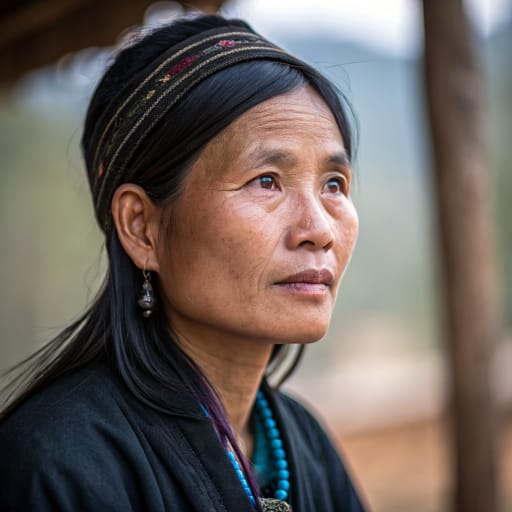
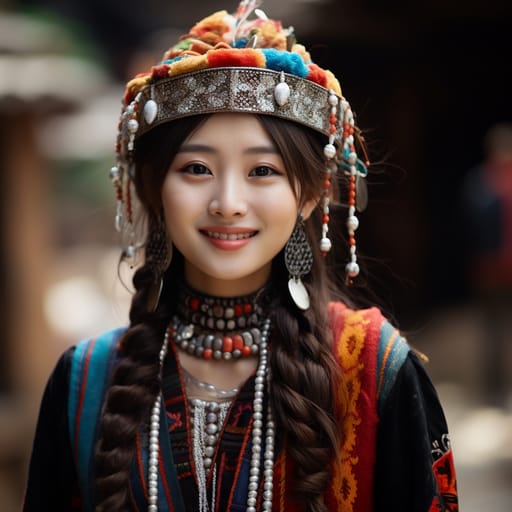
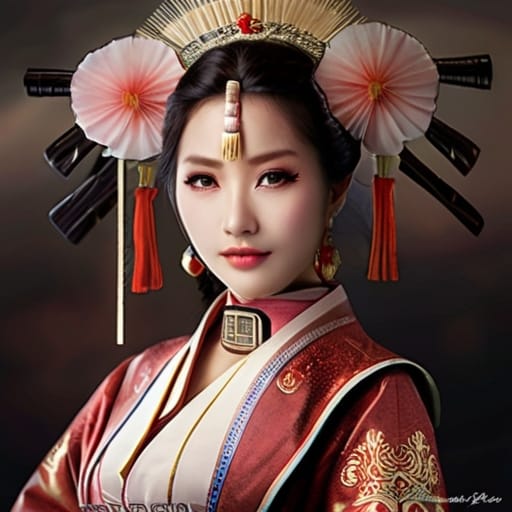
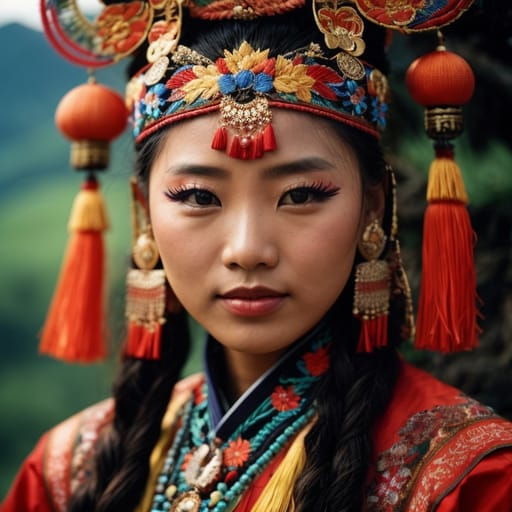
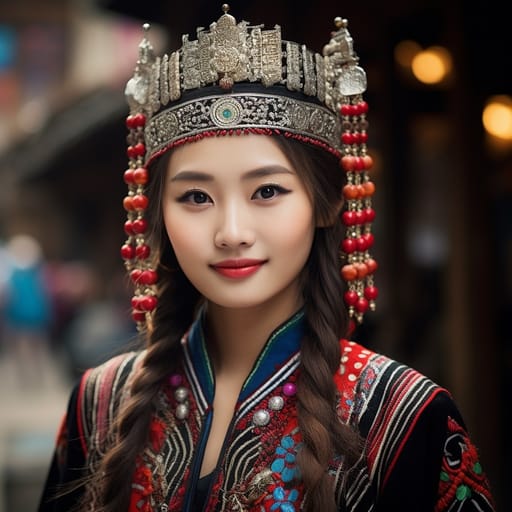
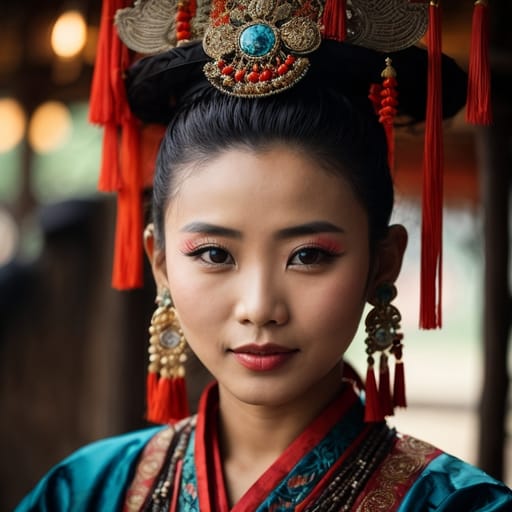
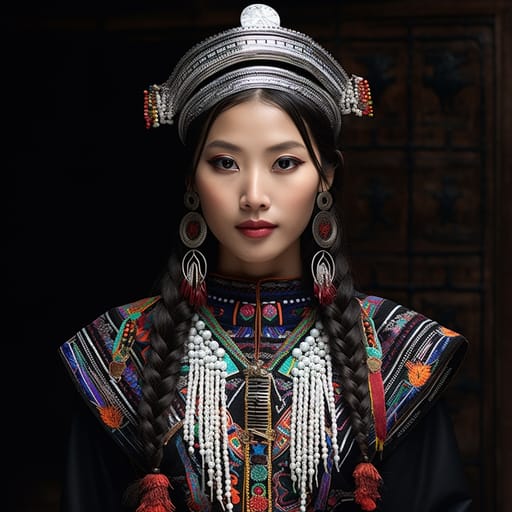
Typical Sui Phenotypes
Reference for AI generation: hair, eyes, skin, facial structure, build
The Sui are a small Kra-Dai-speaking population concentrated in the Duliu River valley of southern Guizhou, and their phenotype reads as a southern East Asian baseline with the slightly softer, rounder facial geometry common to lowland Kam-Sui groups. Hair is uniformly black or near-black with a cool brown-black cast in strong sunlight, almost always straight or with a faint wave at the ends, fine to medium in diameter, and slow to grey — older Sui women in traditional dress often retain dark hair into their sixties. Coarse, thick, or curly hair is essentially absent.
Eyes are dark brown to nearly black, with the epicanthic fold near-universal and typically pronounced; the palpebral fissure tends to be narrower and more horizontally set than in northern Han populations, and the upper lid often lacks a visible crease. Skin sits in the Fitzpatrick III–IV range, with a warm yellow-olive undertone that browns rather than reddens; agricultural workers in the rice terraces tan deeper, while women who spend more time indoors weaving or doing batik work often hold a pale ivory tone. Freckling and ruddiness are uncommon.
Facial structure trends toward moderately wide, low-bridged noses with rounded tips and modest alar flare — narrower than southern Zhuang or Dong neighbors but broader than northern Han. Cheekbones are present but not high or sharp; the jaw is typically rounded and the chin small, giving an overall soft oval rather than angular profile. Lips are medium in fullness, evenly proportioned, with a defined cupid's bow.
Build is small and compact. Adult men average roughly 162–168 cm and women 150–156 cm, with slender frames, narrow shoulders, fine wrists and ankles, and a tendency toward lean musculature from terrace farming rather than bulk. Body hair is sparse. There is little visible phenotype split between the Shuili and Shuiqing dialect branches; the more noticeable variation is between rice-valley and upland-village Sui, the latter trending darker-skinned and slightly more weathered.
Sui Body & Anatomy Reference
Per-feature anatomical profile for AI nude generation: East Asian Sinitic / Mongoloid phenotype
Sui Boobs & Breasts
Bust reference for Sui women: small-to-medium cup, modest projection, which is typical of East Asian Sinitic / Mongoloid ancestry. Areolas measure about 26-36mm across, with light-pink to medium-brown pigmentation. Body type (ectomorph-to-mesomorph, lean frame) shapes the bust as well, so Sui tits are usually firm and modestly projecting; smaller cup size than the South Asian or Western Asian average. In AI imagery, keep the forward-set shape rather than drifting toward the fuller South Asian or Levantine bust profile.
Sui Ass & Hips
The Sui ass is typically small-to-medium, modest projection, narrower hip profile, which sets it apart from the fuller projected glutes of the West African or Polynesian phenotype. Underneath, the pelvis shows narrower iliac crests, less gluteal-femoral fat deposition, part of the East Asian Sinitic / Mongoloid skeletal pattern. For Sui butt pics and AI renders, match that silhouette and the overall build (ectomorph-to-mesomorph, lean frame).
Sui Vagina & Pussy
Sui pussy and vulvar anatomy presents light-pink to medium-brown labial pigmentation, smaller labia minora, consistent with the East Asian Sinitic / Mongoloid phenotype's pigmentation pattern. Sui pubic hair is typically straight fine texture, sparser distribution than the South Asian norm, in the inverted-triangle pattern. For anatomically accurate Sui pussy renders the labial coloration should match the surrounding light to medium skin tone with a continuous gradient, and the hair should keep its straight fine texture.
Sui Dicks & Penis
Sui dicks follow the East Asian Sinitic / Mongoloid reference data: regional mean ~11-12cm erect; moderate girth; light-brown shaft pigmentation. Shaft color should track the light to medium skin tone with a smooth change toward the glans, and Sui pubic hair keeps its straight fine texture.
Sui Body, Curves & Build
Sui body type and overall build presents as ectomorph-to-mesomorph, lean frame, with mean adult female BMI 20-23: the characteristic East Asian Sinitic / Mongoloid habitus. Sui curves and proportions should keep the regional skeletal frame (height, shoulder-to-hip ratio, limb proportions) rather than a generic mesomorph default.
Sui Skin Tone & Hair Texture
Sui skin sits in the light to medium (Fitzpatrick II-IV) band. Hair is typically straight 1A, fine-to-medium, predominantly black, in keeping with the East Asian Sinitic / Mongoloid phenotype. In nude renders the skin should stay one even tone from face to body, and body, pubic and head hair should match.
Data depth
0/100Coverage of image-grounded phenotype observations · drives AI generation diversity
- Sample size
- 0/40· 0 images
- Image quality
- 0/30· 0% high
- Confidence
- 0/20
- Source diversity
- 0/10
- ·No image observations yet
Explore phenotype categories
Structured taxonomy with peer-reviewed scales · 22 anatomical categories
Erotic Poses & Sex Positions
From the pose catalog: 219 named positions with reference skeletons
Frequently asked questions about Sui people
Where is the Sui homeland?
The Sui homeland is Sandu Shui Autonomous County (China) in East Asia.
What language do Sui people speak?
Sui people primarily speak Kra-Dai / Kam-Sui / Sui.
What religion do Sui people practice?
The predominant religion among Sui people is Animism.






Make your own Sui images
Five a day, free, no credits to buy. The studio starts from this group's phenotype data, so you can set body type, pose and style and keep the traits accurate.
Start with Sui