Help us get this right
Does this portrait look right for Hani?
Nobody has judged this one yet. You would be the first.
Hani Erotic
Yunnan (China)
Animism
About Hani People
The Hani are a hill people of southern Yunnan, concentrated in the Ailao and Wuliang ranges between the Red River and the Mekong, with sizable populations spilling across the borders into northern Laos, Vietnam, and Myanmar (where related groups go by names like Akha and Hani). They are best known to the outside world for the rice terraces around Honghe — a thousand-year-old hydrological system carved into mountainsides so steep that the paddies stack like contour lines, fed by forest watersheds the villages have always treated as inviolable. The terraces are not a tourist set-piece for the Hani themselves; they are the practical solution to farming a vertical landscape, and the village-forest-terrace-river arrangement is something closer to an inherited engineering doctrine than a folk custom.
Their language belongs to the Loloish branch of Sino-Tibetan, putting them in the same broad family as the Yi and Lisu but on a distinct internal limb. Hani itself is a cluster rather than a single tongue — Haya, Biyue, Haobai, Akha and several others are mutually intelligible to varying degrees, and a Latin-based orthography developed in the 1950s sits alongside older religious and genealogical oral traditions. The patrilineal genealogies are striking: men commonly recite chains of ancestors going back fifty or sixty generations, with each son's given name beginning with the final syllable of the father's, so the lineage is literally encoded in the names.
Religious life is animist in practice, organized around village priests — the beima or, among the Akha, the pima — who handle the agricultural calendar, conduct funerals, and recite the migration epics that trace the people's descent from the high northern grasslands down into the present hills. Ancestor veneration runs in parallel: every house has its altar, and lineage rites mark the year as firmly as the planting and harvest do. The most distinctive seasonal observances are the Kuzhazha swing festival in early summer and the Zhaluote long-table feast in autumn, when an entire village's tables are pushed end-to-end down the lane and households contribute dishes to the common stretch. Buddhism and Christianity have made inroads at the edges, particularly among Akha communities in Thailand and Myanmar, but in the Yunnan core the older ritual world is still the working framework rather than a heritage display.
Related ethnic groups
Groups that share Hani's homeland, region, language, or religious tradition. These are likely candidates for comparative phenotype reference.
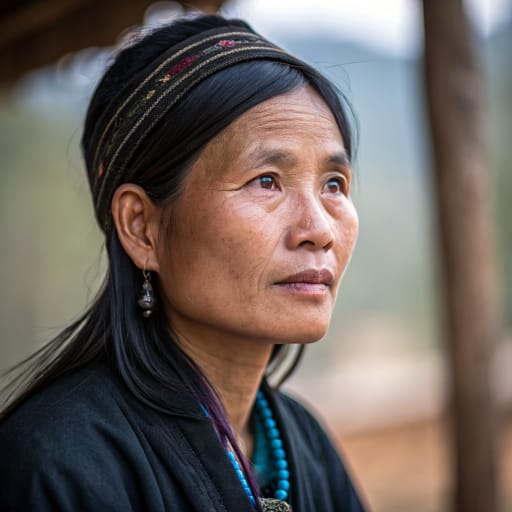
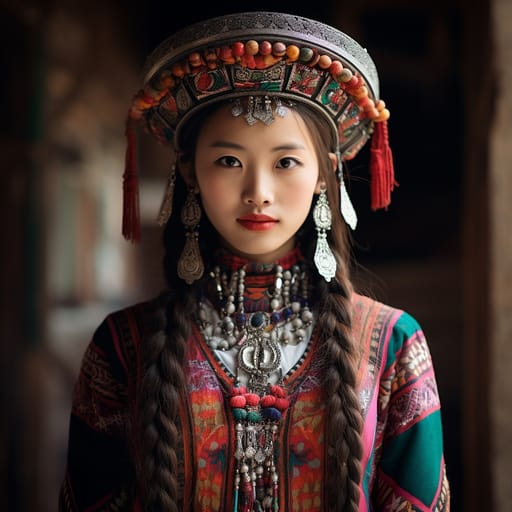

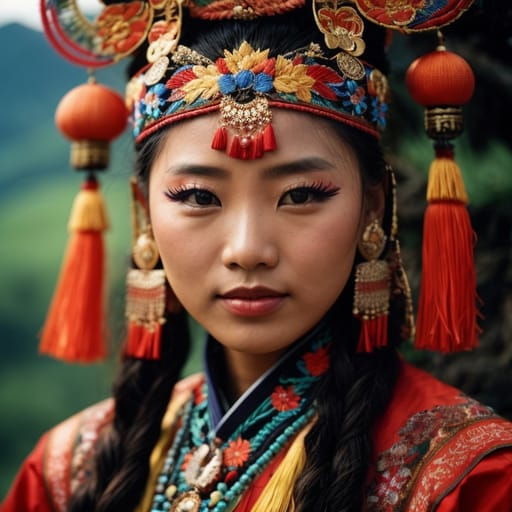
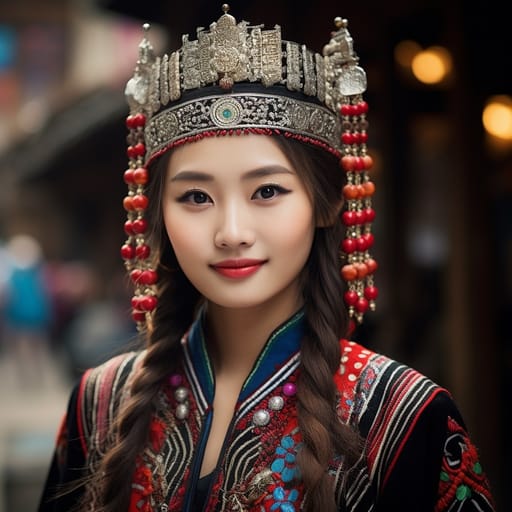


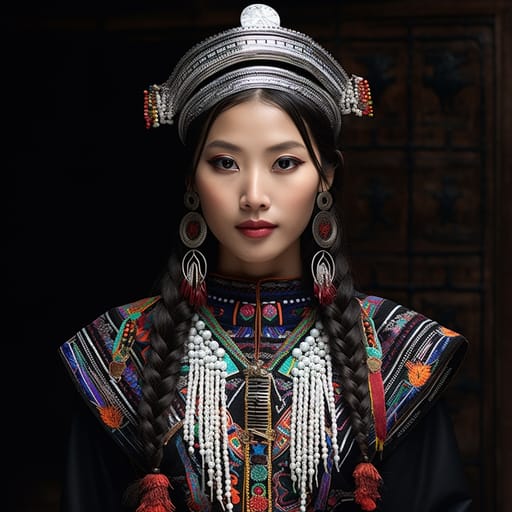
Typical Hani Phenotypes
Reference for AI generation: hair, eyes, skin, facial structure, build
The Hani are a Tibeto-Burman highland people concentrated in the Ailao and Wuliang mountains of southern Yunnan, and their phenotype reads as a southern variant of the broader East Asian template — closer in build and feature to Yi, Lahu, and northern Thai populations than to Han Chinese from the lowlands. Hair is uniformly black or near-black, straight to gently wavy, coarse in shaft and dense — graying late, with the deep brown-black pigmentation that holds even into the seventh decade. Premature silvering is rare. Body and facial hair is sparse on men; brows are typically thin and softly arched rather than heavy.
Eyes run dark brown to almost black, with the epicanthic fold near-universal and a noticeably narrower palpebral fissure than in Han populations farther north. The fold tends to be full and continuous rather than partial, giving the eye a clean almond shape with a slight upward outer canthus. Skin tone covers Fitzpatrick III to IV, with warm golden-olive undertones; field-working women and men in the terraced rice valleys tan to a deeper bronze that sits closer to IV–V on sun-exposed surfaces, while interior skin stays lighter and more yellow-toned.
Faces are broad through the cheekbones with a flatter midface and shallow nasal bridge — the alar base is wide, the nose tip rounded and short rather than projecting. Lips are medium in fullness, the lower slightly heavier than the upper. Jaws are softer and more tapered than the squarer Mongolic patterns to the north, producing a heart-to-oval face. Stature is modest: men cluster around 160–168 cm, women 150–158 cm, with compact, wiry builds shaped by generations of terrace agriculture at altitude — narrow shoulders, low body fat, strong calves and forearms. Sub-group variation between the Hani proper, Akha, Haoni, and Biyue branches is real but subtle, mostly registering as small differences in face length and skin depth rather than distinct phenotype clusters.
Hani Body & Anatomy Reference
East Asian Sinitic / Mongoloid phenotype: anatomy reference for AI nude generation
Hani Boobs & Breasts
Hani tits and boobs run small-to-medium cup, modest projection, the classic East Asian Sinitic / Mongoloid bust profile. Hani nipples and areolas show light-pink to medium-brown areolar pigmentation against the light-to-medium skin tone, with areolar diameter typically in the 26-36mm range and forward-set positioning rather than the fuller South Asian or Levantine bust profile. Hani breasts trend firm and modestly projecting; smaller cup size than the South Asian or Western Asian average, a function of the ectomorph-to-mesomorph, lean frame body habitus and the mean adult female BMI 20-23. For anatomically accurate AI-generated Hani nudes the render preserves the small-to-medium cup, modest projection shape, 26-36mm areolas with light-pink to medium-brown pigmentation, and the torso proportions of the East Asian Sinitic / Mongoloid phenotype.
Hani Ass & Hips
Hani hips and butt usually read as small-to-medium, modest projection, narrower hip profile. The skeletal base is narrower iliac crests, less gluteal-femoral fat deposition, the East Asian Sinitic / Mongoloid pattern. Set against the fuller projected glutes of the West African or Polynesian phenotype, the difference is easy to see, and the hip-to-waist ratio is often what identifies Hani women in photos.
Hani Vagina & Pussy
Expect light-pink to medium-brown labial pigmentation, smaller labia minora on Hani women, in keeping with East Asian Sinitic / Mongoloid ancestry. The pubic hair is straight fine texture, sparser distribution than the South Asian norm. Coloring should run evenly from the light to medium skin of the thighs to the labia, and Hani nude imagery should keep the hair's straight fine texture.
Hani Dicks & Penis
Hani dick and penile anatomy in adult AI generation should anchor on the regional reference data: regional mean ~11-12cm erect, moderate girth, and light-brown shaft pigmentation. The Hani cock profile reflects the East Asian Sinitic / Mongoloid population's anthropometric measurements. The shaft pigmentation should track the surrounding light to medium skin tone, and the pubic hair should keep its straight fine texture in the typical inverted-V escutcheon.
Hani Body, Curves & Build
Hani body type: ectomorph-to-mesomorph, lean frame, with mean adult female BMI 20-23. This is the typical East Asian Sinitic / Mongoloid build. Height range, shoulder-to-hip ratio and fat distribution all follow from it, which is what an accurate Hani nude body should show.
Hani Skin Tone & Hair Texture
Hani skin tone falls in the light to medium (Fitzpatrick II-IV) band, the surface signal most often miscalibrated by generic AI nude generators. Hani hair texture is typically straight 1A, fine-to-medium, predominantly black, characteristic of the East Asian Sinitic / Mongoloid phenotype. In Hani nude renders the skin should hold that band consistently across the body.
Data depth
0/100Coverage of image-grounded phenotype observations · drives AI generation diversity
- Sample size
- 0/40· 0 images
- Image quality
- 0/30· 0% high
- Confidence
- 0/20
- Source diversity
- 0/10
- ·No image observations yet
Explore phenotype categories
Structured taxonomy with peer-reviewed scales · 22 anatomical categories
Erotic Poses & Sex Positions
From the pose catalog: 219 named positions with reference skeletons
Frequently asked questions about Hani people
Where is the Hani homeland?
The Hani homeland is Yunnan (China) in East Asia.
What language do Hani people speak?
Hani people primarily speak Sino-Tibetan / Loloish / Hani.
What religion do Hani people practice?
The predominant religion among Hani people is Animism.






Make your own Hani images
Five a day, free, no credits to buy. The studio starts from this group's phenotype data, so you can set body type, pose and style and keep the traits accurate.
Start with Hani