No portrait yet
Minyue Erotic
The Min River basin and coast of what is now Fujian province, southeastern China, with centers near present-day Fuzhou and at Chengcun, Wuyishan.
An extinct, unrecorded Yue language (affiliation unknown; Tai-Kadai, Austroasiatic and Austronesian links have been proposed). The region's later population speaks Min Chinese (Sino-Tibetan).
Indigenous Yue religion: snake veneration, spirit mediums and divination. No scripture or doctrine survives.
One of the Baiyue (Hundred Yue) peoples of ancient southern China, alongside the Dong'ou, Nanyue, Luoyue and the Yue of Zhejiang. The short-lived Dongyue kingdom split from Minyue around 135 BCE.
About Minyue People
The Minyue were an ancient people and kingdom of China's southeast coast, in what is now Fujian province, who held their mountains and river mouths from roughly the late fourth century BCE until 110 BCE, when the Han empire conquered them, deported much of the population north, and left the rest to be absorbed over centuries into the Chinese-speaking south. They belonged to the Baiyue, the Hundred Yue, a loose Chinese label for the non-Chinese peoples who lived from the Yangtze delta down to northern Vietnam. What set the Minyue apart within that crowd was a state of their own. Their ruling house claimed descent from the kings of Yue, the Zhejiang power broken by Chu, and refugees from that collapse seem to have fused with the older inhabitants of the Min River basin.
Geography did much of the work. Fujian is walled off from the interior by the Wuyi range and faces the sea, so the Minyue were boat people and hill people at once, hard to reach and harder to hold. Qin demoted their king Wuzhu to a local chief. He backed the winning side in the wars that followed, and in 202 BCE the first Han emperor restored his title. For the next ninety years Minyue behaved like a regional power, not a vassal: it attacked the neighboring kingdom of Dong'ou in 138 BCE and Nanyue in 135 BCE, and each time the Han court stepped in. One king was killed by his own brother to buy off an invasion. That brother, Zou Yushan, later rebelled himself, and Emperor Wu's armies came by land and sea to end the kingdom. The histories claim the land was emptied, its people resettled between the Yangtze and the Huai. Historians doubt it: many likely stayed in the hills.
Their language is lost. It was not Chinese, and scholars argue over whether the Yue tongues were related to Tai, Austroasiatic or Austronesian languages; what little survives of any Yue speech is a handful of words in Chinese transcription. Chinese writers described Yue peoples as cropping their hair, tattooing their bodies and treating the snake as sacred, and the character for Min contains the sign for a snake or insect. Traces remain. Boat-shaped coffins, older than the kingdom itself, sit in the cliffs of the Wuyi Mountains, a walled royal city of the Han period has been excavated at Chengcun near Wuyishan, and snake temples still draw worshipers in parts of northern Fujian. The Min languages spoken across Fujian and Taiwan today are Chinese, but they are among the most divergent branches of it, and some linguists hear an older substrate underneath.
Related ethnic groups
Groups that share Minyue's homeland, region, language, or religious tradition. These are likely candidates for comparative phenotype reference.
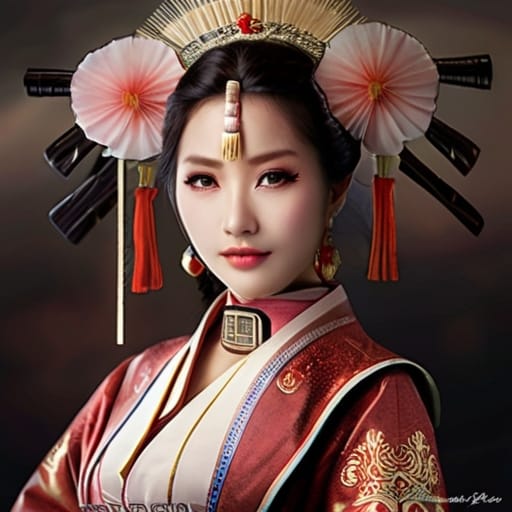
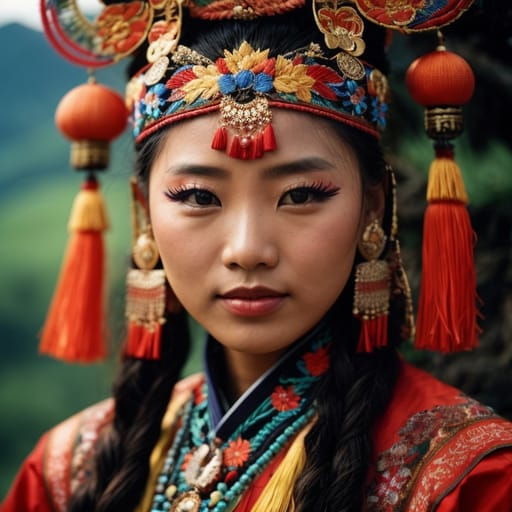
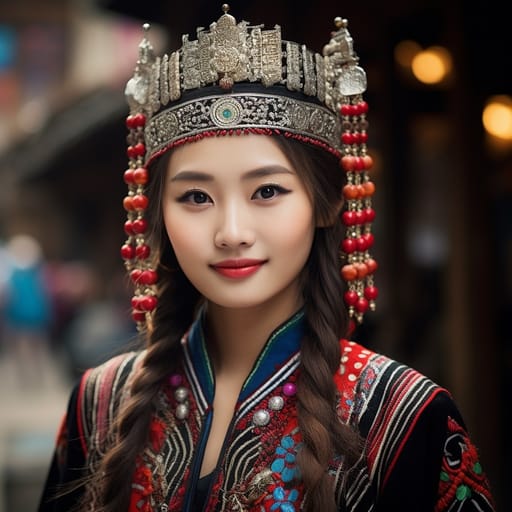
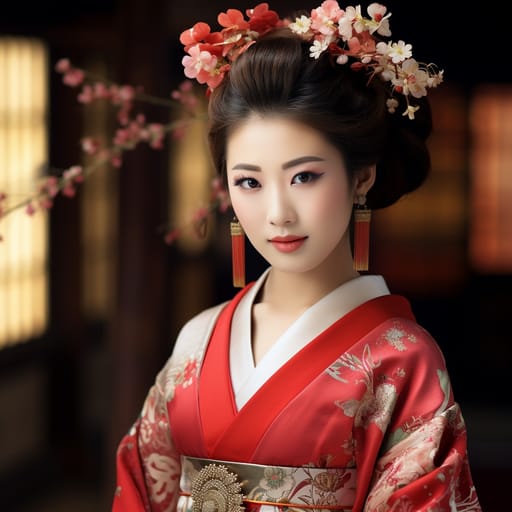
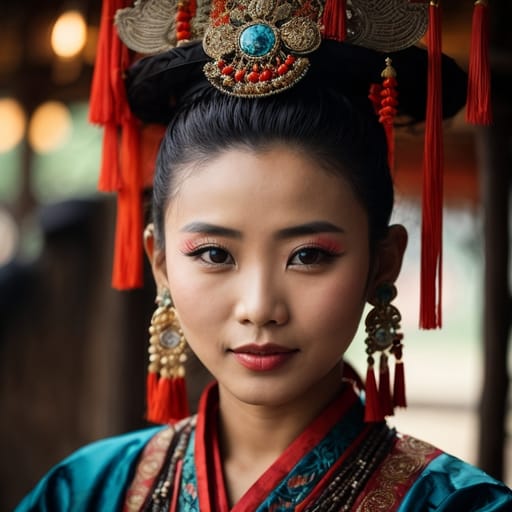
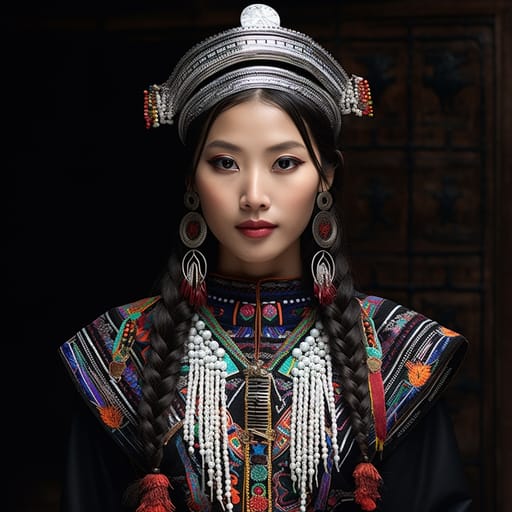
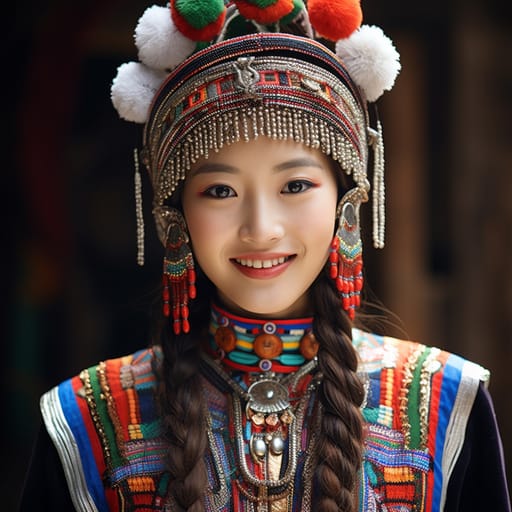
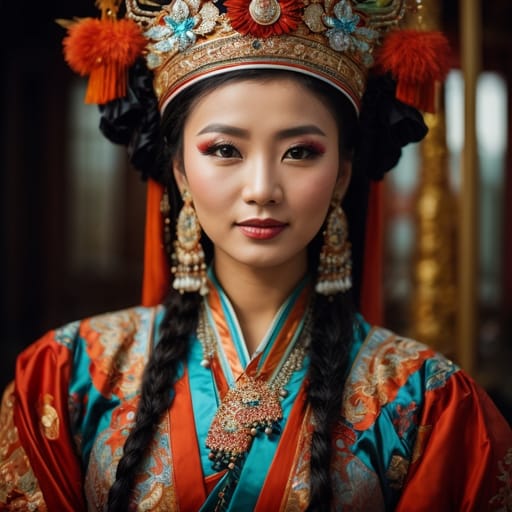
Typical Minyue Phenotypes
Reference for AI generation: hair, eyes, skin, facial structure, build
Minyue Body & Anatomy Reference
East Asian Sinitic / Mongoloid phenotype: anatomy reference for AI nude generation
Minyue Boobs & Breasts
Bust reference for Minyue women: small-to-medium cup, modest projection, which is typical of East Asian Sinitic / Mongoloid ancestry. Areolas measure about 26-36mm across, with light-pink to medium-brown pigmentation. Body type (ectomorph-to-mesomorph, lean frame) shapes the bust as well, so Minyue tits are usually firm and modestly projecting; smaller cup size than the South Asian or Western Asian average. In AI imagery, keep the forward-set shape rather than drifting toward the fuller South Asian or Levantine bust profile.
Minyue Ass & Hips
The Minyue ass is typically small-to-medium, modest projection, narrower hip profile, which sets it apart from the fuller projected glutes of the West African or Polynesian phenotype. Underneath, the pelvis shows narrower iliac crests, less gluteal-femoral fat deposition, part of the East Asian Sinitic / Mongoloid skeletal pattern. For Minyue butt pics and AI renders, match that silhouette and the overall build (ectomorph-to-mesomorph, lean frame).
Minyue Vagina & Pussy
Minyue pussy and vulvar anatomy presents light-pink to medium-brown labial pigmentation, smaller labia minora, consistent with the East Asian Sinitic / Mongoloid phenotype's pigmentation pattern. Minyue pubic hair is typically straight fine texture, sparser distribution than the South Asian norm, in the inverted-triangle pattern. For anatomically accurate Minyue pussy renders the labial coloration should match the surrounding light to medium skin tone with a continuous gradient, and the hair should keep its straight fine texture.
Minyue Dicks & Penis
Minyue dicks follow the East Asian Sinitic / Mongoloid reference data: regional mean ~11-12cm erect; moderate girth; light-brown shaft pigmentation. Shaft color should track the light to medium skin tone with a smooth change toward the glans, and Minyue pubic hair keeps its straight fine texture.
Minyue Body, Curves & Build
Minyue body type and overall build presents as ectomorph-to-mesomorph, lean frame, with mean adult female BMI 20-23: the characteristic East Asian Sinitic / Mongoloid habitus. Minyue curves and proportions should keep the regional skeletal frame (height, shoulder-to-hip ratio, limb proportions) rather than a generic mesomorph default.
Minyue Skin Tone & Hair Texture
Minyue skin sits in the light to medium (Fitzpatrick II-IV) band. Hair is typically straight 1A, fine-to-medium, predominantly black, in keeping with the East Asian Sinitic / Mongoloid phenotype. In nude renders the skin should stay one even tone from face to body, and body, pubic and head hair should match.
Explore phenotype categories
Structured taxonomy with peer-reviewed scales · 22 anatomical categories
Erotic Poses & Sex Positions
From the pose catalog: 219 named positions with reference skeletons
Frequently asked questions about Minyue people
Where is the Minyue homeland?
The Minyue homeland is The Min River basin and coast of what is now Fujian province, southeastern China, with centers near present-day Fuzhou and at Chengcun, Wuyishan. in East Asia.
What language do Minyue people speak?
Minyue people primarily speak An extinct, unrecorded Yue language (affiliation unknown; Tai-Kadai, Austroasiatic and Austronesian links have been proposed). The region's later population speaks Min Chinese (Sino-Tibetan)..
What religion do Minyue people practice?
The predominant religion among Minyue people is Indigenous Yue religion: snake veneration, spirit mediums and divination. No scripture or doctrine survives..






Make your own Minyue images
Five a day, free, no credits to buy. The studio starts from this group's phenotype data, so you can set body type, pose and style and keep the traits accurate.
Start with Minyue