No portrait yet
Oroqen Erotic
The Greater and Lesser Khingan ranges of northeastern China, in the Oroqen Autonomous Banner of Hulunbuir, Inner Mongolia, and the forest counties of northern Heilongjiang, with a small related population across the Amur in Russia.
Oroqen (Tungusic, Northern branch, closely related to Evenki); Mandarin Chinese now dominant among younger generations.
Traditionally shamanism with animist veneration of fire, mountains and the bear; largely secular today with residual folk practice.
River-valley sub-groups including the Kumarchen and Birarchen; part of the Northern Tungusic family alongside the Evenki.
About Oroqen People
The Oroqen are the mounted forest hunters of the Khingan ranges, a Tungusic people whose name is usually glossed as people of the mountain ridges. Within living memory they moved through the taiga of China's far northeast on horseback, hunting roe deer, moose and bear. They are among the smallest of China's fifty-six recognized nationalities, fewer than ten thousand people, most of them in the Oroqen Autonomous Banner of Hulunbuir in Inner Mongolia and in the forest counties of Heilongjiang along the Amur. A few related Orochen live across the river in Russia, where the census folds them into the Evenki.
Their language belongs to the northern Tungusic group and sits so close to Evenki that linguists argue over whether it is a separate language or a dialect. It has never had a script. Most Oroqen under fifty speak Mandarin at home, and fluent speakers now number in the hundreds. The material culture of the forest has held up better: conical lodges of birch poles, skinned with bark in summer and roe deer hide in winter, birch bark canoes and cradles stitched with sinew, and the roe deer head cap, a hunter's disguise made from a real deer head with ears and antlers left on, now the emblem the Oroqen show to outsiders. Camps were built around the ulileng, a band of related households that hunted together and split every kill equally. Clans stood above them, and river valleys named the sub-groups: the Kumarchen of the Kumar, the Birarchen of the Bira.
Oroqen religion was shamanic. Fire was treated as a living elder and never spat into or poked with a knife. The bear was addressed as grandfather, killed only with ritual apology, and its bones were laid on a tree platform rather than in the ground. The Qing enrolled Oroqen hunters in the Butha banners as scouts and soldiers and sorted them into mounted and foot Oroqen. The Japanese occupation of Manchuria was far harsher: men were pressed into forest units and plied with opium, and the population had fallen steeply by 1945. The new Chinese state settled them in villages in the 1950s, and in 1952 the shamans were persuaded to hold one last ceremony sending their spirits away. The final practicing shaman, Chuonnasuan, died in 2000. In 1996 the banner banned hunting and collected the rifles, closing the life the whole culture was built around. Today the Oroqen farm, log, guide tourists and staff the local government, and each June the Gulunmuta fire festival brings out the deerskin robes, the zandaren songs and the mosukun narrative chants the older generation still carries.
Related ethnic groups
Groups that share Oroqen's homeland, region, language, or religious tradition. These are likely candidates for comparative phenotype reference.
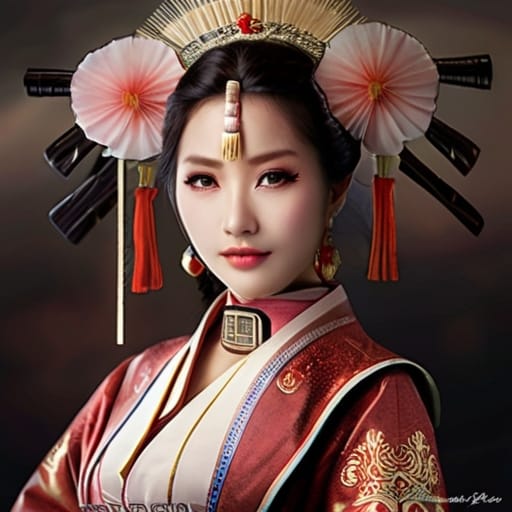
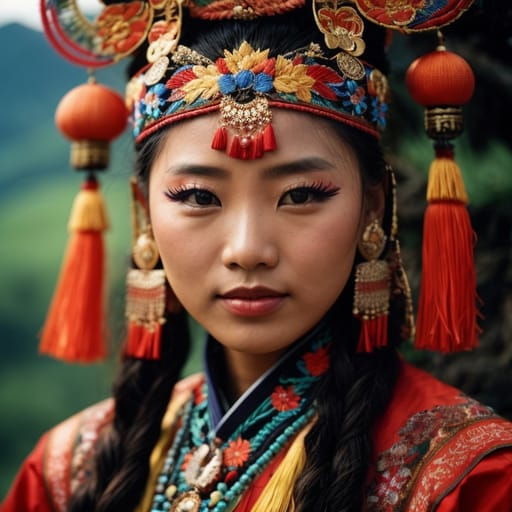
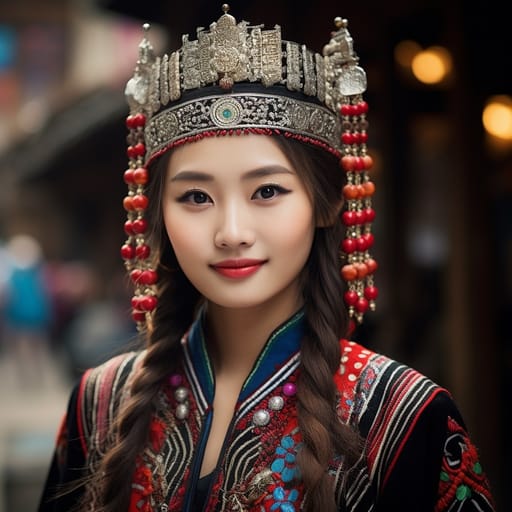
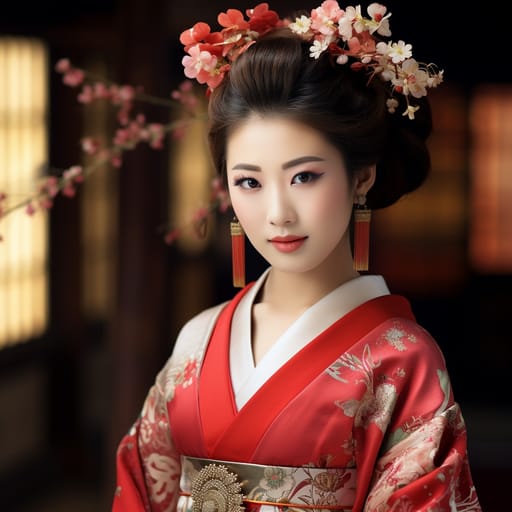
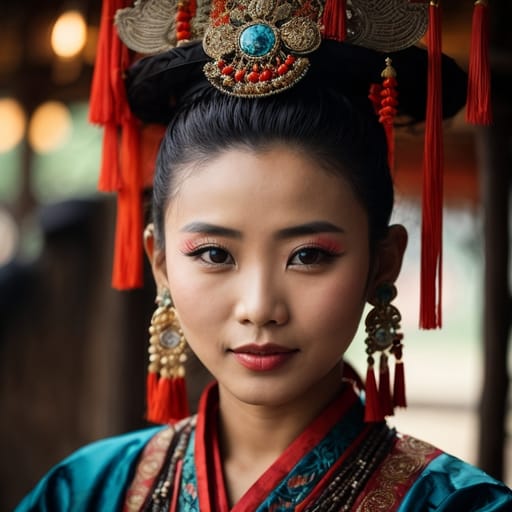
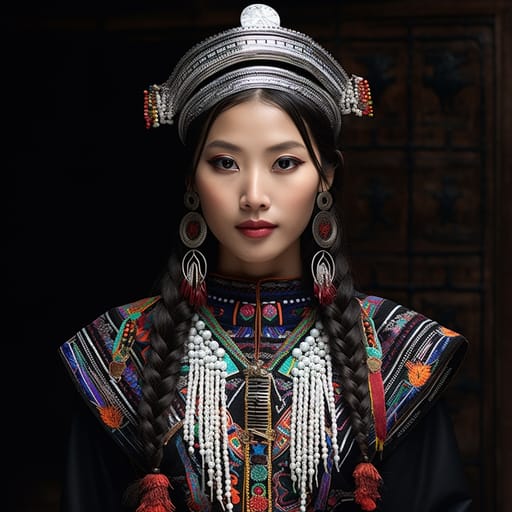
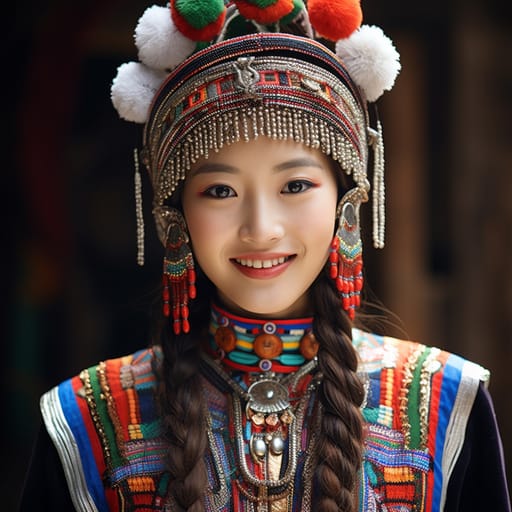
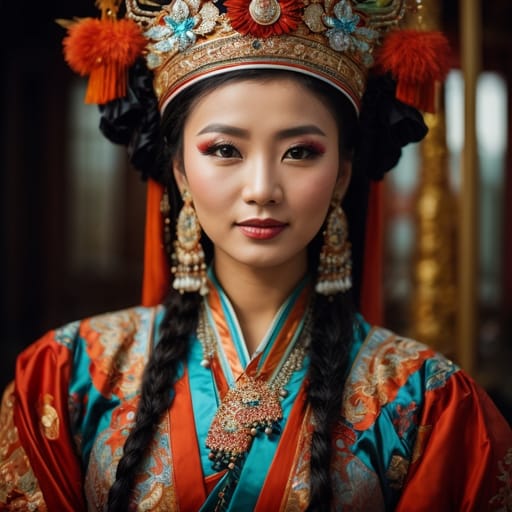
Typical Oroqen Phenotypes
Reference for AI generation: hair, eyes, skin, facial structure, build
Oroqen Body & Anatomy Reference
East Asian Sinitic / Mongoloid phenotype: anatomy reference for AI nude generation
Oroqen Boobs & Breasts
Oroqen tits and boobs run small-to-medium cup, modest projection, the classic East Asian Sinitic / Mongoloid bust profile. Oroqen nipples and areolas show light-pink to medium-brown areolar pigmentation against the light-to-medium skin tone, with areolar diameter typically in the 26-36mm range and forward-set positioning rather than the fuller South Asian or Levantine bust profile. Oroqen breasts trend firm and modestly projecting; smaller cup size than the South Asian or Western Asian average, a function of the ectomorph-to-mesomorph, lean frame body habitus and the mean adult female BMI 20-23. For anatomically accurate AI-generated Oroqen nudes the render preserves the small-to-medium cup, modest projection shape, 26-36mm areolas with light-pink to medium-brown pigmentation, and the torso proportions of the East Asian Sinitic / Mongoloid phenotype.
Oroqen Ass & Hips
Oroqen hips and butt usually read as small-to-medium, modest projection, narrower hip profile. The skeletal base is narrower iliac crests, less gluteal-femoral fat deposition, the East Asian Sinitic / Mongoloid pattern. Set against the fuller projected glutes of the West African or Polynesian phenotype, the difference is easy to see, and the hip-to-waist ratio is often what identifies Oroqen women in photos.
Oroqen Vagina & Pussy
Expect light-pink to medium-brown labial pigmentation, smaller labia minora on Oroqen women, in keeping with East Asian Sinitic / Mongoloid ancestry. The pubic hair is straight fine texture, sparser distribution than the South Asian norm. Coloring should run evenly from the light to medium skin of the thighs to the labia, and Oroqen nude imagery should keep the hair's straight fine texture.
Oroqen Dicks & Penis
Oroqen dick and penile anatomy in adult AI generation should anchor on the regional reference data: regional mean ~11-12cm erect, moderate girth, and light-brown shaft pigmentation. The Oroqen cock profile reflects the East Asian Sinitic / Mongoloid population's anthropometric measurements. The shaft pigmentation should track the surrounding light to medium skin tone, and the pubic hair should keep its straight fine texture in the typical inverted-V escutcheon.
Oroqen Body, Curves & Build
Oroqen body type: ectomorph-to-mesomorph, lean frame, with mean adult female BMI 20-23. This is the typical East Asian Sinitic / Mongoloid build. Height range, shoulder-to-hip ratio and fat distribution all follow from it, which is what an accurate Oroqen nude body should show.
Oroqen Skin Tone & Hair Texture
Oroqen skin tone falls in the light to medium (Fitzpatrick II-IV) band, the surface signal most often miscalibrated by generic AI nude generators. Oroqen hair texture is typically straight 1A, fine-to-medium, predominantly black, characteristic of the East Asian Sinitic / Mongoloid phenotype. In Oroqen nude renders the skin should hold that band consistently across the body.
Explore phenotype categories
Structured taxonomy with peer-reviewed scales · 22 anatomical categories
Erotic Poses & Sex Positions
From the pose catalog: 219 named positions with reference skeletons
Frequently asked questions about Oroqen people
Where is the Oroqen homeland?
The Oroqen homeland is The Greater and Lesser Khingan ranges of northeastern China, in the Oroqen Autonomous Banner of Hulunbuir, Inner Mongolia, and the forest counties of northern Heilongjiang, with a small related population across the Amur in Russia. in East Asia.
What language do Oroqen people speak?
Oroqen people primarily speak Oroqen (Tungusic, Northern branch, closely related to Evenki); Mandarin Chinese now dominant among younger generations..
What religion do Oroqen people practice?
The predominant religion among Oroqen people is Traditionally shamanism with animist veneration of fire, mountains and the bear; largely secular today with residual folk practice..






Make your own Oroqen images
Five a day, free, no credits to buy. The studio starts from this group's phenotype data, so you can set body type, pose and style and keep the traits accurate.
Start with Oroqen