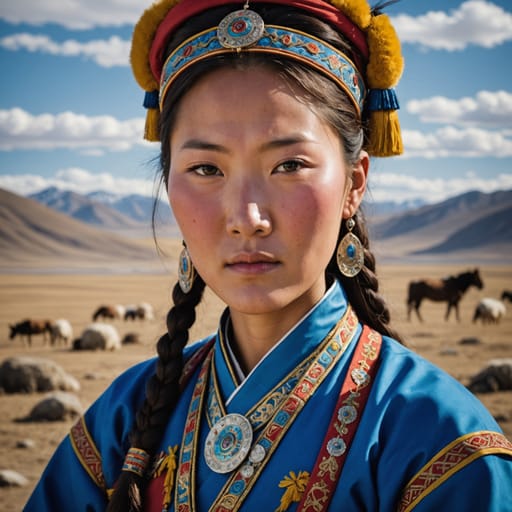
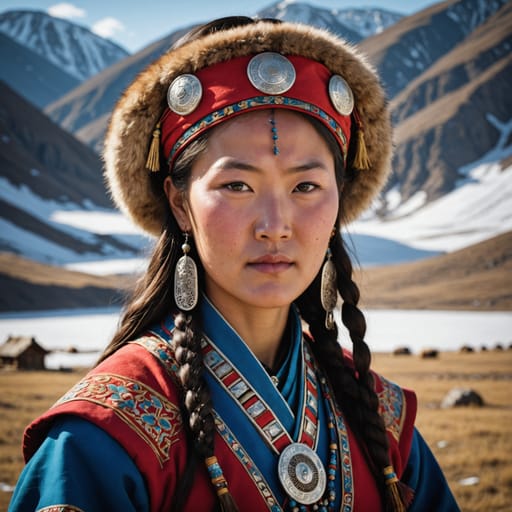
Help us get this right
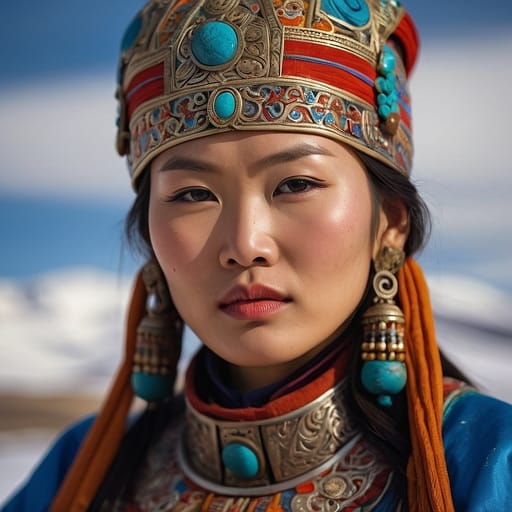
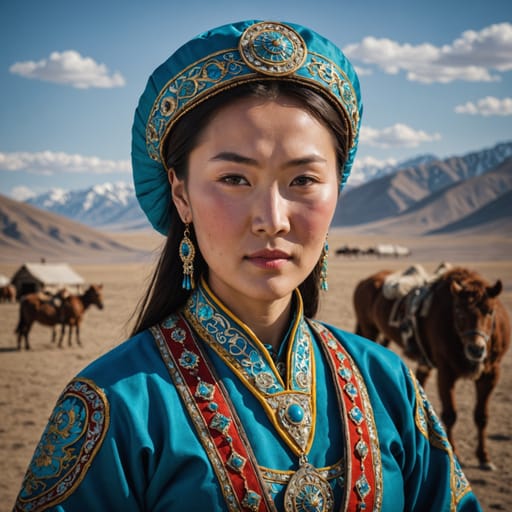
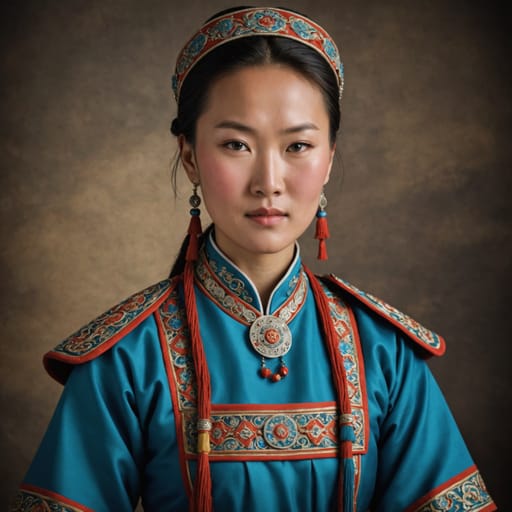
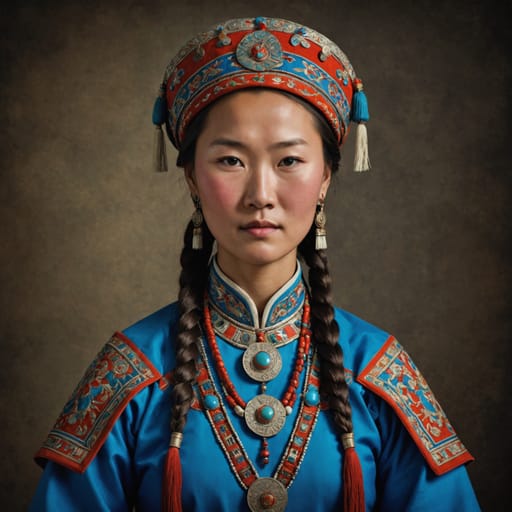
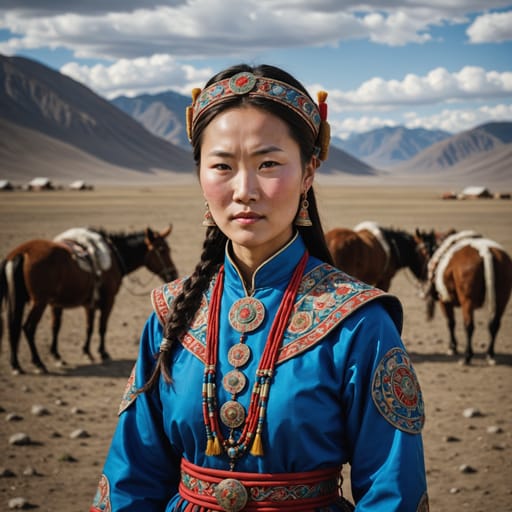
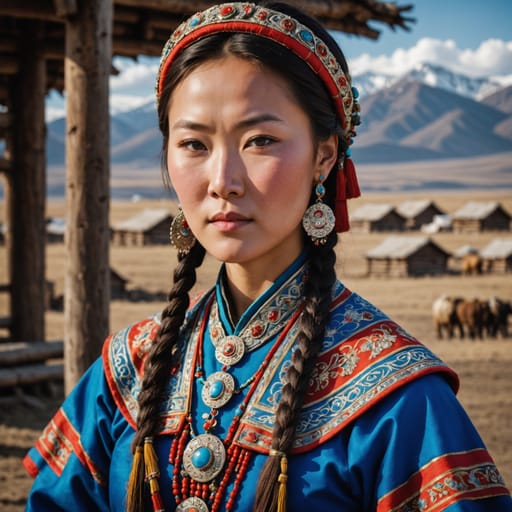
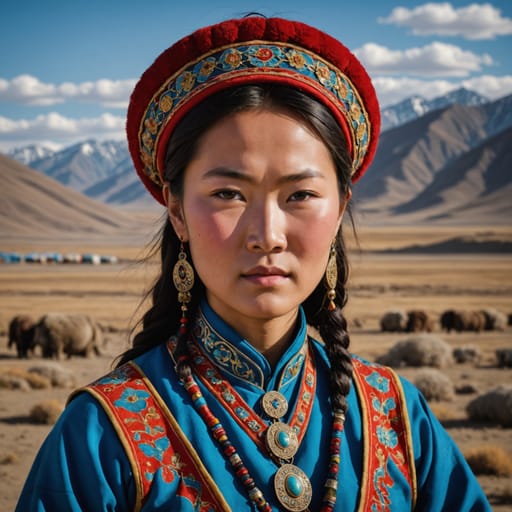
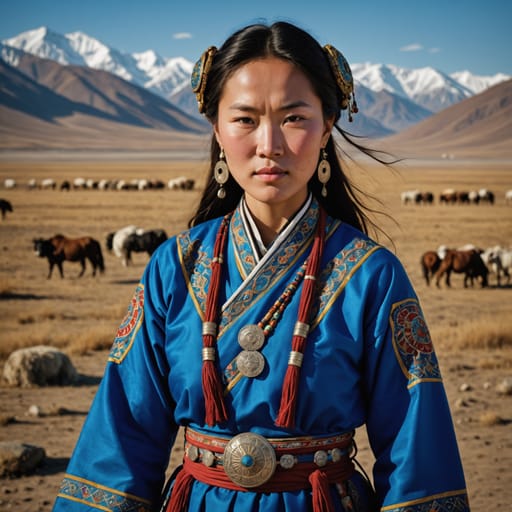
Does this portrait look right for Khalkha Mongol?
One tap. It takes a second and it is recorded.
3 say it looks right, 0 say it looks off.
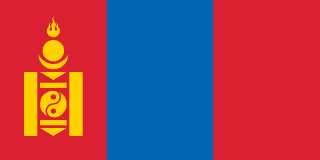

Mongolia
MNEast Asia
Mongolia is home to 10 documented ethnic groups in East Asia, led by Khalkha Mongol (~84%), Kazakh Mongolian (~4%), Other Mongolian (~3%), Dorvod (~3%). This page blends their phenotype and demographic data into one weighted reference: skin tone, facial features, hair texture and build, drawn from published census and ancestry sources.
Demographic Composition
Composition weights are derived from self-identification in published census and demographic surveys. Each row links to the source ethnic-group atlas page.
| Ethnic group | Weight | Source |
|---|---|---|
 Khalkha Mongol Khalkha Mongol | 84.2% | National Statistics Office of Mongolia 2020 Population and Housing Census, self-identified Khalkha (~84.2%, ~2.7M); the dominant Mongolian ethnic group, distributed throughout the country with particular concentrations in central, eastern, and southern Mongolia. Khalkha is the basis for the standard Mongolian language used by the state |
 Kazakh Mongolian Kazakh Mongolian | 3.8% | Mongolia 2020 Census, self-identified Kazakh (~3.8%, ~120,000+); concentrated in Bayan-Ölgii Province in westernmost Mongolia (where Kazakhs comprise approximately 90% of the provincial population) plus smaller communities in Khovd Province. Cross-border population shared with Kazakhstan, where the Bayan-Ölgii Kazakhs are recognized as part of the broader Kazakh diaspora |
 Other Mongolian Other Mongolian | 3.2% | Mongolia 2020 Census, self-identified other ethnic groups not separately enumerated above; comprises smaller Oirat sub-groups (Torgut, Ööld, Khoton, Myangad), the Tuva-related Uriankhai sub-groups, plus Russian-Mongolian and Chinese-Mongolian sub-populations |
 Dorvod Dorvod | 2.6% | Mongolia 2020 Census, self-identified Dörvöd / Dörvöt (~2.6%, ~83,000+); the largest of the western Oirat-Mongol sub-groups, concentrated in Uvs Province in northwestern Mongolia. Speak the Dörvöd dialect of Oirat Mongolian |
 Bayad Bayad | 1.8% | Mongolia 2020 Census, self-identified Bayad (~1.8%, ~57,000+); an Oirat-Mongol sub-group concentrated in Uvs Province |
 Buryat Buryat | 1.4% | Mongolia 2020 Census, self-identified Buryat (~1.4%, ~45,000+); the Mongolian-resident sub-population of the broader Buryat ethnic group concentrated primarily in the Republic of Buryatia in Russia. Mongolian-Buryats are concentrated in northern Mongolia (Khentii, Selenge, Dornod provinces) along the Russian border |
 Zakhchin Zakhchin | 1.1% | Mongolia 2020 Census, self-identified Zakhchin (~1.1%, ~35,000+); an Oirat-Mongol sub-group concentrated in Khovd Province in western Mongolia |
 Uriankhai Uriankhai | 1.0% | Mongolia 2020 Census, self-identified Uriankhai (~1.0%, ~32,000+); an Oirat-Mongol-related group concentrated in Khovd and Bayan-Ölgii provinces. Cross-border population includes the Tuvan-related Uriankhai populations of Russia (Tuva Republic) and the Altay region |
 Dariganga Dariganga | 0.9% | Mongolia 2020 Census, self-identified Dariganga (~0.9%, ~28,000+); a southeastern Mongolian Khalkha-related sub-group concentrated in Sükhbaatar Province |
 Tsaatan Tsaatan | 0.0% | Mongolia 2020 Census, self-identified Tsaatan / Dukha (~282); the very small Indigenous reindeer-herding people of northern Khövsgöl Province in Mongolia. Speak a Turkic language (Dukha, related to Tuvan), distinct from Mongolic languages. Cross-border population shared with the Tuvan-related populations of Russia |
Mongolia Phenotype Profile
Mongolia's population is among the most demographically distinct in East Asia — approximately 84% Khalkha Mongol per the 2020 Census plus the various smaller Oirat-Mongol and Buryat-Mongol sub-groups (combined ~10% of the population) plus the substantial Kazakh-Mongolian minority (~3.8%, concentrated in Bayan-Ölgii Province) plus several smaller Indigenous and recent-immigrant communities. The country's demographic structure reflects approximately 800+ years of Mongol political and cultural history: the Mongol Empire (1206-1368) established under Chinggis Khaan, the post-Yuan-Dynasty Khalkha consolidation, the Manchu Qing-Dynasty incorporation (1691-1911), the 1911-1924 independence struggle, the Mongolian People's Republic (1924-1992) under Soviet Russian alignment, and the post-1992 democratic transition.
Genome-wide studies (HUGO Pan-Asian SNP Consortium 2009 plus subsequent Mongolian genetic studies) place Mongolian populations within the broader Northeast Asian / Siberian-influenced cluster, with subtle population-level distinctions from Northern Han Chinese (closer Mongol-Han relationships in eastern Inner-Mongolia-region samples), from Korean populations, and from broader Central Asian Turkic populations. Skin tone across the population spans Fitzpatrick II-IV with III-IV the modal value nationally — somewhat darker than Yamato Japanese or Korean populations, tracking the high-latitude continental UV exposure plus the broader Northeast Asian / Siberian source-population characteristics. Hair is overwhelmingly straight (Andre Walker 1A-1B) and uniformly black/very dark brown across the broader Mongol population. Facial features show the characteristic Mongol distinguishing features (epicanthic-fold variants nearly universal, broader face shapes with very prominent cheekbones, narrower-to-moderate nasal bridges) that distinguish Mongol populations from Han Chinese, Korean, and Japanese populations in older anthropological literature. Eye color is uniformly brown to dark brown across the broader Mongol population, with the Kazakh-Mongolian sub-population in Bayan-Ölgii showing somewhat broader hair-color and eye-color distributions reflecting the broader West-Eurasian-admixed Kazakh genetic profile. Build is robust by East Asian standards — adult Mongolian male mean stature is approximately 168-172 cm in 2010s-2020s cohorts.
Mongolia Body & Anatomy Reference
Per-feature anatomical profile for AI nude generation: East Asian Sinitic / Mongoloid phenotype dominant in Mongolia
Mongolia Women: Boobs & Breasts
Mongolia women's tits and boobs reflect the small-to-medium cup, modest projection East Asian Sinitic / Mongoloid bust profile dominant in the Mongolia demographic composition. Mongolia nipples and areolas show light-pink to medium-brown areolar pigmentation against the light-to-medium skin tone, with areolar diameter typically in the 26-36mm range, distinct from the the fuller South Asian or Levantine bust profile. Mongolia breast morphology trends firm and modestly projecting; smaller cup size than the South Asian or Western Asian average, a function of the ectomorph-to-mesomorph, lean frame body habitus and mean adult female BMI 20-23. For anatomically-accurate AI-generated Mongolia nude women the render should preserve: small-to-medium cup, modest projection shape, 26-36mm areolas with regional pigmentation, and the torso proportions of the East Asian Sinitic / Mongoloid phenotype.
Mongolia Women: Ass & Hips
Mongolia women's ass and hip morphology presents as small-to-medium, modest projection, narrower hip profile, distinctly different from the fuller projected glutes of the West African or Polynesian phenotype. Mongolia pelvic profile shows narrower iliac crests, less gluteal-femoral fat deposition, anchored in the East Asian Sinitic / Mongoloid skeletal pattern that dominates the Mongolia ethnic composition. Mongolia butt shots in adult AI imagery should render the small-to-medium, modest projection, narrower hip profile silhouette with the ectomorph-to-mesomorph, lean frame build and the gluteal-femoral fat distribution typical of the East Asian Sinitic / Mongoloid phenotype rather than defaulting to a globally-averaged shape that generic AI generators produce.
Mongolia Women: Vagina & Pussy
Mongolia women's pussy and vulvar anatomy presents light-pink to medium-brown labial pigmentation, smaller labia minora, consistent with the East Asian Sinitic / Mongoloid phenotype's pigmentation pattern dominant in Mongolia. Mongolia pubic hair is typically straight fine texture, sparser distribution than the South Asian norm, distributed in the inverted-triangle pattern with regional-typical density. AI-generated Mongolia nude imagery should preserve the light-pink to medium-brown labial pigmentation and the straight fine texture hair texture rather than defaulting to a Western-European pink-and-sparse template. For anatomically-accurate Mongolia pussy renders the labial pigmentation should match the surrounding light to medium skin tone of the East Asian Sinitic / Mongoloid phenotype.
Mongolia Men: Dicks & Penis
Mongolia men's dick and penile anatomy in adult AI generation should anchor on the regional reference data: regional mean ~11-12cm erect, moderate girth, and light-brown shaft pigmentation. Mongolia cock profile reflects the East Asian Sinitic / Mongoloid ancestral population's anthropometric measurements rather than a globally-averaged Western-pornography default. For anatomically-accurate Mongolia nude male imagery the shaft pigmentation should track the surrounding light to medium skin tone, with continuous glans-to-shaft pigmentation transition and the straight fine texture pubic-hair texture distributed in the typical inverted-V escutcheon. Circumcision status across Mongolia men varies by religious and cultural tradition rather than ancestral phenotype.
Mongolia People: Body, Curves & Build
Mongolia body type and overall build presents as ectomorph-to-mesomorph, lean frame, with mean adult female BMI 20-23: the characteristic East Asian Sinitic / Mongoloid habitus dominant in the Mongolia demographic composition. Mongolia curves and proportions in adult AI imagery should preserve the regional skeletal frame (height, shoulder-to-hip ratio, limb proportions) rather than scaling to a Western-European mesomorph default. The Mongolia nude female form, when rendered with anatomical fidelity, shows the height range, frame width, and adipose distribution pattern typical of the East Asian Sinitic / Mongoloid phenotype. Generic AI image generators tend to collapse regional body types into a few default shapes; the Ethnic Erotic phenotype-anchored approach preserves the Mongolia build as its own reference category.
Mongolia People: Skin Tone & Hair Texture
Mongolia skin tone falls in the light to medium (Fitzpatrick II-IV) band, the surface signal most often miscalibrated by generic AI nude generators trained on Western-photographic datasets. Mongolia hair texture is typically straight 1A, fine-to-medium, predominantly black, characteristic of the East Asian Sinitic / Mongoloid phenotype. For anatomically-accurate Mongolia nude renders the skin should hold the Fitzpatrick band consistently across body surface rather than showing the lighter-than-face body shading that AI generators default to. Mongolia hair pigmentation and texture on body, pubic, and head should match across the figure rather than mixing textures (a common AI artefact).
A descriptive view, not a claim about individuals
This page shows a weighted aggregate of phenotype observations across the Mongolia population, based on demographic composition from published census and ancestry sources. Phenotypes within any country are far more varied than the aggregate suggests; this is a descriptive reference, not a deterministic claim about any individual. For source-level detail on individual ethnic groups, see the constituent atlas pages linked below.
Methodology Notes
Composition weights are derived from the National Statistics Office of Mongolia 2020 Population and Housing Census, the most recent comprehensive Mongolian census. Mongolia enumerates self-identified ethnic-group affiliation across Khalkha plus approximately 19 recognized sub-groups (the various Oirat sub-groups, Buryat, Kazakh, Tsaatan, etc.). Genome-wide ancestry context (HUGO Pan-Asian 2009) supports phenotype interpretation. Caveats: (1) the various Oirat-Mongol sub-groups (Dörvöd, Bayad, Zakhchin, Torgut, Ööld, Khoton, Uriankhai) are linguistically and culturally distinct in some respects but share substantial cultural-genetic continuity — the umbrella aggregations capture this with some loss of internal distinctness; (2) the Mongolian-resident Buryat and Tsaatan populations are small fractions of the larger Buryat and Tuvan-related Uriankhai populations of Russia; (3) the Kazakh-Mongolian sub-population in Bayan-Ölgii is the only Mongolian province with a non-Mongol ethnic majority and represents the most demographically distinct regional sub-population; (4) the very small Tsaatan reindeer-herding community is the southernmost reindeer-herding population in the world and is at substantial risk of cultural-linguistic loss given the small population size and modernization pressures.
Primary Sources
- 1.National Statistics Office of Mongolia. 2020 Population and Housing Census of Mongolia. Ulaanbaatar: NSO; 2021.
- 2.HUGO Pan-Asian SNP Consortium. Mapping human genetic diversity in Asia. Science. 2009;326(5959):1541-1545. doi:10.1126/science.1177074
- 3.Atwood CP. Encyclopedia of Mongolia and the Mongol Empire. New York: Facts on File; 2004.
- 4.Bulag UE. The Mongols at China's Edge: History and the Politics of National Unity. Lanham: Rowman & Littlefield; 2002.
- 5.Sneath D. The Headless State: Aristocratic Orders, Kinship Society, and Misrepresentations of Nomadic Inner Asia. New York: Columbia University Press; 2007.
Other countries in East Asia
Aggregate phenotype references for neighbouring East Asia nations, weighted by demographic composition.