Help us get this right
Does this portrait look right for Manchu?
One tap. It takes a second and it is recorded.
2 say it looks right, 1 says it looks off.
Manchu Erotic
About Manchu People
The Manchu are the people who, in 1644, walked through a gate that a Ming general opened for them and ended up ruling China for nearly three centuries. That fact tends to swallow everything else about them, but it's the wrong place to start. Before the Qing dynasty, before the banner system, before they were called Manchu at all, they were Jurchen — a confederation of forest and river peoples in the northeast, hunting sable, raising horses, fishing the Sungari and Amur. The name "Manchu" was a political act: Hong Taiji declared it in 1635 to bind the tribes into a single nation suitable for conquest. It worked.
Their homeland — what foreigners call Manchuria and what the Chinese state now calls the Northeast — is a cold, flat-bottomed country of black soil, larch forest, and long winters, hemmed in by the Greater Khingan range to the west and the Korean peninsula to the south. The Manchu language belongs to the Tungusic family, distantly related to Evenki and Nanai, and unrelated to Chinese in any structural sense. It is a vowel-harmonizing, agglutinating language written in a vertical script adapted from Mongolian, which itself was adapted from Uyghur. For two centuries it was a court language with a vast translation bureaucracy behind it. Today it has perhaps a few dozen first-language speakers left, almost all elderly, in villages along the Heilongjiang border. Recovery efforts exist; nobody pretends the trajectory is good.
Manchu religion was — and where it survives, still is — shamanic, organized around clan shamans who mediated between the living and the spirits of ancestors, animals, and place. The Qing emperors, even at their most Confucianized, kept a shaman's altar in the Forbidden City and continued sacrificing pigs to ancestral spirits in a small wooden pavilion behind the throne hall. Buddhism and Chinese folk religion layered on top over the centuries, but the shamanic substrate never fully dissolved.
What makes the Manchu unusual among conquest peoples is that they assimilated so thoroughly into the population they ruled that, by the 20th century, most of their roughly ten million descendants spoke only Mandarin and were culturally indistinguishable from Han neighbors. The category survived; the distinctiveness mostly didn't. Sub-groups like the Xibe, resettled to Xinjiang in the 1760s as a garrison, ended up preserving the old language better than the heartland did — a quiet historical irony.
Related ethnic groups
Groups that share Manchu's homeland, region, language, or religious tradition. These are likely candidates for comparative phenotype reference.
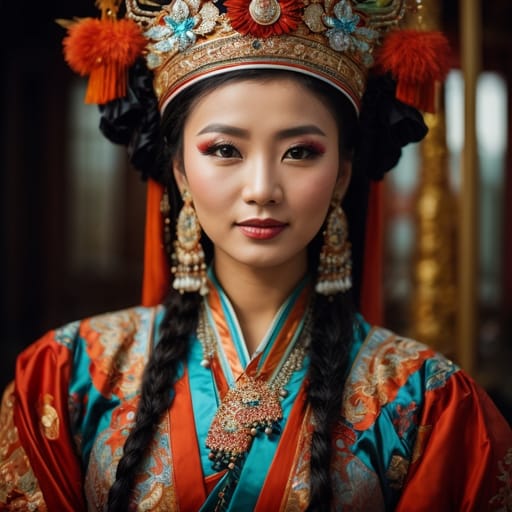
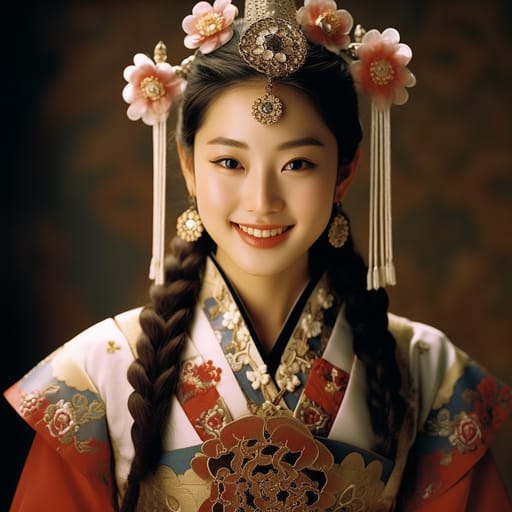
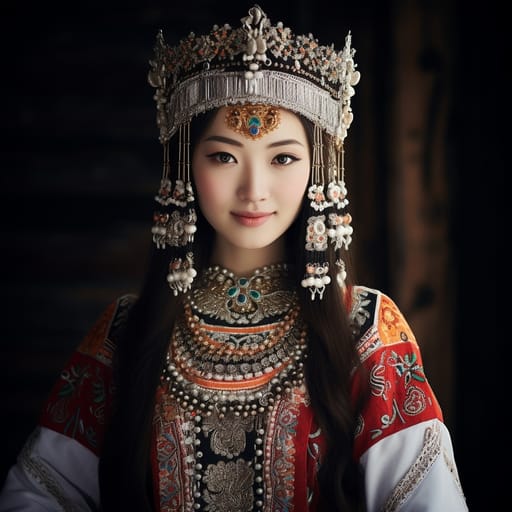
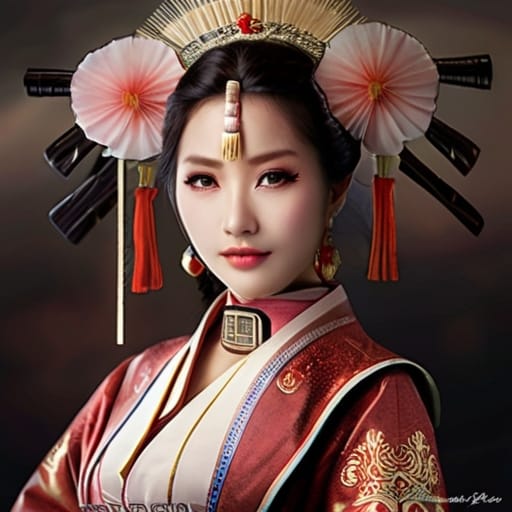
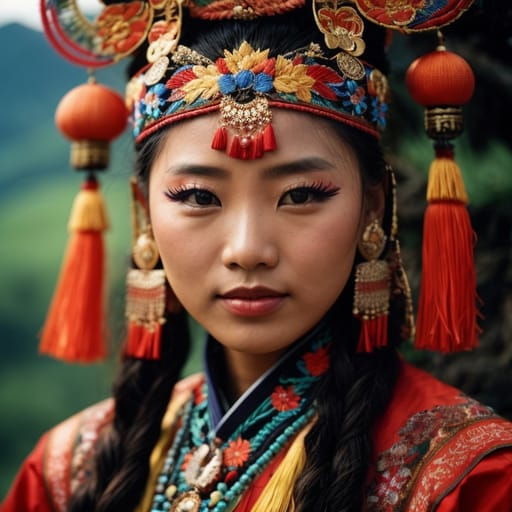
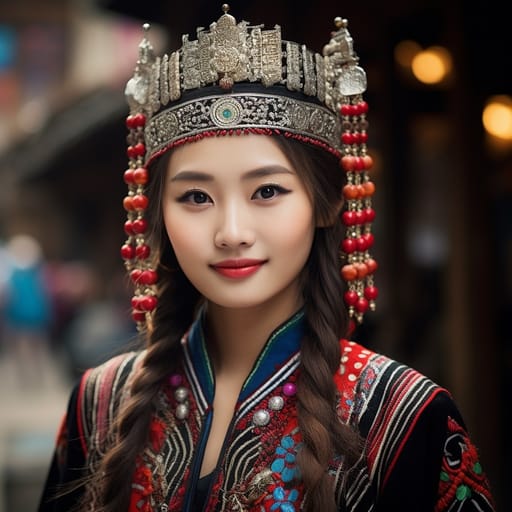
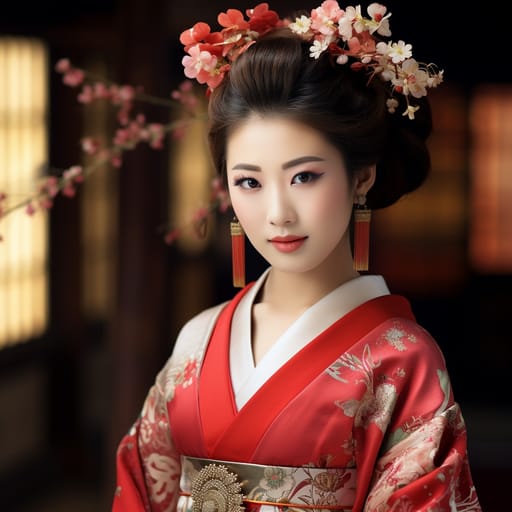
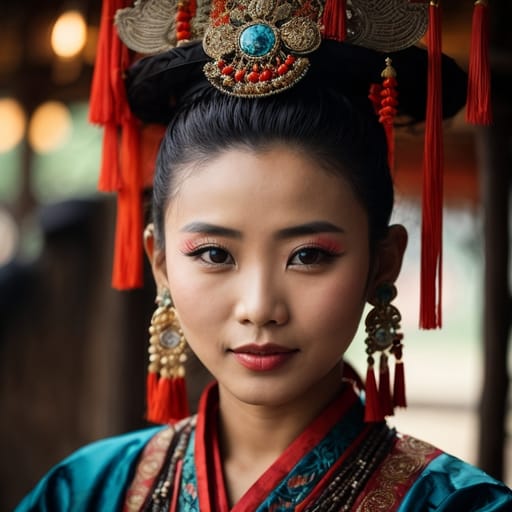
Geographic Distribution: Manchu populations across 1 country
Each row is ranked by the group's share of that country's population, with the source citation drawn from published census and demographic surveys. Click through for the full per-country phenotype profile.
| Country | Share | Source |
|---|---|---|
| China | 0.7% | China 2020 Census, self-identified Manchu (~10.4M); the historical ruling ethnic group of the Qing Dynasty (1644-1912), now concentrated in Liaoning, Hebei, Heilongjiang, Jilin, and Beijing. The Manchu language is critically endangered with only a few hundred fluent speakers, but ethnic self-identification has remained strong |
Typical Manchu Phenotypes
Reference for AI generation: hair, eyes, skin, facial structure, build
The Manchu phenotype reads as a recognizable variant of Northeast Asian morphology, distinct from Han Chinese in ways that were more pronounced before three centuries of intermarriage softened the contrast. The classical Manchu look — still visible in rural Heilongjiang and Jilin populations and preserved in Qing-era portraiture — runs taller, broader-faced, and lighter-skinned than the Han average to the south.
Hair is uniformly black to very dark brown, coarse in texture, and overwhelmingly straight with high density. Premature graying is uncommon. Eye color sits in the dark brown range, occasionally lightening to a warmer russet brown in older individuals. The epicanthic fold is near-universal but tends to be lighter and less pronounced than in southern Han or Korean populations, and the single-lid (monolid) and low-crease double-lid forms are both common. Eye shape is typically elongated and slightly upswept, with a relatively narrow palpebral fissure.
Skin tone is pale — Fitzpatrick II to III — with cool to neutral undertones and a tendency to flush red rather than tan under cold-weather sun exposure. The famously fair complexion of Qing imperial women was not artistic license; it tracks the population baseline.
Facial structure is the most distinctive feature. Manchu faces tend to be broad and flat across the malar plane, with high, wide-set cheekbones and a relatively short midface. The nose is medium in projection with a straight or slightly low bridge and moderate alar width — broader than Korean, narrower than Mongolian. Lips are medium in fullness. Jaws are squared in men, more tapered in women, with a tendency toward a strong mandibular angle.
Build is taller than the Han mean, with documented average heights closer to Northern Mongolian and Korean ranges — historically a horse-and-archery culture, and the skeletal proportions reflect it. Limbs are proportionally long, shoulders broad, and body composition runs lean-muscular in younger adults, with a tendency toward central weight gain with age. Sub-group variation is now driven more by degree of Han admixture than by historical clan lineage, with the most archetypal phenotype concentrated in northeastern rural counties and Xibe-related populations in Xinjiang.
Manchu Body & Anatomy Reference
East Asian Sinitic / Mongoloid phenotype: anatomy reference for AI nude generation
Manchu Boobs & Breasts
Manchu tits and boobs run small-to-medium cup, modest projection, the classic East Asian Sinitic / Mongoloid bust profile. Manchu nipples and areolas show light-pink to medium-brown areolar pigmentation against the light-to-medium skin tone, with areolar diameter typically in the 26-36mm range and forward-set positioning rather than the fuller South Asian or Levantine bust profile. Manchu breasts trend firm and modestly projecting; smaller cup size than the South Asian or Western Asian average, a function of the ectomorph-to-mesomorph, lean frame body habitus and the mean adult female BMI 20-23. For anatomically accurate AI-generated Manchu nudes the render preserves the small-to-medium cup, modest projection shape, 26-36mm areolas with light-pink to medium-brown pigmentation, and the torso proportions of the East Asian Sinitic / Mongoloid phenotype.
Manchu Ass & Hips
Manchu hips and butt usually read as small-to-medium, modest projection, narrower hip profile. The skeletal base is narrower iliac crests, less gluteal-femoral fat deposition, the East Asian Sinitic / Mongoloid pattern. Set against the fuller projected glutes of the West African or Polynesian phenotype, the difference is easy to see, and the hip-to-waist ratio is often what identifies Manchu women in photos.
Manchu Vagina & Pussy
Expect light-pink to medium-brown labial pigmentation, smaller labia minora on Manchu women, in keeping with East Asian Sinitic / Mongoloid ancestry. The pubic hair is straight fine texture, sparser distribution than the South Asian norm. Coloring should run evenly from the light to medium skin of the thighs to the labia, and Manchu nude imagery should keep the hair's straight fine texture.
Manchu Dicks & Penis
Manchu dick and penile anatomy in adult AI generation should anchor on the regional reference data: regional mean ~11-12cm erect, moderate girth, and light-brown shaft pigmentation. The Manchu cock profile reflects the East Asian Sinitic / Mongoloid population's anthropometric measurements. The shaft pigmentation should track the surrounding light to medium skin tone, and the pubic hair should keep its straight fine texture in the typical inverted-V escutcheon.
Manchu Body, Curves & Build
Manchu body type: ectomorph-to-mesomorph, lean frame, with mean adult female BMI 20-23. This is the typical East Asian Sinitic / Mongoloid build. Height range, shoulder-to-hip ratio and fat distribution all follow from it, which is what an accurate Manchu nude body should show.
Manchu Skin Tone & Hair Texture
Manchu skin tone falls in the light to medium (Fitzpatrick II-IV) band, the surface signal most often miscalibrated by generic AI nude generators. Manchu hair texture is typically straight 1A, fine-to-medium, predominantly black, characteristic of the East Asian Sinitic / Mongoloid phenotype. In Manchu nude renders the skin should hold that band consistently across the body.
Data depth
0/100Coverage of image-grounded phenotype observations · drives AI generation diversity
- Sample size
- 0/40· 0 images
- Image quality
- 0/30· 0% high
- Confidence
- 0/20
- Source diversity
- 0/10
- ·No image observations yet
Explore phenotype categories
Structured taxonomy with peer-reviewed scales · 22 anatomical categories
Erotic Poses & Sex Positions
From the pose catalog: 219 named positions with reference skeletons
Frequently asked questions about Manchu people
Where is the Manchu homeland?
The Manchu homeland is Manchuria in East Asia.
What countries do Manchu people live in?
Manchu populations are documented across 1 country: China.
What language do Manchu people speak?
Manchu people primarily speak Tungusic / Manchu[.
What religion do Manchu people practice?
The predominant religion among Manchu people is Shamanism.






Make your own Manchu images
Five a day, free, no credits to buy. The studio starts from this group's phenotype data, so you can set body type, pose and style and keep the traits accurate.
Start with Manchu