Help us get this right
Does this portrait look right for Sibe?
Nobody has judged this one yet. You would be the first.
Sibe Erotic
About Sibe People
The Sibe are a Tungusic people split, by an act of imperial bookkeeping, into two populations that no longer quite recognize each other. The eastern Sibe live where they always have — in Liaoning and Jilin, the old Manchurian heartland — long since absorbed into the surrounding Han and Manchu world, speaking Mandarin and keeping their identity mostly on paper. The western Sibe live four thousand kilometers away in the Ili valley of Xinjiang, descendants of about a thousand soldiers and their families dispatched in 1764 by the Qianlong Emperor to garrison the empire's new frontier. They were told the posting would last sixty years. They never came back, and it is among them that the Sibe language and the older textures of the culture have actually survived.
The language belongs to the Tungusic family and is closely related to Manchu — close enough that for much of the twentieth century Sibe scribes in Xinjiang were the only fluent readers left of the Qing imperial archives, and Beijing flew them in to work through the documents. Sibe is still written in a slightly modified Manchu script, one of the few living uses of that writing system anywhere. Among the western Sibe it remains a household language; among the eastern population it is functionally gone.
Religion sits in layers. Shamanism is the older substrate — clan shamans, drum rituals, the long apprenticeship in which a candidate climbs a ladder of knives — and it persisted through the Qing centuries alongside an overlay of Tibetan Buddhism and ancestor veneration absorbed from Manchu court practice. The shamanic tradition was badly damaged in the twentieth century but has been partially reconstructed from manuscripts and surviving practitioners, and clan-level rites still mark births, illness, and the dead. The major communal festival is Xifanjie, the eighteenth day of the fourth lunar month, which commemorates the 1764 westward march; it is observed at both ends of the diaspora, but with very different weight. In Xinjiang it is a living holiday with archery, wrestling, and a fermented flour dish called buda; in the east it tends to be a memorial gesture. Archery in particular has stayed close to Sibe self-image — the western communities produced a disproportionate share of China's competitive archers through the late twentieth century, a direct line from the garrison's military origins to the present.
Related ethnic groups
Groups that share Sibe's homeland, region, language, or religious tradition. These are likely candidates for comparative phenotype reference.
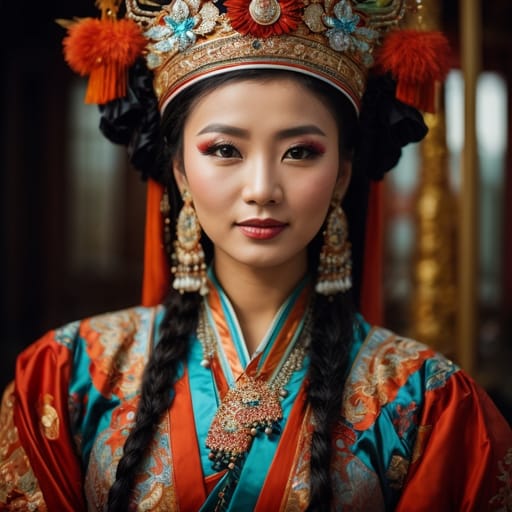
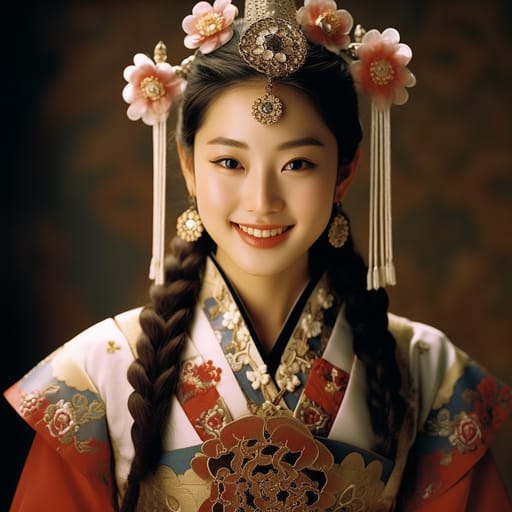
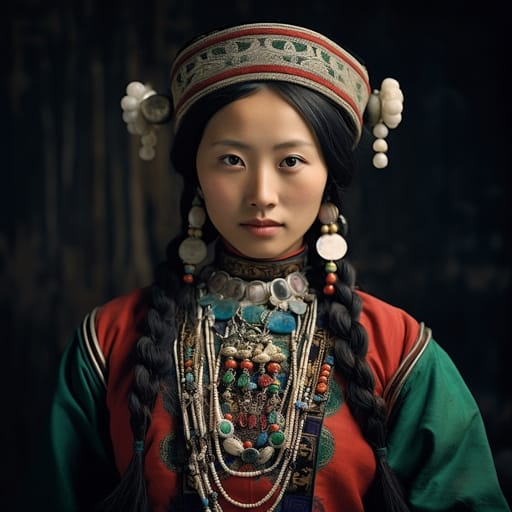
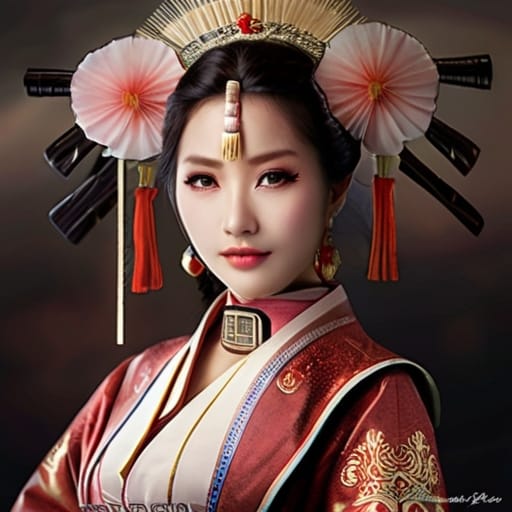
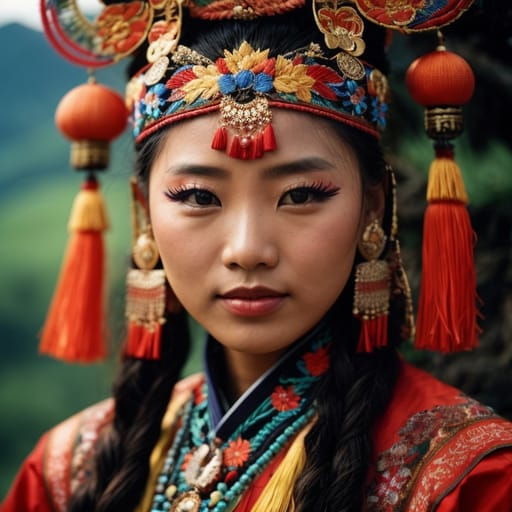
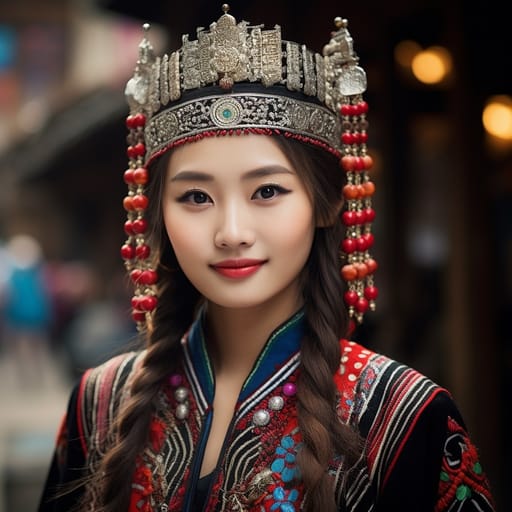
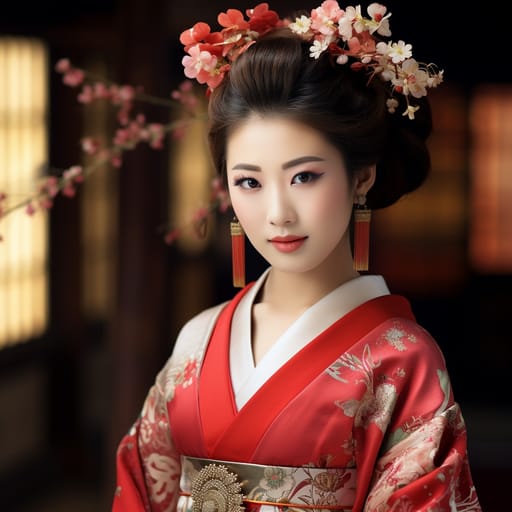
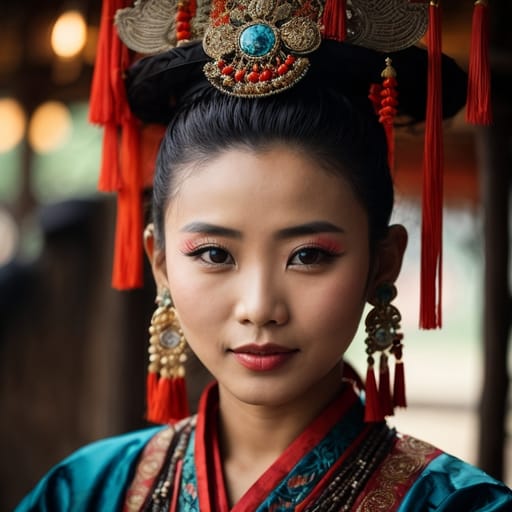
Typical Sibe Phenotypes
Reference for AI generation: hair, eyes, skin, facial structure, build
The Sibe (Xibe) are a small Tungusic people split between two homelands — the original Manchurian core in Liaoning and Jilin, and the Ili Valley garrison communities in Xinjiang descended from 18th-century military relocations. Phenotype sits squarely within the Northeast Asian range, with hair almost uniformly straight and coarse, jet to dark brown-black, very rarely lightening to soft brown in childhood before darkening. Body hair is sparse; facial hair on men is light and slow-developing, similar to neighboring Manchu and Mongol populations.
Eyes run dark brown to near-black, with a near-universal epicanthic fold and a single-lid (monolid) or low-set crease being more common than a high double fold. The palpebral fissure tends to be narrow and slightly upslanting at the outer canthus. Brows are straight or gently arched, often thin in women and moderately full in men. Skin tones cluster in Fitzpatrick II–III — a pale ivory or warm beige with yellow-to-neutral undertones, capable of tanning to a light olive-brown but rarely reading as dark. Ili Sibe, exposed to higher-altitude steppe sun, often photograph a shade warmer than their Liaoning relatives.
Facial architecture is the most distinctive part of the profile. Cheekbones are wide and high-set, the midface broad, and the lower jaw relatively narrow — producing the diamond or inverted-triangle face seen in actress Tong Liya. Noses are typically medium in length with a low-to-moderate bridge and a softly rounded, modestly wide tip; alar flare is restrained compared with southern Han populations. Lips run medium-thin to medium, with a defined cupid's bow rather than full eversion. Foreheads are smooth and rounded.
Build is lean and long-limbed for an East Asian group, reflecting the Manchurian-steppe ancestry. Average male stature lands around 170–172 cm, female around 158–162 cm, with broader shoulders and longer torsos than southern Chinese norms. Body composition skews slim-muscular in youth, with a tendency toward central weight gain rather than peripheral fullness in middle age.
Sibe Body & Anatomy Reference
East Asian Sinitic / Mongoloid phenotype: anatomy reference for AI nude generation
Sibe Boobs & Breasts
Bust reference for Sibe women: small-to-medium cup, modest projection, which is typical of East Asian Sinitic / Mongoloid ancestry. Areolas measure about 26-36mm across, with light-pink to medium-brown pigmentation. Body type (ectomorph-to-mesomorph, lean frame) shapes the bust as well, so Sibe tits are usually firm and modestly projecting; smaller cup size than the South Asian or Western Asian average. In AI imagery, keep the forward-set shape rather than drifting toward the fuller South Asian or Levantine bust profile.
Sibe Ass & Hips
The Sibe ass is typically small-to-medium, modest projection, narrower hip profile, which sets it apart from the fuller projected glutes of the West African or Polynesian phenotype. Underneath, the pelvis shows narrower iliac crests, less gluteal-femoral fat deposition, part of the East Asian Sinitic / Mongoloid skeletal pattern. For Sibe butt pics and AI renders, match that silhouette and the overall build (ectomorph-to-mesomorph, lean frame).
Sibe Vagina & Pussy
Sibe pussy and vulvar anatomy presents light-pink to medium-brown labial pigmentation, smaller labia minora, consistent with the East Asian Sinitic / Mongoloid phenotype's pigmentation pattern. Sibe pubic hair is typically straight fine texture, sparser distribution than the South Asian norm, in the inverted-triangle pattern. For anatomically accurate Sibe pussy renders the labial coloration should match the surrounding light to medium skin tone with a continuous gradient, and the hair should keep its straight fine texture.
Sibe Dicks & Penis
Sibe dicks follow the East Asian Sinitic / Mongoloid reference data: regional mean ~11-12cm erect; moderate girth; light-brown shaft pigmentation. Shaft color should track the light to medium skin tone with a smooth change toward the glans, and Sibe pubic hair keeps its straight fine texture.
Sibe Body, Curves & Build
Sibe body type and overall build presents as ectomorph-to-mesomorph, lean frame, with mean adult female BMI 20-23: the characteristic East Asian Sinitic / Mongoloid habitus. Sibe curves and proportions should keep the regional skeletal frame (height, shoulder-to-hip ratio, limb proportions) rather than a generic mesomorph default.
Sibe Skin Tone & Hair Texture
Sibe skin sits in the light to medium (Fitzpatrick II-IV) band. Hair is typically straight 1A, fine-to-medium, predominantly black, in keeping with the East Asian Sinitic / Mongoloid phenotype. In nude renders the skin should stay one even tone from face to body, and body, pubic and head hair should match.
Data depth
0/100Coverage of image-grounded phenotype observations · drives AI generation diversity
- Sample size
- 0/40· 0 images
- Image quality
- 0/30· 0% high
- Confidence
- 0/20
- Source diversity
- 0/10
- ·No image observations yet
Explore phenotype categories
Structured taxonomy with peer-reviewed scales · 22 anatomical categories
Erotic Poses & Sex Positions
From the pose catalog: 219 named positions with reference skeletons
Frequently asked questions about Sibe people
Where is the Sibe homeland?
The Sibe homeland is China (Liaoning, Jilin, Xinjiang) in East Asia.
What language do Sibe people speak?
Sibe people primarily speak Tungusic / Xibe.
What religion do Sibe people practice?
The predominant religion among Sibe people is Shamanism.






Make your own Sibe images
Five a day, free, no credits to buy. The studio starts from this group's phenotype data, so you can set body type, pose and style and keep the traits accurate.
Start with Sibe