Help us get this right
Does this portrait look right for Kaxabu?
Nobody has judged this one yet. You would be the first.
Kaxabu Erotic
The Puli Basin, Nantou County, central Taiwan, with ancestral lands on the Taichung plain
Kaxabu (Austronesian, Formosan branch; closely related to Pazeh and often classed as a dialect of it), with Mandarin and Taiwanese Hokkien in daily use
Presbyterian Christianity and Taiwanese folk religion, alongside household rites for ancestors
One of Taiwan's plains indigenous peoples, the Pingpu; closely tied to the Pazeh
About Kaxabu People
The Kaxabu are a plains people of central Taiwan who spent most of the twentieth century officially not existing. Taiwan's lowland indigenous groups, collectively the Pingpu, were the first to meet Han settlement, the first to lose land to it, and the first to be written off by administrators as fully assimilated. The Kaxabu kept their name, their kin networks and their ceremonies through all of it, in a cluster of villages around Puli in Nantou County. That basin is not their first home. Their ancestors farmed the Taichung plain to the northwest and moved inland in the 1820s and 1830s, when settler pressure and a run of land disputes made staying untenable, joining other plains groups in a coordinated migration into the hills. The Puli Basin, ringed by mountains near the geographic center of the island, has been Kaxabu ground ever since.
Their language is Austronesian, of the Formosan branch that makes Taiwan the likely origin point of the entire family, and it sits very close to Pazeh: close enough that linguists have argued for decades over whether Kaxabu is a separate language or a dialect, and close enough that the Kaxabu themselves insist on the distinction. Either way it is barely spoken. The last fluent speaker of Pazeh died in 2010, and what survives is held in wordlists, in elders' partial memory, and above all in song. The ai-yan ballads, named for the vocable that anchors every verse, carry genealogy and old place names in lines singers can still reproduce even where the grammar has gone. Ritual life runs on the same logic of retrieval. The year turns on a harvest gathering built around a long foot race for the young men and a night of linked-hands circle singing, reconstructed and re-argued at least as much as inherited. Religion is layered rather than singular: Presbyterian congregations, which did much of the early documentary work on the language, Taiwanese folk temples down the road from them, and household observances for ancestors that predate both. Recognition has come locally and in pieces, at the county level, while the plains peoples as a whole keep pressing the central government for a legal status that would confirm on paper what their neighbors in Puli have never doubted.
Related ethnic groups
Groups that share Kaxabu's homeland, region, language, or religious tradition. These are likely candidates for comparative phenotype reference.

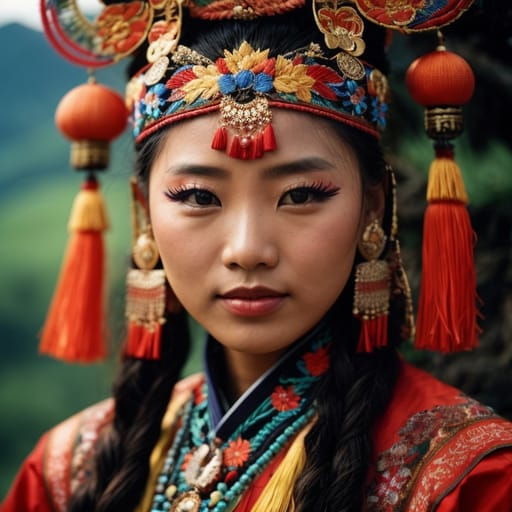
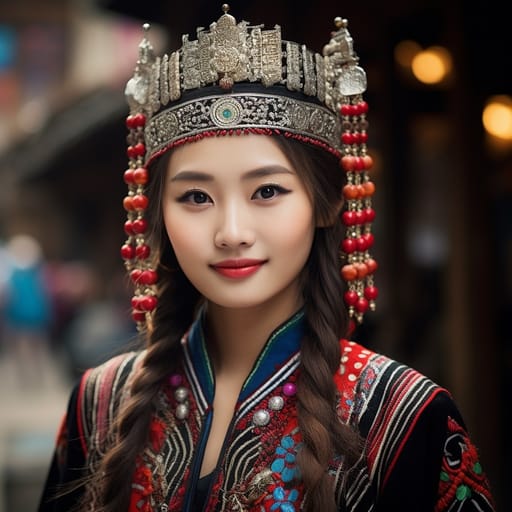

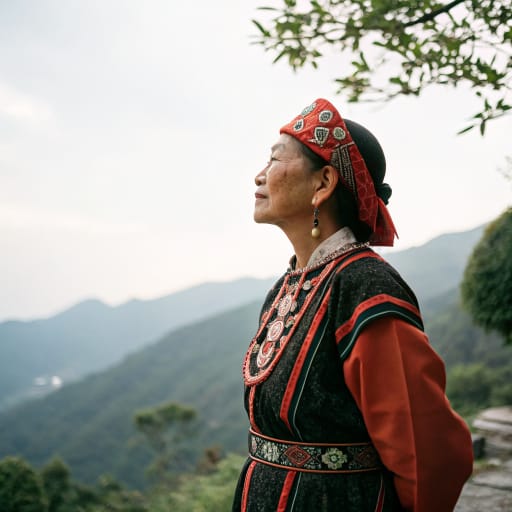

Typical Kaxabu Phenotypes
Reference for AI generation: hair, eyes, skin, facial structure, build
Kaxabu Body & Anatomy Reference
East Asian Sinitic / Mongoloid phenotype: anatomy reference for AI nude generation
Kaxabu Boobs & Breasts
Kaxabu tits and boobs run small-to-medium cup, modest projection, the classic East Asian Sinitic / Mongoloid bust profile. Kaxabu nipples and areolas show light-pink to medium-brown areolar pigmentation against the light-to-medium skin tone, with areolar diameter typically in the 26-36mm range and forward-set positioning rather than the fuller South Asian or Levantine bust profile. Kaxabu breasts trend firm and modestly projecting; smaller cup size than the South Asian or Western Asian average, a function of the ectomorph-to-mesomorph, lean frame body habitus and the mean adult female BMI 20-23. For anatomically accurate AI-generated Kaxabu nudes the render preserves the small-to-medium cup, modest projection shape, 26-36mm areolas with light-pink to medium-brown pigmentation, and the torso proportions of the East Asian Sinitic / Mongoloid phenotype.
Kaxabu Ass & Hips
Kaxabu hips and butt usually read as small-to-medium, modest projection, narrower hip profile. The skeletal base is narrower iliac crests, less gluteal-femoral fat deposition, the East Asian Sinitic / Mongoloid pattern. Set against the fuller projected glutes of the West African or Polynesian phenotype, the difference is easy to see, and the hip-to-waist ratio is often what identifies Kaxabu women in photos.
Kaxabu Vagina & Pussy
Expect light-pink to medium-brown labial pigmentation, smaller labia minora on Kaxabu women, in keeping with East Asian Sinitic / Mongoloid ancestry. The pubic hair is straight fine texture, sparser distribution than the South Asian norm. Coloring should run evenly from the light to medium skin of the thighs to the labia, and Kaxabu nude imagery should keep the hair's straight fine texture.
Kaxabu Dicks & Penis
Kaxabu dick and penile anatomy in adult AI generation should anchor on the regional reference data: regional mean ~11-12cm erect, moderate girth, and light-brown shaft pigmentation. The Kaxabu cock profile reflects the East Asian Sinitic / Mongoloid population's anthropometric measurements. The shaft pigmentation should track the surrounding light to medium skin tone, and the pubic hair should keep its straight fine texture in the typical inverted-V escutcheon.
Kaxabu Body, Curves & Build
Kaxabu body type: ectomorph-to-mesomorph, lean frame, with mean adult female BMI 20-23. This is the typical East Asian Sinitic / Mongoloid build. Height range, shoulder-to-hip ratio and fat distribution all follow from it, which is what an accurate Kaxabu nude body should show.
Kaxabu Skin Tone & Hair Texture
Kaxabu skin tone falls in the light to medium (Fitzpatrick II-IV) band, the surface signal most often miscalibrated by generic AI nude generators. Kaxabu hair texture is typically straight 1A, fine-to-medium, predominantly black, characteristic of the East Asian Sinitic / Mongoloid phenotype. In Kaxabu nude renders the skin should hold that band consistently across the body.
Explore phenotype categories
Structured taxonomy with peer-reviewed scales · 22 anatomical categories
Erotic Poses & Sex Positions
From the pose catalog: 219 named positions with reference skeletons
Frequently asked questions about Kaxabu people
Where is the Kaxabu homeland?
The Kaxabu homeland is The Puli Basin, Nantou County, central Taiwan, with ancestral lands on the Taichung plain in East Asia.
What language do Kaxabu people speak?
Kaxabu people primarily speak Kaxabu (Austronesian, Formosan branch; closely related to Pazeh and often classed as a dialect of it), with Mandarin and Taiwanese Hokkien in daily use.
What religion do Kaxabu people practice?
The predominant religion among Kaxabu people is Presbyterian Christianity and Taiwanese folk religion, alongside household rites for ancestors.






Make your own Kaxabu images
Five a day, free, no credits to buy. The studio starts from this group's phenotype data, so you can set body type, pose and style and keep the traits accurate.
Start with Kaxabu