Help us get this right
Does this portrait look right for Japanese?
One tap. It takes a second and it is recorded.
1 says it looks right, 0 say it looks off.
Japanese Erotic
Japonic / Japanese
Shinto, Buddhism
Kantō, Kansai, Hokkaido, Tōhoku, Hōnichi, Satsugū, Chūgoku, Echigo, Tōkai, Shinshuu, Hokuriku, Hachijō, along with significant populations in Brazil, the United States and the Philippines.
About Japanese People
The Japanese are the people of an archipelago that runs the length of Korea down to the latitude of North Africa — a country that is mostly mountain, with the population pressed into a thin coastal lowland that holds nearly everyone. That geography did most of the early work: enough isolation from the Asian mainland to develop distinctly, enough contact through Korea and China to absorb writing, Buddhism, and bureaucratic statecraft, and a long internal frontier to the north that wasn't fully settled until the nineteenth century. The result is a population that reads as homogeneous from outside but contains real internal seams — the Tōhoku north with its harder winters and older speech, the Kansai axis around Kyoto and Osaka with its merchant rhythm and its own intonation, the Kantō plain centered on Tokyo, and the southern Kyushu varieties (Hōnichi, Satsugū) that sit far enough from standard Japanese to be mutually difficult. Hachijō, on a remote Pacific island, preserves features old enough that some linguists treat it as a separate Japonic language altogether.
Japanese is a Japonic language with no settled extra-family relatives — proposals linking it to Korean or to the Altaic grouping have not held up — and its written form layers three scripts: kanji borrowed from Chinese, plus the two native syllabaries, hiragana and katakana, used in parallel for grammar, foreign words, and emphasis. Religious life is famously double-tracked. Most people are nominally both Shinto and Buddhist without contradiction: shrines for births, the new year, and weddings; temples for funerals and the ancestral dead. Practice tends to be ritual and seasonal rather than confessional, and a large share of the population describes itself as non-religious while still observing both calendars.
The historical inflection points are sharper than the placid surface suggests. The Tokugawa shogunate's two and a half centuries of near-closure ended abruptly with the Meiji Restoration in 1868, which compressed industrialization and a constitution into a single generation. Defeat in 1945 ended an empire and produced the postwar reconstruction that made Japan an economic power, then a demographic cautionary tale: the country is aging faster than any peer, and rural depopulation is reshaping prefectures that mattered for centuries. Outside Japan, the largest Japanese-descended communities are in Brazil — the result of an early-twentieth-century labor migration to São Paulo's coffee zones — followed by the United States and the Philippines, with each diaspora carrying a slightly different slice of the home culture frozen at the moment of departure.
Related ethnic groups
Groups that share Japanese's homeland, region, language, or religious tradition. These are likely candidates for comparative phenotype reference.
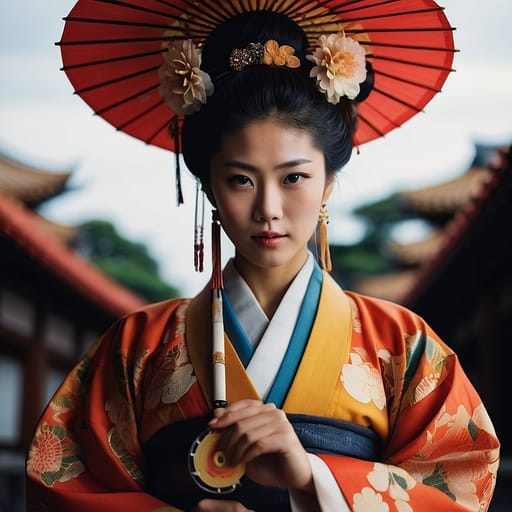
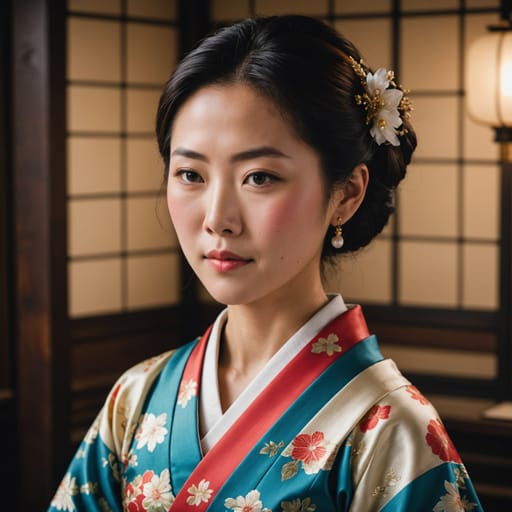
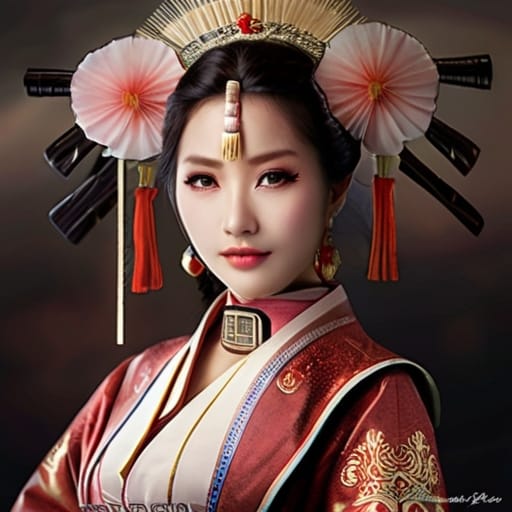
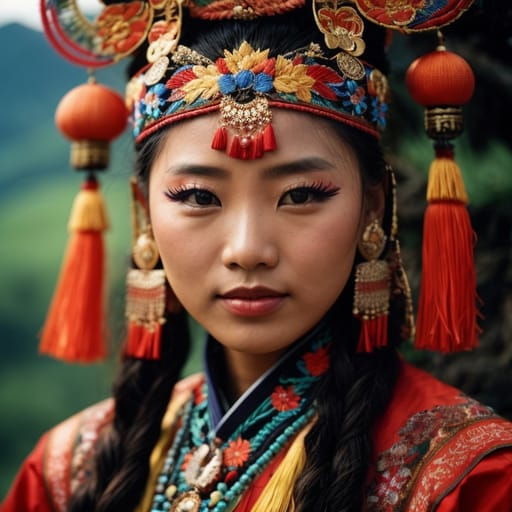
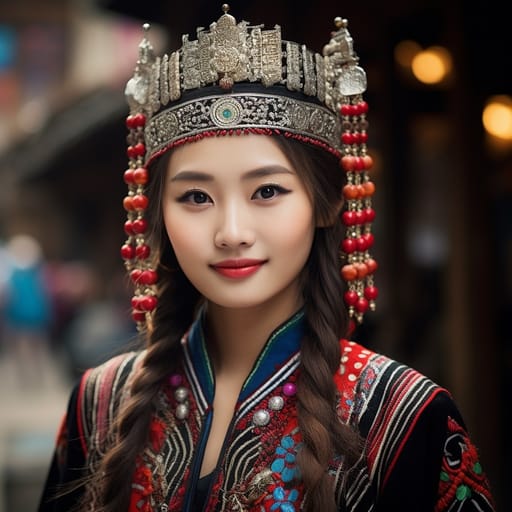
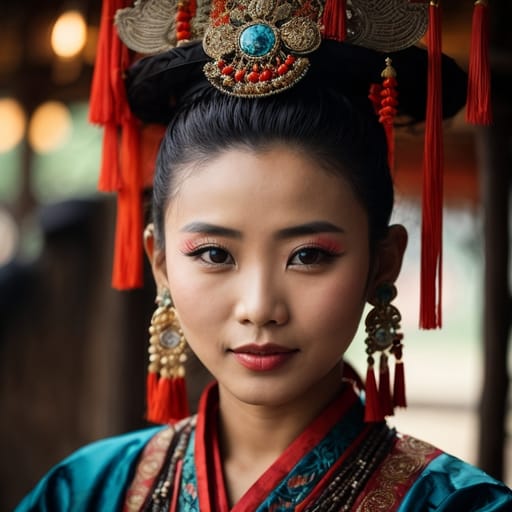
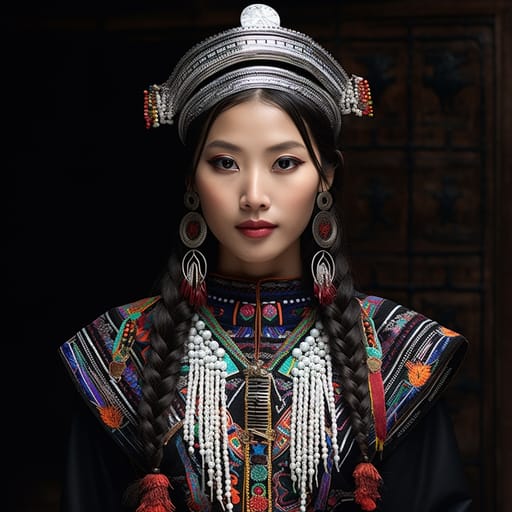
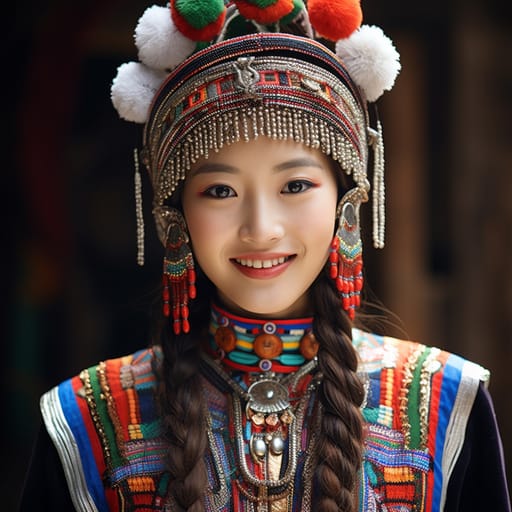
Typical Japanese Phenotypes
Reference for AI generation: hair, eyes, skin, facial structure, build
Japanese phenotype sits within the broader East Asian range but carries its own structural signature — generally finer-boned facial architecture than continental Northeast Asian groups, with a higher incidence of softer jawlines and less pronounced malar projection than Korean or Northern Han populations. Hair is overwhelmingly straight to lightly wavy, jet-black to very dark brown, medium in diameter and high in density; natural lightening to brown tones occurs but true light hair is essentially absent without dye. A meaningful minority — particularly in Tōhoku and Hokkaido, where Jōmon-derived ancestry runs higher — show slightly wavier hair texture and somewhat heavier facial and body hair than the Yayoi-dominant Kantō and Kansai average.
Eyes are dark brown, occasionally near-black, with the epicanthic fold near-universal though often less pronounced than in Han Chinese or Mongolian populations. The single eyelid (tanken) is common but the double eyelid (futae) appears in roughly 30–50% of the population depending on region, with higher rates in southern and Jōmon-influenced areas. Eye shape tends almond, slightly upturned at the outer corner.
Skin spans Fitzpatrick II–IV, generally fair with cool to neutral undertones — the porcelain pallor associated with the cultural ideal exists naturally in a sizeable share of women, especially in northern regions, while Satsugū and Okinawan-adjacent southern Kyūshū populations tend warmer, more olive, and tan more readily. Noses are typically narrow with a low-to-medium bridge and modest alar width; lips run medium-thin to medium, with less eversion than Southeast Asian averages.
Build is among the slighter in East Asia — average male stature around 171 cm, female around 158 cm, with a tendency toward narrow shoulders, short-to-medium torso length, and lower body fat at comparable BMI than Western populations. The Jōmon–Yayoi cline is the single most useful axis for understanding Japanese phenotype variation: northern and southern peripheries (Tōhoku, Hokkaido, Kyūshū) carry more robust features, deeper-set eyes, and heavier brows, while the Kantō–Kansai core skews toward the gracile, oval-faced, fine-featured archetype most often shorthanded as "Japanese."
Japanese Body & Anatomy Reference
East Asian Sinitic / Mongoloid phenotype: anatomy reference for AI nude generation
Japanese Boobs & Breasts
The typical Japanese bust is small-to-medium cup, modest projection, in line with the wider East Asian Sinitic / Mongoloid pattern. Areolas usually fall in the 26-36mm range, with light-pink to medium-brown areolar pigmentation against the light-to-medium skin tone. Compared with the fuller South Asian or Levantine bust profile, Japanese breasts sit forward and are generally firm and modestly projecting; smaller cup size than the South Asian or Western Asian average. A faithful AI render of Japanese tits keeps that shape and areola size.
Japanese Ass & Hips
Butt shape among Japanese women: small-to-medium, modest projection, narrower hip profile, over narrower iliac crests, less gluteal-femoral fat deposition. This follows East Asian Sinitic / Mongoloid ancestry and looks quite unlike the fuller projected glutes of the West African or Polynesian phenotype. An accurate Japanese ass in adult AI imagery keeps both the silhouette and the overall build (ectomorph-to-mesomorph, lean frame) instead of a generic average.
Japanese Vagina & Pussy
Vulvar anatomy among Japanese women: light-pink to medium-brown labial pigmentation, smaller labia minora. Pubic hair tends to be straight fine texture, sparser distribution than the South Asian norm, in the usual inverted-triangle pattern. Both follow East Asian Sinitic / Mongoloid pigmentation, which is why Japanese pussy renders should not fall back on a pale, sparse Western template.
Japanese Dicks & Penis
The Japanese cock profile, from East Asian Sinitic / Mongoloid anthropometric data: regional mean ~11-12cm erect; moderate girth; light-brown shaft pigmentation. Pubic hair has a straight fine texture and forms the usual inverted-V pattern. Whether Japanese men are circumcised follows religious and cultural practice rather than phenotype.
Japanese Body, Curves & Build
Build and curves among Japanese women follow the East Asian Sinitic / Mongoloid pattern: ectomorph-to-mesomorph, lean frame, mean adult female BMI 20-23. Proportions matter as much as skin tone, so Japanese figures should keep their regional height and limb ratios.
Japanese Skin Tone & Hair Texture
The Japanese skin range is light to medium (Fitzpatrick II-IV), and hair tends to be straight 1A, fine-to-medium, predominantly black. That combination marks the East Asian Sinitic / Mongoloid phenotype, and skin tone is the trait AI generators most often get wrong for Japanese women.
Data depth
49/100Coverage of image-grounded phenotype observations · drives AI generation diversity
- Sample size
- 40/40· 57 images
- Image quality
- 4/30· 7% high
- Confidence
- 5/20· mean 0.42
- Source diversity
- 0/10· wikipedia
- ·Low overall confidence
- ·Mostly low-quality source images
- ·Wikipedia-only source, not population-representative
Observed Distribution: Image Sample
Empirical observations from analyzed photographs · supplementary signal, not population truth
Sample: 57 images analyzed (57 wikipedia). Quality: 4 high, 31 medium, 19 low, 3 very_low. Avg analyzer confidence: 0.42.
Skin tone (Fitzpatrick): I (2%), II (9%), III (37%), IV (18%), V (2%), unclear (33%)
Hair color: black (68%), gray/white (14%), other (5%), unclear (12%)
Hair texture: straight (46%), wavy (2%), curly (4%), coily (2%), bald (7%), shaved (5%), covered (32%), unclear (4%)
Eye color: dark brown (56%), unclear (44%)
Epicanthic fold: 81% present, 5% absent, 14% unclear
Caveats: Quality skews toward older or low-resolution photos; phenotype detail may be lossy. Low average analyzer confidence: many photos partially obscured or historical. Sample is 100% Wikipedia notable people, which skews toward male, public-life, and modern figures, not population-representative.
Last aggregated: May 7, 2026
Explore phenotype categories
Structured taxonomy with peer-reviewed scales · 22 anatomical categories
- SkinFitzpatrick I to VI, undertone, pigmentation
- EyesColor, shape, eyelid, epicanthic fold
- Head hairColor, Andre Walker texture, hairline
- Body shapeHeath-Carter somatotype, WHR, frame
- NoseBridge, tip, nostril, alar width
- Lips & mouthVolume, Cupid’s bow, philtrum
Measured in Japanese portraits
Notable Japanese People
70 reference figures, sourced from Wikipedia
- Kobo Abe, author of The Woman in the Dunes
- Matsuo Basho, author of The Narrow Road to the Deep North
- Osamu Dazai, author of No Longer Human
- Yasunari Kawabata, winner of the Nobel Prize in Literature
- Kenzaburo Oe, winner of the Nobel Prize in Literature
- Murasaki Shikibu, author of The Tale of Genji
- Sei Shonagon, author of The Pillow Book
- Natsume Soseki, author of Kokoro
- Kenko Yoshida, author of Essays in Idleness
- Yoshisuke Aikawa, 1880-1967), founder of Nissan
- Takeo Fujisawa, 1910-1988), co-founder of the automobile manufacturer Honda
- Hirotoshi Honda, founder of Mugen Motorsports
- Konosuke Matsushita, founder of Panasonic
- Hiroshi Mikitani, founder of Rakuten
- Mitsui Takatoshi, 1622-1694), founder of Mitsui
- Mikimoto Kokichi, 1858-1954), founder of Mikimoto
- Soichiro Honda, 1906-1991), co-founder of the automobile manufacturer Honda
- Jujiro Matsuda, 1875-1952), founder of Mazda automobile company
- Michio Suzuki, 1887-1982), founder of Suzuki
- Eiji Toyoda, 1913-2013), founder of luxury automobile manufacturer Lexus
- Kiichiro Toyoda, 1894-1952), founder of automobile manufacturer Toyota in 1937
- Sakichi Toyoda, 1867-1930), founder of Toyota Industries and Toyota Group
- Adams, William, foreign born)
- Amago Yoshihisa, See also Amago clan
- Date Masamune, See also Date clan
- Fujiwara no Hidesato, Tawara no Tōda)
- Ryūzōji Takanobu, See also Ryūzōji clan
- Minamoto no Yoriie, r. 1202-1203
- Minamoto no Sanetomo, r. 1203-1219
- Kujō Yoritsune, r. 1226-1244
- Kujō Yoritsugu, r. 1244-1252
- Prince Munetaka, r. 1252-1266
- Prince Koreyasu, r. 1266-1289
- Prince Hisaakira, r. 1289-1308
- Prince Morikuni, r. 1308-1333
- Prince Morinaga, r.1333-1334
- Prince Norinaga, r. 1334-1338
- Hōjō Tokimasa, r. 1203-1205
- Hōjō Yoshitoki, r. 1205-1224
- Hōjō Yasutoki, r. 1224-1242
- Hōjō Tsunetoki, r. 1242-1246
- Hōjō Tokiyori, r. 1246-1256
- Hōjō Tokimune, r. 1268-1284
- Hōjō Sadatoki, r. 1284-1301
- Hōjō Morotoki, r. 1301-1311
- Hōjō Takatoki, r. 1316-1326
- Ashikaga Takauji, ruled 1338-1358
- Ashikaga Yoshiakira, r. 1359-1368
- Ashikaga Yoshimitsu, r. 1368-1394
- Ashikaga Yoshimochi, r. 1395-1423
- Ashikaga Yoshikazu, r. 1423-1425
- Ashikaga Yoshinori, r. 1429-1441
- Ashikaga Yoshikatsu, r. 1442-1443
- Ashikaga Yoshimasa, r. 1449-1473
- Ashikaga Yoshihisa, r. 1474-1489
- Ashikaga Yoshitane, r. 1490-1493, 1508-1521
- Ashikaga Yoshizumi, r. 1494-1508
- Ashikaga Yoshiharu, r. 1521-1546
- Ashikaga Yoshiteru, r. 1546-1565
- Ashikaga Yoshiaki, r. 1568-1573
- Tokugawa Mitsukuni, of the Mito domain
- Tokugawa Nariaki, of the Mito domain
- Tokugawa Mochiharu, of the Hitotsubashi branch
- Tokugawa Munetake, of the Tayasu branch.
- Matsudaira Katamori, of the Aizu branch.
- Matsudaira Sadanobu, born into the Tayasu branch, adopted into the Hisamatsu-Matsudaira of Shirakawa.
- Kuroki Itei, Kuroki Tamemoto)
- Airi Ōtsu, organic farmer
- Hisao Taoka, engineer
- Masashi Usami, engineer
Erotic Poses & Sex Positions
From the pose catalog: 219 named positions with reference skeletons
Frequently asked questions about Japanese people
Where is the Japanese homeland?
The Japanese homeland is Japan in East Asia.
What language do Japanese people speak?
Japanese people primarily speak Japonic / Japanese.
What religion do Japanese people practice?
The predominant religion among Japanese people is Shinto, Buddhism.






Make your own Japanese images
Five a day, free, no credits to buy. The studio starts from this group's phenotype data, so you can set body type, pose and style and keep the traits accurate.
Start with Japanese