Help us get this right
Does this portrait look right for Koreans?
One tap. It takes a second and it is recorded.
0 say it looks right, 1 says it looks off.
Koreans Erotic
Also known as: Korean
Korea (North Korea, South Korea)
Korean
Shamanism
Jeju Islanders, along with significant populations in the United States, China, Russia, Japan, Canada, Australia, Vietnam, and the Philippines
About Koreans People
Koreans are an East Asian people whose identity is unusually tightly bound to a single peninsula and a single language — a coherence that's striking when you set it next to the patchwork ethnic maps of most of the continent. Roughly seventy-five million people speak Korean as a first language, and the overwhelming majority of them trace their families to the peninsula itself, with sizable diasporas in China's northeast, Central Asia (the Koryo-saram, deported there by Stalin in 1937), Japan, and the Americas. The peninsula sits between China and the Japanese archipelago, and Korean history is in large part the story of staying recognizably Korean while absorbing pressure from both directions.
The Korean language is a genuine puzzle for linguists. It's usually treated as a language isolate, sometimes grouped tentatively with Japanese under a contested Japonic-Koreanic frame, but the comparative evidence is thin and the matter is unsettled. What's clear is that Korean is structurally unlike Chinese — it's agglutinative, verb-final, and built on an elaborate honorific system that encodes the relationship between speaker and listener into nearly every sentence. Hangul, the alphabet commissioned by King Sejong in the fifteenth century, was designed deliberately to fit the language's phonology, and its spread broke a long monopoly of literacy held by the classical-Chinese-reading elite.
Religiously, Koreans are pluralistic in a way the headline numbers don't capture. Christianity (mostly Protestant, with a large Catholic minority) and Buddhism are the two formal traditions with the largest followings, while a significant share of the population reports no religious affiliation. Underneath all of this runs Muism — Korean shamanism — which has never really gone away. The mudang, usually a woman, performs gut rituals to mediate between the living and the dead, to mark family transitions, or to settle a household's bad luck. Confucian ethics, meanwhile, are not practiced as a religion but saturate everyday life: ancestor rites, the weight given to seniority, the architecture of family obligation.
The Jeju Islanders are the clearest internal distinction within the group — an island people off the southern coast with their own dialect (often mutually unintelligible with standard Korean), a matrifocal social tradition, and the famous haenyeo, the women free-divers who still harvest shellfish into old age. The twentieth-century split of the peninsula into two states is the other inflection point that shapes Korean identity now: a single people, one language, two political worlds that have grown increasingly unlike each other.
Related ethnic groups
Groups that share Koreans's homeland, region, language, or religious tradition. These are likely candidates for comparative phenotype reference.
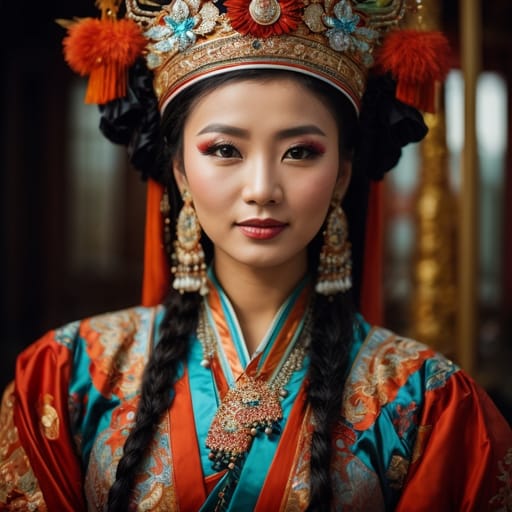
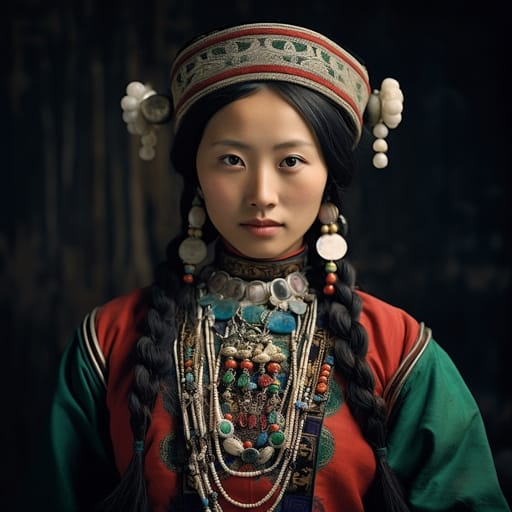
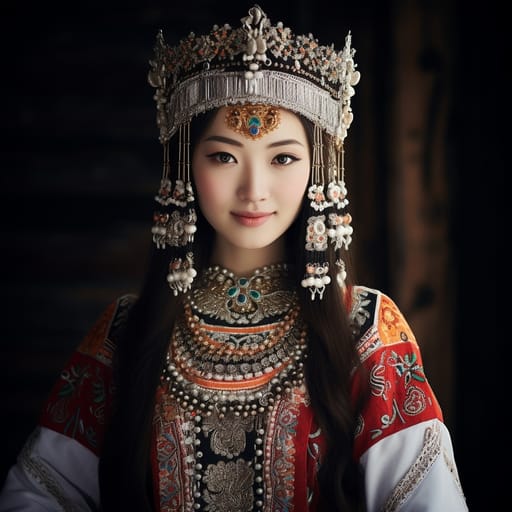
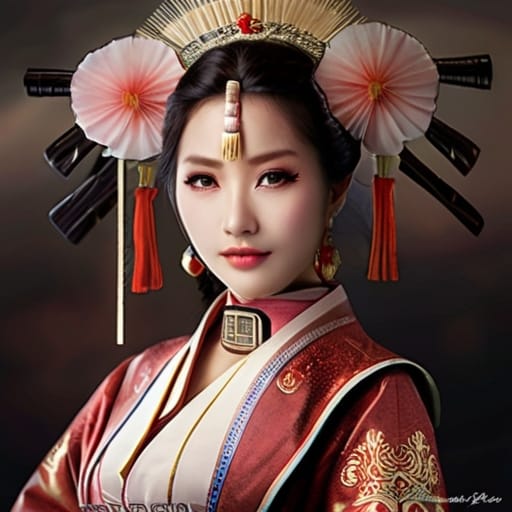
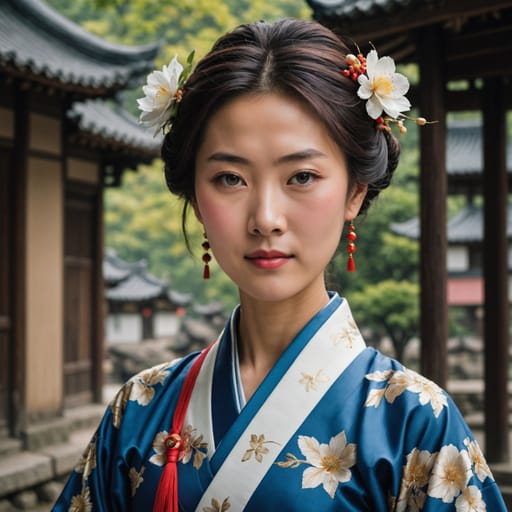
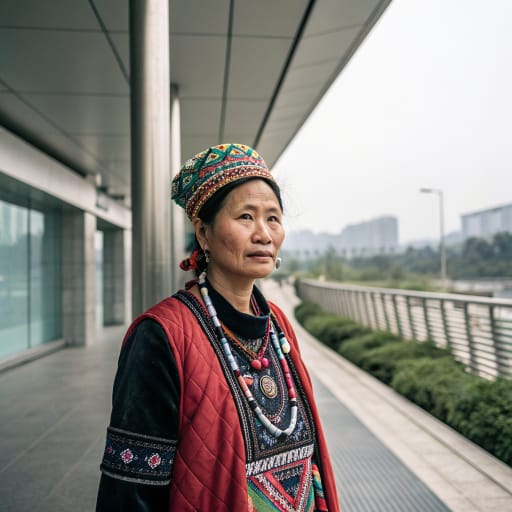
Typical Koreans Phenotypes
Reference for AI generation: hair, eyes, skin, facial structure, build
Koreans show one of the most phenotypically consistent profiles in East Asia, the result of a relatively narrow founder population and limited historical admixture compared to neighboring Chinese and Japanese groups. Hair is near-universally straight, coarse-shafted, and very dark — true black to deep brown-black, with the soft natural lightening that some Japanese populations show being uncommon here. Texture runs thick and dense; gentle wave appears in a minority but tight curl is essentially absent. Premature graying is somewhat more common than in Han Chinese populations.
Eyes carry a near-universal epicanthic fold, often more pronounced than in southern Han Chinese, giving the characteristic smooth upper-lid line that Korean cosmetic culture has built an entire surgical industry around. Iris color is uniformly dark brown, frequently dark enough to read as black at distance. The palpebral fissure tends to be narrower and more horizontal than in Japanese or Mongolian neighbors, with a single eyelid (no visible crease) appearing in roughly half the population.
Skin tone clusters tightly in Fitzpatrick III with a cool, slightly pink or neutral undertone — noticeably lighter and pinker on average than southern Chinese or Southeast Asian groups, and a key marketing pillar of the K-beauty industry. Olive and sallow undertones are uncommon. Strong sun exposure tans the skin to a warm IV but rarely deeper.
Facial structure is the most distinctive Korean signature: a broad, relatively flat midface with prominent zygomatic (cheekbone) breadth, a wider and more square mandible than Japanese or Han populations, and a nose with a low-to-medium bridge and moderate alar width. Lips are medium in fullness, often with a defined cupid's bow. Stature has shifted dramatically — modern South Korean men average around 174 cm, women 161 cm, among the tallest in East Asia and a full 15+ cm taller than the same population a century ago. Builds tend toward lean with low body-fat distribution.
Jeju Islanders show subtly darker, warmer skin and slightly broader facial features, reflecting older southern coastal lineages distinct from the mainland Korean type.
Koreans Body & Anatomy Reference
East Asian Sinitic / Mongoloid phenotype: anatomy reference for AI nude generation
Koreans Boobs & Breasts
The typical Koreans bust is small-to-medium cup, modest projection, in line with the wider East Asian Sinitic / Mongoloid pattern. Areolas usually fall in the 26-36mm range, with light-pink to medium-brown areolar pigmentation against the light-to-medium skin tone. Compared with the fuller South Asian or Levantine bust profile, Koreans breasts sit forward and are generally firm and modestly projecting; smaller cup size than the South Asian or Western Asian average. A faithful AI render of Koreans tits keeps that shape and areola size.
Koreans Ass & Hips
Butt shape among Koreans women: small-to-medium, modest projection, narrower hip profile, over narrower iliac crests, less gluteal-femoral fat deposition. This follows East Asian Sinitic / Mongoloid ancestry and looks quite unlike the fuller projected glutes of the West African or Polynesian phenotype. An accurate Koreans ass in adult AI imagery keeps both the silhouette and the overall build (ectomorph-to-mesomorph, lean frame) instead of a generic average.
Koreans Vagina & Pussy
Vulvar anatomy among Koreans women: light-pink to medium-brown labial pigmentation, smaller labia minora. Pubic hair tends to be straight fine texture, sparser distribution than the South Asian norm, in the usual inverted-triangle pattern. Both follow East Asian Sinitic / Mongoloid pigmentation, which is why Koreans pussy renders should not fall back on a pale, sparse Western template.
Koreans Dicks & Penis
The Koreans cock profile, from East Asian Sinitic / Mongoloid anthropometric data: regional mean ~11-12cm erect; moderate girth; light-brown shaft pigmentation. Pubic hair has a straight fine texture and forms the usual inverted-V pattern. Whether Koreans men are circumcised follows religious and cultural practice rather than phenotype.
Koreans Body, Curves & Build
Build and curves among Koreans women follow the East Asian Sinitic / Mongoloid pattern: ectomorph-to-mesomorph, lean frame, mean adult female BMI 20-23. Proportions matter as much as skin tone, so Koreans figures should keep their regional height and limb ratios.
Koreans Skin Tone & Hair Texture
The Koreans skin range is light to medium (Fitzpatrick II-IV), and hair tends to be straight 1A, fine-to-medium, predominantly black. That combination marks the East Asian Sinitic / Mongoloid phenotype, and skin tone is the trait AI generators most often get wrong for Koreans women.
Data depth
0/100Coverage of image-grounded phenotype observations · drives AI generation diversity
- Sample size
- 0/40· 0 images
- Image quality
- 0/30· 0% high
- Confidence
- 0/20
- Source diversity
- 0/10
- ·No image observations yet
Explore phenotype categories
Structured taxonomy with peer-reviewed scales · 22 anatomical categories
Erotic Poses & Sex Positions
From the pose catalog: 219 named positions with reference skeletons
Frequently asked questions about Koreans people
Where is the Koreans homeland?
The Koreans homeland is Korea (North Korea, South Korea) in East Asia.
What language do Koreans people speak?
Koreans people primarily speak Korean.
What religion do Koreans people practice?
The predominant religion among Koreans people is Shamanism.
What are other names for Koreans people?
Koreans people are also known as Korean.






Make your own Koreans images
Five a day, free, no credits to buy. The studio starts from this group's phenotype data, so you can set body type, pose and style and keep the traits accurate.
Start with Koreans