Help us get this right
Does this portrait look right for Bonan people (Bao'an)?
One tap. It takes a second and it is recorded.
0 say it looks right, 1 says it looks off.
Bonan people (Bao'an) Erotic
Jishishan County, Gansu (and Tongren, Qinghai), China
Bonan / Bao'an (Mongolic)
Sunni Islam (majority); a Tibetan Buddhist minority in Qinghai
About Bonan people (Bao'an) People
The Bonan, also written Bao'an or Baoan, are a small Mongolic-speaking people of the Gansu and Qinghai borderlands in China, one of the country's officially recognized ethnic groups, numbering roughly twenty thousand. Most live in Jishishan County of Gansu near the Yellow River, having migrated there from the Tongren region of Qinghai. Their language, Bonan, belongs to the Mongolic family and is heavily influenced by Chinese, Tibetan and Amdo neighbors; it is largely unwritten, and many Bonan also speak Chinese.
Society and subsistence
The Bonan are farmers and herders of the plateau margins who also have a strong craft tradition, and are especially famous for making finely worked knives and daggers, the Bonan knife being a celebrated product of their metalworking that has been listed as national intangible cultural heritage. Bonan tradition traces their origin to a garrison at Bao'an near Tongren, from which most migrated to the Gansu side of the border in the nineteenth century after local conflict, and the knives are made above all around the Dahejia area. Most Bonan are Sunni Muslims, and Islam is central to community life in Gansu, while a smaller, related Tibetan Buddhist population around Tongren in Qinghai is officially classified as Monguor rather than Bonan, reflecting the group's mixed origins. Patrilineal families, village mosques and craft workshops organize social and economic life.
Appearance and adornment
Bonan people show mixed Mongolic, Tibetan and Central Asian features, generally with dark hair, brown eyes and moderately broad faces of medium build. Among the Muslim majority, dress follows the custom of the Chinese northwest: white or black brimless caps and long coats for men, and headscarves with modest long dresses for women. Women's festival dress may add embroidered trim and silver ornaments. Craftsmen are often depicted with their distinctive ornamented knives, whose inlaid handles and patterned blades are a mark of Bonan skill.
Related ethnic groups
Groups that share Bonan people (Bao'an)'s homeland, region, language, or religious tradition. These are likely candidates for comparative phenotype reference.

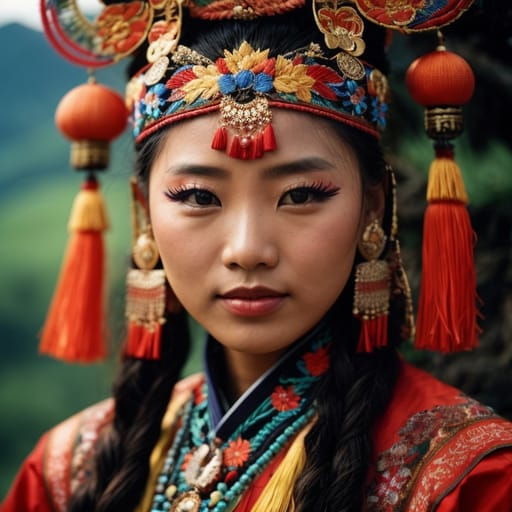
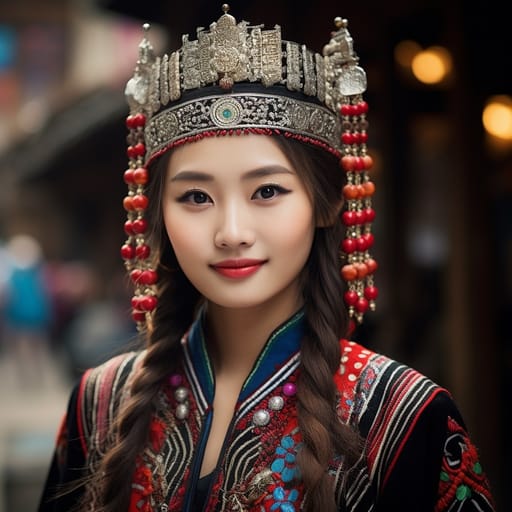
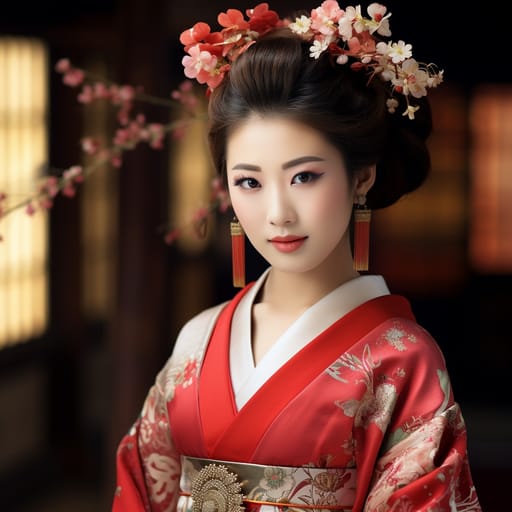
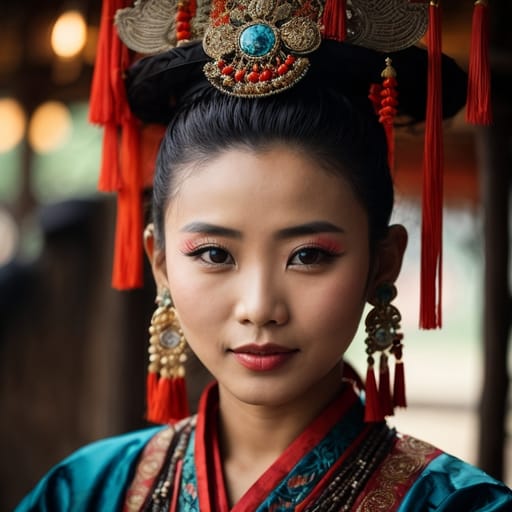
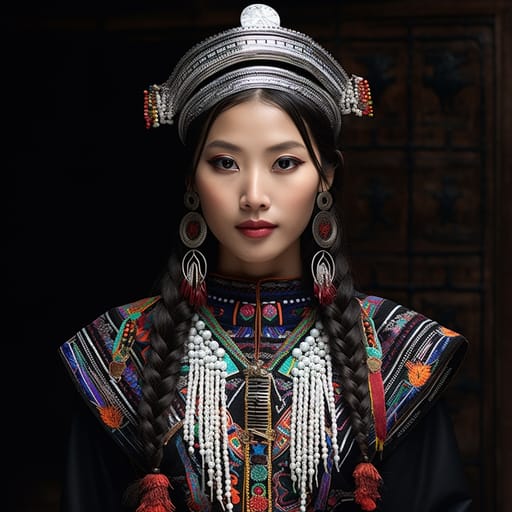
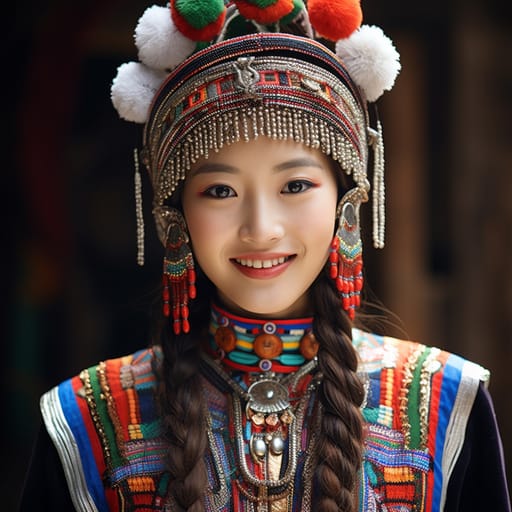
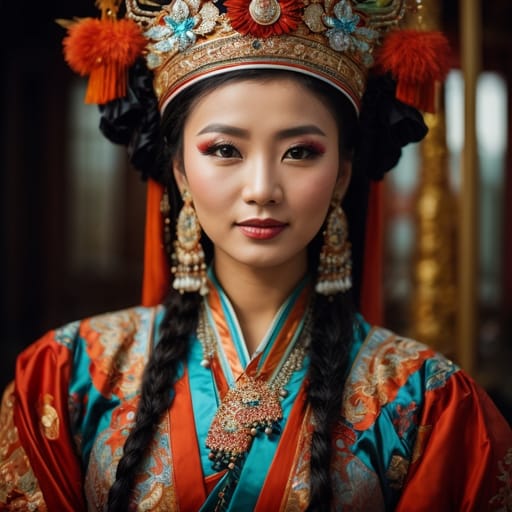
Typical Bonan people (Bao'an) Phenotypes
Reference for AI generation: hair, eyes, skin, facial structure, build
Bonan people (Bao'an) Body & Anatomy Reference
East Asian Sinitic / Mongoloid phenotype: anatomy reference for AI nude generation
Bonan people (Bao'an) Boobs & Breasts
Bonan people (Bao'an) boobs follow the East Asian Sinitic / Mongoloid profile: small-to-medium cup, modest projection. Areolar diameter is usually 26-36mm, and the coloring is light-pink to medium-brown areolar pigmentation against the light-to-medium skin tone. Breast shape tracks body composition (ectomorph-to-mesomorph, lean frame, mean adult female BMI 20-23), so Bonan people (Bao'an) breasts tend to be firm and modestly projecting; smaller cup size than the South Asian or Western Asian average. Expect a forward-set shape, not the fuller South Asian or Levantine bust profile.
Bonan people (Bao'an) Ass & Hips
Bonan people (Bao'an) ass and hip morphology presents as small-to-medium, modest projection, narrower hip profile, distinctly different from the fuller projected glutes of the West African or Polynesian phenotype. The Bonan people (Bao'an) pelvic profile shows narrower iliac crests, less gluteal-femoral fat deposition, anchored in the East Asian Sinitic / Mongoloid skeletal pattern. Bonan people (Bao'an) butt shots in adult AI imagery should render the small-to-medium, modest projection, narrower hip profile silhouette with the overall build (ectomorph-to-mesomorph, lean frame) and the fat distribution typical of the East Asian Sinitic / Mongoloid phenotype.
Bonan people (Bao'an) Vagina & Pussy
Bonan people (Bao'an) pussy anatomy typically shows light-pink to medium-brown labial pigmentation, smaller labia minora. Pubic hair is usually straight fine texture, sparser distribution than the South Asian norm. In AI-generated Bonan people (Bao'an) nudes, labial color should blend into the light to medium skin with a gradual transition, and the hair should keep its straight fine texture.
Bonan people (Bao'an) Dicks & Penis
Penis reference for Bonan people (Bao'an) men: regional mean ~11-12cm erect, moderate girth. Coloring: light-brown shaft pigmentation. An accurate Bonan people (Bao'an) cock in AI imagery matches the surrounding light to medium skin rather than a generic porn default. Circumcision depends on religion and custom, not ancestry.
Bonan people (Bao'an) Body, Curves & Build
The Bonan people (Bao'an) figure is generally ectomorph-to-mesomorph, lean frame, with mean adult female BMI 20-23, characteristic of East Asian Sinitic / Mongoloid ancestry. AI image tools tend to flatten regional body types into a few stock shapes; here the Bonan people (Bao'an) build is kept as its own reference.
Bonan people (Bao'an) Skin Tone & Hair Texture
Skin: light to medium (Fitzpatrick II-IV). Hair: straight 1A, fine-to-medium, predominantly black. Both are typical of East Asian Sinitic / Mongoloid ancestry. The most common mistake in AI nudes of Bonan people (Bao'an) women is a body rendered lighter than the face.
Explore phenotype categories
Structured taxonomy with peer-reviewed scales · 22 anatomical categories
Erotic Poses & Sex Positions
From the pose catalog: 219 named positions with reference skeletons
Frequently asked questions about Bonan people (Bao'an) people
Where is the Bonan people (Bao'an) homeland?
The Bonan people (Bao'an) homeland is Jishishan County, Gansu (and Tongren, Qinghai), China in East Asia.
What language do Bonan people (Bao'an) people speak?
Bonan people (Bao'an) people primarily speak Bonan / Bao'an (Mongolic).
What religion do Bonan people (Bao'an) people practice?
The predominant religion among Bonan people (Bao'an) people is Sunni Islam (majority); a Tibetan Buddhist minority in Qinghai.






Make your own Bonan people (Bao'an) images
Five a day, free, no credits to buy. The studio starts from this group's phenotype data, so you can set body type, pose and style and keep the traits accurate.
Start with Bonan people (Bao'an)