No portrait yet
Bunun Erotic
The Central Mountain Range and eastern foothills of Taiwan, chiefly Nantou, Hualien, Kaohsiung and Taitung counties.
Predominantly Christian, Presbyterian and Roman Catholic, layered over a traditional belief system centered on hanitu spirits.
Five dialect-based divisions: Isbukun, Takbanuaz, Takivatan, Takitudu and Takibakha, with the Takipulan branch extinct. One of Taiwan's officially recognized indigenous peoples.
About Bunun People
The Bunun call themselves exactly that: bunun is simply their word for person. They are Taiwan's mountain people, the group that lived highest and moved farthest. While most of the island's indigenous peoples held valleys and coastal plains, the Bunun built scattered hamlets above 1,000 meters in the Central Mountain Range, and through the eighteenth and nineteenth centuries they kept pushing south and east until their territory covered parts of what are now Nantou, Hualien, Kaohsiung and Taitung counties. The expansion was less conquest than steady drift, a few households at a time following hunting ground and workable slope. It made them the most widely spread of Taiwan's indigenous groups and left five surviving dialects, Isbukun the largest.
Their language is Austronesian, and that matters more than it sounds. Taiwan is the homeland of the entire Austronesian family, the root from which Malay, Tagalog, Malagasy and Hawaiian eventually branched, and Bunun sits on one of its oldest and most divergent limbs. Millet, not rice, organized the year. The ritual calendar tracked planting, weeding and harvest, and the Bunun recorded it on painted wooden boards in a pictographic notation, the closest thing to writing developed independently anywhere in indigenous Taiwan. The best known ceremony is pasibutbut, the millet prayer: men stand in a closed circle, begin on a low unison and climb in overlapping microtonal steps toward a chord whose quality is read as a forecast of the harvest. When recordings reached ethnomusicologists in the 1940s, the piece unsettled comfortable assumptions about how polyphony develops. The spring ear-shooting festival, malahtangia, still puts a bow in a boy's hands and a deer's ear on a post.
Bunun society ran on patrilineal clans and the authority of elders rather than hereditary chiefs, part of why the Japanese colonial administration found them so hard to pin down. Fighters under leaders such as Lamatasinsin held out in the southern highlands into the 1930s, longer than anyone else on the island. The answer was forced resettlement downhill, which broke the hamlet pattern and much of the ritual year with it. Christianity, mostly Presbyterian and Roman Catholic, arrived in the decades after and is now close to universal, though absorbed rather than simply substituted: hanitu, the spirit that inhabits people, animals and objects alike, has not left the vocabulary.
Related ethnic groups
Groups that share Bunun's homeland, region, language, or religious tradition. These are likely candidates for comparative phenotype reference.

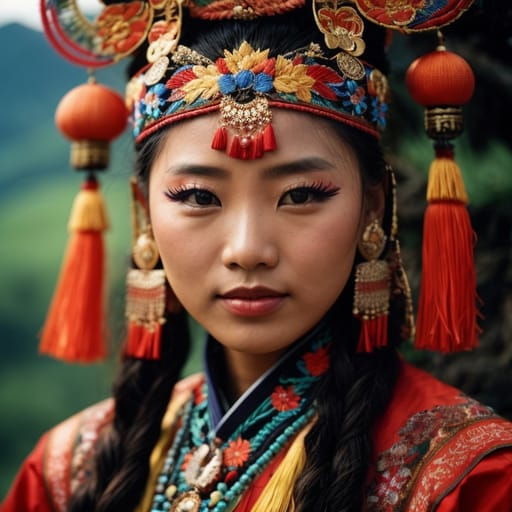
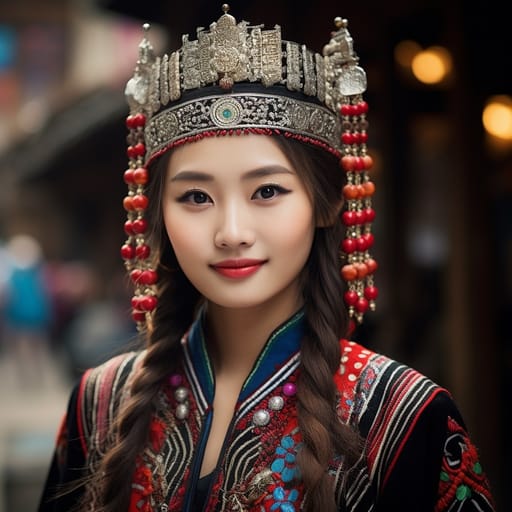

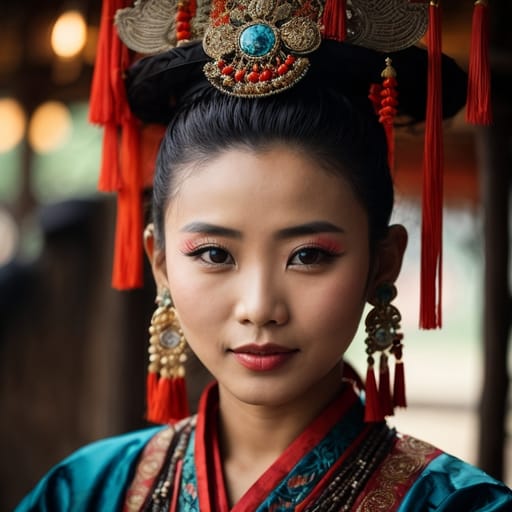
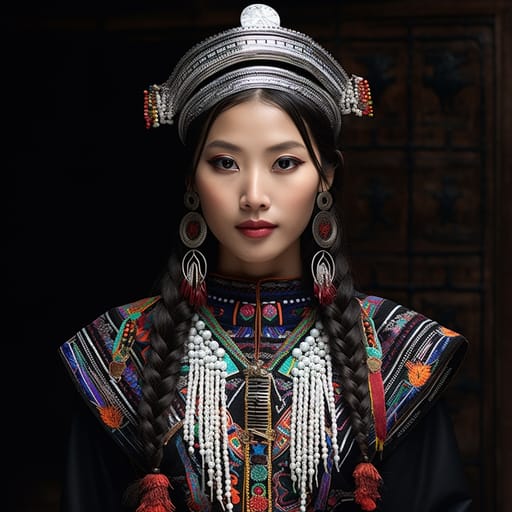
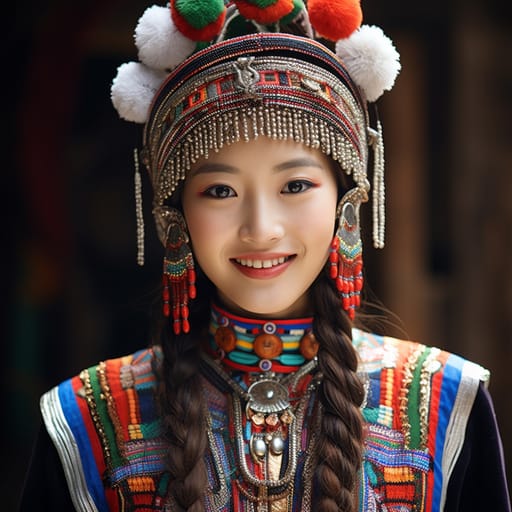
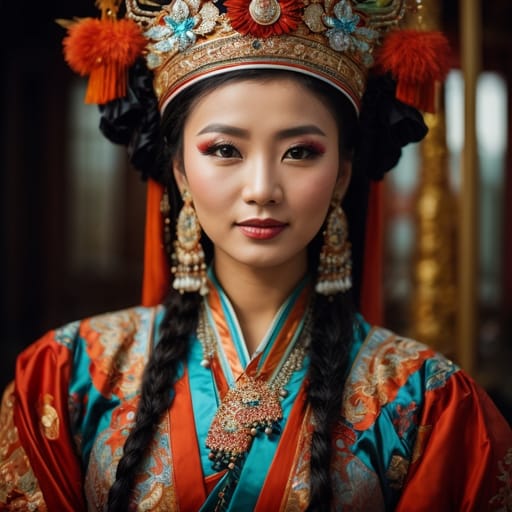
Typical Bunun Phenotypes
Reference for AI generation: hair, eyes, skin, facial structure, build
Bunun Body & Anatomy Reference
Anatomy by feature, East Asian Sinitic / Mongoloid phenotype
Bunun Boobs & Breasts
Bunun boobs follow the East Asian Sinitic / Mongoloid profile: small-to-medium cup, modest projection. Areolar diameter is usually 26-36mm, and the coloring is light-pink to medium-brown areolar pigmentation against the light-to-medium skin tone. Breast shape tracks body composition (ectomorph-to-mesomorph, lean frame, mean adult female BMI 20-23), so Bunun breasts tend to be firm and modestly projecting; smaller cup size than the South Asian or Western Asian average. Expect a forward-set shape, not the fuller South Asian or Levantine bust profile.
Bunun Ass & Hips
Bunun ass and hip morphology presents as small-to-medium, modest projection, narrower hip profile, distinctly different from the fuller projected glutes of the West African or Polynesian phenotype. The Bunun pelvic profile shows narrower iliac crests, less gluteal-femoral fat deposition, anchored in the East Asian Sinitic / Mongoloid skeletal pattern. Bunun butt shots in adult AI imagery should render the small-to-medium, modest projection, narrower hip profile silhouette with the overall build (ectomorph-to-mesomorph, lean frame) and the fat distribution typical of the East Asian Sinitic / Mongoloid phenotype.
Bunun Vagina & Pussy
Bunun pussy anatomy typically shows light-pink to medium-brown labial pigmentation, smaller labia minora. Pubic hair is usually straight fine texture, sparser distribution than the South Asian norm. In AI-generated Bunun nudes, labial color should blend into the light to medium skin with a gradual transition, and the hair should keep its straight fine texture.
Bunun Dicks & Penis
Penis reference for Bunun men: regional mean ~11-12cm erect, moderate girth. Coloring: light-brown shaft pigmentation. An accurate Bunun cock in AI imagery matches the surrounding light to medium skin rather than a generic porn default. Circumcision depends on religion and custom, not ancestry.
Bunun Body, Curves & Build
The Bunun figure is generally ectomorph-to-mesomorph, lean frame, with mean adult female BMI 20-23, characteristic of East Asian Sinitic / Mongoloid ancestry. AI image tools tend to flatten regional body types into a few stock shapes; here the Bunun build is kept as its own reference.
Bunun Skin Tone & Hair Texture
Skin: light to medium (Fitzpatrick II-IV). Hair: straight 1A, fine-to-medium, predominantly black. Both are typical of East Asian Sinitic / Mongoloid ancestry. The most common mistake in AI nudes of Bunun women is a body rendered lighter than the face.
Explore phenotype categories
Structured taxonomy with peer-reviewed scales · 22 anatomical categories
Erotic Poses & Sex Positions
From the pose catalog: 219 named positions with reference skeletons
Frequently asked questions about Bunun people
Where is the Bunun homeland?
The Bunun homeland is The Central Mountain Range and eastern foothills of Taiwan, chiefly Nantou, Hualien, Kaohsiung and Taitung counties. in East Asia.
What language do Bunun people speak?
Bunun people primarily speak Bunun (Austronesian, Formosan branch).
What religion do Bunun people practice?
The predominant religion among Bunun people is Predominantly Christian, Presbyterian and Roman Catholic, layered over a traditional belief system centered on hanitu spirits..






Make your own Bunun images
Five a day, free, no credits to buy. The studio starts from this group's phenotype data, so you can set body type, pose and style and keep the traits accurate.
Start with Bunun