Help us get this right
Does this portrait look right for Mulao?
Nobody has judged this one yet. You would be the first.
Mulao Erotic
Northern Guangxi, China, centered on Luocheng Mulao Autonomous County in Hechi and nearby counties.
Mulam (Kra-Dai, Kam-Sui branch); most speakers also use Zhuang and local Chinese dialects, and Chinese is the written language.
Folk religion centered on ancestor veneration, blended with Taoist ritual and Buddhism.
Kam-Sui peoples of the Kra-Dai family; closely related to the Dong (Kam), Sui and Maonan. Organized into clans that trace descent through the male line.
About Mulao People
The Mulao call themselves Mulam, and the name says a lot about where they stand: mu marks a person, and lam echoes the name the Dong use for themselves. The Dong are the people the Mulao are most closely related to. The 2020 census counted about 277,000 Mulao. Most live in the limestone hills and river valleys of northern Guangxi, and Luocheng Mulao Autonomous County in Hechi is the one place where their name is on the map. They have kept a separate identity in a region where the Zhuang are the large neighbor and Han settlers have been moving in for centuries. Their language, Mulam, belongs to the Kam-Sui branch of the Kra-Dai family. That places it with Dong, Sui and Maonan rather than with the Zhuang spoken next door. Mulam is tonal, has no script of its own and has taken in a great deal of Chinese vocabulary. Most Mulao move easily among Mulam, Zhuang and the local Chinese dialect, and younger people are steadily shifting toward Chinese.
Village life runs on kinship. Descent passes through the male line, and many clans keep written family histories that often trace a founding ancestor to settlers from other provinces who married locally, a pattern found across southern China. Religion is practical rather than doctrinal. Honoring ancestors is at the center, with Taoist ritual and Buddhist elements mixed in rather than kept apart. The clearest example is the Yifan festival, a clan thanksgiving held every few years after the autumn harvest. Families gather to honor their ancestors and the gods believed to keep people, livestock and crops healthy, and the festival is now on China's national list of intangible cultural heritage. Other details are easy to miss from outside. Luocheng sits on coal, and Mulao households burned it long before industrial mining arrived. The traditional home is built at ground level, unlike the stilt houses of the Dong, and is organized around a coal fire pit sunk into the floor that heats the room and cooks the food. Singing matters socially too. For generations, young men and women sang improvised verses back and forth on hillsides during festivals as a main way of courting, and those song exchanges still appear in festival performances today.
Related ethnic groups
Groups that share Mulao's homeland, region, language, or religious tradition. These are likely candidates for comparative phenotype reference.
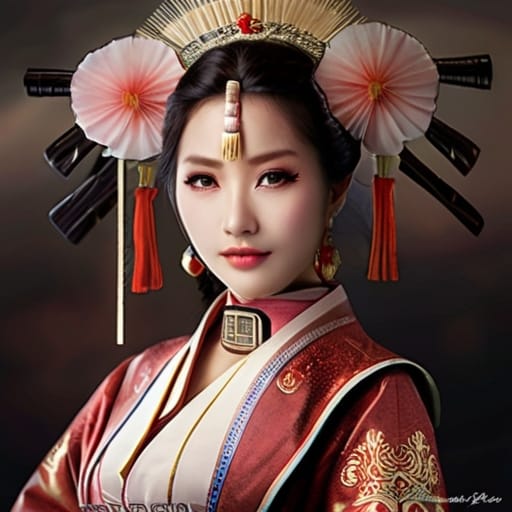
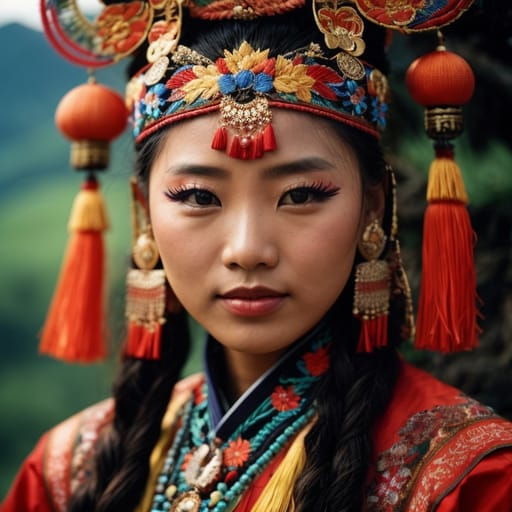
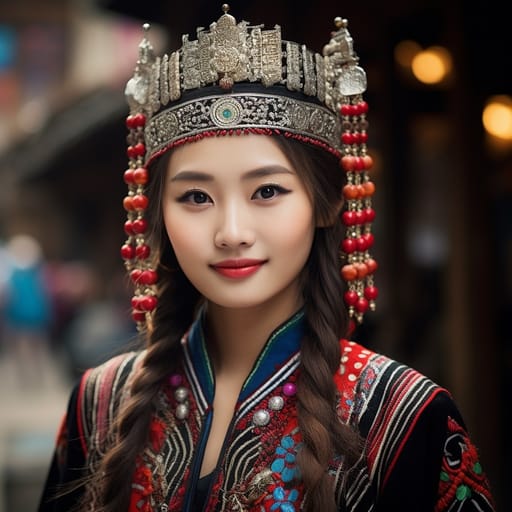
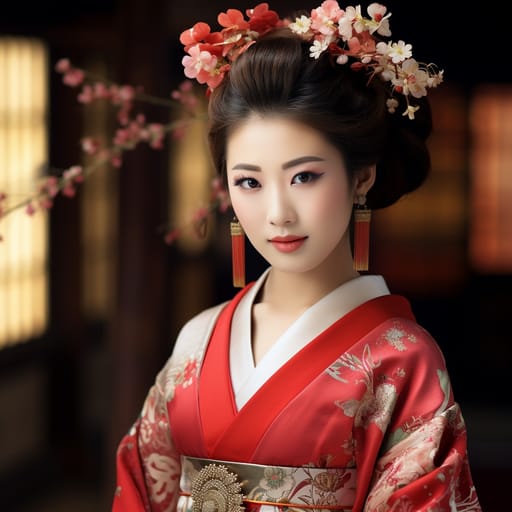
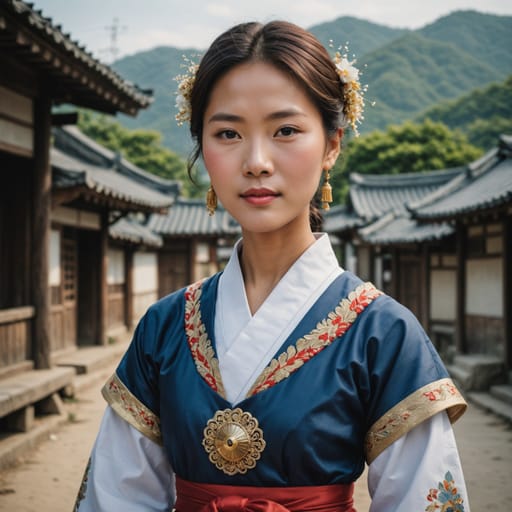
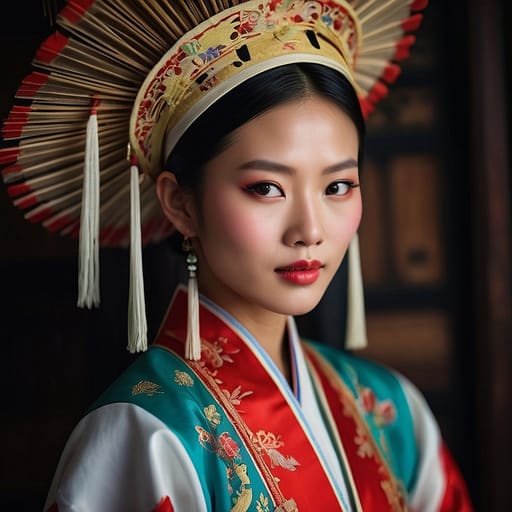
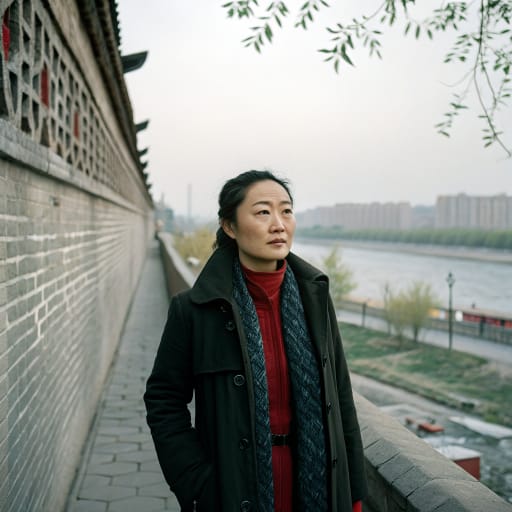
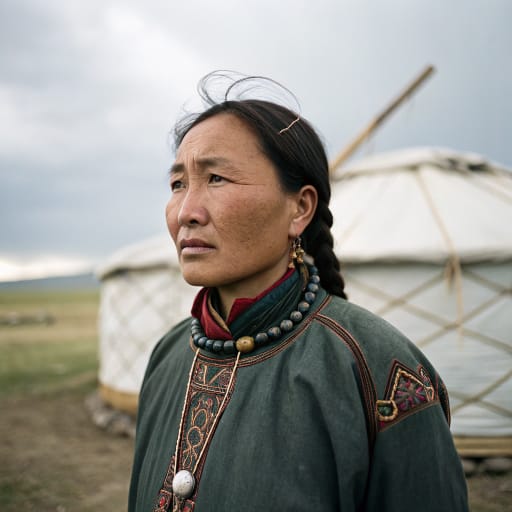
Typical Mulao Phenotypes
Reference for AI generation: hair, eyes, skin, facial structure, build
Mulao Body & Anatomy Reference
Anatomy by feature, East Asian Sinitic / Mongoloid phenotype
Mulao Boobs & Breasts
Mulao boobs follow the East Asian Sinitic / Mongoloid profile: small-to-medium cup, modest projection. Areolar diameter is usually 26-36mm, and the coloring is light-pink to medium-brown areolar pigmentation against the light-to-medium skin tone. Breast shape tracks body composition (ectomorph-to-mesomorph, lean frame, mean adult female BMI 20-23), so Mulao breasts tend to be firm and modestly projecting; smaller cup size than the South Asian or Western Asian average. Expect a forward-set shape, not the fuller South Asian or Levantine bust profile.
Mulao Ass & Hips
Mulao ass and hip morphology presents as small-to-medium, modest projection, narrower hip profile, distinctly different from the fuller projected glutes of the West African or Polynesian phenotype. The Mulao pelvic profile shows narrower iliac crests, less gluteal-femoral fat deposition, anchored in the East Asian Sinitic / Mongoloid skeletal pattern. Mulao butt shots in adult AI imagery should render the small-to-medium, modest projection, narrower hip profile silhouette with the overall build (ectomorph-to-mesomorph, lean frame) and the fat distribution typical of the East Asian Sinitic / Mongoloid phenotype.
Mulao Vagina & Pussy
Mulao pussy anatomy typically shows light-pink to medium-brown labial pigmentation, smaller labia minora. Pubic hair is usually straight fine texture, sparser distribution than the South Asian norm. In AI-generated Mulao nudes, labial color should blend into the light to medium skin with a gradual transition, and the hair should keep its straight fine texture.
Mulao Dicks & Penis
Penis reference for Mulao men: regional mean ~11-12cm erect, moderate girth. Coloring: light-brown shaft pigmentation. An accurate Mulao cock in AI imagery matches the surrounding light to medium skin rather than a generic porn default. Circumcision depends on religion and custom, not ancestry.
Mulao Body, Curves & Build
The Mulao figure is generally ectomorph-to-mesomorph, lean frame, with mean adult female BMI 20-23, characteristic of East Asian Sinitic / Mongoloid ancestry. AI image tools tend to flatten regional body types into a few stock shapes; here the Mulao build is kept as its own reference.
Mulao Skin Tone & Hair Texture
Skin: light to medium (Fitzpatrick II-IV). Hair: straight 1A, fine-to-medium, predominantly black. Both are typical of East Asian Sinitic / Mongoloid ancestry. The most common mistake in AI nudes of Mulao women is a body rendered lighter than the face.
Explore phenotype categories
Structured taxonomy with peer-reviewed scales · 22 anatomical categories
Erotic Poses & Sex Positions
From the pose catalog: 219 named positions with reference skeletons
Frequently asked questions about Mulao people
Where is the Mulao homeland?
The Mulao homeland is Northern Guangxi, China, centered on Luocheng Mulao Autonomous County in Hechi and nearby counties. in East Asia.
What language do Mulao people speak?
Mulao people primarily speak Mulam (Kra-Dai, Kam-Sui branch); most speakers also use Zhuang and local Chinese dialects, and Chinese is the written language..
What religion do Mulao people practice?
The predominant religion among Mulao people is Folk religion centered on ancestor veneration, blended with Taoist ritual and Buddhism..






Make your own Mulao images
Five a day, free, no credits to buy. The studio starts from this group's phenotype data, so you can set body type, pose and style and keep the traits accurate.
Start with Mulao