Help us get this right
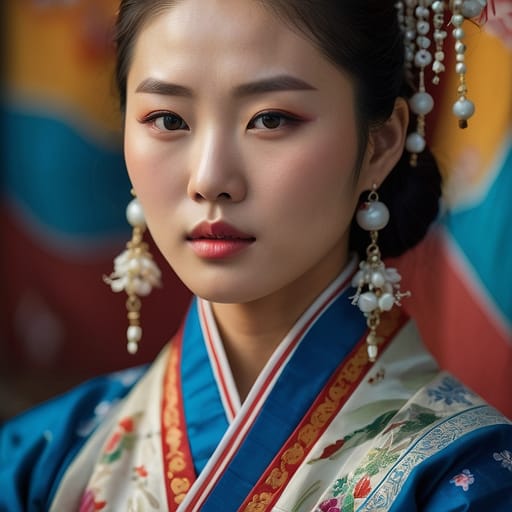
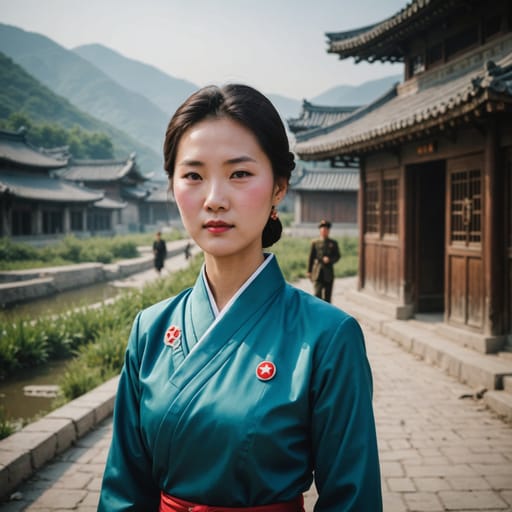
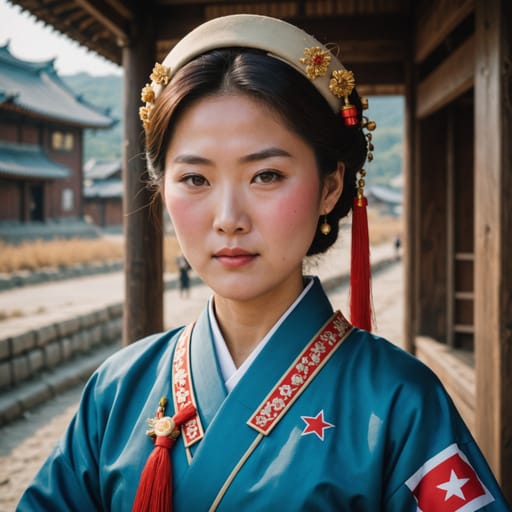
Does this portrait look right for Korean?
Nobody has judged this one yet. You would be the first.
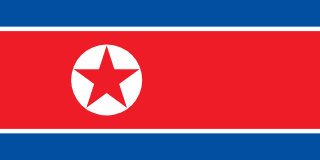

North Korea
KPEast Asia
North Korea is home to 3 documented ethnic groups in East Asia, led by Korean (~100%), Chinese North Korean (~0%), Japanese North Korean (~0%). This page blends their phenotype and demographic data into one weighted reference: skin tone, facial features, hair texture and build, drawn from published census and ancestry sources.
Demographic Composition
Composition weights are derived from self-identification in published census and demographic surveys. Each row links to the source ethnic-group atlas page.
| Ethnic group | Weight | Source |
|---|---|---|
 Korean Korean | 99.9% | DPRK Central Bureau of Statistics 2008 Population Census (the most recent comprehensive North Korean census, conducted with UNFPA technical assistance) plus subsequent UN demographic estimates; ethnic Koreans (Chosŏn-saram) comprise approximately 99.9% of the resident population — the most demographically homogeneous national population in East Asia. The DPRK's near-uniform ethnic composition reflects the country's effective closure to non-Korean immigration since the 1953 armistice plus the historical demographic homogeneity of the Korean Peninsula |
 Chinese North Korean Chinese North Korean | 0.1% | DPRK Central Bureau of Statistics 2008 Census plus diplomatic-source estimates; the small Chinese-North Korean Hwagyo population (~10,000-15,000), descendants of Chinese migrants who remained in North Korea after the 1953 armistice. Concentrated in Pyongyang plus border-region cities. The community has historically maintained limited cross-border ties to the Yanbian Korean Autonomous Prefecture in China |
 Japanese North Korean Japanese North Korean | 0.0% | Estimated from DPRK and South Korean defector-testimony sources; the small Japanese-North Korean population (~1,800-2,000) comprises predominantly the Japanese spouses of Zainichi Korean repatriates who returned to North Korea under the 1959-1984 'Repatriation Project' (Kikoku Jigyō) plus approximately a dozen Japanese abductees and a small number of children. Most are not officially enumerated and live in restricted circumstances |
North Korea Phenotype Profile
North Korea is the most demographically homogeneous national population in East Asia — approximately 99.9% ethnic Korean (Chosŏn-saram) with tiny Chinese-North Korean (Hwagyo, ~0.08%) and Japanese-North Korean (~0.02%) sub-populations. The country's near-uniform ethnic composition reflects the historical demographic homogeneity of the Korean Peninsula plus the DPRK's effective closure to non-Korean immigration since the 1953 armistice. The 2008 Central Bureau of Statistics Population Census (conducted with UNFPA technical assistance, the most recent comprehensive North Korean census) is the canonical data source.
The phenotype distribution within North Korea closely matches the broader Korean source population — see /country/south-korea for the detailed Korean phenotype profile. Skin tone is predominantly Fitzpatrick II-III with seasonal tanning. Hair is uniformly straight (Andre Walker 1A-1B), uniformly black to very dark brown. Facial features track Northeast Asian source populations: epicanthic-fold variants nearly universal, narrower-to-moderate nasal bridges, oval-to-rectangular face shapes with prominent cheekbones. Eye color is uniformly brown to dark brown. Build is intermediate; adult North Korean stature has not kept pace with the South Korean secular trend due to documented chronic undernutrition over the post-1990s period — UN nutritional surveys document a substantial north-south stature gap (estimated 3-8 cm depending on cohort and methodology) that would not exist if the two populations had similar nutritional access. Within-population variance is small; the demographic homogeneity of North Korea produces narrower phenotype-distribution breadth than any other national population in East Asia.
North Korea also has the most demographically distinct stature pattern within East Asia due to the 1990s North Korean famine ('Arduous March', approximately 600,000-3.5 million deaths depending on estimate) and ongoing chronic food insecurity affecting subsequent cohorts. Adult mean stature in North Korean defector populations resettled in South Korea has been documented to be substantially shorter than ROK-born age-matched cohorts, with the differential narrowing in second-generation defector children resettled in nutritional-access conditions matching South Korea — strong evidence that the gap reflects developmental nutritional factors rather than population-genetic differences between North and South Korean populations.
North Korea Body & Anatomy Reference
Per-feature anatomical profile for AI nude generation: East Asian Sinitic / Mongoloid phenotype dominant in North Korea
North Korea Women: Boobs & Breasts
North Korea women's tits and boobs reflect the small-to-medium cup, modest projection East Asian Sinitic / Mongoloid bust profile dominant in the North Korea demographic composition. North Korea nipples and areolas show light-pink to medium-brown areolar pigmentation against the light-to-medium skin tone, with areolar diameter typically in the 26-36mm range, distinct from the the fuller South Asian or Levantine bust profile. North Korea breast morphology trends firm and modestly projecting; smaller cup size than the South Asian or Western Asian average, a function of the ectomorph-to-mesomorph, lean frame body habitus and mean adult female BMI 20-23. For anatomically-accurate AI-generated North Korea nude women the render should preserve: small-to-medium cup, modest projection shape, 26-36mm areolas with regional pigmentation, and the torso proportions of the East Asian Sinitic / Mongoloid phenotype.
North Korea Women: Ass & Hips
North Korea women's ass and hip morphology presents as small-to-medium, modest projection, narrower hip profile, distinctly different from the fuller projected glutes of the West African or Polynesian phenotype. North Korea pelvic profile shows narrower iliac crests, less gluteal-femoral fat deposition, anchored in the East Asian Sinitic / Mongoloid skeletal pattern that dominates the North Korea ethnic composition. North Korea butt shots in adult AI imagery should render the small-to-medium, modest projection, narrower hip profile silhouette with the ectomorph-to-mesomorph, lean frame build and the gluteal-femoral fat distribution typical of the East Asian Sinitic / Mongoloid phenotype rather than defaulting to a globally-averaged shape that generic AI generators produce.
North Korea Women: Vagina & Pussy
North Korea women's pussy and vulvar anatomy presents light-pink to medium-brown labial pigmentation, smaller labia minora, consistent with the East Asian Sinitic / Mongoloid phenotype's pigmentation pattern dominant in North Korea. North Korea pubic hair is typically straight fine texture, sparser distribution than the South Asian norm, distributed in the inverted-triangle pattern with regional-typical density. AI-generated North Korea nude imagery should preserve the light-pink to medium-brown labial pigmentation and the straight fine texture hair texture rather than defaulting to a Western-European pink-and-sparse template. For anatomically-accurate North Korea pussy renders the labial pigmentation should match the surrounding light to medium skin tone of the East Asian Sinitic / Mongoloid phenotype.
North Korea Men: Dicks & Penis
North Korea men's dick and penile anatomy in adult AI generation should anchor on the regional reference data: regional mean ~11-12cm erect, moderate girth, and light-brown shaft pigmentation. North Korea cock profile reflects the East Asian Sinitic / Mongoloid ancestral population's anthropometric measurements rather than a globally-averaged Western-pornography default. For anatomically-accurate North Korea nude male imagery the shaft pigmentation should track the surrounding light to medium skin tone, with continuous glans-to-shaft pigmentation transition and the straight fine texture pubic-hair texture distributed in the typical inverted-V escutcheon. Circumcision status across North Korea men varies by religious and cultural tradition rather than ancestral phenotype.
North Korea People: Body, Curves & Build
North Korea body type and overall build presents as ectomorph-to-mesomorph, lean frame, with mean adult female BMI 20-23: the characteristic East Asian Sinitic / Mongoloid habitus dominant in the North Korea demographic composition. North Korea curves and proportions in adult AI imagery should preserve the regional skeletal frame (height, shoulder-to-hip ratio, limb proportions) rather than scaling to a Western-European mesomorph default. The North Korea nude female form, when rendered with anatomical fidelity, shows the height range, frame width, and adipose distribution pattern typical of the East Asian Sinitic / Mongoloid phenotype. Generic AI image generators tend to collapse regional body types into a few default shapes; the Ethnic Erotic phenotype-anchored approach preserves the North Korea build as its own reference category.
North Korea People: Skin Tone & Hair Texture
North Korea skin tone falls in the light to medium (Fitzpatrick II-IV) band, the surface signal most often miscalibrated by generic AI nude generators trained on Western-photographic datasets. North Korea hair texture is typically straight 1A, fine-to-medium, predominantly black, characteristic of the East Asian Sinitic / Mongoloid phenotype. For anatomically-accurate North Korea nude renders the skin should hold the Fitzpatrick band consistently across body surface rather than showing the lighter-than-face body shading that AI generators default to. North Korea hair pigmentation and texture on body, pubic, and head should match across the figure rather than mixing textures (a common AI artefact).
A descriptive view, not a claim about individuals
This page shows a weighted aggregate of phenotype observations across the North Korea population, based on demographic composition from published census and ancestry sources. Phenotypes within any country are far more varied than the aggregate suggests; this is a descriptive reference, not a deterministic claim about any individual. For source-level detail on individual ethnic groups, see the constituent atlas pages linked below.
Methodology Notes
Composition weights are derived from the DPRK Central Bureau of Statistics 2008 Population Census (the most recent comprehensive North Korean census, conducted with UNFPA technical assistance — the only 21st c. North Korean census with publicly-released microdata) cross-referenced with subsequent UN demographic estimates and defector-testimony sources for the small foreign-descended populations. Genome-wide studies of North Korean populations are limited to defector cohorts resettled in South Korea (Jung et al. 2010 with broader Korean Peninsula sampling); the composition profile cannot rely on within-DPRK genome-wide sampling that does not exist in the published literature. Caveats: (1) the 2008 Census is now over 15 years out of date; subsequent demographic estimates rely on UN modeling rather than direct census enumeration; (2) the Hwagyo and Japanese-North-Korean populations are not enumerated as separate ethnic categories in the DPRK census instruments — the shares are diplomatic-source estimates; (3) the documented adult-stature shortfall between North and South Korean cohorts is a developmental-nutritional pattern rather than a population-genetic difference; the underlying ethnic Korean phenotype distribution should be considered identical between the two countries with the stature shortfall arising from environmental rather than genetic factors; (4) the DPRK's effective demographic closure since 1953 has produced the most extreme demographic homogeneity of any East Asian national population — this composition reflects that homogeneity rather than capturing any meaningful sub-population diversity that does not exist.
Primary Sources
- 1.DPRK Central Bureau of Statistics. DPR Korea 2008 Population Census National Report. Pyongyang: Central Bureau of Statistics; 2009.
- 2.Pak S, Schwekendiek D, Kim HK. Height and living standards in North Korea, 1930s-1980s. Economic History Review. 2011;64(S1):142-158. doi:10.1111/j.1468-0289.2010.00531.x
- 3.Schwekendiek D. The North Korean Standard of Living during the Famine. Social Science & Medicine. 2008;66(3):596-608. doi:10.1016/j.socscimed.2007.10.018
- 4.Jung J, Kang H, Cho YS, et al. Gene flow between the Korean peninsula and its neighboring countries. PLoS ONE. 2010;5(7):e11855. doi:10.1371/journal.pone.0011855
- 5.Smith H. North Korea: Markets and Military Rule. Cambridge: Cambridge University Press; 2015.
Other countries in East Asia
Aggregate phenotype references for neighbouring East Asia nations, weighted by demographic composition.