Help us get this right
Does this portrait look right for Hāfu?
Nobody has judged this one yet. You would be the first.
Hāfu Erotic
Japan, overwhelmingly urban, with concentrations in Tokyo, the Kansai cities, and Okinawa; smaller populations abroad.
Japanese (Japonic), usually first and often only; a second language from the non-Japanese parent in some households.
The ordinary Japanese pattern of Shinto and Buddhist observance held lightly, plus whatever the non-Japanese parent brings; Catholicism is common in Japanese-Filipino families.
Not a descent group. Overlapping categories include Amerasians in Okinawa, Japanese-Filipino children, and families of Zainichi Korean background; kikokushijo (returnee children) and naturalized citizens test the same boundary of Japaneseness.
About Hāfu People
Hāfu is not a descent group. It has no homeland of its own, no ancestral language, no religion attached to it. The word is Japanese, taken from the English "half," and it names anyone with one Japanese parent and one who is not. What it actually describes is a position inside Japanese society, which for a long time has treated nationality, language, and face as one indivisible package. Hāfu are the people for whom that package comes apart. Their homeland is Japan: most are born there, raised there, schooled there, and speak Japanese as a first and frequently only language, a fact that reliably surprises strangers who compliment the fluency or open in English. The number is usually put somewhere near one in thirty births, though the counting depends entirely on what you decide to count, and families with mixed ancestry two generations back appear in no figure at all.
The term surfaced in the early 1970s through pop music and television, and it displaced konketsuji, "mixed-blood child," a phrase weighed down by the postwar occupation. Children born to Japanese women and Allied servicemen after 1945 were the first large cohort, and many ended up in institutions, among them the Elizabeth Saunders Home that Miki Sawada opened at Ōiso in 1948. Okinawa, which carries most of the American bases, has its own long version of this history, including a school founded in 1998 by mothers of such children. The law carried the same assumptions: until the 1984 reform, Japanese nationality passed through the father alone, and dual nationals are still expected on paper to pick one passport in early adulthood, a rule enforced loosely and resented widely. Then there is the picture problem. The hāfu of magazines and variety shows has a white American or European parent, and the modeling industry has run on that face for fifty years, while the far larger demographic reality is a Chinese, Korean, or Filipino parent and a childhood indistinguishable from anyone else's. That gap does most of the work: the visibly foreign get asked where they are really from, and the rest simply go uncounted. When Ariana Miyamoto and Priyanka Yoshikawa took national pageant titles in 2015 and 2016, the argument that followed was never really about them. Activists once floated daburu, "double," as a replacement word. It did not take. Most people say hāfu, and increasingly say it about themselves.
Related ethnic groups
Groups that share Hāfu's homeland, region, language, or religious tradition. These are likely candidates for comparative phenotype reference.
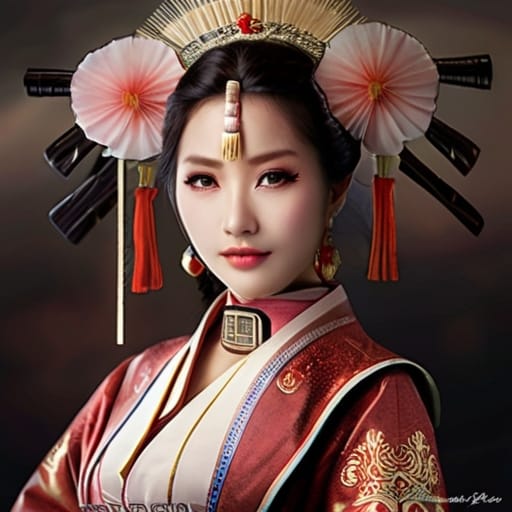
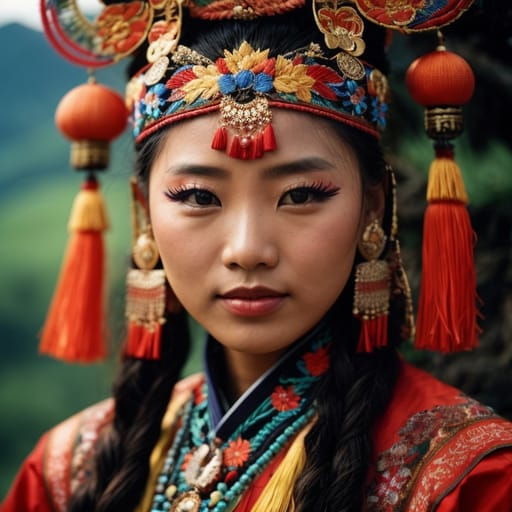
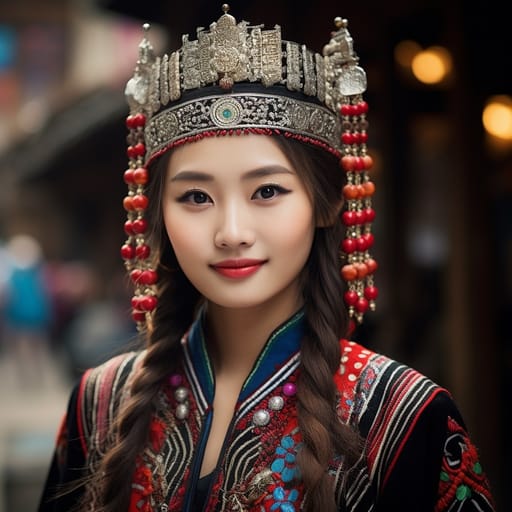
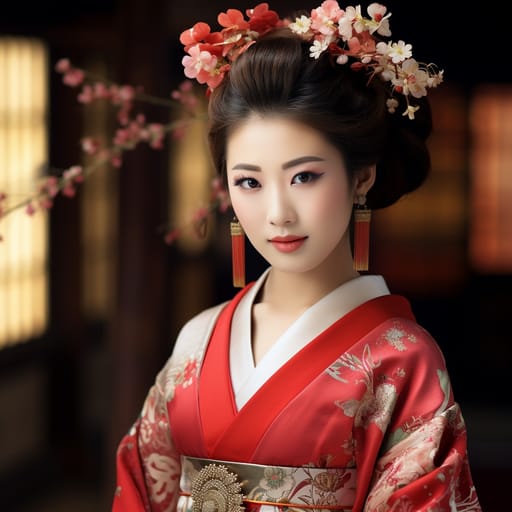
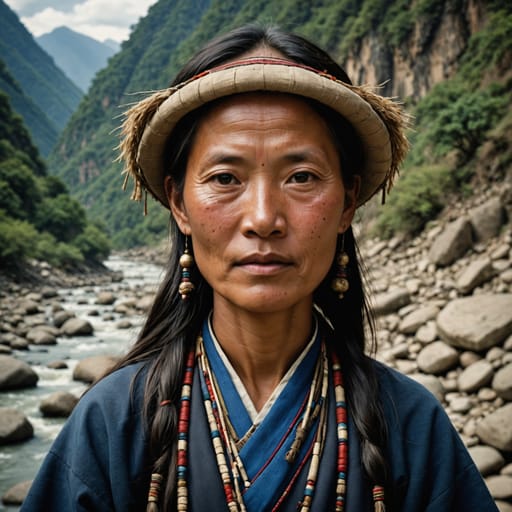
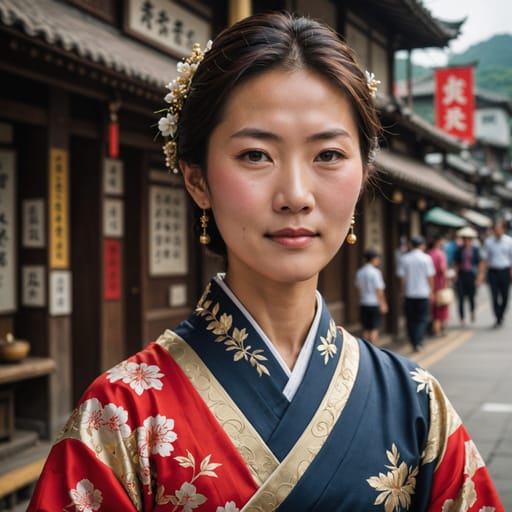
Typical Hāfu Phenotypes
Reference for AI generation: hair, eyes, skin, facial structure, build
Hāfu Body & Anatomy Reference
Anatomy by feature, East Asian Sinitic / Mongoloid phenotype
Hāfu Boobs & Breasts
Hāfu tits and boobs run small-to-medium cup, modest projection, the classic East Asian Sinitic / Mongoloid bust profile. Hāfu nipples and areolas show light-pink to medium-brown areolar pigmentation against the light-to-medium skin tone, with areolar diameter typically in the 26-36mm range and forward-set positioning rather than the fuller South Asian or Levantine bust profile. Hāfu breasts trend firm and modestly projecting; smaller cup size than the South Asian or Western Asian average, a function of the ectomorph-to-mesomorph, lean frame body habitus and the mean adult female BMI 20-23. For anatomically accurate AI-generated Hāfu nudes the render preserves the small-to-medium cup, modest projection shape, 26-36mm areolas with light-pink to medium-brown pigmentation, and the torso proportions of the East Asian Sinitic / Mongoloid phenotype.
Hāfu Ass & Hips
Hāfu hips and butt usually read as small-to-medium, modest projection, narrower hip profile. The skeletal base is narrower iliac crests, less gluteal-femoral fat deposition, the East Asian Sinitic / Mongoloid pattern. Set against the fuller projected glutes of the West African or Polynesian phenotype, the difference is easy to see, and the hip-to-waist ratio is often what identifies Hāfu women in photos.
Hāfu Vagina & Pussy
Expect light-pink to medium-brown labial pigmentation, smaller labia minora on Hāfu women, in keeping with East Asian Sinitic / Mongoloid ancestry. The pubic hair is straight fine texture, sparser distribution than the South Asian norm. Coloring should run evenly from the light to medium skin of the thighs to the labia, and Hāfu nude imagery should keep the hair's straight fine texture.
Hāfu Dicks & Penis
Hāfu dick and penile anatomy in adult AI generation should anchor on the regional reference data: regional mean ~11-12cm erect, moderate girth, and light-brown shaft pigmentation. The Hāfu cock profile reflects the East Asian Sinitic / Mongoloid population's anthropometric measurements. The shaft pigmentation should track the surrounding light to medium skin tone, and the pubic hair should keep its straight fine texture in the typical inverted-V escutcheon.
Hāfu Body, Curves & Build
Hāfu body type: ectomorph-to-mesomorph, lean frame, with mean adult female BMI 20-23. This is the typical East Asian Sinitic / Mongoloid build. Height range, shoulder-to-hip ratio and fat distribution all follow from it, which is what an accurate Hāfu nude body should show.
Hāfu Skin Tone & Hair Texture
Hāfu skin tone falls in the light to medium (Fitzpatrick II-IV) band, the surface signal most often miscalibrated by generic AI nude generators. Hāfu hair texture is typically straight 1A, fine-to-medium, predominantly black, characteristic of the East Asian Sinitic / Mongoloid phenotype. In Hāfu nude renders the skin should hold that band consistently across the body.
Explore phenotype categories
Structured taxonomy with peer-reviewed scales · 22 anatomical categories
Erotic Poses & Sex Positions
From the pose catalog: 219 named positions with reference skeletons
Frequently asked questions about Hāfu people
Where is the Hāfu homeland?
The Hāfu homeland is Japan, overwhelmingly urban, with concentrations in Tokyo, the Kansai cities, and Okinawa; smaller populations abroad. in East Asia.
What language do Hāfu people speak?
Hāfu people primarily speak Japanese (Japonic), usually first and often only; a second language from the non-Japanese parent in some households..
What religion do Hāfu people practice?
The predominant religion among Hāfu people is The ordinary Japanese pattern of Shinto and Buddhist observance held lightly, plus whatever the non-Japanese parent brings; Catholicism is common in Japanese-Filipino families..






Make your own Hāfu images
Five a day, free, no credits to buy. The studio starts from this group's phenotype data, so you can set body type, pose and style and keep the traits accurate.
Start with Hāfu