No portrait yet
Tanguts Erotic
Northwest China: Ningxia, Gansu, eastern Qinghai, northern Shaanxi and western Inner Mongolia, with earlier origins on the eastern Tibetan plateau in Qinghai and Sichuan
Tangut (Sino-Tibetan, Tibeto-Burman, Qiangic, Gyalrongic branch), extinct, written in its own logographic script
Buddhism drawing on Chinese and Tibetan traditions, alongside state Confucianism and indigenous shamanic practice
Qiangic peoples of the Tibeto-Burman family; ruled by the Tuoba (Weiming) clan; possible descendants among the Minyak (Muya) of western Sichuan
About Tanguts People
The Tanguts were a Tibeto-Burman speaking people who, between the seventh and thirteenth centuries, moved off the eastern edge of the Tibetan plateau into what is now northwest China and built an empire there, the Western Xia (1038 to 1227), before the Mongols destroyed it and the Tanguts ceased to exist as a distinct people. They called themselves Mi or Minyak. Tangut is the Turkic and Mongol name for them, Dangxiang the Chinese one. Their territory as an empire ran from the Ordos loop of the Yellow River west along the Hexi Corridor, taking in today's Ningxia, much of Gansu, and slices of Qinghai, Shaanxi and Inner Mongolia, with a capital at Xingqing, the modern city of Yinchuan. That put them astride the overland Silk Road, and they taxed it.
Their language belonged to the Qiangic group of Tibeto-Burman, and recent work places it in the Gyalrongic branch, which makes its closest living relatives the Gyalrong languages of western Sichuan rather than Tibetan or Chinese. What sets the Tanguts apart is that they wrote it down in a script of their own. The founding emperor, Li Yuanhao, commissioned the Tangut script in 1036, two years before he declared himself emperor. It looks like Chinese from across a room, dense with strokes, but not one character is borrowed, and there are nearly six thousand of them. The same emperor ordered his subjects to adopt a distinctive haircut, shaved on the crown with hair left long at the temples, and banned Chinese dress at court. Identity was state policy. The Western Xia was a Buddhist state that translated the canon into Tangut and printed it, drawing on both Chinese and Tibetan tantric traditions: the office of Imperial Preceptor held by a Tibetan lama, later famous under the Mongol Yuan, first appears at the Tangut court. Confucian learning and older shamanic practice ran alongside.
The end came in 1227. Genghis Khan died during his final campaign against them, and the Mongols answered by leveling the capital and killing much of its population. Survivors were absorbed into Han, Mongol, Tibetan and Hui communities over the following centuries. The Minyak people around Kangding in Sichuan and a few clans in Anhui with Tangut epitaphs are the closest thing to descendants. The script outlived the empire by nearly three hundred years, with the last dated inscription on a pillar in Hebei from 1502, then went unread until a Russian expedition dug a sealed library out of a stupa at the dead city of Khara-Khoto in 1909. The imperial tombs outside Yinchuan, nine earthen pyramids on the flats below the Helan Mountains, are the most visible thing the Tanguts left standing.
Related ethnic groups
Groups that share Tanguts's homeland, region, language, or religious tradition. These are likely candidates for comparative phenotype reference.

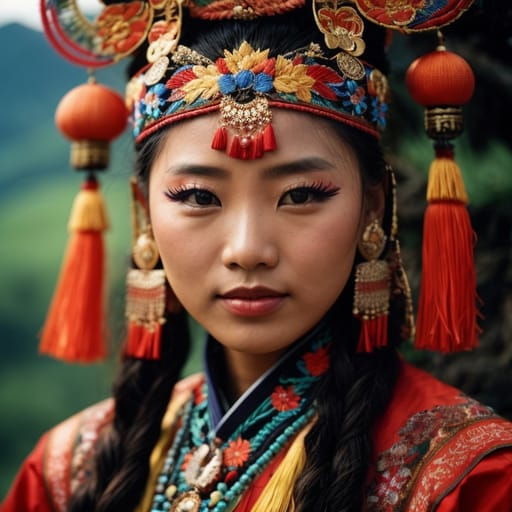
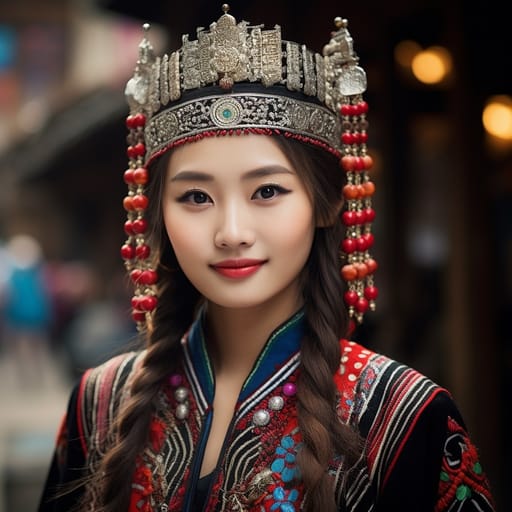

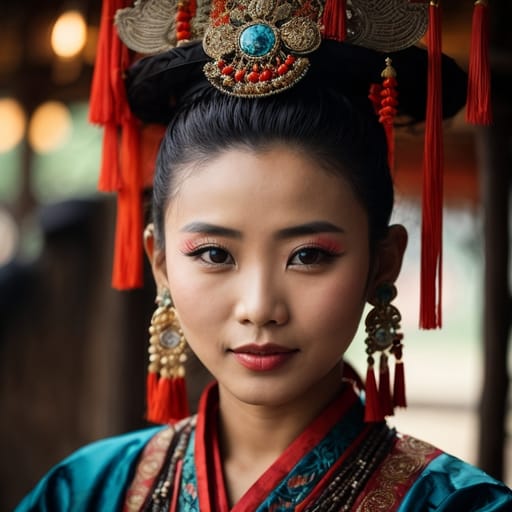
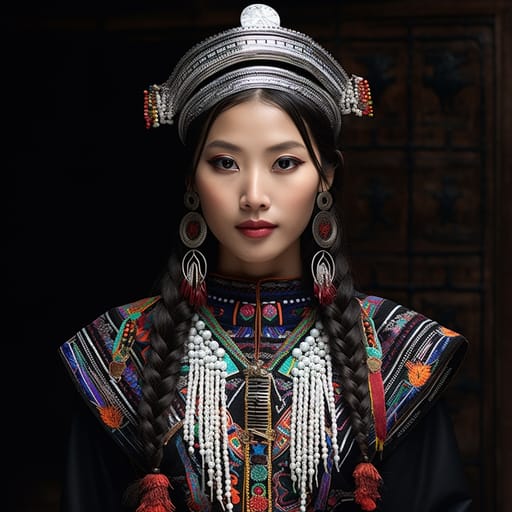
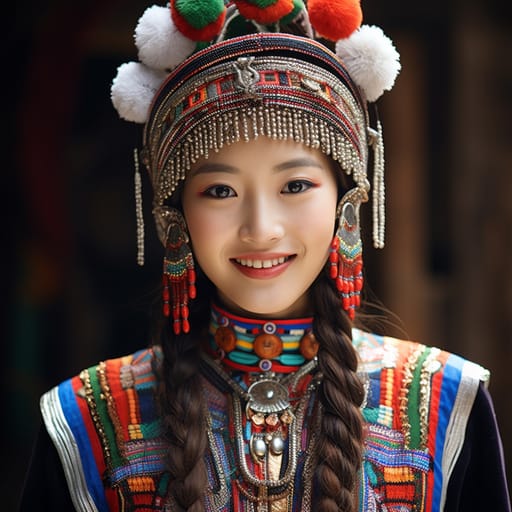
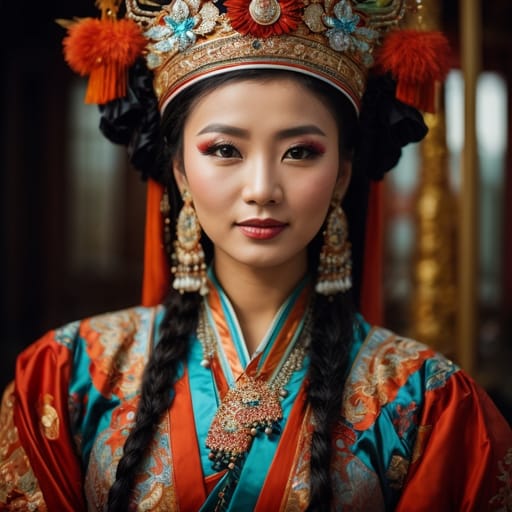
Typical Tanguts Phenotypes
Reference for AI generation: hair, eyes, skin, facial structure, build
Tanguts Body & Anatomy Reference
Per-feature anatomical profile for AI nude generation: East Asian Sinitic / Mongoloid phenotype
Tanguts Boobs & Breasts
Tanguts boobs follow the East Asian Sinitic / Mongoloid profile: small-to-medium cup, modest projection. Areolar diameter is usually 26-36mm, and the coloring is light-pink to medium-brown areolar pigmentation against the light-to-medium skin tone. Breast shape tracks body composition (ectomorph-to-mesomorph, lean frame, mean adult female BMI 20-23), so Tanguts breasts tend to be firm and modestly projecting; smaller cup size than the South Asian or Western Asian average. Expect a forward-set shape, not the fuller South Asian or Levantine bust profile.
Tanguts Ass & Hips
Tanguts ass and hip morphology presents as small-to-medium, modest projection, narrower hip profile, distinctly different from the fuller projected glutes of the West African or Polynesian phenotype. The Tanguts pelvic profile shows narrower iliac crests, less gluteal-femoral fat deposition, anchored in the East Asian Sinitic / Mongoloid skeletal pattern. Tanguts butt shots in adult AI imagery should render the small-to-medium, modest projection, narrower hip profile silhouette with the overall build (ectomorph-to-mesomorph, lean frame) and the fat distribution typical of the East Asian Sinitic / Mongoloid phenotype.
Tanguts Vagina & Pussy
Tanguts pussy anatomy typically shows light-pink to medium-brown labial pigmentation, smaller labia minora. Pubic hair is usually straight fine texture, sparser distribution than the South Asian norm. In AI-generated Tanguts nudes, labial color should blend into the light to medium skin with a gradual transition, and the hair should keep its straight fine texture.
Tanguts Dicks & Penis
Penis reference for Tanguts men: regional mean ~11-12cm erect, moderate girth. Coloring: light-brown shaft pigmentation. An accurate Tanguts cock in AI imagery matches the surrounding light to medium skin rather than a generic porn default. Circumcision depends on religion and custom, not ancestry.
Tanguts Body, Curves & Build
The Tanguts figure is generally ectomorph-to-mesomorph, lean frame, with mean adult female BMI 20-23, characteristic of East Asian Sinitic / Mongoloid ancestry. AI image tools tend to flatten regional body types into a few stock shapes; here the Tanguts build is kept as its own reference.
Tanguts Skin Tone & Hair Texture
Skin: light to medium (Fitzpatrick II-IV). Hair: straight 1A, fine-to-medium, predominantly black. Both are typical of East Asian Sinitic / Mongoloid ancestry. The most common mistake in AI nudes of Tanguts women is a body rendered lighter than the face.
Explore phenotype categories
Structured taxonomy with peer-reviewed scales · 22 anatomical categories
Erotic Poses & Sex Positions
From the pose catalog: 219 named positions with reference skeletons
Frequently asked questions about Tanguts people
Where is the Tanguts homeland?
The Tanguts homeland is Northwest China: Ningxia, Gansu, eastern Qinghai, northern Shaanxi and western Inner Mongolia, with earlier origins on the eastern Tibetan plateau in Qinghai and Sichuan in East Asia.
What language do Tanguts people speak?
Tanguts people primarily speak Tangut (Sino-Tibetan, Tibeto-Burman, Qiangic, Gyalrongic branch), extinct, written in its own logographic script.
What religion do Tanguts people practice?
The predominant religion among Tanguts people is Buddhism drawing on Chinese and Tibetan traditions, alongside state Confucianism and indigenous shamanic practice.






Make your own Tanguts images
Five a day, free, no credits to buy. The studio starts from this group's phenotype data, so you can set body type, pose and style and keep the traits accurate.
Start with Tanguts