Help us get this right
Does this portrait look right for Monguor people (Tu)?
One tap. It takes a second and it is recorded.
1 says it looks right, 0 say it looks off.
Monguor people (Tu) Erotic
Huzhu, Minhe and Datong areas, Qinghai (and parts of Gansu), China
Monguor: Mongghul and Mangghuer (Mongolic)
Tibetan Buddhism (Gelug), with folk religion and shamanic ritual
the Tu nationality; Mongghul and Mangghuer subgroups
About Monguor people (Tu) People
The Monguor, officially the Tu people in China, are a Mongolic-speaking group of the Qinghai and Gansu borderlands on the northeastern edge of the Tibetan Plateau, numbering roughly two hundred ninety thousand. They are concentrated in the Huzhu, Minhe and Datong areas of Qinghai and in parts of Gansu. Their speech, divided into the Mongghul and Mangghuer varieties, belongs to the Mongolic family and carries heavy Tibetan and Chinese influence. Most Monguor are bilingual or trilingual, and Chinese is widely used.
Society and subsistence
The Monguor are chiefly settled farmers of the plateau valleys, growing barley, wheat, potatoes and rapeseed and raising livestock, a mixed economy shaped by centuries of contact among Mongol, Tibetan and Han populations. Some Monguor trace descent from Mongol garrisons and local rulers of the Yuan and Ming periods, and communities were historically organized under hereditary native chiefs known as tusi, though their exact origins remain debated. Tibetan Buddhism of the Gelug school is central to their religious life, with important monasteries, monks and pilgrimage, alongside folk religion, mountain and household deities, and shamanic ritual specialists. The Nadun harvest festival, with masked dance and drama, is a celebrated Monguor tradition.
Appearance and adornment
Monguor people show the North Asian phenotype of the eastern plateau, with straight black hair, dark eyes and broad faces, of medium build weathered by high-altitude sun. Monguor women are noted for brightly colored costume, above all sleeves and sleeve-panels sewn in rainbow bands of red, yellow, green, blue, white and black, worn with embroidered gowns, aprons, ornamented headdresses and silver and coral jewelry. Tu embroidery is widely admired, and the details of a woman's headdress and hairstyle traditionally signaled her home district and marital status. Men wear robes, sashes, boots and felt or fur hats; modern dress is common day to day.
Related ethnic groups
Groups that share Monguor people (Tu)'s homeland, region, language, or religious tradition. These are likely candidates for comparative phenotype reference.
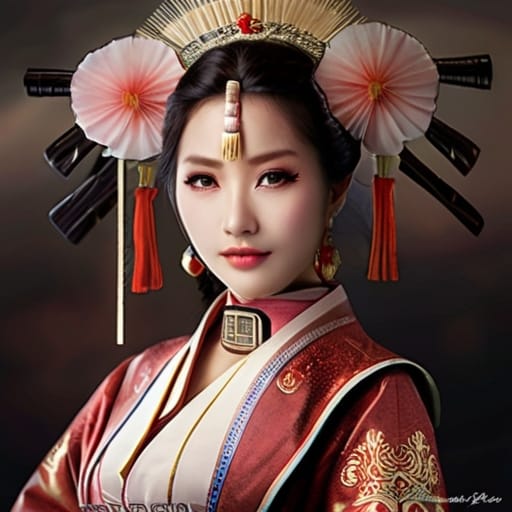
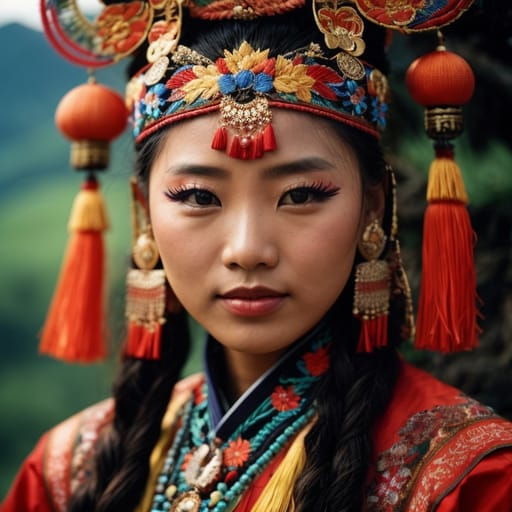
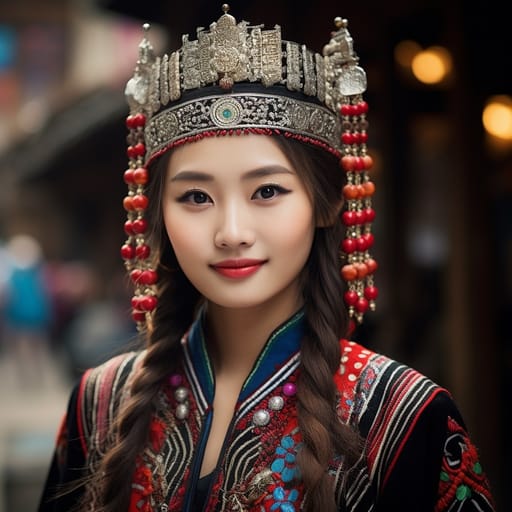
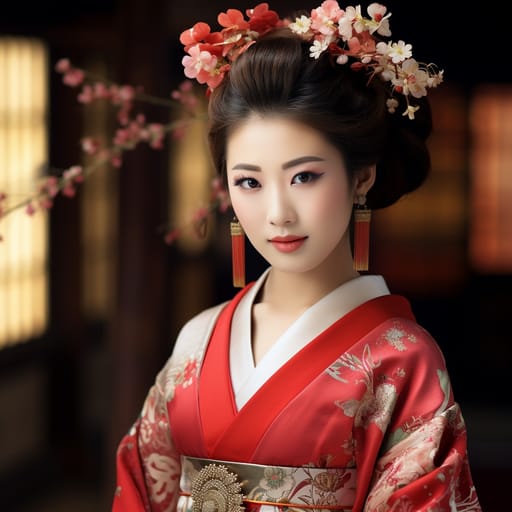
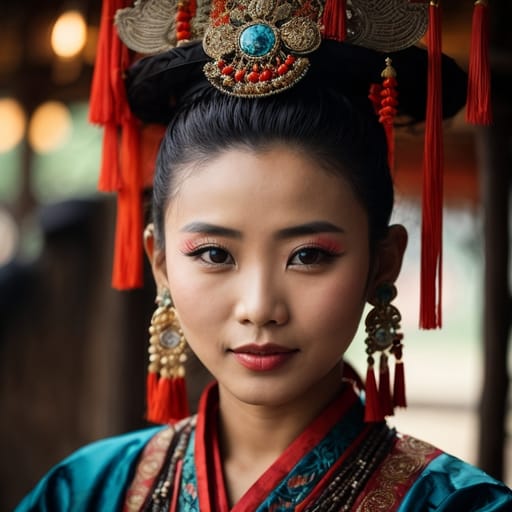
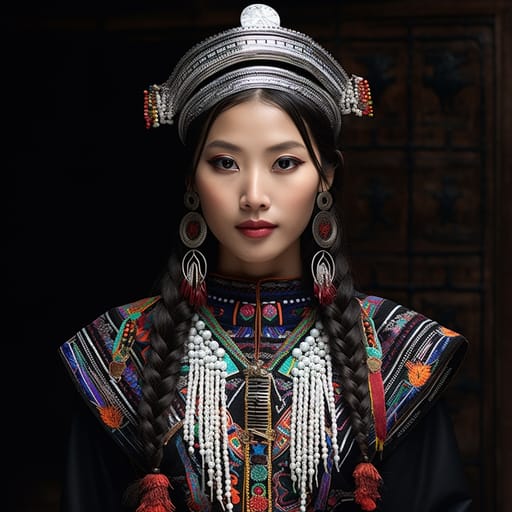
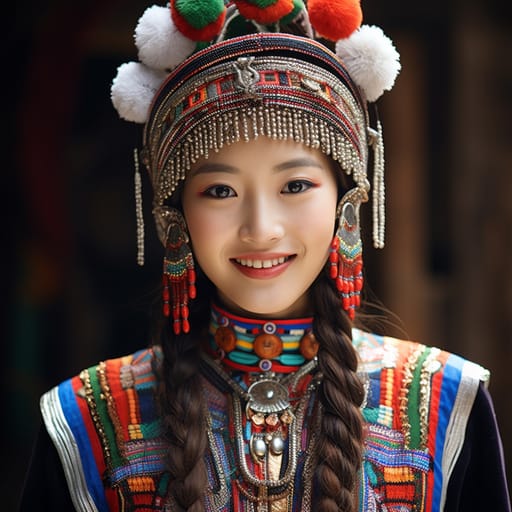
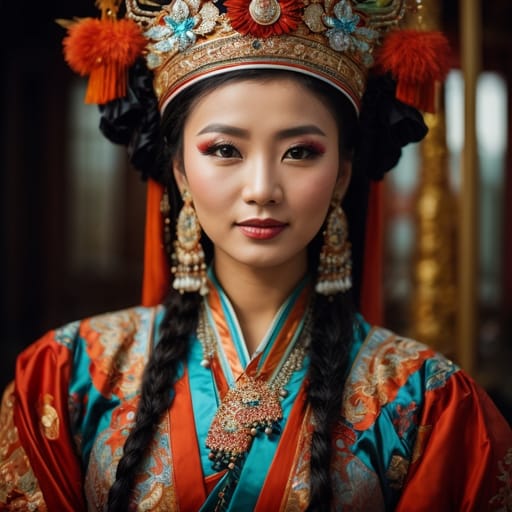
Typical Monguor people (Tu) Phenotypes
Reference for AI generation: hair, eyes, skin, facial structure, build
Monguor people (Tu) Body & Anatomy Reference
Per-feature anatomical profile for AI nude generation: East Asian Sinitic / Mongoloid phenotype
Monguor people (Tu) Boobs & Breasts
Monguor people (Tu) tits and boobs run small-to-medium cup, modest projection, the classic East Asian Sinitic / Mongoloid bust profile. Monguor people (Tu) nipples and areolas show light-pink to medium-brown areolar pigmentation against the light-to-medium skin tone, with areolar diameter typically in the 26-36mm range and forward-set positioning rather than the fuller South Asian or Levantine bust profile. Monguor people (Tu) breasts trend firm and modestly projecting; smaller cup size than the South Asian or Western Asian average, a function of the ectomorph-to-mesomorph, lean frame body habitus and the mean adult female BMI 20-23. For anatomically accurate AI-generated Monguor people (Tu) nudes the render preserves the small-to-medium cup, modest projection shape, 26-36mm areolas with light-pink to medium-brown pigmentation, and the torso proportions of the East Asian Sinitic / Mongoloid phenotype.
Monguor people (Tu) Ass & Hips
Monguor people (Tu) hips and butt usually read as small-to-medium, modest projection, narrower hip profile. The skeletal base is narrower iliac crests, less gluteal-femoral fat deposition, the East Asian Sinitic / Mongoloid pattern. Set against the fuller projected glutes of the West African or Polynesian phenotype, the difference is easy to see, and the hip-to-waist ratio is often what identifies Monguor people (Tu) women in photos.
Monguor people (Tu) Vagina & Pussy
Expect light-pink to medium-brown labial pigmentation, smaller labia minora on Monguor people (Tu) women, in keeping with East Asian Sinitic / Mongoloid ancestry. The pubic hair is straight fine texture, sparser distribution than the South Asian norm. Coloring should run evenly from the light to medium skin of the thighs to the labia, and Monguor people (Tu) nude imagery should keep the hair's straight fine texture.
Monguor people (Tu) Dicks & Penis
Monguor people (Tu) dick and penile anatomy in adult AI generation should anchor on the regional reference data: regional mean ~11-12cm erect, moderate girth, and light-brown shaft pigmentation. The Monguor people (Tu) cock profile reflects the East Asian Sinitic / Mongoloid population's anthropometric measurements. The shaft pigmentation should track the surrounding light to medium skin tone, and the pubic hair should keep its straight fine texture in the typical inverted-V escutcheon.
Monguor people (Tu) Body, Curves & Build
Monguor people (Tu) body type: ectomorph-to-mesomorph, lean frame, with mean adult female BMI 20-23. This is the typical East Asian Sinitic / Mongoloid build. Height range, shoulder-to-hip ratio and fat distribution all follow from it, which is what an accurate Monguor people (Tu) nude body should show.
Monguor people (Tu) Skin Tone & Hair Texture
Monguor people (Tu) skin tone falls in the light to medium (Fitzpatrick II-IV) band, the surface signal most often miscalibrated by generic AI nude generators. Monguor people (Tu) hair texture is typically straight 1A, fine-to-medium, predominantly black, characteristic of the East Asian Sinitic / Mongoloid phenotype. In Monguor people (Tu) nude renders the skin should hold that band consistently across the body.
Explore phenotype categories
Structured taxonomy with peer-reviewed scales · 22 anatomical categories
Erotic Poses & Sex Positions
From the pose catalog: 219 named positions with reference skeletons
Frequently asked questions about Monguor people (Tu) people
Where is the Monguor people (Tu) homeland?
The Monguor people (Tu) homeland is Huzhu, Minhe and Datong areas, Qinghai (and parts of Gansu), China in East Asia.
What language do Monguor people (Tu) people speak?
Monguor people (Tu) people primarily speak Monguor: Mongghul and Mangghuer (Mongolic).
What religion do Monguor people (Tu) people practice?
The predominant religion among Monguor people (Tu) people is Tibetan Buddhism (Gelug), with folk religion and shamanic ritual.






Make your own Monguor people (Tu) images
Five a day, free, no credits to buy. The studio starts from this group's phenotype data, so you can set body type, pose and style and keep the traits accurate.
Start with Monguor people (Tu)