Help us get this right
Does this portrait look right for Yi?
One tap. It takes a second and it is recorded.
2 say it looks right, 0 say it looks off.
Yi Erotic
China (Yunnan, Sichuan, Guizhou, Guangxi)
Bimoism
Phù Lá, Azha
About Yi People
The Yi are one of the largest of China's recognized minorities, with around nine million people scattered across the mountainous interior where Yunnan, Sichuan, Guizhou, and Guangxi meet. "Yi" is an administrative umbrella more than a self-description: it gathers together dozens of communities — Nuosu, Sani, Lipo, Axi, Phù Lá, Azha and many others — who often cannot understand each other's speech and would not, left to themselves, necessarily claim a shared identity. What binds them in the ethnographer's ledger is a family of closely related Loloish languages within the Tibeto-Burman branch of Sino-Tibetan, and a set of cultural reference points that have outlasted centuries of pressure from lowland Han neighbors.
Historically the Yi were highland people, and the geography still shapes them. The Liangshan range in southern Sichuan, in particular, is Nuosu country — terrain steep enough that until the Communist consolidation of the 1950s much of it operated under a hereditary caste system, with a "Black Yi" aristocracy, "White Yi" commoners, and a stratum of bonded servants. The system is gone, but family names and old hierarchies still register socially in some valleys. Elsewhere, in the gentler hills of Yunnan, Yi communities lived more porously alongside Han, Bai, and Hani neighbors and absorbed correspondingly more from them.
The Yi have their own writing system — a syllabary of roughly a thousand characters, traditionally the working script of the bimo, the ritual specialist who is the spine of Yi religious life. Bimoism is not a church and has no doctrine in the Western sense; it is a body of practice carried in chanted texts, transmitted father to son, dealing with funerals, ancestor veneration, illness, dispute, and the management of an unseen world densely populated with spirits of place. A bimo is consulted the way one might consult a lawyer, a doctor, and a priest at once. Alongside bimoism sits the work of the sunyi, a shamanic figure whose authority comes from possession rather than text.
The Torch Festival, held in the sixth lunar month, is the calendar's anchor — three days of bonfires, bullfights, wrestling, and courtship that draw scattered Yi communities back to common ground. Embroidery, silverwork, and the felt cloak called the chá'ěrwǎ, worn against the highland cold, remain everyday markers of belonging rather than performances staged for outsiders.
Related ethnic groups
Groups that share Yi's homeland, region, language, or religious tradition. These are likely candidates for comparative phenotype reference.
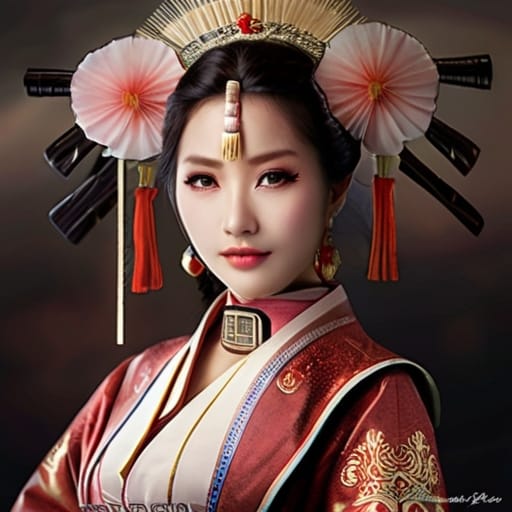
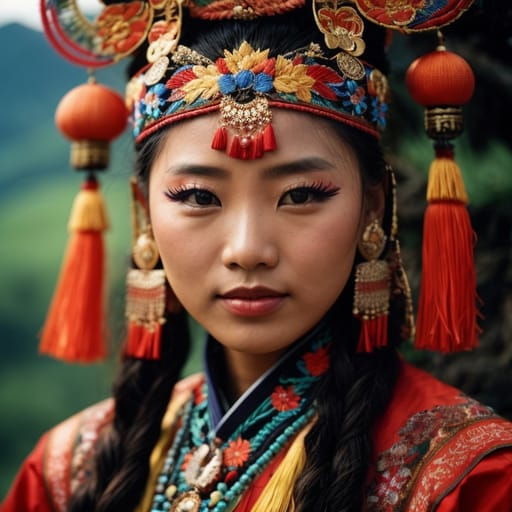
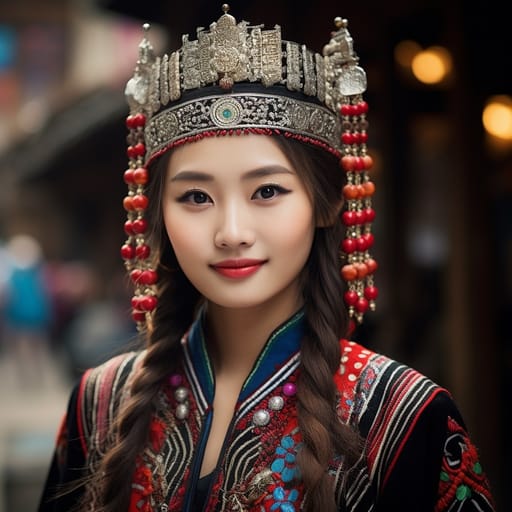
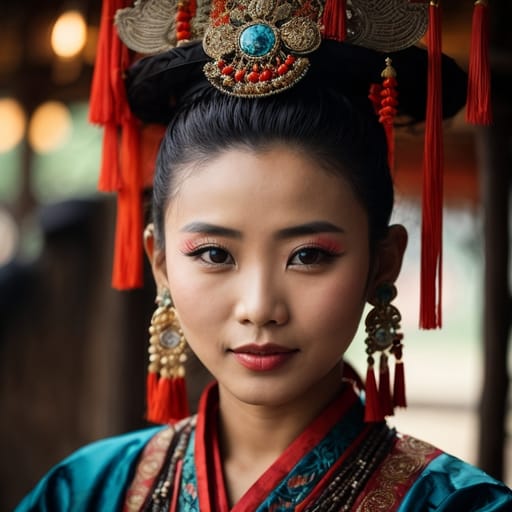
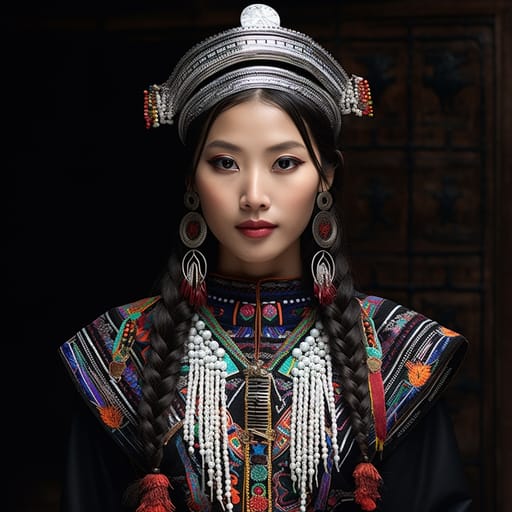
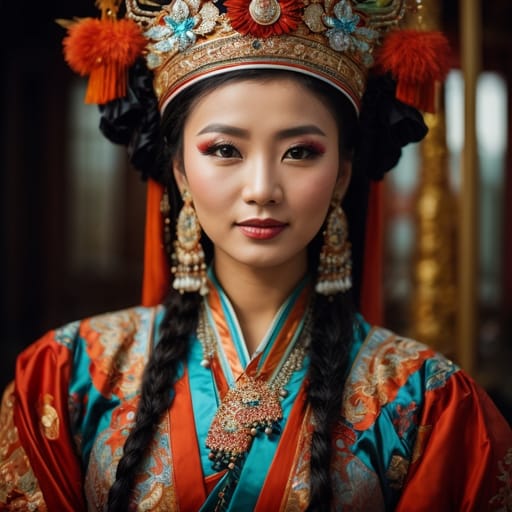
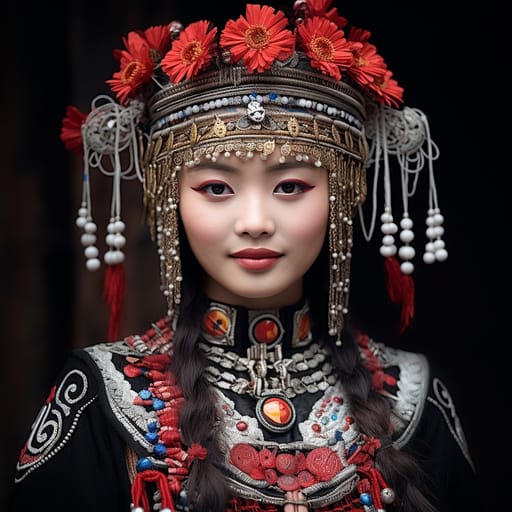
Geographic Distribution: Yi populations across 1 country
Each row is ranked by the group's share of that country's population, with the source citation drawn from published census and demographic surveys. Click through for the full per-country phenotype profile.
| Country | Share | Source |
|---|---|---|
| China | 0.7% | China 2020 Census, self-identified Yi (~9.8M); concentrated in Yunnan, Sichuan, and Guizhou. Tibeto-Burman language family. Historically called Lolo in older Western ethnographic literature |
Typical Yi Phenotypes
Reference for AI generation: hair, eyes, skin, facial structure, build
The Yi sit at the southwestern edge of East Asian phenotype, in the Tibeto-Burman highlands where Loloish-speaking peoples have stayed relatively endogamous for centuries. The result is a look that reads recognizably East Asian but diverges in specific, consistent ways from the Han majority that surrounds them — particularly the Liangshan Yi of Sichuan, who are the most phenotypically distinct branch.
Hair is uniformly black, straight to very lightly wavy, and notably thick — the coarse, heavy strand diameter typical of Tibeto-Burman highland populations. Graying tends to come late. Eyes run dark brown to near-black, almond-shaped, with the epicanthic fold near-universal but often less pronounced and less hooded than in northern Han populations; the palpebral fissure tilts upward at the outer corner in a milder, flatter way than in groups further north. Skin tone covers Fitzpatrick III to IV, with a warm olive-to-bronze undertone rather than the cooler ivory often associated with northern East Asian groups. High-altitude Liangshan Yi frequently show a deeper, sun-weathered tone with visible cheek flush from UV and cold exposure — singer Hailai Ahmu carries the recognizable Liangshan complexion and bone structure.
Facial structure is where the Yi diverge most clearly. Cheekbones are high and broad but the midface is less flattened than in Han or Mongolic populations — there's more projection through the nose and brow. Noses tend to have a defined bridge with moderate alar width, sometimes approaching the slightly aquiline form seen in Tibetan populations. Lips are medium-full, jawlines often angular in men and softly tapered in women, with a relatively narrow chin.
Build runs lean and wiry, with men typically 165–172 cm and women 152–158 cm — shorter than the Han average but with denser musculature suited to mountain terrain. The Phù Lá of the Vietnam-China border and the Azha of southern Yunnan trend slightly shorter and darker-skinned than the Liangshan branch, with somewhat softer facial features and less pronounced cheekbone breadth.
Yi Body & Anatomy Reference
Anatomy by feature, East Asian Sinitic / Mongoloid phenotype
Yi Boobs & Breasts
Yi tits and boobs run small-to-medium cup, modest projection, the classic East Asian Sinitic / Mongoloid bust profile. Yi nipples and areolas show light-pink to medium-brown areolar pigmentation against the light-to-medium skin tone, with areolar diameter typically in the 26-36mm range and forward-set positioning rather than the fuller South Asian or Levantine bust profile. Yi breasts trend firm and modestly projecting; smaller cup size than the South Asian or Western Asian average, a function of the ectomorph-to-mesomorph, lean frame body habitus and the mean adult female BMI 20-23. For anatomically accurate AI-generated Yi nudes the render preserves the small-to-medium cup, modest projection shape, 26-36mm areolas with light-pink to medium-brown pigmentation, and the torso proportions of the East Asian Sinitic / Mongoloid phenotype.
Yi Ass & Hips
Yi hips and butt usually read as small-to-medium, modest projection, narrower hip profile. The skeletal base is narrower iliac crests, less gluteal-femoral fat deposition, the East Asian Sinitic / Mongoloid pattern. Set against the fuller projected glutes of the West African or Polynesian phenotype, the difference is easy to see, and the hip-to-waist ratio is often what identifies Yi women in photos.
Yi Vagina & Pussy
Expect light-pink to medium-brown labial pigmentation, smaller labia minora on Yi women, in keeping with East Asian Sinitic / Mongoloid ancestry. The pubic hair is straight fine texture, sparser distribution than the South Asian norm. Coloring should run evenly from the light to medium skin of the thighs to the labia, and Yi nude imagery should keep the hair's straight fine texture.
Yi Dicks & Penis
Yi dick and penile anatomy in adult AI generation should anchor on the regional reference data: regional mean ~11-12cm erect, moderate girth, and light-brown shaft pigmentation. The Yi cock profile reflects the East Asian Sinitic / Mongoloid population's anthropometric measurements. The shaft pigmentation should track the surrounding light to medium skin tone, and the pubic hair should keep its straight fine texture in the typical inverted-V escutcheon.
Yi Body, Curves & Build
Yi body type: ectomorph-to-mesomorph, lean frame, with mean adult female BMI 20-23. This is the typical East Asian Sinitic / Mongoloid build. Height range, shoulder-to-hip ratio and fat distribution all follow from it, which is what an accurate Yi nude body should show.
Yi Skin Tone & Hair Texture
Yi skin tone falls in the light to medium (Fitzpatrick II-IV) band, the surface signal most often miscalibrated by generic AI nude generators. Yi hair texture is typically straight 1A, fine-to-medium, predominantly black, characteristic of the East Asian Sinitic / Mongoloid phenotype. In Yi nude renders the skin should hold that band consistently across the body.
Data depth
32/100Coverage of image-grounded phenotype observations · drives AI generation diversity
- Sample size
- 15/40· 7 images
- Image quality
- 7/30· 14% high
- Confidence
- 10/20· mean 0.65
- Source diversity
- 0/10· wikipedia
- ·Small sample (n<10)
- ·Mostly low-quality source images
- ·Wikipedia-only source, not population-representative
Observed Distribution: Image Sample
Empirical observations from analyzed photographs · supplementary signal, not population truth
Sample: 7 images analyzed (7 wikipedia). Quality: 1 high, 5 medium, 1 low, 0 very_low. Avg analyzer confidence: 0.65.
Skin tone (Fitzpatrick): II (14%), III (29%), IV (43%), unclear (14%)
Hair color: light/medium brown (29%), gray/white (29%), black (29%), unclear (14%)
Hair texture: straight (71%), shaved (14%), covered (14%)
Eye color: dark brown (86%), unclear (14%)
Epicanthic fold: 86% present, 0% absent, 14% unclear
Caveats: Sample size 7 is small, so the observed distribution should be treated as suggestive, not definitive. Quality skews toward older or low-resolution photos; phenotype detail may be lossy. Sample is 100% Wikipedia notable people, which skews toward male, public-life, and modern figures, not population-representative.
Last aggregated: May 7, 2026
Explore phenotype categories
Structured taxonomy with peer-reviewed scales · 22 anatomical categories
Notable Yi People
11 reference figures, sourced from Wikipedia
- Hailai Ahmu, singer
- He Jie, singer
- Pearl Fu, community leader
- Long Zhiyi, former chairman of the Guizhou Provincial Committee of the CPPCC
- Zhang Chong, former vice chairman of the CPPCC
- Zhang Liyin, singer
- Long Yun, governor and warlord of Yunnan Province
- Lu Han, general and governor of Yunnan Province
- Xiao Yedan, Yi clan leader
- Yang Likun, actress
- Cheng Li-wun, Chairperson of the Kuomintang
Erotic Poses & Sex Positions
From the pose catalog: 219 named positions with reference skeletons
Frequently asked questions about Yi people
Where is the Yi homeland?
The Yi homeland is China (Yunnan, Sichuan, Guizhou, Guangxi) in East Asia.
What countries do Yi people live in?
Yi populations are documented across 1 country: China.
What language do Yi people speak?
Yi people primarily speak Sino-Tibetan / Loloish.
What religion do Yi people practice?
The predominant religion among Yi people is Bimoism.






Make your own Yi images
Five a day, free, no credits to buy. The studio starts from this group's phenotype data, so you can set body type, pose and style and keep the traits accurate.
Start with Yi