No portrait yet
Donghu Erotic
The steppe and river country of southeastern Inner Mongolia, western Liaoning and eastern Mongolia, centered on the Xilamulun and Laoha basins east of the Greater Khingan range, in present-day China and Mongolia.
Unrecorded and unattested; reconstructed as Para-Mongolic or early Mongolic on the evidence of their Xianbei and Khitan successors (Mongolic).
No direct record. Worship of heaven, earth, sun, moon, mountains and rivers, along with ancestor cult and shamanic practice, inferred from Chinese accounts of the Wuhuan and Xianbei.
A confederation of allied steppe tribes rather than a single nation; ancestral to the Wuhuan and the Xianbei, and through the Xianbei to the Tuoba, Murong and Yuwen houses, the Kumo Xi, the Khitan and the later Mongolic peoples.
About Donghu People
The Donghu were a loose confederation of horse and cattle herders who held the grasslands and river valleys of what is now southeastern Inner Mongolia, western Liaoning and eastern Mongolia from about the seventh century BCE until 208 BCE, when the Xiongnu broke them. The survivors regrouped under two new names, the Wuhuan and the Xianbei, and the Xianbei line runs on through the Khitan and the Kumo Xi into the Mongolic peoples of the present day. Even the name is an outsider's. Donghu means roughly "the Hu of the east," Chinese shorthand for the northerners who lived east of the Xiongnu, and what these people called themselves was never written down. That is the central difficulty with them: they left no texts, no inscriptions and no readable language, so every sentence about them descends from the annals of enemies or from what was buried with the dead. Scholars who assign them a tongue reason backward, from the speech of their descendants, which points to something Mongolic or near to it rather than Turkic.
Two encounters fix them in the record. Around 300 BCE the state of Yan sent an officer named Qin Kai to them as a hostage. He learned the country, went home, and used what he knew to push the Donghu back a thousand li, after which Yan walled the frontier behind him. A century later the Donghu tested the new Xiongnu ruler Modu and mistook his patience for weakness. When their king demanded Modu's best horse he handed it over. When the king demanded one of his wives, he handed her over too. When the king asked for a strip of empty borderland between them, Modu executed the advisors who counseled giving it up and rode east. The confederation did not survive the year. Archaeologists connect the Donghu, with reservations, to the Upper Xiajiadian culture of the Xilamulun basin, whose bronze workers favored curled animals, coiled snakes and daggers with heavy pommels. For the texture of daily life there is only what Han observers later wrote of the Wuhuan: a groom who worked for his wife's family before taking her home, elders ranked below fighting men, and a conviction that the dead traveled to a red mountain in Liaodong, guided there by a dog killed for the purpose.
Related ethnic groups
Groups that share Donghu's homeland, region, language, or religious tradition. These are likely candidates for comparative phenotype reference.
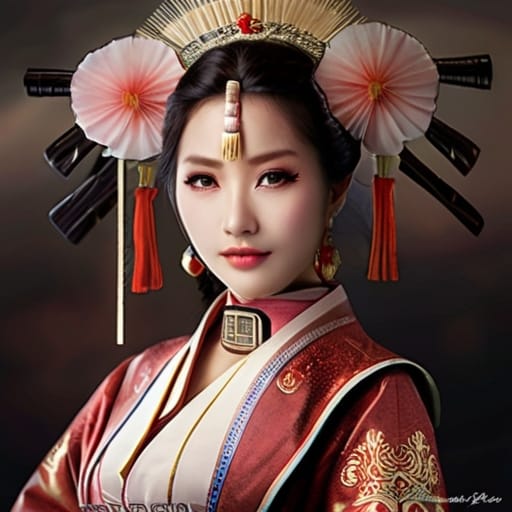
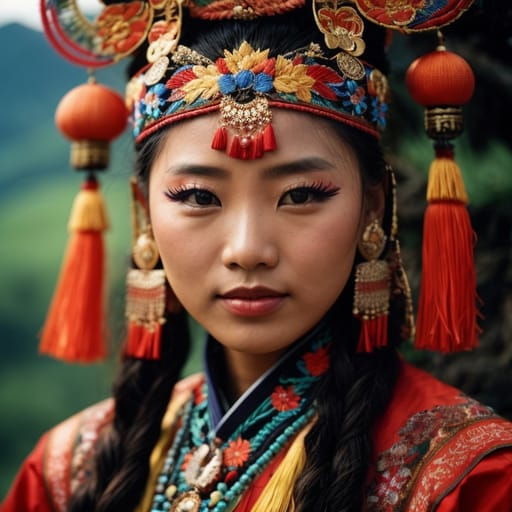
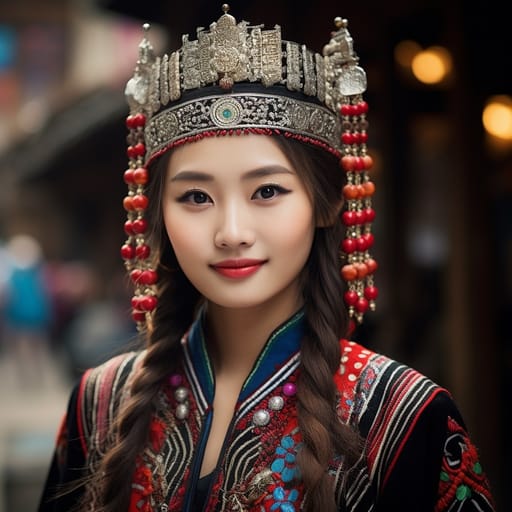
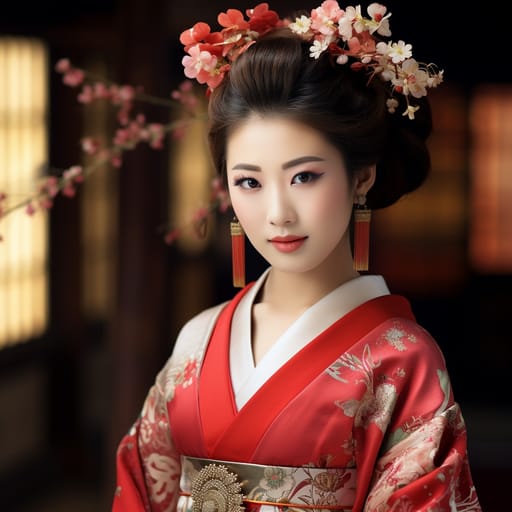
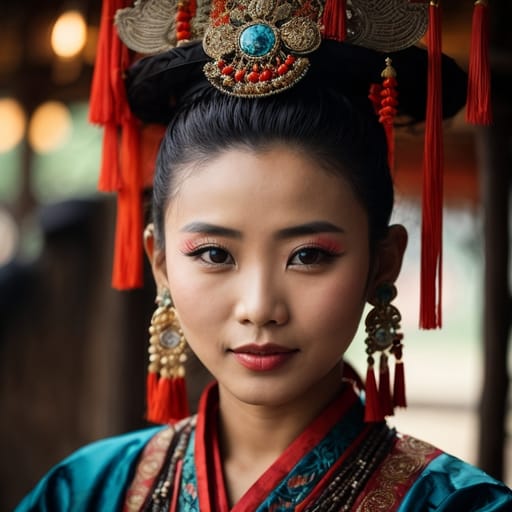
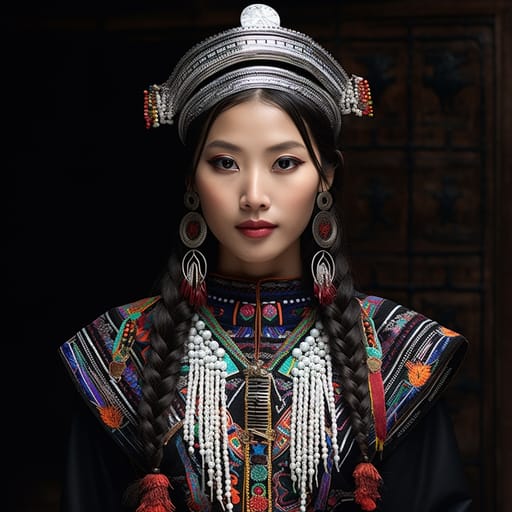
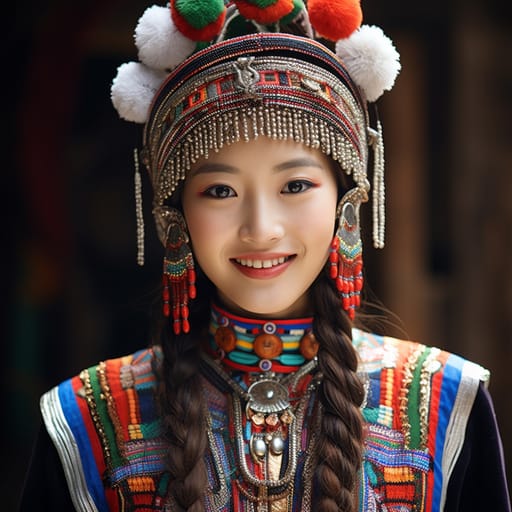
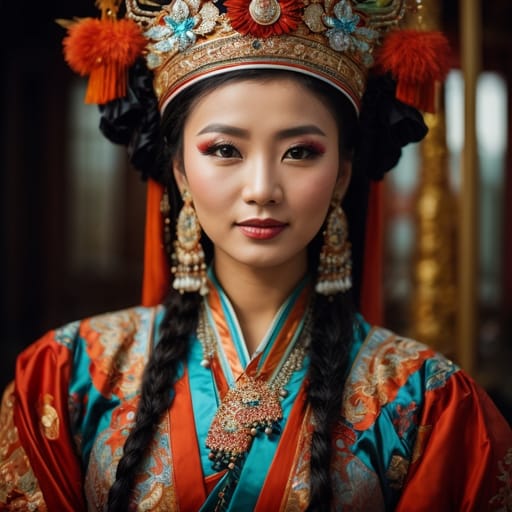
Typical Donghu Phenotypes
Reference for AI generation: hair, eyes, skin, facial structure, build
Donghu Body & Anatomy Reference
East Asian Sinitic / Mongoloid phenotype: anatomy reference for AI nude generation
Donghu Boobs & Breasts
Bust reference for Donghu women: small-to-medium cup, modest projection, which is typical of East Asian Sinitic / Mongoloid ancestry. Areolas measure about 26-36mm across, with light-pink to medium-brown pigmentation. Body type (ectomorph-to-mesomorph, lean frame) shapes the bust as well, so Donghu tits are usually firm and modestly projecting; smaller cup size than the South Asian or Western Asian average. In AI imagery, keep the forward-set shape rather than drifting toward the fuller South Asian or Levantine bust profile.
Donghu Ass & Hips
The Donghu ass is typically small-to-medium, modest projection, narrower hip profile, which sets it apart from the fuller projected glutes of the West African or Polynesian phenotype. Underneath, the pelvis shows narrower iliac crests, less gluteal-femoral fat deposition, part of the East Asian Sinitic / Mongoloid skeletal pattern. For Donghu butt pics and AI renders, match that silhouette and the overall build (ectomorph-to-mesomorph, lean frame).
Donghu Vagina & Pussy
Donghu pussy and vulvar anatomy presents light-pink to medium-brown labial pigmentation, smaller labia minora, consistent with the East Asian Sinitic / Mongoloid phenotype's pigmentation pattern. Donghu pubic hair is typically straight fine texture, sparser distribution than the South Asian norm, in the inverted-triangle pattern. For anatomically accurate Donghu pussy renders the labial coloration should match the surrounding light to medium skin tone with a continuous gradient, and the hair should keep its straight fine texture.
Donghu Dicks & Penis
Donghu dicks follow the East Asian Sinitic / Mongoloid reference data: regional mean ~11-12cm erect; moderate girth; light-brown shaft pigmentation. Shaft color should track the light to medium skin tone with a smooth change toward the glans, and Donghu pubic hair keeps its straight fine texture.
Donghu Body, Curves & Build
Donghu body type and overall build presents as ectomorph-to-mesomorph, lean frame, with mean adult female BMI 20-23: the characteristic East Asian Sinitic / Mongoloid habitus. Donghu curves and proportions should keep the regional skeletal frame (height, shoulder-to-hip ratio, limb proportions) rather than a generic mesomorph default.
Donghu Skin Tone & Hair Texture
Donghu skin sits in the light to medium (Fitzpatrick II-IV) band. Hair is typically straight 1A, fine-to-medium, predominantly black, in keeping with the East Asian Sinitic / Mongoloid phenotype. In nude renders the skin should stay one even tone from face to body, and body, pubic and head hair should match.
Explore phenotype categories
Structured taxonomy with peer-reviewed scales · 22 anatomical categories
Erotic Poses & Sex Positions
From the pose catalog: 219 named positions with reference skeletons
Frequently asked questions about Donghu people
Where is the Donghu homeland?
The Donghu homeland is The steppe and river country of southeastern Inner Mongolia, western Liaoning and eastern Mongolia, centered on the Xilamulun and Laoha basins east of the Greater Khingan range, in present-day China and Mongolia. in East Asia.
What language do Donghu people speak?
Donghu people primarily speak Unrecorded and unattested; reconstructed as Para-Mongolic or early Mongolic on the evidence of their Xianbei and Khitan successors (Mongolic)..
What religion do Donghu people practice?
The predominant religion among Donghu people is No direct record. Worship of heaven, earth, sun, moon, mountains and rivers, along with ancestor cult and shamanic practice, inferred from Chinese accounts of the Wuhuan and Xianbei..






Make your own Donghu images
Five a day, free, no credits to buy. The studio starts from this group's phenotype data, so you can set body type, pose and style and keep the traits accurate.
Start with Donghu