No portrait yet
Khitan Erotic
Shira Muren and Laoha river basins of present-day Inner Mongolia and Liaoning, China, ranging into eastern Mongolia and the Russian Far East
Khitan (Para-Mongolic, extinct), written in the Khitan large and small scripts, with Chinese widely used at court
Shamanism with sky, ancestor and mountain worship centered on Mount Muye, overlaid by strong Buddhist patronage under the Liao and Confucian administrative practice
Traditionally eight tribes, dominated by the imperial Yelü and consort Xiao clans. Western Liao (Qara Khitai) offshoot in Central Asia. The Daur are regarded as the likeliest living descendants.
About Khitan People
The Khitan were a historical pastoral people of the steppe and forest margin in what is now Inner Mongolia, Liaoning and eastern Mongolia, attested from the fourth century and dominant across northern East Asia from 907 to 1125 as the ruling house of the Liao dynasty. Over the following centuries they were absorbed into Han Chinese, Mongol and Jurchen populations, with the Daur of Inner Mongolia and Heilongjiang the most likely direct descendants. The name outlived the people: it is the root of Cathay, and of Kitay, the ordinary Russian word for China.
What set the Khitan apart from the other herding peoples of their world was that they built a state and ran it two ways at once. Yelü Abaoji ended the old practice of electing a khan from among eight tribes every three years, made himself emperor, and his successors governed the nomadic north through a Northern Chancellery and the farming Chinese south through a Southern Chancellery modeled on Tang practice. The court never sat still. Emperors moved with the seasons between hunting camps and five capitals, and business was done from tents as much as from palaces. Two writing systems, the Khitan large and small scripts, were commissioned within five years of each other in the 920s. Both are read today only in part, which is why so much of Khitan history comes through Chinese sources and archaeology rather than in their own words. The language is usually placed in the Para-Mongolic group, a sibling of Mongolic rather than its ancestor.
Religion layered rather than replaced. The ancestral cult of sky and mountain centered on Mount Muye, where the founding legend has a man on a white horse meeting a woman on a gray ox, and white horses and gray oxen remained the sacrifice of choice. Onto that the Liao court laid intense Buddhist patronage, printing the canon and raising pagodas, some of which still stand, including the timber pagoda at Yingxian. Emperors also performed a rain rite of shooting at willow branches and a periodic rebirth ceremony in which the ruler reenacted his own birth. Society was organized around two great lineages, the imperial Yelü and the consort Xiao, who intermarried generation after generation. Xiao women held real power, as regents and occasionally as field commanders. Elite dead were dressed for burial in gilt metal face masks and body nets of silver or copper wire, a custom without close parallel among their neighbors. When the Jurchen destroyed the Liao in 1125, the prince Yelü Dashi led survivors west across the steppe and founded the Qara Khitai in Central Asia, which lasted nearly a century before it too fell to the Mongols.
Related ethnic groups
Groups that share Khitan's homeland, region, language, or religious tradition. These are likely candidates for comparative phenotype reference.

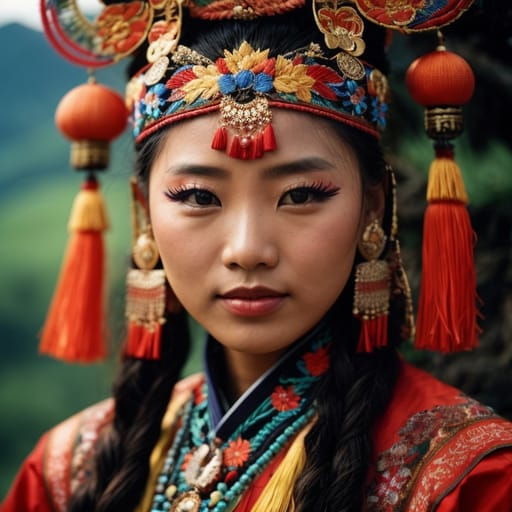
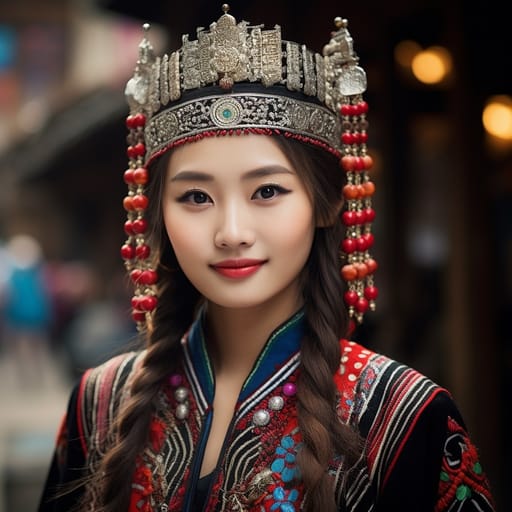

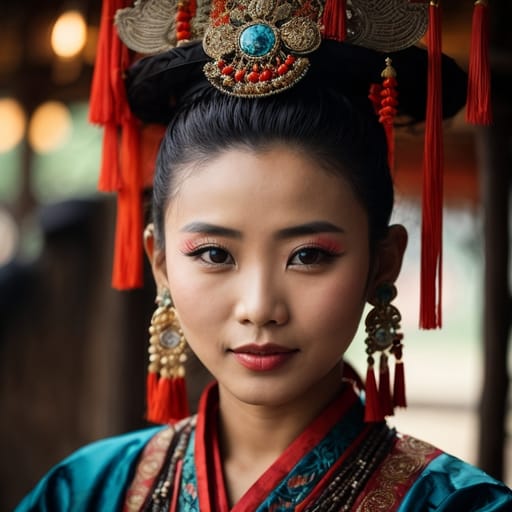
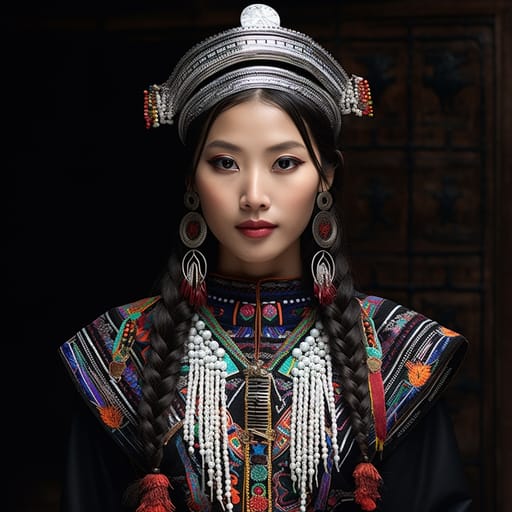
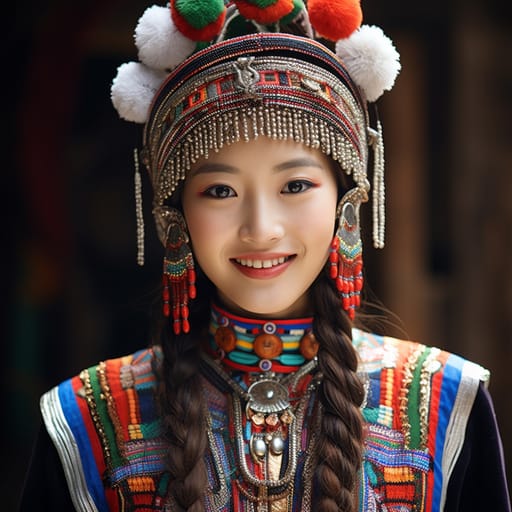
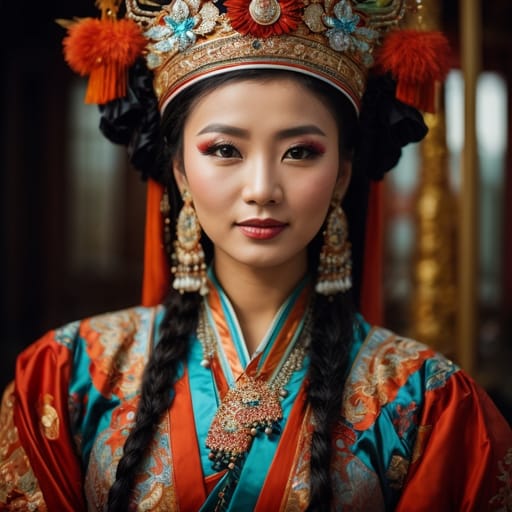
Typical Khitan Phenotypes
Reference for AI generation: hair, eyes, skin, facial structure, build
Khitan Body & Anatomy Reference
Anatomy by feature, East Asian Sinitic / Mongoloid phenotype
Khitan Boobs & Breasts
Bust reference for Khitan women: small-to-medium cup, modest projection, which is typical of East Asian Sinitic / Mongoloid ancestry. Areolas measure about 26-36mm across, with light-pink to medium-brown pigmentation. Body type (ectomorph-to-mesomorph, lean frame) shapes the bust as well, so Khitan tits are usually firm and modestly projecting; smaller cup size than the South Asian or Western Asian average. In AI imagery, keep the forward-set shape rather than drifting toward the fuller South Asian or Levantine bust profile.
Khitan Ass & Hips
The Khitan ass is typically small-to-medium, modest projection, narrower hip profile, which sets it apart from the fuller projected glutes of the West African or Polynesian phenotype. Underneath, the pelvis shows narrower iliac crests, less gluteal-femoral fat deposition, part of the East Asian Sinitic / Mongoloid skeletal pattern. For Khitan butt pics and AI renders, match that silhouette and the overall build (ectomorph-to-mesomorph, lean frame).
Khitan Vagina & Pussy
Khitan pussy and vulvar anatomy presents light-pink to medium-brown labial pigmentation, smaller labia minora, consistent with the East Asian Sinitic / Mongoloid phenotype's pigmentation pattern. Khitan pubic hair is typically straight fine texture, sparser distribution than the South Asian norm, in the inverted-triangle pattern. For anatomically accurate Khitan pussy renders the labial coloration should match the surrounding light to medium skin tone with a continuous gradient, and the hair should keep its straight fine texture.
Khitan Dicks & Penis
Khitan dicks follow the East Asian Sinitic / Mongoloid reference data: regional mean ~11-12cm erect; moderate girth; light-brown shaft pigmentation. Shaft color should track the light to medium skin tone with a smooth change toward the glans, and Khitan pubic hair keeps its straight fine texture.
Khitan Body, Curves & Build
Khitan body type and overall build presents as ectomorph-to-mesomorph, lean frame, with mean adult female BMI 20-23: the characteristic East Asian Sinitic / Mongoloid habitus. Khitan curves and proportions should keep the regional skeletal frame (height, shoulder-to-hip ratio, limb proportions) rather than a generic mesomorph default.
Khitan Skin Tone & Hair Texture
Khitan skin sits in the light to medium (Fitzpatrick II-IV) band. Hair is typically straight 1A, fine-to-medium, predominantly black, in keeping with the East Asian Sinitic / Mongoloid phenotype. In nude renders the skin should stay one even tone from face to body, and body, pubic and head hair should match.
Explore phenotype categories
Structured taxonomy with peer-reviewed scales · 22 anatomical categories
Erotic Poses & Sex Positions
From the pose catalog: 219 named positions with reference skeletons
Frequently asked questions about Khitan people
Where is the Khitan homeland?
The Khitan homeland is Shira Muren and Laoha river basins of present-day Inner Mongolia and Liaoning, China, ranging into eastern Mongolia and the Russian Far East in East Asia.
What language do Khitan people speak?
Khitan people primarily speak Khitan (Para-Mongolic, extinct), written in the Khitan large and small scripts, with Chinese widely used at court.
What religion do Khitan people practice?
The predominant religion among Khitan people is Shamanism with sky, ancestor and mountain worship centered on Mount Muye, overlaid by strong Buddhist patronage under the Liao and Confucian administrative practice.






Make your own Khitan images
Five a day, free, no credits to buy. The studio starts from this group's phenotype data, so you can set body type, pose and style and keep the traits accurate.
Start with Khitan