No portrait yet
She Erotic
The hills of southeastern China, mainly northeastern Fujian and southern Zhejiang, with smaller communities in Jiangxi, Guangdong and Anhui
She Chinese, close to Hakka (Sino-Tibetan, Sinitic); Ho Ne, spoken by about a thousand people in Guangdong (Hmong-Mien); Mandarin widely used
Ancestor veneration centered on the Panhu legend, mixed with Taoist ritual and Chinese folk religion
Clans of the Lan, Lei and Zhong surnames; regional communities in Fujian, Zhejiang, Jiangxi and Guangdong; Ho Ne speakers in Guangdong; one of China's 56 recognized ethnic groups
About She People
The She call themselves Shanha, usually glossed as mountain guests, and the name fits. For centuries they farmed the steep, forested hill country where Fujian, Guangdong and Jiangxi meet. They lived beside Han settlers but were never counted as part of them. The Chinese character for their name refers to fields cleared by burning, an outsider's label for the slash-and-burn farming that once shaped life in the uplands. Today most She live in villages and county towns across northeastern Fujian and southern Zhejiang. Jingning She Autonomous County in Zhejiang is the only county in China set aside for them. Smaller communities live in Jiangxi, Guangdong and Anhui.
What holds the She together is less a territory than a shared origin story. They trace their descent to Panhu, a dragon-dog. In the legend, Panhu brought an ancient emperor the head of an enemy general and won the emperor's daughter as his reward. Their children founded the lineages behind the surnames that still mark She families, mainly Lan, Lei and Zhong. Clans kept painted scrolls of the Panhu story and carved ancestral staffs for ancestor rites. Phoenix Mountain near Chaozhou in Guangdong is remembered as the place it all began. Religious life mixes this ancestor veneration with Taoist ritual and local folk practice rather than following a single creed.
Language is where the She story gets complicated. Nearly all She speak a Chinese variety close to Hakka, and scholars still debate how centuries in the same southern hills produced that closeness. A small community in a handful of Guangdong counties keeps a separate language, Ho Ne. It belongs to the Hmong-Mien family, the same family as the languages of the Miao and Yao. It has only around a thousand speakers, and the number is shrinking.
The She have spent much of their history on the move. They fought Tang dynasty armies in the southern border hills in the seventh century, and afterward She clans moved northeast over many generations. By Ming and Qing times they had settled in eastern Fujian and Zhejiang. The People's Republic formally recognized them as a distinct nationality in 1956. Much of the older culture lives on in song. For generations, singers traded songs back and forth between villages and between men and women, carrying courtship, news and family history. On the third day of the third lunar month, families cook rice dyed black with leaves, a dish tied to the memory of the Tang-era rebel leader Lei Wanxing. Women's phoenix dress, with high wrapped hair and a headdress whose shape changes from county to county, is still the clearest marker at weddings and festivals.
Related ethnic groups
Groups that share She's homeland, region, language, or religious tradition. These are likely candidates for comparative phenotype reference.
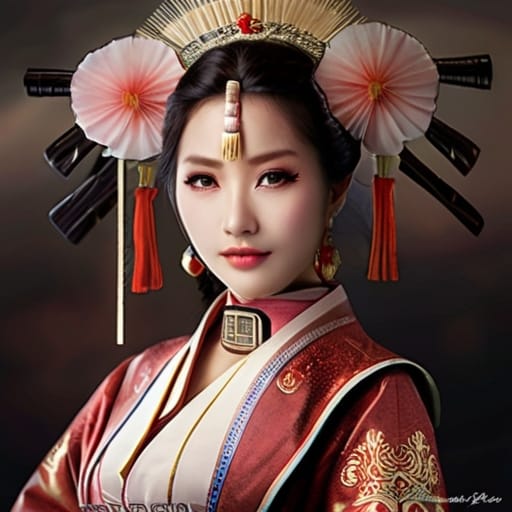
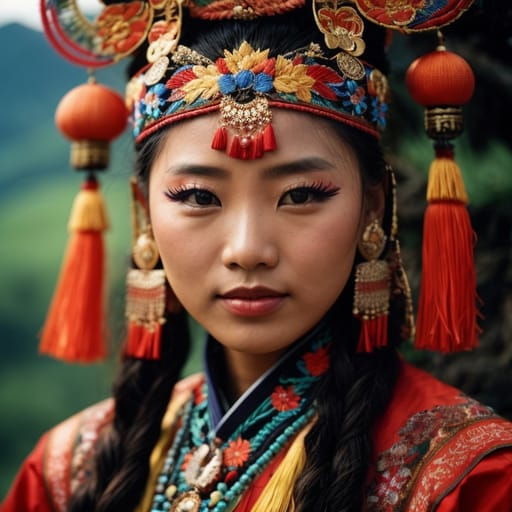
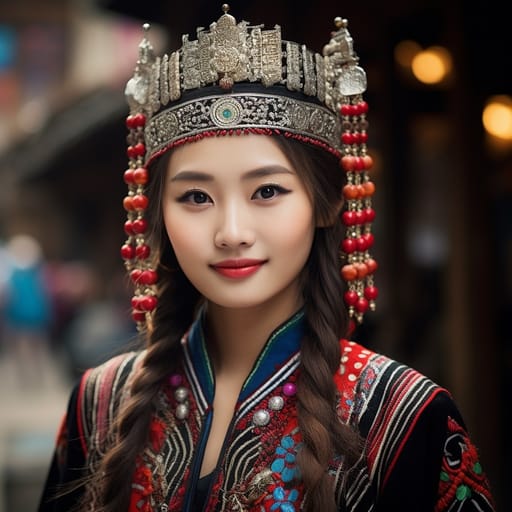
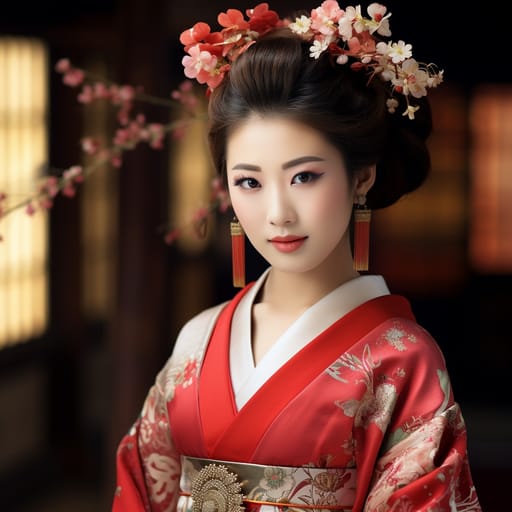
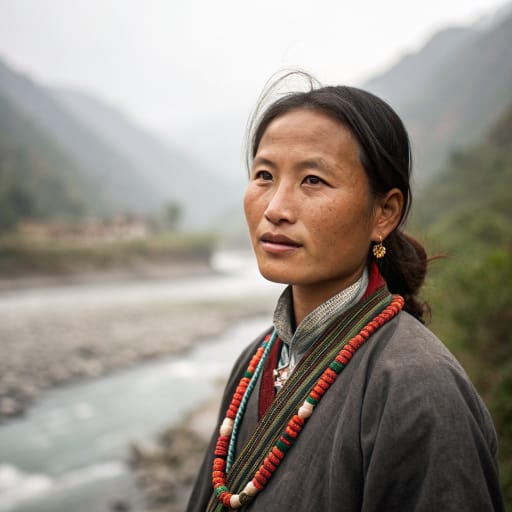
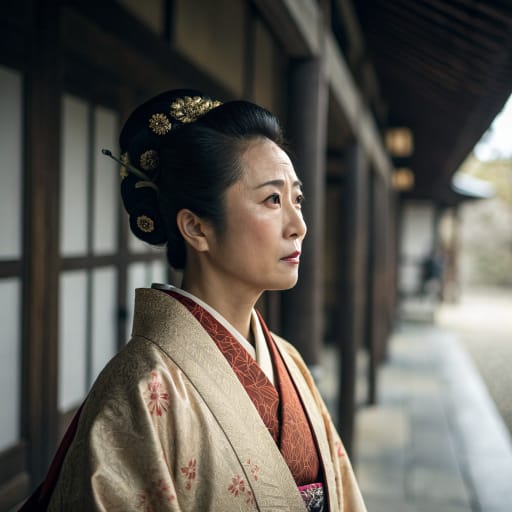
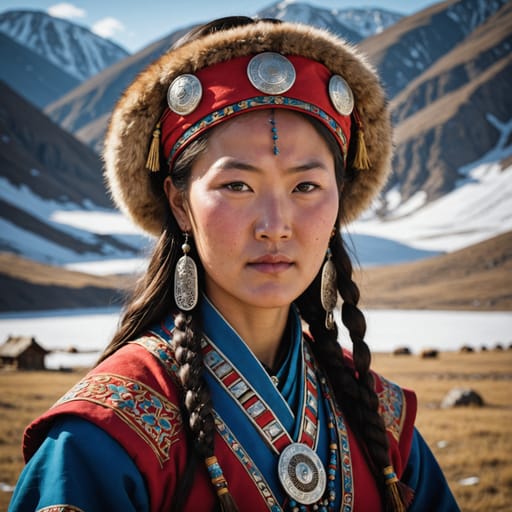
Typical She Phenotypes
Reference for AI generation: hair, eyes, skin, facial structure, build
She Body & Anatomy Reference
Per-feature anatomical profile for AI nude generation: East Asian Sinitic / Mongoloid phenotype
She Boobs & Breasts
She boobs follow the East Asian Sinitic / Mongoloid profile: small-to-medium cup, modest projection. Areolar diameter is usually 26-36mm, and the coloring is light-pink to medium-brown areolar pigmentation against the light-to-medium skin tone. Breast shape tracks body composition (ectomorph-to-mesomorph, lean frame, mean adult female BMI 20-23), so She breasts tend to be firm and modestly projecting; smaller cup size than the South Asian or Western Asian average. Expect a forward-set shape, not the fuller South Asian or Levantine bust profile.
She Ass & Hips
She ass and hip morphology presents as small-to-medium, modest projection, narrower hip profile, distinctly different from the fuller projected glutes of the West African or Polynesian phenotype. The She pelvic profile shows narrower iliac crests, less gluteal-femoral fat deposition, anchored in the East Asian Sinitic / Mongoloid skeletal pattern. She butt shots in adult AI imagery should render the small-to-medium, modest projection, narrower hip profile silhouette with the overall build (ectomorph-to-mesomorph, lean frame) and the fat distribution typical of the East Asian Sinitic / Mongoloid phenotype.
She Vagina & Pussy
She pussy anatomy typically shows light-pink to medium-brown labial pigmentation, smaller labia minora. Pubic hair is usually straight fine texture, sparser distribution than the South Asian norm. In AI-generated She nudes, labial color should blend into the light to medium skin with a gradual transition, and the hair should keep its straight fine texture.
She Dicks & Penis
Penis reference for She men: regional mean ~11-12cm erect, moderate girth. Coloring: light-brown shaft pigmentation. An accurate She cock in AI imagery matches the surrounding light to medium skin rather than a generic porn default. Circumcision depends on religion and custom, not ancestry.
She Body, Curves & Build
The She figure is generally ectomorph-to-mesomorph, lean frame, with mean adult female BMI 20-23, characteristic of East Asian Sinitic / Mongoloid ancestry. AI image tools tend to flatten regional body types into a few stock shapes; here the She build is kept as its own reference.
She Skin Tone & Hair Texture
Skin: light to medium (Fitzpatrick II-IV). Hair: straight 1A, fine-to-medium, predominantly black. Both are typical of East Asian Sinitic / Mongoloid ancestry. The most common mistake in AI nudes of She women is a body rendered lighter than the face.
Explore phenotype categories
Structured taxonomy with peer-reviewed scales · 22 anatomical categories
Erotic Poses & Sex Positions
From the pose catalog: 219 named positions with reference skeletons
Frequently asked questions about She people
Where is the She homeland?
The She homeland is The hills of southeastern China, mainly northeastern Fujian and southern Zhejiang, with smaller communities in Jiangxi, Guangdong and Anhui in East Asia.
What language do She people speak?
She people primarily speak She Chinese, close to Hakka (Sino-Tibetan, Sinitic); Ho Ne, spoken by about a thousand people in Guangdong (Hmong-Mien); Mandarin widely used.
What religion do She people practice?
The predominant religion among She people is Ancestor veneration centered on the Panhu legend, mixed with Taoist ritual and Chinese folk religion.






Make your own She images
Five a day, free, no credits to buy. The studio starts from this group's phenotype data, so you can set body type, pose and style and keep the traits accurate.
Start with She