Help us get this right
Does this portrait look right for Pumi?
Nobody has judged this one yet. You would be the first.
Pumi Erotic
Northwest Yunnan, chiefly Lanping, Ninglang, Lijiang, Yongsheng and Weixi counties, with related Prinmi communities in Muli and Yanyuan in southwest Sichuan, China.
Prinmi, in northern and southern varieties (Qiangic, Tibeto-Burman, Sino-Tibetan); Southwestern Mandarin widely spoken alongside it, and the language has no traditional writing system of its own.
Indigenous ancestor, hearth and mountain worship conducted by Hangui priests, practiced alongside Gelug school Tibetan Buddhism.
Qiangic branch of Tibeto-Burman, alongside the Qiang, Ersu and Namuyi. Split administratively between the Pumi nationality in Yunnan and Prinmi speakers officially classified as Tibetan in Sichuan.
About Pumi People
The Pumi know themselves as Prinmi, a name usually glossed as white people, and they are among the smallest of China's officially recognized nationalities: a little over forty thousand, most of them in the mountain country of northwest Yunnan where the Nujiang, Lancang and Jinsha rivers run south in parallel gorges. Their villages sit high, in Lanping, Ninglang, Lijiang, Yongsheng and Weixi, on slopes given to barley, buckwheat, corn and potatoes rather than wet rice. Their own accounts and the linguistic evidence both point north. Prinmi belongs to the Qiangic group within Tibeto-Burman, closer to the languages of the Sichuan highlands than to anything spoken by their Bai, Naxi or Yi neighbors, and the history it implies is one of herding people working their way south off the Qinghai-Tibetan plateau over a long stretch of centuries. Chinese records for most of that time filed them under the catch-all label Xifan, which covered a great many peoples and clarified none of them. The Pumi designation itself dates only to 1960, and it stopped at a provincial line: Prinmi speakers across the border in Muli and Yanyuan, in Sichuan, were classified as Tibetan instead. The same people carry different official identities depending on which side of the boundary their village happens to sit.
Religion runs on two tracks that most families see no conflict in. Gelug Tibetan Buddhism came with the monastic estates around Muli and is genuinely theirs; so is the older indigenous practice, handled by ritual specialists called Hangui, who chant from memory and manage the business of ancestors, hearth and mountain. The clearest expression of it is the funeral, where a sheep is fed grain and liquor, spoken to, and killed, its task being to lead the dead back along the migration route to the ancestral country in the north. The route is recited aloud, place by place. Houses are stacked log construction built around a central hearth flanked by two posts, one understood as male and one as female, and the hearth takes an offering before anyone eats. At thirteen a child is brought to it for the trouser or skirt ceremony, standing with one foot on a sack of grain and one on a side of cured pork, food and wealth underfoot, and walks away dressed as an adult. Some Pumi families near Lugu Lake took up the visiting-marriage arrangements of their Na neighbors. New Year is slaughter season, and the pig is pressed flat and cured whole to last the year.
Related ethnic groups
Groups that share Pumi's homeland, region, language, or religious tradition. These are likely candidates for comparative phenotype reference.
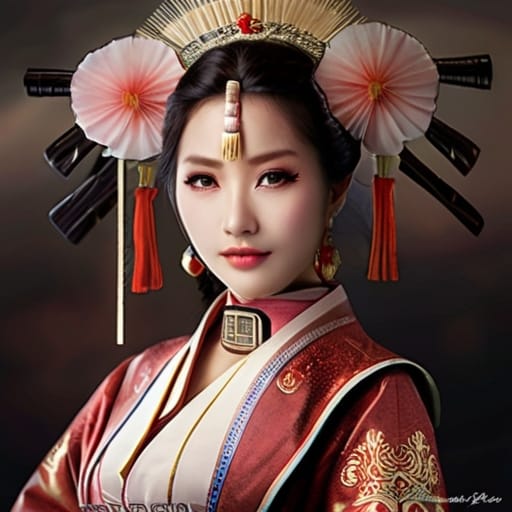
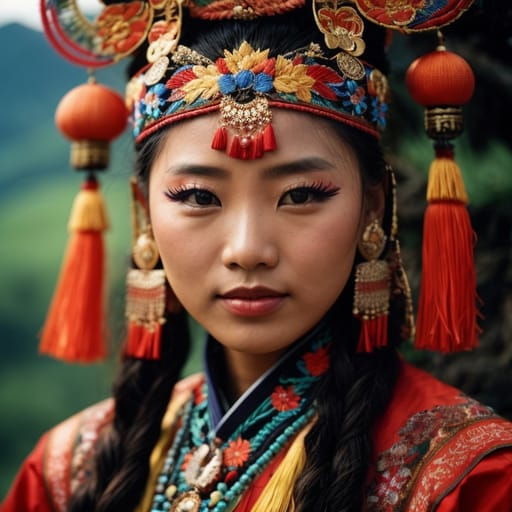
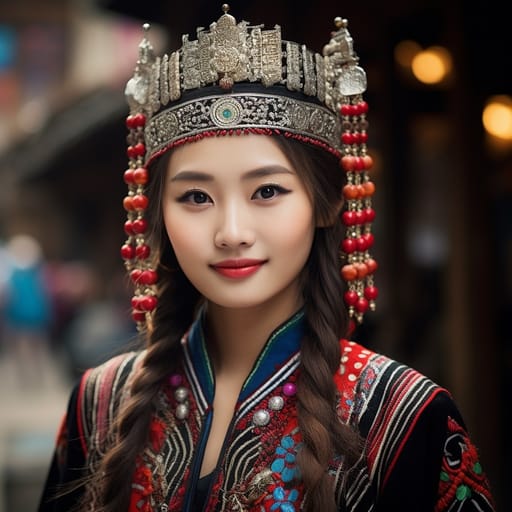
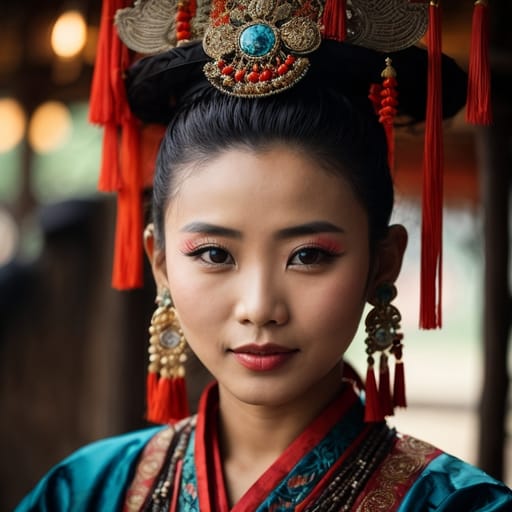
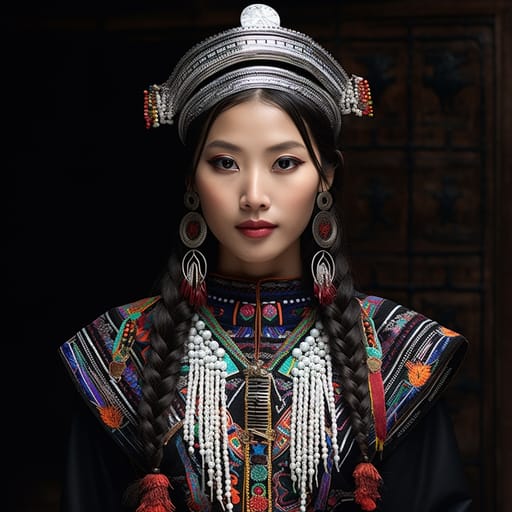
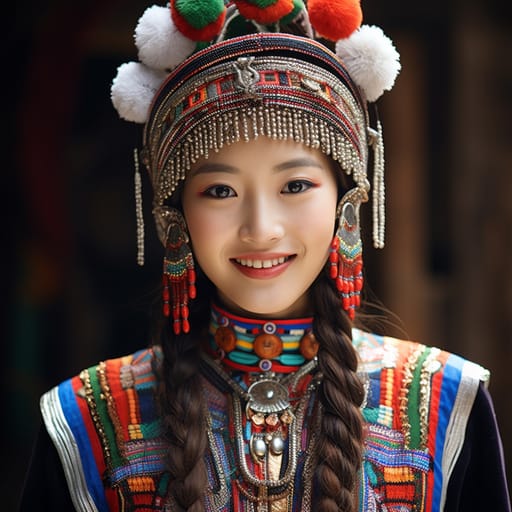
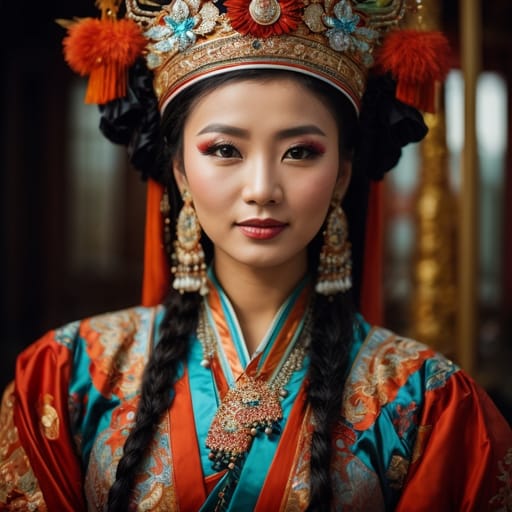
Typical Pumi Phenotypes
Reference for AI generation: hair, eyes, skin, facial structure, build
Pumi Body & Anatomy Reference
Anatomy by feature, East Asian Sinitic / Mongoloid phenotype
Pumi Boobs & Breasts
Bust reference for Pumi women: small-to-medium cup, modest projection, which is typical of East Asian Sinitic / Mongoloid ancestry. Areolas measure about 26-36mm across, with light-pink to medium-brown pigmentation. Body type (ectomorph-to-mesomorph, lean frame) shapes the bust as well, so Pumi tits are usually firm and modestly projecting; smaller cup size than the South Asian or Western Asian average. In AI imagery, keep the forward-set shape rather than drifting toward the fuller South Asian or Levantine bust profile.
Pumi Ass & Hips
The Pumi ass is typically small-to-medium, modest projection, narrower hip profile, which sets it apart from the fuller projected glutes of the West African or Polynesian phenotype. Underneath, the pelvis shows narrower iliac crests, less gluteal-femoral fat deposition, part of the East Asian Sinitic / Mongoloid skeletal pattern. For Pumi butt pics and AI renders, match that silhouette and the overall build (ectomorph-to-mesomorph, lean frame).
Pumi Vagina & Pussy
Pumi pussy and vulvar anatomy presents light-pink to medium-brown labial pigmentation, smaller labia minora, consistent with the East Asian Sinitic / Mongoloid phenotype's pigmentation pattern. Pumi pubic hair is typically straight fine texture, sparser distribution than the South Asian norm, in the inverted-triangle pattern. For anatomically accurate Pumi pussy renders the labial coloration should match the surrounding light to medium skin tone with a continuous gradient, and the hair should keep its straight fine texture.
Pumi Dicks & Penis
Pumi dicks follow the East Asian Sinitic / Mongoloid reference data: regional mean ~11-12cm erect; moderate girth; light-brown shaft pigmentation. Shaft color should track the light to medium skin tone with a smooth change toward the glans, and Pumi pubic hair keeps its straight fine texture.
Pumi Body, Curves & Build
Pumi body type and overall build presents as ectomorph-to-mesomorph, lean frame, with mean adult female BMI 20-23: the characteristic East Asian Sinitic / Mongoloid habitus. Pumi curves and proportions should keep the regional skeletal frame (height, shoulder-to-hip ratio, limb proportions) rather than a generic mesomorph default.
Pumi Skin Tone & Hair Texture
Pumi skin sits in the light to medium (Fitzpatrick II-IV) band. Hair is typically straight 1A, fine-to-medium, predominantly black, in keeping with the East Asian Sinitic / Mongoloid phenotype. In nude renders the skin should stay one even tone from face to body, and body, pubic and head hair should match.
Explore phenotype categories
Structured taxonomy with peer-reviewed scales · 22 anatomical categories
Erotic Poses & Sex Positions
From the pose catalog: 219 named positions with reference skeletons
Frequently asked questions about Pumi people
Where is the Pumi homeland?
The Pumi homeland is Northwest Yunnan, chiefly Lanping, Ninglang, Lijiang, Yongsheng and Weixi counties, with related Prinmi communities in Muli and Yanyuan in southwest Sichuan, China. in East Asia.
What language do Pumi people speak?
Pumi people primarily speak Prinmi, in northern and southern varieties (Qiangic, Tibeto-Burman, Sino-Tibetan); Southwestern Mandarin widely spoken alongside it, and the language has no traditional writing system of its own..
What religion do Pumi people practice?
The predominant religion among Pumi people is Indigenous ancestor, hearth and mountain worship conducted by Hangui priests, practiced alongside Gelug school Tibetan Buddhism..






Make your own Pumi images
Five a day, free, no credits to buy. The studio starts from this group's phenotype data, so you can set body type, pose and style and keep the traits accurate.
Start with Pumi