No portrait yet
Xirong Erotic
The Wei River valley and the uplands west and northwest of it: present-day Shaanxi, Gansu, Ningxia, and eastern Qinghai, China
Unrecorded; probably several unrelated languages, some of them likely early Qiangic (Sino-Tibetan)
No doctrinal record survives; burial evidence points to ancestral rites and animal sacrifice
A Chinese umbrella category, one of the four directional labels alongside Dongyi, Nanman, and Beidi; named constituent groups include the Quanrong, Yiqu, Jiang Rong, Luhun, and Lirong
About Xirong People
Xirong was never a name anyone called themselves. It is a Chinese direction plus a Chinese word for war: the Rong of the west, applied across the Zhou centuries and into the Warring States period to the many peoples holding the Wei River valley, the Gansu corridor, and the highland margins of what are now Shaanxi, Ningxia, and eastern Qinghai. The character rong doubles as the classical word for weapons and armed force, which tells you most of what the Zhou court meant by it. Those peoples were absorbed, by conquest, forced resettlement, and intermarriage, into the frontier state of Qin and its neighbors over the last centuries BCE. Their descendants are in the population of northwest China, and some of what they were carried forward into the later Qiang and Di of the same uplands.
Because the label was a category and not an identity, it flattened real differences: dozens of polities with their own rulers, and probably several unrelated languages, filed under one heading by the scribes who fought them. Individual names do survive in the annals. The Quanrong took the Western Zhou capital in 771 BCE and killed King You, ending Zhou power in the west and pushing the dynasty east to Luoyang, so that the whole Spring and Autumn era dates from that defeat. The Jiang Rong and the Luhun were drawn into the alliance politics of the central states as clients and as troops, useful until they were not. The Yiqu, on the Jing River, held out longest as an organized power and were finished by Qin in the third century BCE. Qin itself grew up on this frontier and grew strong on it, taking Rong land and Rong soldiers generation after generation, which is part of why the eastern states thought Qin half barbarian. None of these peoples left writing, so the record gives them no voice of their own. What comes closest is the ground: at Majiayuan in eastern Gansu, Warring States tombs associated with a Xirong polity held chariots sheathed in gold and silver with inlay and animal ornament in a style shared with the steppe to the north. That is not the material culture of a poor periphery, whatever the annals implied about the people who made it.
Related ethnic groups
Groups that share Xirong's homeland, region, language, or religious tradition. These are likely candidates for comparative phenotype reference.
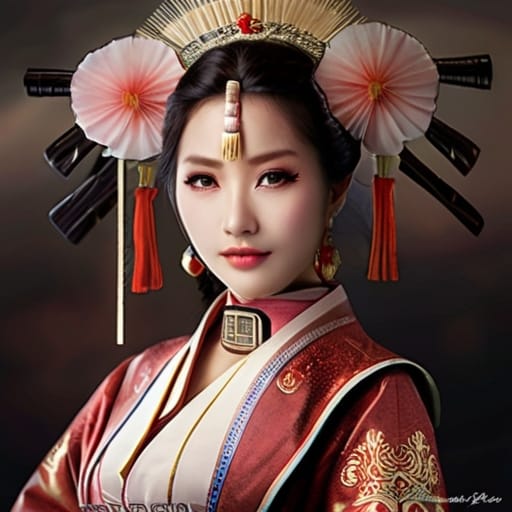
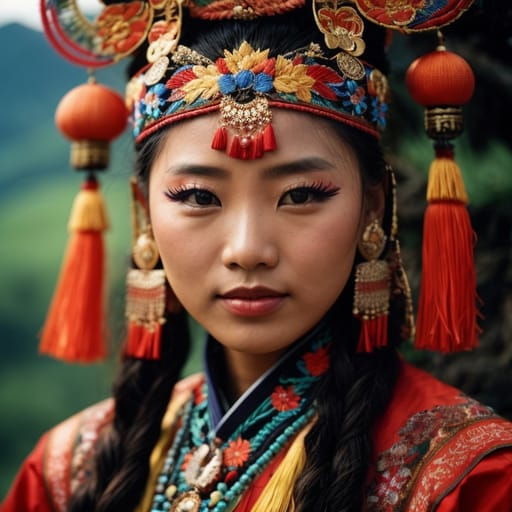
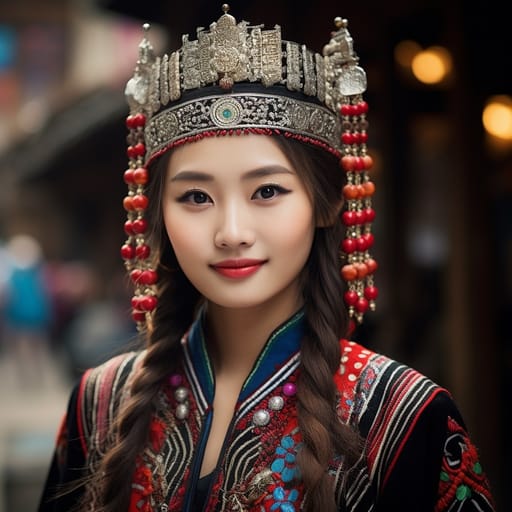
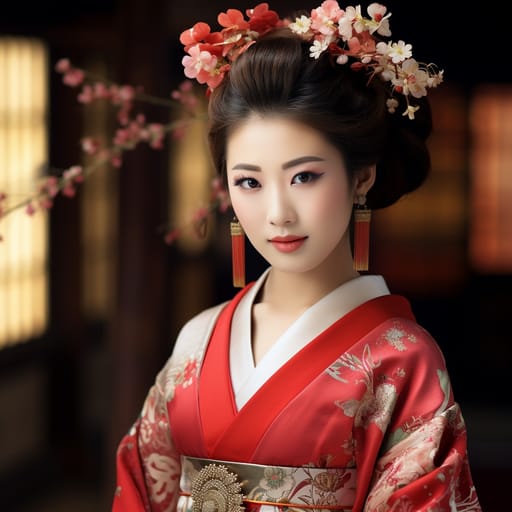
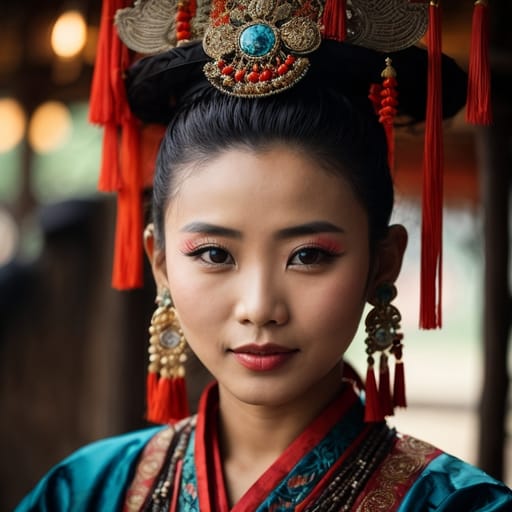
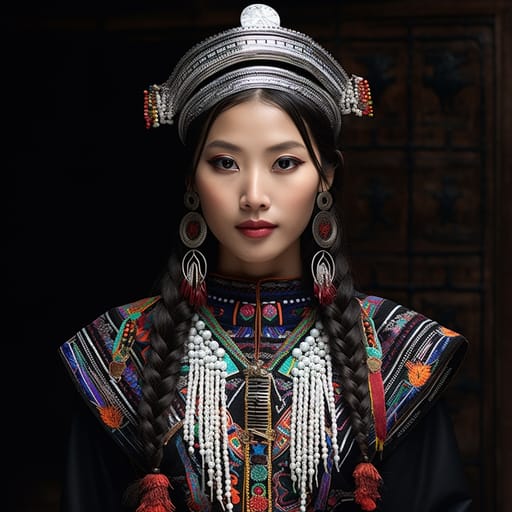
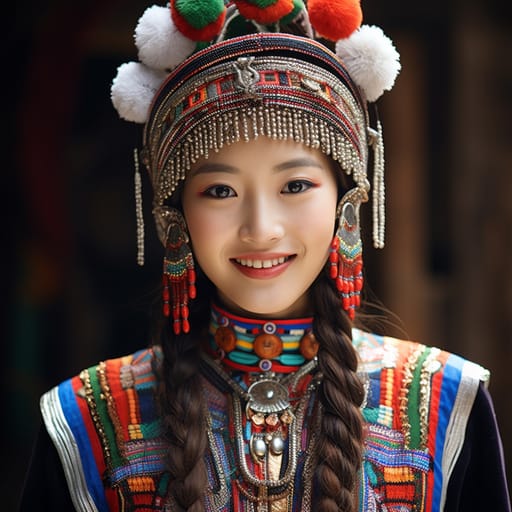
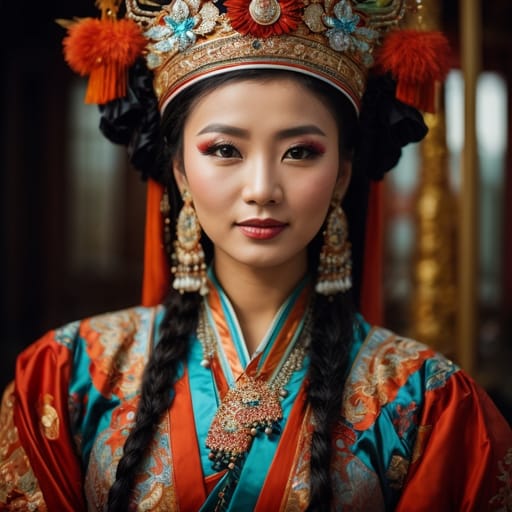
Typical Xirong Phenotypes
Reference for AI generation: hair, eyes, skin, facial structure, build
Xirong Body & Anatomy Reference
Anatomy by feature, East Asian Sinitic / Mongoloid phenotype
Xirong Boobs & Breasts
The typical Xirong bust is small-to-medium cup, modest projection, in line with the wider East Asian Sinitic / Mongoloid pattern. Areolas usually fall in the 26-36mm range, with light-pink to medium-brown areolar pigmentation against the light-to-medium skin tone. Compared with the fuller South Asian or Levantine bust profile, Xirong breasts sit forward and are generally firm and modestly projecting; smaller cup size than the South Asian or Western Asian average. A faithful AI render of Xirong tits keeps that shape and areola size.
Xirong Ass & Hips
Butt shape among Xirong women: small-to-medium, modest projection, narrower hip profile, over narrower iliac crests, less gluteal-femoral fat deposition. This follows East Asian Sinitic / Mongoloid ancestry and looks quite unlike the fuller projected glutes of the West African or Polynesian phenotype. An accurate Xirong ass in adult AI imagery keeps both the silhouette and the overall build (ectomorph-to-mesomorph, lean frame) instead of a generic average.
Xirong Vagina & Pussy
Vulvar anatomy among Xirong women: light-pink to medium-brown labial pigmentation, smaller labia minora. Pubic hair tends to be straight fine texture, sparser distribution than the South Asian norm, in the usual inverted-triangle pattern. Both follow East Asian Sinitic / Mongoloid pigmentation, which is why Xirong pussy renders should not fall back on a pale, sparse Western template.
Xirong Dicks & Penis
The Xirong cock profile, from East Asian Sinitic / Mongoloid anthropometric data: regional mean ~11-12cm erect; moderate girth; light-brown shaft pigmentation. Pubic hair has a straight fine texture and forms the usual inverted-V pattern. Whether Xirong men are circumcised follows religious and cultural practice rather than phenotype.
Xirong Body, Curves & Build
Build and curves among Xirong women follow the East Asian Sinitic / Mongoloid pattern: ectomorph-to-mesomorph, lean frame, mean adult female BMI 20-23. Proportions matter as much as skin tone, so Xirong figures should keep their regional height and limb ratios.
Xirong Skin Tone & Hair Texture
The Xirong skin range is light to medium (Fitzpatrick II-IV), and hair tends to be straight 1A, fine-to-medium, predominantly black. That combination marks the East Asian Sinitic / Mongoloid phenotype, and skin tone is the trait AI generators most often get wrong for Xirong women.
Explore phenotype categories
Structured taxonomy with peer-reviewed scales · 22 anatomical categories
Erotic Poses & Sex Positions
From the pose catalog: 219 named positions with reference skeletons
Frequently asked questions about Xirong people
Where is the Xirong homeland?
The Xirong homeland is The Wei River valley and the uplands west and northwest of it: present-day Shaanxi, Gansu, Ningxia, and eastern Qinghai, China in East Asia.
What language do Xirong people speak?
Xirong people primarily speak Unrecorded; probably several unrelated languages, some of them likely early Qiangic (Sino-Tibetan).
What religion do Xirong people practice?
The predominant religion among Xirong people is No doctrinal record survives; burial evidence points to ancestral rites and animal sacrifice.






Make your own Xirong images
Five a day, free, no credits to buy. The studio starts from this group's phenotype data, so you can set body type, pose and style and keep the traits accurate.
Start with Xirong