Help us get this right
Does this portrait look right for Waxiang?
Nobody has judged this one yet. You would be the first.
Waxiang Erotic
Hunan (China)
Chinese folk religion
About Waxiang People
The Waxiang are a small population scattered across the western mountains of Hunan, concentrated in Yuanling, Luxi, Chenxi, and a handful of surrounding counties along the upper Yuan River. They are not officially recognized as a separate ethnicity in China — most are classed as Han, some as Miao — but they speak something their neighbors cannot understand, and that linguistic stubbornness is what holds the group together as a distinct identity. The estimates put their numbers somewhere around 300,000 to 400,000 speakers, almost all of them in this one corner of Hunan.
Waxiang Chinese is the puzzle. It is clearly a Sinitic language, but linguists have argued for decades over where exactly it fits. It does not slot neatly into Mandarin, Xiang, or any of the other recognized branches; some researchers treat it as its own primary subdivision of Chinese, others as a deep archaism preserved in mountain isolation, others as a contact language shaped by long cohabitation with Miao and Tujia speakers. It carries vocabulary and tonal features that look older than the surrounding dialects, and its speakers have historically been bilingual with whichever local language dominated trade. The result is a speech community that sounds, to a Mandarin speaker, like Chinese rendered through an unfamiliar grammar.
The community's own origin story tracks them to military settlers and refugees who moved into western Hunan during the upheavals of the late imperial period — Ming-era garrisons, Qing-era migrations — and then never fully assimilated outward. The mountain terrain helped. Villages cluster along stream valleys and terraced slopes, with farming, tea, and forest products as the economic backbone. Religious life follows the broader pattern of rural southern Chinese folk practice: ancestor veneration at the family altar, lineage halls where they survive, local tutelary deities tied to specific peaks and waterways, and the calendar of festivals that organizes the agricultural year. Daoist and Buddhist elements thread through everyday ritual without anyone bothering to separate them.
What outsiders notice first, after the language, is the cultural braiding with neighboring Miao and Tujia communities — wedding songs, funeral customs, embroidery patterns, and certain festival foods that show clear cross-pollination. The Waxiang sit at a hinge point between Han China and the southwestern minority belt, and they have spent several centuries being a little of both without ever resolving into either.
Related ethnic groups
Groups that share Waxiang's homeland, region, language, or religious tradition. These are likely candidates for comparative phenotype reference.
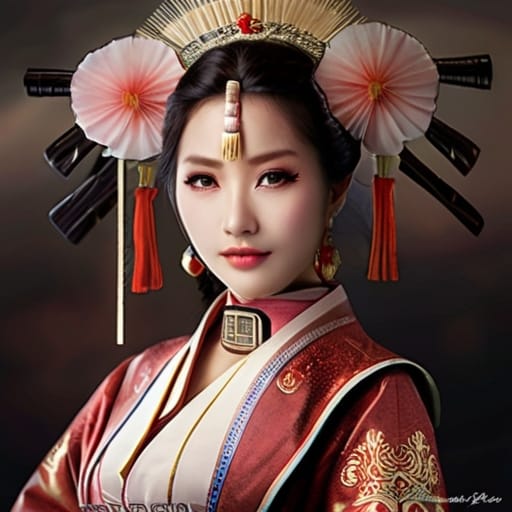
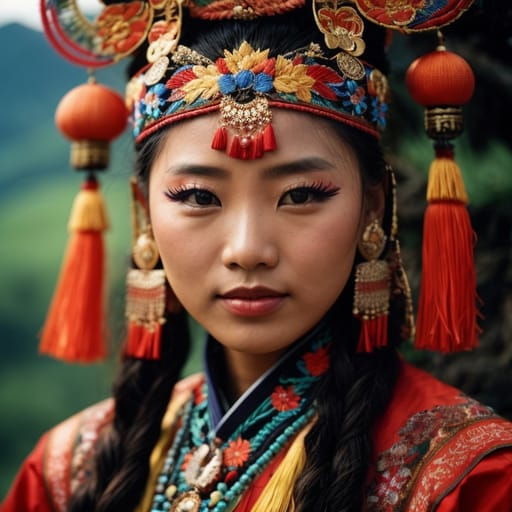
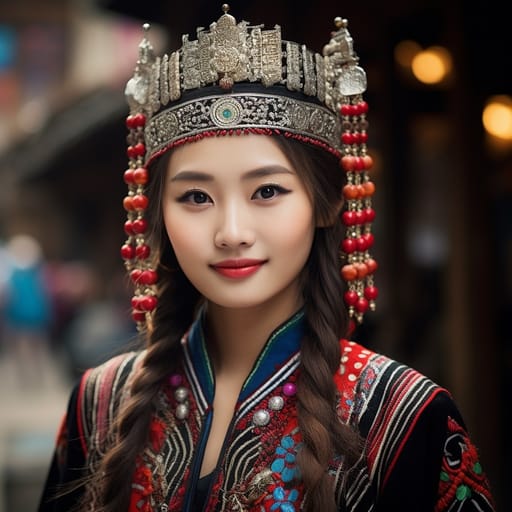
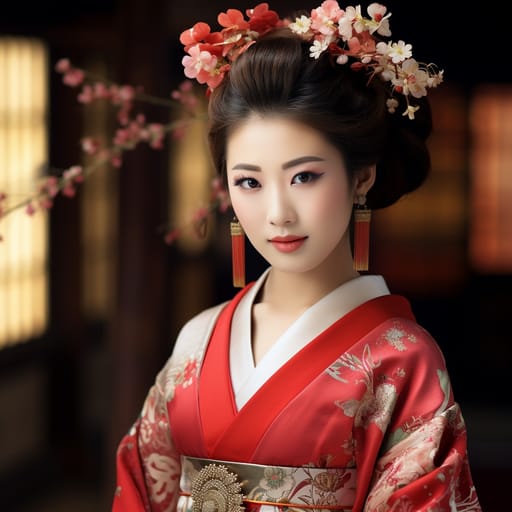
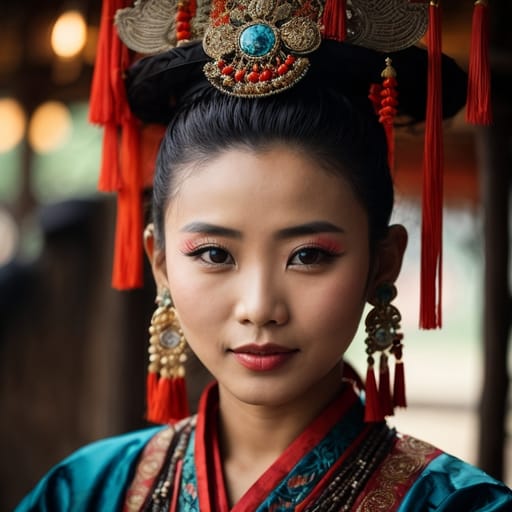
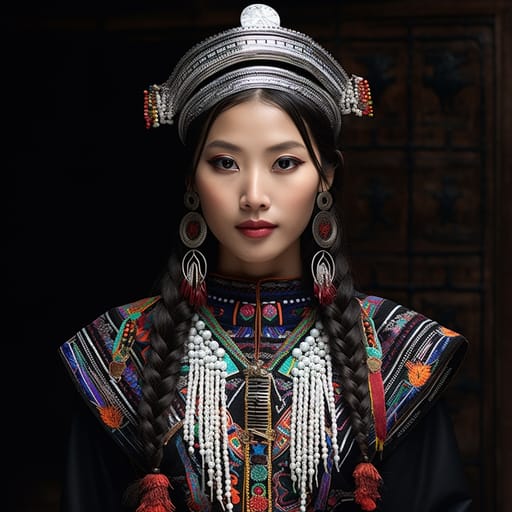
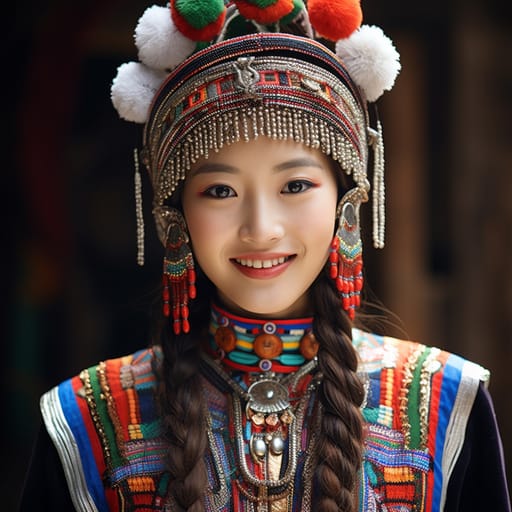
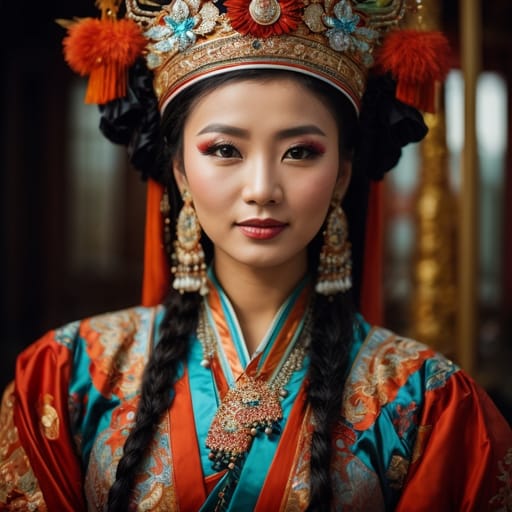
Typical Waxiang Phenotypes
Reference for AI generation: hair, eyes, skin, facial structure, build
The Waxianghua-speaking population of western Hunan — concentrated in Yuanling, Luxi, Guzhang, and surrounding counties along the Yuan River — sits inside the broader East Asian phenotype range but skews toward the southern Han pattern with measurable Hmong-Mien and Tujia admixture from centuries of contact with neighboring Miao and Tujia communities. Hair is uniformly black or near-black, straight to faintly wavy, coarse in texture, and holds its color late into life relative to northern populations. Graying is gradual rather than early. Facial and body hair is sparse on men, almost absent on women.
Eye color runs from medium to very dark brown, with true black-brown common. The epicanthic fold is near-universal, though often softer and less pronounced than in northern Han or Korean populations — many Waxiang individuals show a partial or tapered fold rather than the deep, fully covered inner canthus typical further north. Eye shape tends toward almond with a moderate upward outer slant. Skin falls in the Fitzpatrick III–IV range, with warm yellow to light olive undertones; rural agricultural exposure deepens this to a tanned IV in working populations, while younger urban Waxiang often present closer to III with a porcelain quality.
Facial structure is the clearest regional marker. Compared to northern Han, Waxiang faces tend to be shorter and rounder, with less prominent cheekbones, softer jawlines, and a flatter mid-face. Noses are small to medium with a low-to-medium bridge and moderate alar width — narrower than Hmong-Mien neighbors but broader than coastal Han. Lips are medium in fullness, often with a defined cupid's bow. Song Zuying, whose father is Waxiang, illustrates the typical soft-featured oval face and refined nose of the group.
Build is compact. Adult male stature averages roughly 165–170 cm, female 153–158 cm — shorter than the national Han mean. Frames are slender to lightly muscled, with narrow shoulders, modest hip-to-waist ratios, and a tendency toward lean rather than stocky proportions even in laboring populations.
Waxiang Body & Anatomy Reference
Anatomy by feature, East Asian Sinitic / Mongoloid phenotype
Waxiang Boobs & Breasts
The typical Waxiang bust is small-to-medium cup, modest projection, in line with the wider East Asian Sinitic / Mongoloid pattern. Areolas usually fall in the 26-36mm range, with light-pink to medium-brown areolar pigmentation against the light-to-medium skin tone. Compared with the fuller South Asian or Levantine bust profile, Waxiang breasts sit forward and are generally firm and modestly projecting; smaller cup size than the South Asian or Western Asian average. A faithful AI render of Waxiang tits keeps that shape and areola size.
Waxiang Ass & Hips
Butt shape among Waxiang women: small-to-medium, modest projection, narrower hip profile, over narrower iliac crests, less gluteal-femoral fat deposition. This follows East Asian Sinitic / Mongoloid ancestry and looks quite unlike the fuller projected glutes of the West African or Polynesian phenotype. An accurate Waxiang ass in adult AI imagery keeps both the silhouette and the overall build (ectomorph-to-mesomorph, lean frame) instead of a generic average.
Waxiang Vagina & Pussy
Vulvar anatomy among Waxiang women: light-pink to medium-brown labial pigmentation, smaller labia minora. Pubic hair tends to be straight fine texture, sparser distribution than the South Asian norm, in the usual inverted-triangle pattern. Both follow East Asian Sinitic / Mongoloid pigmentation, which is why Waxiang pussy renders should not fall back on a pale, sparse Western template.
Waxiang Dicks & Penis
The Waxiang cock profile, from East Asian Sinitic / Mongoloid anthropometric data: regional mean ~11-12cm erect; moderate girth; light-brown shaft pigmentation. Pubic hair has a straight fine texture and forms the usual inverted-V pattern. Whether Waxiang men are circumcised follows religious and cultural practice rather than phenotype.
Waxiang Body, Curves & Build
Build and curves among Waxiang women follow the East Asian Sinitic / Mongoloid pattern: ectomorph-to-mesomorph, lean frame, mean adult female BMI 20-23. Proportions matter as much as skin tone, so Waxiang figures should keep their regional height and limb ratios.
Waxiang Skin Tone & Hair Texture
The Waxiang skin range is light to medium (Fitzpatrick II-IV), and hair tends to be straight 1A, fine-to-medium, predominantly black. That combination marks the East Asian Sinitic / Mongoloid phenotype, and skin tone is the trait AI generators most often get wrong for Waxiang women.
Data depth
18/100Coverage of image-grounded phenotype observations · drives AI generation diversity
- Sample size
- 3/40· 1 image
- Image quality
- 0/30· 0% high
- Confidence
- 15/20· mean 0.72
- Source diversity
- 0/10· wikipedia
- ·No image observations yet
- ·Wikipedia-only source, not population-representative
Explore phenotype categories
Structured taxonomy with peer-reviewed scales · 22 anatomical categories
Notable Waxiang People
1 reference figure, sourced from Wikipedia
- Song Zuying, mother is Miao, father is Waxiang.[citation needed]
Erotic Poses & Sex Positions
From the pose catalog: 219 named positions with reference skeletons
Frequently asked questions about Waxiang people
Where is the Waxiang homeland?
The Waxiang homeland is Hunan (China) in East Asia.
What language do Waxiang people speak?
Waxiang people primarily speak Sino-Tibetan / Chinese / Waxiang Chinese.
What religion do Waxiang people practice?
The predominant religion among Waxiang people is Chinese folk religion.






Make your own Waxiang images
Five a day, free, no credits to buy. The studio starts from this group's phenotype data, so you can set body type, pose and style and keep the traits accurate.
Start with Waxiang