No portrait yet
Spokane Erotic
The Spokane River basin of eastern Washington state, United States, centered on the Spokane Indian Reservation at Wellpinit; members are also enrolled at Colville and Coeur d'Alene.
Spokane, or Npoqínišcn (Salishan, Southern Interior branch), a dialect continuum with Kalispel and Montana Salish; English is the everyday language.
Presbyterian and Catholic Christianity dating to nineteenth century missions, alongside continuing Plateau ceremonial practice including the winter dance.
Interior Salish of the Columbia Plateau; historically the Upper, Middle and Lower Spokane bands; close kin to the Kalispel, Pend d'Oreille, Coeur d'Alene and Colville peoples.
About Spokane People
The Spokane take their name from the river, and the river took its shape from a set of falls in the middle of what is now Washington's second largest city. Before the mills and the streetlights, those falls were a fishery: a place where chinook stacked up in the narrows every summer and where families from up and down the Plateau came to trade, argue, marry and eat. Say the name the way they do, with the last syllable flat: spo-KAN. The tribe was historically three bands, Upper, Middle and Lower, spread along the Spokane and the Little Spokane, each with its own fishing stations and its own claim on the surrounding camas and bitterroot grounds. Their language, Npoqínišcn, belongs to the Southern Interior branch of Salishan and sits so close to Kalispel and Montana Salish that the three function as dialects of one tongue. Coeur d'Alene is the near neighbor, respected but not quite understood. Fluent first speakers now number in the handfuls, and immersion classrooms are doing the slow work of making more.
Horses reached the Plateau early in the eighteenth century and gave some Spokane families a second life hunting bison east of the Rockies. The fur trade arrived in 1810 with Spokane House at the confluence of the two rivers, the first sustained non-Native settlement in the state. Then came the missionaries, Presbyterians at Tshimakain in 1838 and Jesuits working the upper river, which is why Spokane households today can be Protestant or Catholic along lines drawn nearly two centuries ago, usually without much heat. Spokane Garry, sent north as a boy to a mission school on the Red River and returned as a literate teacher, spent his adult life trying to broker a settlement that never held. In 1858 Colonel George Wright ended the Plateau wars by rounding up roughly eight hundred Spokane horses and shooting them, an act of economic destruction the tribe still names by its location on the river. The reservation followed in 1881, west of the water near Wellpinit. Grand Coulee Dam went up without fish ladders and ended the salmon runs outright by 1942; compensation took until 2019. An open pit uranium mine ran on reservation land from 1955 to 1981 and left a Superfund site the tribe has spent decades forcing someone to clean up. The Spokane are still here, a few thousand enrolled, still on the river, still keeping count of what the river is owed.
Related ethnic groups
Groups that share Spokane's homeland, region, language, or religious tradition. These are likely candidates for comparative phenotype reference.
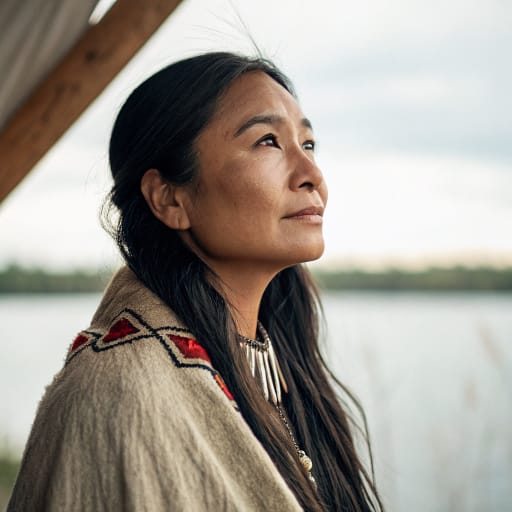
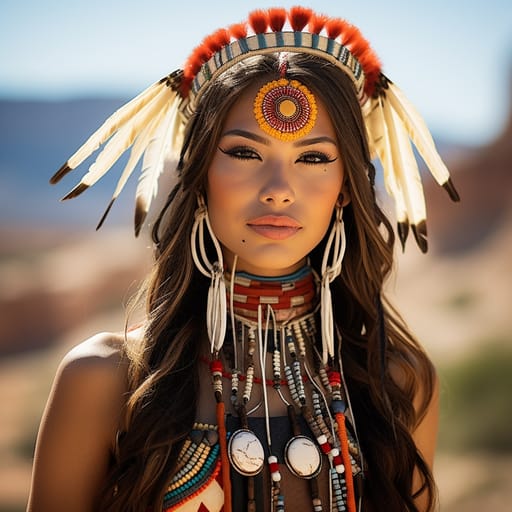
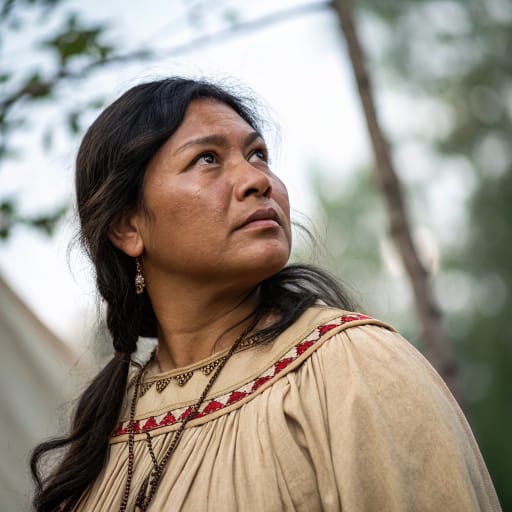
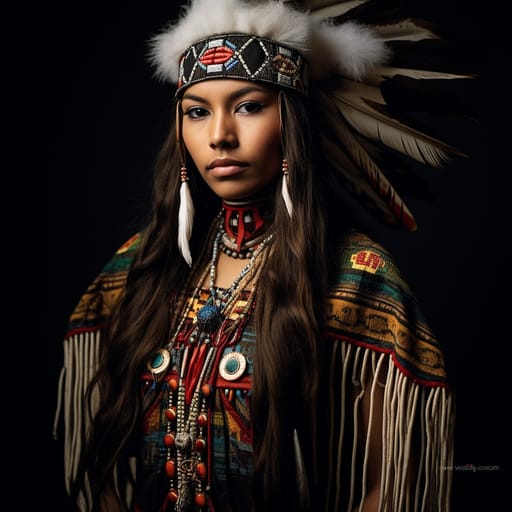
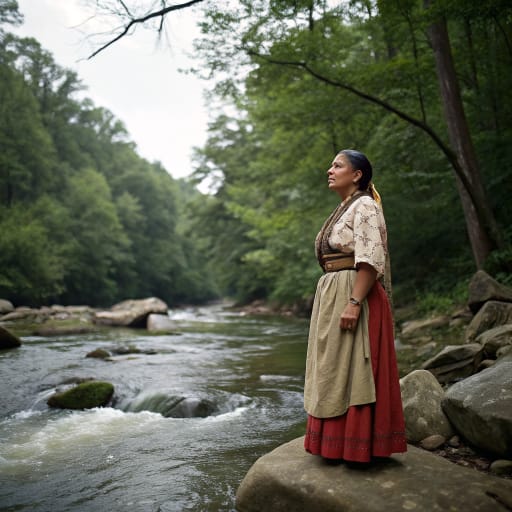
Typical Spokane Phenotypes
Reference for AI generation: hair, eyes, skin, facial structure, build
Spokane Body & Anatomy Reference
Per-feature anatomical profile for AI nude generation: Indigenous Northern American / Algonquian-Iroquoian phenotype
Spokane Boobs & Breasts
The typical Spokane bust is medium cup, moderate projection, in line with the wider Indigenous Northern American / Algonquian-Iroquoian pattern. Areolas usually fall in the 30-44mm range, with medium-brown areolar pigmentation against the copper-to-medium-brown skin tone. Compared with the smaller East Asian bust, Spokane breasts sit forward and are generally full and moderate projection. A faithful AI render of Spokane tits keeps that shape and areola size.
Spokane Ass & Hips
Butt shape among Spokane women: medium, moderate-to-full projection, over medium iliac crests. This follows Indigenous Northern American / Algonquian-Iroquoian ancestry and looks quite unlike the slim East Asian narrow-hip profile. An accurate Spokane ass in adult AI imagery keeps both the silhouette and the overall build (mesomorph, broader frame in northern Indigenous populations) instead of a generic average.
Spokane Vagina & Pussy
Vulvar anatomy among Spokane women: medium-brown labial pigmentation. Pubic hair tends to be straight medium-coarse texture, in the usual inverted-triangle pattern. Both follow Indigenous Northern American / Algonquian-Iroquoian pigmentation, which is why Spokane pussy renders should not fall back on a pale, sparse Western template.
Spokane Dicks & Penis
The Spokane cock profile, from Indigenous Northern American / Algonquian-Iroquoian anthropometric data: regional mean ~13cm erect; moderate girth; medium-brown shaft pigmentation. Pubic hair has a straight medium-coarse texture and forms the usual inverted-V pattern. Whether Spokane men are circumcised follows religious and cultural practice rather than phenotype.
Spokane Body, Curves & Build
Build and curves among Spokane women follow the Indigenous Northern American / Algonquian-Iroquoian pattern: mesomorph, broader frame in northern Indigenous populations, mean adult female BMI 25-28. Proportions matter as much as skin tone, so Spokane figures should keep their regional height and limb ratios.
Spokane Skin Tone & Hair Texture
The Spokane skin range is copper to medium-brown (Fitzpatrick III-V), and hair tends to be straight 1A, dark-brown to black, often thick and dense. That combination marks the Indigenous Northern American / Algonquian-Iroquoian phenotype, and skin tone is the trait AI generators most often get wrong for Spokane women.
Explore phenotype categories
Structured taxonomy with peer-reviewed scales · 22 anatomical categories
Erotic Poses & Sex Positions
From the pose catalog: 219 named positions with reference skeletons
Frequently asked questions about Spokane people
Where is the Spokane homeland?
The Spokane homeland is The Spokane River basin of eastern Washington state, United States, centered on the Spokane Indian Reservation at Wellpinit; members are also enrolled at Colville and Coeur d'Alene. in North America.
What language do Spokane people speak?
Spokane people primarily speak Spokane, or Npoqínišcn (Salishan, Southern Interior branch), a dialect continuum with Kalispel and Montana Salish; English is the everyday language..
What religion do Spokane people practice?
The predominant religion among Spokane people is Presbyterian and Catholic Christianity dating to nineteenth century missions, alongside continuing Plateau ceremonial practice including the winter dance..






Make your own Spokane images
Five a day, free, no credits to buy. The studio starts from this group's phenotype data, so you can set body type, pose and style and keep the traits accurate.
Start with Spokane