Help us get this right
Does this portrait look right for Cree?
One tap. It takes a second and it is recorded.
13 say it looks right, 6 say it looks off.
Cree Erotic
Canada (Alberta, Saskatchewan, Manitoba, Ontario, Quebec, Newfoundland and Labrador)
Algic / Algonquian / Cree
Christianity
Innu, Naskapi, Atikamekw, James Bay Cree, Moose Cree, Swampy Cree, Woods Cree, Plains Cree, Métis (including Métis in Canada), Oji-Cree
About Cree People
The Cree are one of the largest Indigenous peoples in North America, spread across an enormous arc of boreal forest, parkland, plains, and tundra-edge country from the foothills of the Rockies in Alberta to the coast of Labrador. That geographic spread is the first thing to understand about them: "Cree" is less a single nation than a family of closely related peoples who recognize each other across distance, dialect, and very different landscapes. A Plains Cree hunter on the prairie in Saskatchewan and a James Bay Cree trapper on the muskeg of subarctic Quebec share a language and a kinship system, but their seasonal rounds, foods, and political histories diverge sharply.
Their language sits inside the Algonquian branch of the Algic family, the same broad relation that includes Ojibwe, Innu-Aimun, Blackfoot, and (more distantly) the Algonquian languages of the Atlantic coast. Cree itself is a dialect continuum rather than a single tongue: Plains Cree, Woods Cree, Swampy Cree, Moose Cree, Atikamekw, and the Innu and Naskapi varieties of the eastern subarctic shade into one another, with mutual intelligibility weakening across the long axis. Cree is also one of the relatively few Indigenous languages in Canada with a robust, daily-use speaker base in the tens of thousands, and it is unusual in being commonly written in a syllabic script, the system devised in the 1840s and adopted enthusiastically, which is now a marker of literacy in much of the north.
The fur trade is the historical inflection point that shaped the modern map. From the seventeenth century onward, Cree bands acted as middlemen and provisioners across the Hudson's Bay Company's reach, and that long commercial relationship, alongside intermarriage with French and Scottish traders, produced the Métis as a distinct people with their own language, Michif, and their own political memory, including the Red River and Northwest resistances of the 1800s. Treaty-era agreements with the Crown, particularly the numbered treaties on the prairies, still structure land, hunting, and governance disputes today.
Most Cree today identify as Christian, predominantly Anglican, Catholic, or evangelical depending on which mission reached which region first, but church attendance generally runs alongside, rather than displaces, older practices: sweat lodges, pipe ceremonies, the round dance, and the seasonal authority of hunters and elders. The James Bay Cree in particular have spent the last half-century building one of the more assertive Indigenous self-government structures in the country, after their confrontation with Quebec over the hydroelectric flooding of their territory in the 1970s.
Related ethnic groups
Groups that share Cree's homeland, region, language, or religious tradition. These are likely candidates for comparative phenotype reference.
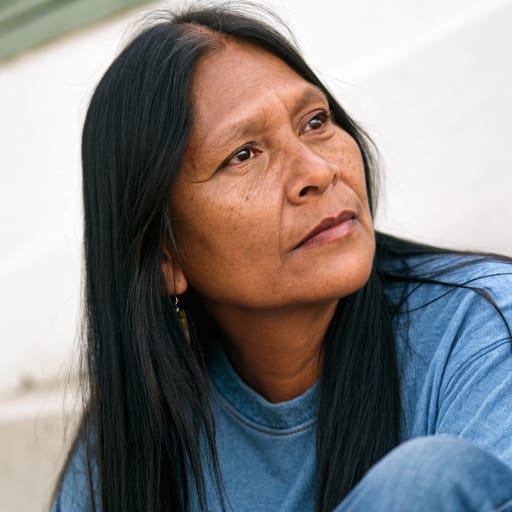
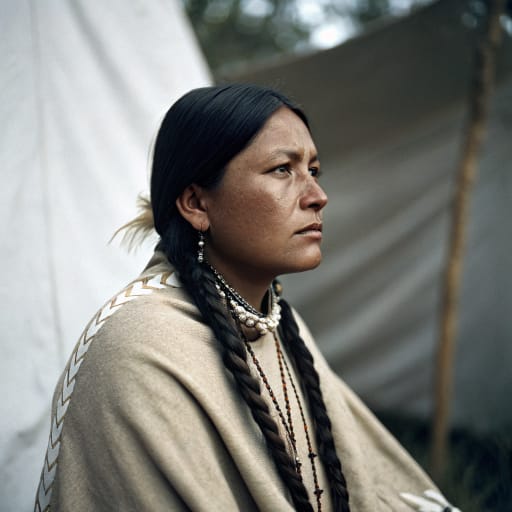
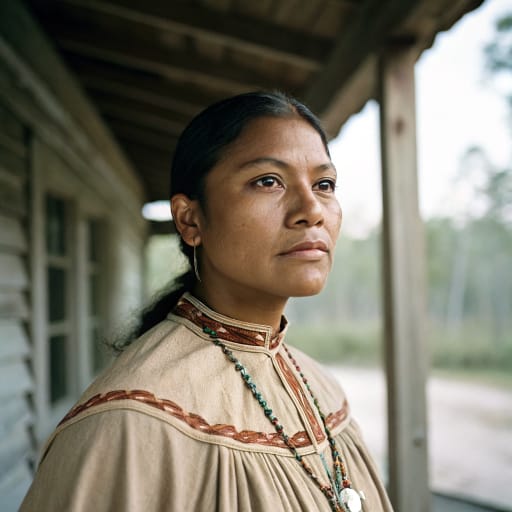
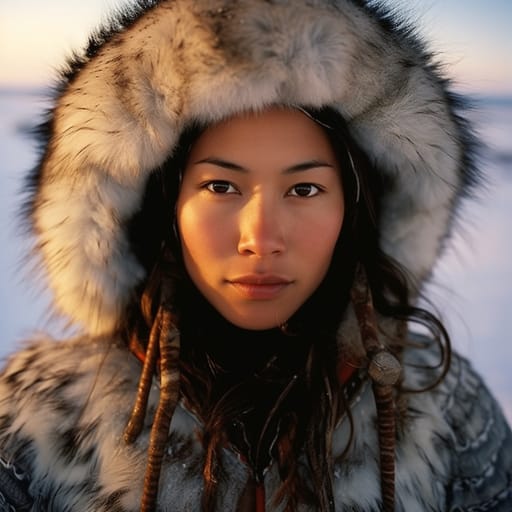
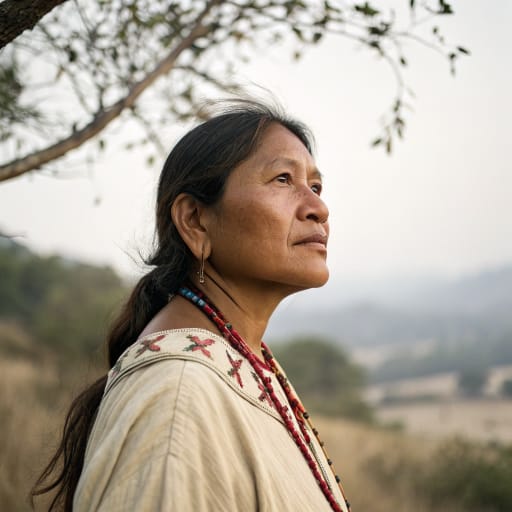
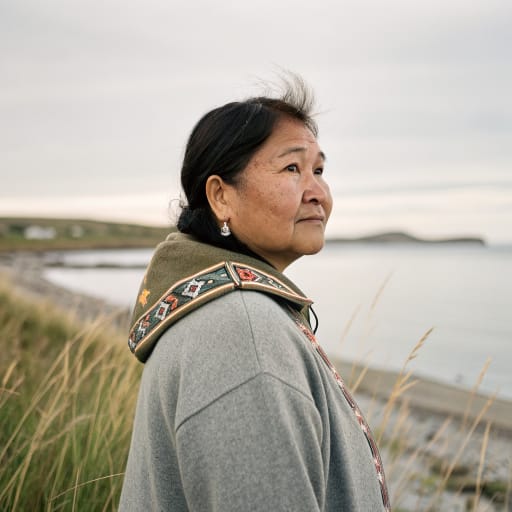
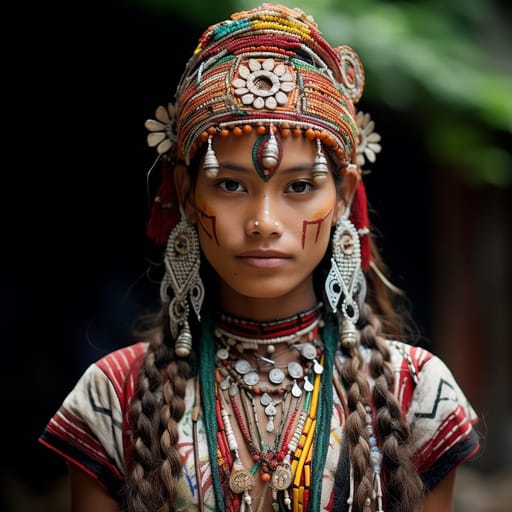
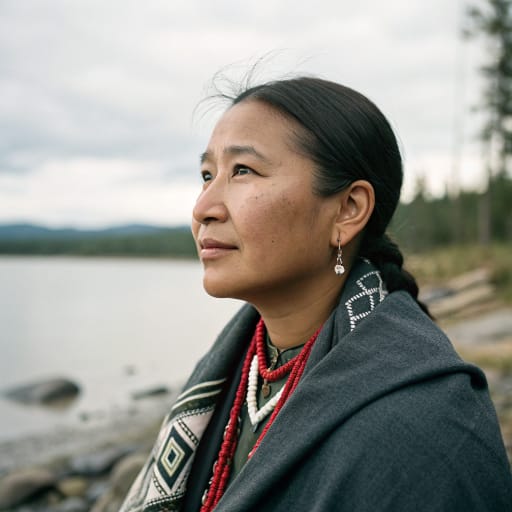
Typical Cree Phenotypes
Reference for AI generation: hair, eyes, skin, facial structure, build
Cree phenotype sits within the broader Northern Algonquian range, taller and leaner on average than the Subarctic groups north of them, with facial structure that reads distinctly Plains-influenced in the western branches and more classically Subarctic in the James Bay and Innu/Naskapi east. The defining structural feature across most subgroups is the combination of high, broad zygomatic arches with a relatively straight or slightly convex nasal bridge, narrower and more aquiline among Plains Cree, broader and lower-set toward James Bay and the Innu coast.
Hair is overwhelmingly Type 1: straight, coarse, dense, and very dark, ranging from true black to deep cool brown. Loose wave appears occasionally, particularly among Métis lines where French and Scottish admixture is documented; these individuals also show the widest hair-color variance, including chestnut and dark auburn. Greying tends to come late. Eyes are typically dark brown to near-black, with medium brown and hazel showing up in Métis populations and along contact-zone communities. The epicanthic fold is present but usually mild (a subtle inner-corner crease rather than the full monolid common in East Asian groups), and the palpebral fissure tends to read slightly almond-shaped.
Skin tone runs Fitzpatrick III to V, with warm copper, olive-bronze, and reddish-brown undertones predominating; Plains Cree often sit on the deeper end, James Bay and Oji-Cree somewhat lighter and yellower. Lips are medium-full, generally well-defined rather than thin. Jawlines tend to be square and strong in men, softer but still angular in women; Ashley Callingbull's facial geometry is a reasonable anchor for the Plains Cree end of the range.
Build trends tall and rangy, particularly Plains Cree men, with documented stature among the highest of historical Indigenous North American groups. Shoulders are typically broad relative to hips, with lean muscle distribution and minimal facial or body hair; beards are usually sparse, and what grows is straight and dark.
Cree Body & Anatomy Reference
Anatomy by feature, Indigenous Northern American / Algonquian-Iroquoian phenotype
Cree Boobs & Breasts
The typical Cree bust is medium cup, moderate projection, in line with the wider Indigenous Northern American / Algonquian-Iroquoian pattern. Areolas usually fall in the 30-44mm range, with medium-brown areolar pigmentation against the copper-to-medium-brown skin tone. Compared with the smaller East Asian bust, Cree breasts sit forward and are generally full and moderate projection. A faithful AI render of Cree tits keeps that shape and areola size.
Cree Ass & Hips
Butt shape among Cree women: medium, moderate-to-full projection, over medium iliac crests. This follows Indigenous Northern American / Algonquian-Iroquoian ancestry and looks quite unlike the slim East Asian narrow-hip profile. An accurate Cree ass in adult AI imagery keeps both the silhouette and the overall build (mesomorph, broader frame in northern Indigenous populations) instead of a generic average.
Cree Vagina & Pussy
Vulvar anatomy among Cree women: medium-brown labial pigmentation. Pubic hair tends to be straight medium-coarse texture, in the usual inverted-triangle pattern. Both follow Indigenous Northern American / Algonquian-Iroquoian pigmentation, which is why Cree pussy renders should not fall back on a pale, sparse Western template.
Cree Dicks & Penis
The Cree cock profile, from Indigenous Northern American / Algonquian-Iroquoian anthropometric data: regional mean ~13cm erect; moderate girth; medium-brown shaft pigmentation. Pubic hair has a straight medium-coarse texture and forms the usual inverted-V pattern. Whether Cree men are circumcised follows religious and cultural practice rather than phenotype.
Cree Body, Curves & Build
Build and curves among Cree women follow the Indigenous Northern American / Algonquian-Iroquoian pattern: mesomorph, broader frame in northern Indigenous populations, mean adult female BMI 25-28. Proportions matter as much as skin tone, so Cree figures should keep their regional height and limb ratios.
Cree Skin Tone & Hair Texture
The Cree skin range is copper to medium-brown (Fitzpatrick III-V), and hair tends to be straight 1A, dark-brown to black, often thick and dense. That combination marks the Indigenous Northern American / Algonquian-Iroquoian phenotype, and skin tone is the trait AI generators most often get wrong for Cree women.
Data depth
61/100Coverage of image-grounded phenotype observations · drives AI generation diversity
- Sample size
- 24/40· 16 images
- Image quality
- 22/30· 44% high
- Confidence
- 15/20· mean 0.78
- Source diversity
- 0/10· wikipedia
- ·Modest sample (n<25)
- ·Wikipedia-only source, not population-representative
Observed Distribution: Image Sample
Empirical observations from analyzed photographs · supplementary signal, not population truth
Sample: 16 images analyzed (16 wikipedia). Quality: 7 high, 8 medium, 1 low, 0 very_low. Avg analyzer confidence: 0.78.
Skin tone (Fitzpatrick): II (38%), III (25%), IV (38%)
Hair color: black (63%), gray/white (38%)
Hair texture: straight (75%), wavy (13%), covered (13%)
Eye color: dark brown (75%), blue (13%), hazel (6%), unclear (6%)
Epicanthic fold: 31% present, 69% absent, 0% unclear
Caveats: Sample size 16 is modest, so secondary patterns may not be reliable. Sample is 100% Wikipedia notable people, which skews toward male, public-life, and modern figures, not population-representative.
Last aggregated: May 7, 2026
Explore phenotype categories
Structured taxonomy with peer-reviewed scales · 22 anatomical categories
Notable Cree People
37 reference figures, sourced from Wikipedia
- Janice Acoose, author, of Sakimay (Saulteaux) and Ninankawe Marival Métis ancestry
- Nathaniel Arcand, Alexander First Nation), actor
- Ethan Bear, b. 1997), NHL hockey player for the Vancouver Canucks
- Craig Berube, Head coach of the Toronto Maple Leafs
- Robyn Bourgeois, author and academic
- Joe Buffalo, actor and skateboarder
- Ashley Callingbull, Enoch Cree Nation), 2015 Mrs. Universe winner, actress and first nations acti…
- Harold Cardinal, writer, political leader, teacher, and lawyer
- Lance Cardinal, artist, presenter, CTV television personality, storyteller
- Jonathan Cheechoo, NHL and KHL hockey player
- Shirley Cheechoo, actress, writer, and filmmaker
- Vern Cheechoo, musician
- Belinda Daniels, language teacher
- Billy Diamond, political leader, first Grand Chief of the Grand Council of the Crees (Eeyou …
- Neil Diamond, filmmaker
- Theoren Fleury, retired NHL hockey player, humanitarian, spokesperson, and author
- Ralph Garvin Steinhauer, tenth Lieutenant Governor of Alberta and first Indigenous to hold that post.
- Edward Gamblin, musician
- Sebastian Gaskin, musician
- Mary Greyeyes, 1920-2011), the first First Nations woman to join the Canadian Armed Forces
- Tomson Highway, playwright, librettist of the first Cree-language opera
- Helen Knott, activist and author
- Jules Koostachin, writer and filmmaker
- Melina Laboucan-Massimo, climate justice advocate
- Wyatt C. Louis, singer-songwriter
- Lawrence Martin, musician and politician
- Ovide Mercredi, National chief of the Assembly of First Nations
- Delia Opekokew, lawyer and activist
- Robert-Falcon Ouellette, A Cree Member of Parliament, played a pivotal role in promoting Indigenous la…
- Romeo Saganash, Member of Parliament for Abitibi-Baie-James-Nunavik-Eeyou, Quebec
- Paul Seesequasis, writer and journalist
- Wavell Starr, professional wrestler
- Clayton Thomas-Müller, activist and memoirist
- Richard Throssel, 1882-1933), photographer
- Loretta Todd, film director
- Shane Yellowbird, country singer
- Alfred Young Man, Chippewa Cree Indians of the Rocky Boy's Reservation, b. 1948), educator, wri…
Erotic Poses & Sex Positions
From the pose catalog: 219 named positions with reference skeletons
Frequently asked questions about Cree people
Where is the Cree homeland?
The Cree homeland is Canada (Alberta, Saskatchewan, Manitoba, Ontario, Quebec, Newfoundland and Labrador) in North America.
What language do Cree people speak?
Cree people primarily speak Algic / Algonquian / Cree.
What religion do Cree people practice?
The predominant religion among Cree people is Christianity.
What does a typical Cree woman look like?
Cree women typically have straight, coarse, very dark hair, from true black to deep brown, and dark brown eyes with a mild epicanthic fold. Skin falls in the Fitzpatrick III to V range with warm copper, olive-bronze or reddish-brown undertones, deeper among Plains Cree. Faces tend to have high, broad cheekbones, a straight or slightly convex nose, medium-full lips and a jawline that is softer than in men but still angular.






Make your own Cree images
Five a day, free, no credits to buy. The studio starts from this group's phenotype data, so you can set body type, pose and style and keep the traits accurate.
Start with Cree