Help us get this right
Does this portrait look right for Choctaw?
One tap. It takes a second and it is recorded.
1 says it looks right, 1 says it looks off.
Choctaw Erotic
United States (Alabama, Florida, Mississippi, Louisiana)
Muskogean / Choctaw
Christianity
About Choctaw People
The Choctaw are a Muskogean-speaking people of the Deep South, historically anchored in what is now central and southern Mississippi and adjacent stretches of Alabama and Louisiana. Their language sits in the same family as Chickasaw, Creek, Seminole, and Alabama-Koasati, and Choctaw and Chickasaw remain mutually intelligible enough that many linguists treat them as closely related dialects of a single tongue. Before European contact the Choctaw were among the largest agricultural societies in the Southeast — settled towns, intensive maize cultivation, and a clan-based matrilineal social order in which descent, identity, and inheritance ran through the mother's line.
The defining rupture in Choctaw history is the 1830 Treaty of Dancing Rabbit Creek and the removal that followed. Under federal pressure they became the first of the so-called Five Civilized Tribes to be marched west to Indian Territory, a forced migration that killed thousands and gave the Trail of Tears its earliest chapter. A minority refused to leave Mississippi, accepted allotments under a clause most never received in good faith, and held on through generations of land loss and legal limbo. That split is why there are three federally and state-recognized Choctaw nations today: the Choctaw Nation of Oklahoma, by far the largest; the Mississippi Band of Choctaw Indians, descended from those who stayed; and the smaller Jena Band in Louisiana.
Religion is overwhelmingly Christian — Baptist and Methodist congregations took deep root in the nineteenth century — but older practice has not disappeared so much as folded into community life. Stickball, the lacrosse-like game the Choctaw call kapucha toli, is still played seriously between communities and is sometimes described, only half-jokingly, as the little brother of war it once stood in for. Social dances, traditional dress for ceremonial occasions, and the language itself are actively maintained through tribal schools and immersion programs, with the Mississippi Band in particular running one of the more successful Native-language revitalization efforts in the country.
One quieter point worth knowing: in 1847, while still recovering from removal, the Choctaw collected a donation for famine relief in Ireland. The gesture has been remembered on both sides ever since, and a sculpture in County Cork commemorates it. It is a small thing, but it tells you something about how the Choctaw have tended to understand themselves in relation to other people — not as victims of history, but as participants in it.
Related ethnic groups
Groups that share Choctaw's homeland, region, language, or religious tradition. These are likely candidates for comparative phenotype reference.
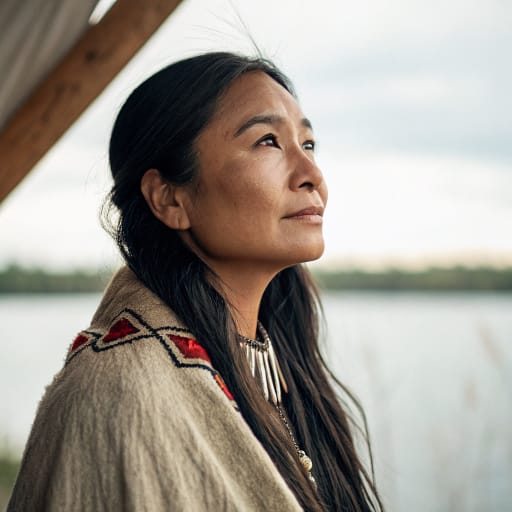
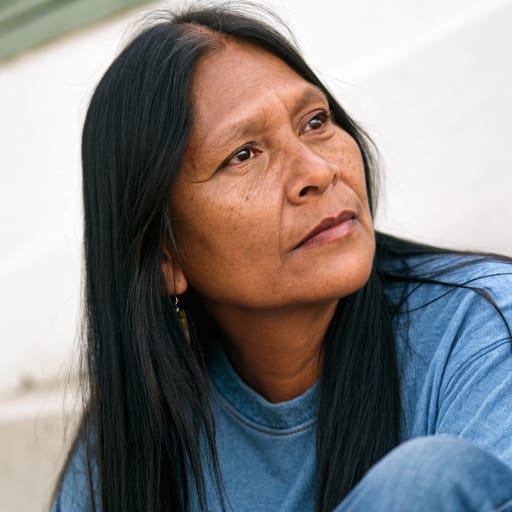
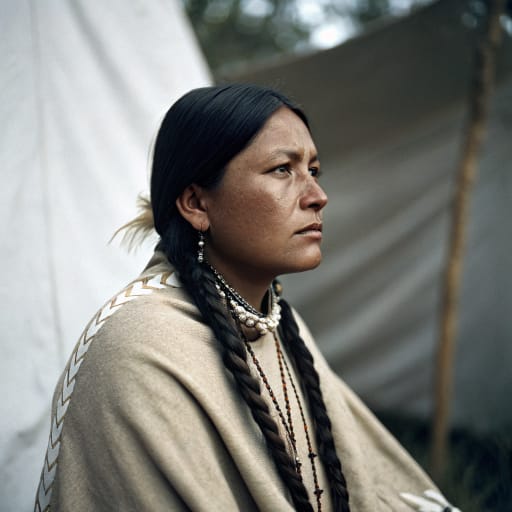
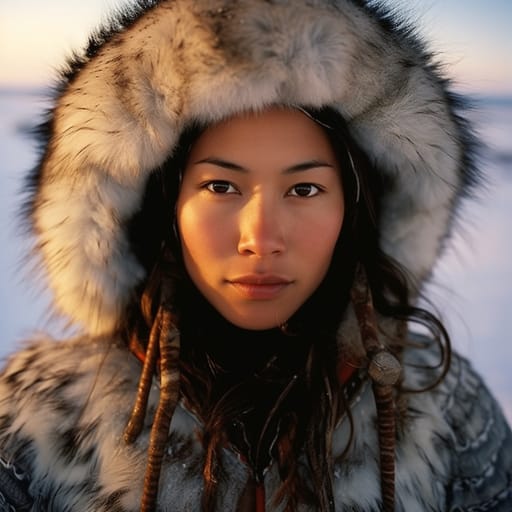
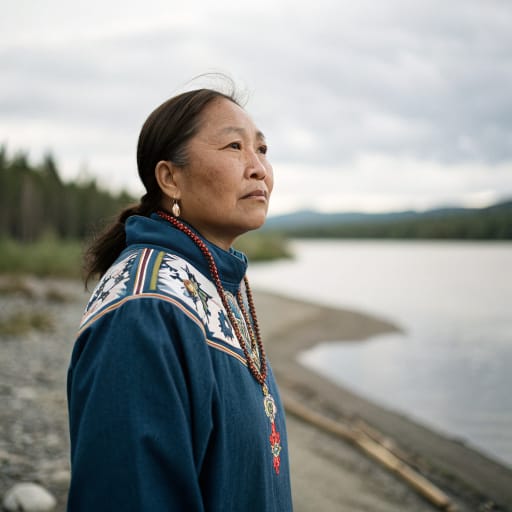
Typical Choctaw Phenotypes
Reference for AI generation: hair, eyes, skin, facial structure, build
The Choctaw phenotype reflects a Southeastern Woodland indigenous baseline modified by several centuries of admixture with European settlers (primarily Scots-Irish and French) and, in significant measure along the lower Mississippi and into Louisiana, with African Americans. The result is a population where a clearly indigenous facial architecture often sits beneath hair, eye, or skin features that read as mixed. Pure phenotypes — the broad-faced, copper-toned, jet-haired profile recorded in 19th-century photographs of Mississippi traditionalists — still occur, particularly within the Mississippi Band of Choctaw Indians, but they are now the minority case rather than the default.
Hair runs heavy and straight in its ancestral form: jet black to very dark brown, coarse-textured, dense, low porosity, with minimal wave. Mixed-ancestry Choctaw frequently show medium-brown to near-black hair with loose wave or even curl, and red or auburn highlights surface in those with Scots-Irish background. Eyes are most often dark brown to black, with a smaller share of hazel, light brown, or — in mixed lines — green and pale blue. The eyelid carries a mild epicanthic fold in many full-blood individuals, less pronounced than East Asian morphology but visible at the inner corner.
Skin spans Fitzpatrick III through V. The traditional tone is a warm reddish-bronze or copper-tan with yellow-gold undertones that deepens readily with sun; mixed individuals trend lighter (olive to fair) or, where African ancestry is present, into deeper brown. Facial structure is the most consistent marker: a broad mid-face, high and rounded cheekbones, a moderately wide nose with a straight or slightly convex bridge and medium alar width, full but not everted lips, and a square, well-defined jaw. Shovel-shaped incisors are common.
Build is typically medium-tall and solid — historically the Choctaw were noted by European observers as taller than average for the region — with broad shoulders, a deep chest, relatively short lower legs, and a tendency toward muscular thickening through the trunk and thighs in middle age.
Choctaw Body & Anatomy Reference
Anatomy by feature, Indigenous Northern American / Algonquian-Iroquoian phenotype
Choctaw Boobs & Breasts
Bust reference for Choctaw women: medium cup, moderate projection, which is typical of Indigenous Northern American / Algonquian-Iroquoian ancestry. Areolas measure about 30-44mm across, with medium-brown pigmentation. Body type (mesomorph, broader frame in northern Indigenous populations) shapes the bust as well, so Choctaw tits are usually full and moderate projection. In AI imagery, keep the forward-set shape rather than drifting toward the smaller East Asian bust.
Choctaw Ass & Hips
The Choctaw ass is typically medium, moderate-to-full projection, which sets it apart from the slim East Asian narrow-hip profile. Underneath, the pelvis shows medium iliac crests, part of the Indigenous Northern American / Algonquian-Iroquoian skeletal pattern. For Choctaw butt pics and AI renders, match that silhouette and the overall build (mesomorph, broader frame in northern Indigenous populations).
Choctaw Vagina & Pussy
Choctaw pussy and vulvar anatomy presents medium-brown labial pigmentation, consistent with the Indigenous Northern American / Algonquian-Iroquoian phenotype's pigmentation pattern. Choctaw pubic hair is typically straight medium-coarse texture, in the inverted-triangle pattern. For anatomically accurate Choctaw pussy renders the labial coloration should match the surrounding copper to medium-brown skin tone with a continuous gradient, and the hair should keep its straight medium-coarse texture.
Choctaw Dicks & Penis
Choctaw dicks follow the Indigenous Northern American / Algonquian-Iroquoian reference data: regional mean ~13cm erect; moderate girth; medium-brown shaft pigmentation. Shaft color should track the copper to medium-brown skin tone with a smooth change toward the glans, and Choctaw pubic hair keeps its straight medium-coarse texture.
Choctaw Body, Curves & Build
Choctaw body type and overall build presents as mesomorph, broader frame in northern Indigenous populations, with mean adult female BMI 25-28: the characteristic Indigenous Northern American / Algonquian-Iroquoian habitus. Choctaw curves and proportions should keep the regional skeletal frame (height, shoulder-to-hip ratio, limb proportions) rather than a generic mesomorph default.
Choctaw Skin Tone & Hair Texture
Choctaw skin sits in the copper to medium-brown (Fitzpatrick III-V) band. Hair is typically straight 1A, dark-brown to black, often thick and dense, in keeping with the Indigenous Northern American / Algonquian-Iroquoian phenotype. In nude renders the skin should stay one even tone from face to body, and body, pubic and head hair should match.
Data depth
0/100Coverage of image-grounded phenotype observations · drives AI generation diversity
- Sample size
- 0/40· 0 images
- Image quality
- 0/30· 0% high
- Confidence
- 0/20
- Source diversity
- 0/10
- ·No image observations yet
Explore phenotype categories
Structured taxonomy with peer-reviewed scales · 22 anatomical categories
Erotic Poses & Sex Positions
From the pose catalog: 219 named positions with reference skeletons
Frequently asked questions about Choctaw people
Where is the Choctaw homeland?
The Choctaw homeland is United States (Alabama, Florida, Mississippi, Louisiana) in North America.
What language do Choctaw people speak?
Choctaw people primarily speak Muskogean / Choctaw.
What religion do Choctaw people practice?
The predominant religion among Choctaw people is Christianity.






Make your own Choctaw images
Five a day, free, no credits to buy. The studio starts from this group's phenotype data, so you can set body type, pose and style and keep the traits accurate.
Start with Choctaw