Help us get this right
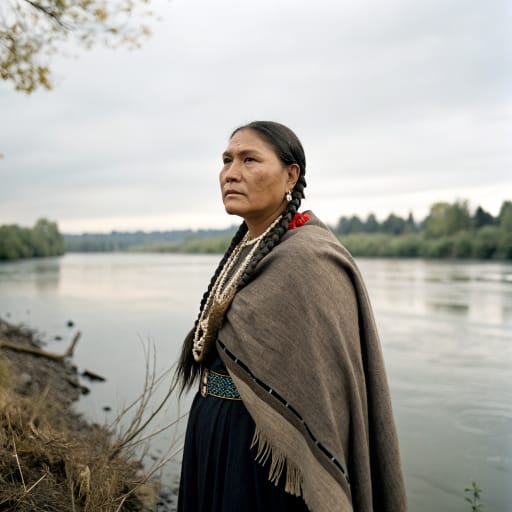
Does this portrait look right for Cherokee?
One tap. It takes a second and it is recorded.
10 say it looks right, 1 says it looks off.
Cherokee Erotic
United States (North Carolina, Tennessee)
Iroquoian / Cherokee
Christianity
Cherokee Nation, Eastern Band, United Keetoowah Band
About Cherokee People
The Cherokee are an Iroquoian-speaking people of the southern Appalachians — the only major Iroquoian group historically rooted that far south, set apart from the Haudenosaunee homelands around the Great Lakes by hundreds of miles and an enormous stretch of Algonquian and Muskogean territory. Their original heartland sat in the ridges and river valleys of what is now western North Carolina, eastern Tennessee, northern Georgia, and upcountry South Carolina: a country of laurel slicks, switchback creeks, and towns built along bottomland flats where the soil was deep enough for corn, beans, and squash.
Cherokee, the language, is structurally Iroquoian but isolated from its nearest relatives, and it is most readily recognized today by its syllabary — eighty-some characters devised in the 1820s by Sequoyah, who was not literate in any other writing system when he built it. Within a few years a substantial portion of the nation could read and write its own language, and a bilingual newspaper, the Cherokee Phoenix, was being printed in New Echota. That episode matters because it is unusual: a writing system invented by one person, for a single language, adopted at scale by its speakers within a generation.
The forced removal of 1838–39, the Trail of Tears, is the inflection point that produced the present three-part political geography. Most of the nation was marched west to Indian Territory in what is now Oklahoma — the ancestors of the Cherokee Nation and the United Keetoowah Band, the two federally recognized tribes headquartered at Tahlequah. A smaller group held on in the Carolina mountains, partly through the protection of individual landholders, and their descendants are the Eastern Band of Cherokee Indians, on the Qualla Boundary near the Smokies. The three governments are distinct, with their own citizenship rolls and politics, and the differences are not cosmetic.
Christianity has been the dominant religious affiliation since the nineteenth century — Baptist and Methodist congregations in particular — but it sits alongside older practice rather than fully replacing it. Stomp dance grounds still operate, especially among Keetoowah communities; clan affiliation, traced matrilineally through seven clans, still shapes social life for many families. The Cherokee are also one of the relatively few Native nations to have run their own constitutional government, court system, and public school network in the nineteenth century, and that institutional memory is visible in how the modern tribes operate.
Related ethnic groups
Groups that share Cherokee's homeland, region, language, or religious tradition. These are likely candidates for comparative phenotype reference.
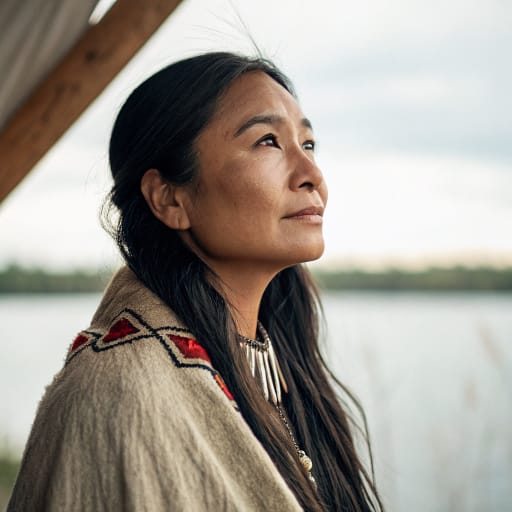
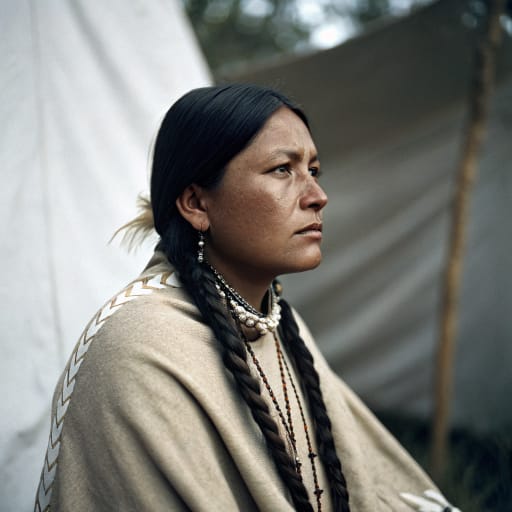
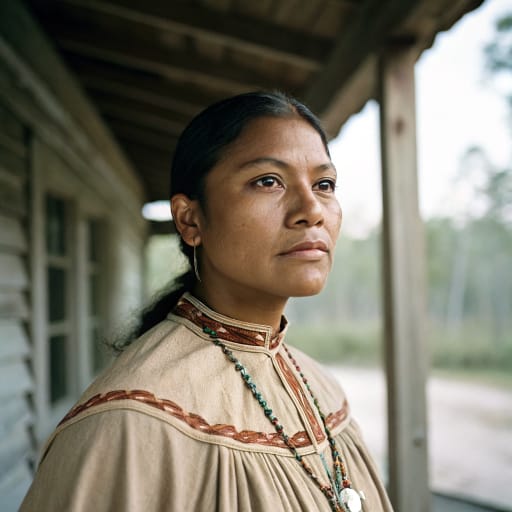
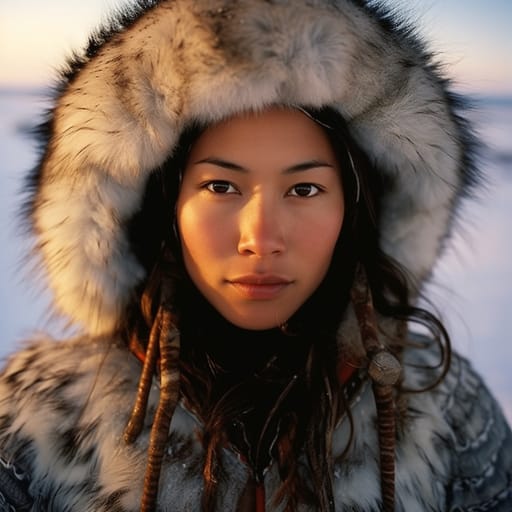
Typical Cherokee Phenotypes
Reference for AI generation: hair, eyes, skin, facial structure, build
Cherokee phenotype sits at the intersection of an indigenous Southeastern Woodlands base population and several centuries of documented admixture with European (especially Scots-Irish) and African American neighbors — and that history shows on faces. The unmixed end of the range looks broadly Southeastern Native: straight black hair, dark brown eyes, copper to olive-brown skin with warm undertones, a relatively broad-rooted nose, and high cheekbones with a wide bizygomatic span. The admixed end — common, not exceptional, particularly in Eastern Band and Cherokee Nation enrollees — runs lighter: chestnut or dark-blonde hair, hazel or green eyes, fair skin that tans to a ruddy bronze rather than burning.
Hair is overwhelmingly straight to gently wavy and coarse in cross-section; tight curl is a marker of African admixture rather than a baseline trait. Graying tends to come late. Eyes are typically almond-shaped and deep-set, with little to no epicanthic fold — the lid morphology is distinct from East Asian patterns despite older anthropological assumptions. Brows are usually moderate in density, lashes dark.
Skin tone spans Fitzpatrick III through V, with most enrolled members today landing III–IV. Undertones lean warm-olive or coppery; the cool-pink undertone seen in Northern European populations is uncommon even among lighter-skinned individuals. Lips are medium-full, the philtrum often well-defined. Nose bridges run from straight to slightly convex, with a moderate alar width — narrower than West African averages, broader than Northern European.
Build is medium-stocky historically, with documented anthropometric tendencies toward a long torso, shorter limbs relative to trunk, and a tendency toward central weight gain in adulthood. Average male stature sits near 5'8", female near 5'4". The Eastern Band, more geographically isolated in the Smokies, retains a higher frequency of the unmixed phenotype; Cherokee Nation citizens in Oklahoma show the widest visible range, including blue-eyed and red-haired members whose lineage is unambiguously documented.
Cherokee Body & Anatomy Reference
Indigenous Northern American / Algonquian-Iroquoian phenotype: anatomy reference for AI nude generation
Cherokee Boobs & Breasts
Cherokee boobs follow the Indigenous Northern American / Algonquian-Iroquoian profile: medium cup, moderate projection. Areolar diameter is usually 30-44mm, and the coloring is medium-brown areolar pigmentation against the copper-to-medium-brown skin tone. Breast shape tracks body composition (mesomorph, broader frame in northern Indigenous populations, mean adult female BMI 25-28), so Cherokee breasts tend to be full and moderate projection. Expect a forward-set shape, not the smaller East Asian bust.
Cherokee Ass & Hips
Cherokee ass and hip morphology presents as medium, moderate-to-full projection, distinctly different from the slim East Asian narrow-hip profile. The Cherokee pelvic profile shows medium iliac crests, anchored in the Indigenous Northern American / Algonquian-Iroquoian skeletal pattern. Cherokee butt shots in adult AI imagery should render the medium, moderate-to-full projection silhouette with the overall build (mesomorph, broader frame in northern Indigenous populations) and the fat distribution typical of the Indigenous Northern American / Algonquian-Iroquoian phenotype.
Cherokee Vagina & Pussy
Cherokee pussy anatomy typically shows medium-brown labial pigmentation. Pubic hair is usually straight medium-coarse texture. In AI-generated Cherokee nudes, labial color should blend into the copper to medium-brown skin with a gradual transition, and the hair should keep its straight medium-coarse texture.
Cherokee Dicks & Penis
Penis reference for Cherokee men: regional mean ~13cm erect, moderate girth. Coloring: medium-brown shaft pigmentation. An accurate Cherokee cock in AI imagery matches the surrounding copper to medium-brown skin rather than a generic porn default. Circumcision depends on religion and custom, not ancestry.
Cherokee Body, Curves & Build
The Cherokee figure is generally mesomorph, broader frame in northern Indigenous populations, with mean adult female BMI 25-28, characteristic of Indigenous Northern American / Algonquian-Iroquoian ancestry. AI image tools tend to flatten regional body types into a few stock shapes; here the Cherokee build is kept as its own reference.
Cherokee Skin Tone & Hair Texture
Skin: copper to medium-brown (Fitzpatrick III-V). Hair: straight 1A, dark-brown to black, often thick and dense. Both are typical of Indigenous Northern American / Algonquian-Iroquoian ancestry. The most common mistake in AI nudes of Cherokee women is a body rendered lighter than the face.
Data depth
13/100Coverage of image-grounded phenotype observations · drives AI generation diversity
- Sample size
- 3/40· 1 image
- Image quality
- 0/30· 0% high
- Confidence
- 10/20· mean 0.62
- Source diversity
- 0/10· wikipedia
- ·No image observations yet
- ·Wikipedia-only source, not population-representative
Explore phenotype categories
Structured taxonomy with peer-reviewed scales · 22 anatomical categories
Notable Cherokee People
4 reference figures, sourced from Wikipedia
- ISBN, Finger, John R. Cherokee Americans: The Eastern Band of Cherokees in the 20th…
- doi, Irwin, Lee (1992). "Cherokee Healing: Myth, Dreams, and Medicine". American I…
- McLoughlin, William G., Cherokee Renascence in the New Republic. (Princeton: Princeton University Pre…
- Mooney, James, . "Myths of the Cherokees." Bureau of American Ethnology, Nineteenth Annual R…
Erotic Poses & Sex Positions
From the pose catalog: 219 named positions with reference skeletons
Frequently asked questions about Cherokee people
Where is the Cherokee homeland?
The Cherokee homeland is United States (North Carolina, Tennessee) in North America.
What language do Cherokee people speak?
Cherokee people primarily speak Iroquoian / Cherokee.
What religion do Cherokee people practice?
The predominant religion among Cherokee people is Christianity.
What does a typical Cherokee woman look like?
Cherokee women range widely in appearance because of centuries of admixture. At one end are straight black hair, dark brown eyes, copper to olive-brown skin and high cheekbones; at the other are chestnut or dark blond hair, hazel or green eyes and fair skin that tans to a ruddy bronze. Skin spans Fitzpatrick III to V, most often III to IV, and women average around 5'4".






Make your own Cherokee images
Five a day, free, no credits to buy. The studio starts from this group's phenotype data, so you can set body type, pose and style and keep the traits accurate.
Start with Cherokee