Help us get this right
Does this portrait look right for Shakori?
One tap. It takes a second and it is recorded.
0 say it looks right, 1 says it looks off.
Shakori Erotic
North Carolina Piedmont, United States: the Eno River valley near present-day Hillsborough and Durham, and possibly earlier around Shocco Creek in Warren County
Shakori, unrecorded and extinct (presumed Siouan, by analogy with neighboring Saponi and Tutelo)
Indigenous traditional beliefs; details unrecorded
Piedmont Siouan peoples; closely allied with the Eno and Adshusheer, later merged with them; survivors probably absorbed by the Catawba
About Shakori People
The Shakori were a small Native American people who lived along the Eno River and nearby streams in the North Carolina Piedmont during the 1600s and early 1700s. By the 1710s they no longer appear in colonial records as a separate group, and most likely merged into larger nations, probably the Catawba to the south. In their own time, what set them apart was their close tie to another people as much as any place. Nearly every colonial account puts them side by side with the Eno, in neighboring or shared towns, moving through the same country and facing the same pressures.
No record of their language survives. The Saponi and Tutelo nearby spoke Siouan languages, so scholars place the Shakori in the same family. They were part of a Siouan pocket in the interior, with Iroquoian Tuscarora to the east, Cherokee in the mountains and Algonquian speakers along the coast. Their religious life was never described in any detail either. For a people this thinly documented, what we know comes mostly from their surroundings and from two outsiders who passed through.
Their world was the Piedmont farming village: corn, beans and squash planted in river bottoms, deer hunted in the uplands, and towns of pole-framed houses near good water. The Great Trading Path from Virginia crossed the Eno in their country, close to present-day Hillsborough. By the later 1600s, deerskins moved north along it in exchange for cloth, metal tools, guns and glass beads. The same trade that brought those goods also put the Shakori within reach of disease and of the slave raids that fed the Carolina Indian slave trade.
The German explorer John Lederer came through in 1670 and recorded the Shakori as neighbors of the Eno. In 1701 the English surveyor John Lawson was guided across the region by a man he called Enoe Will, who headed a combined community of Eno, Shakori and Adshusheer. Lawson shows a people already shrunk and regrouping to survive, a pattern repeated across the Piedmont in those decades. Some writers have tried to tie the Shakori name to Chicora, the land Spanish slavers described on the Carolina coast in the 1520s, but no one has ever shown that the two are connected.
Today their legacy lives mostly on the map. Shocco Creek and Shocco Township in Warren County carry a form of the name and may mark an earlier home. Shakori Hills in Chatham County carries it as well. The Eno River valley, now largely protected parkland, still holds archaeological sites from the Piedmont towns of their era.
Related ethnic groups
Groups that share Shakori's homeland, region, language, or religious tradition. These are likely candidates for comparative phenotype reference.
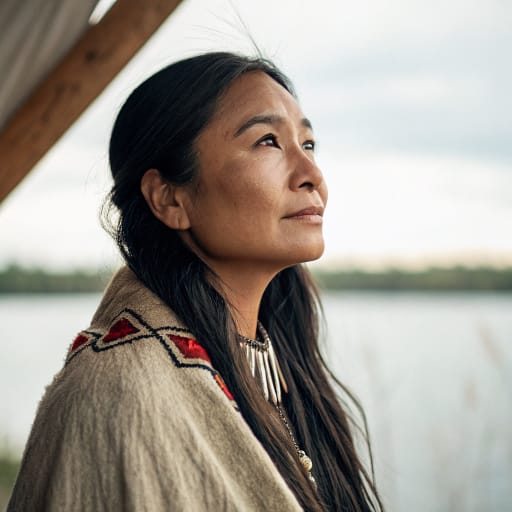
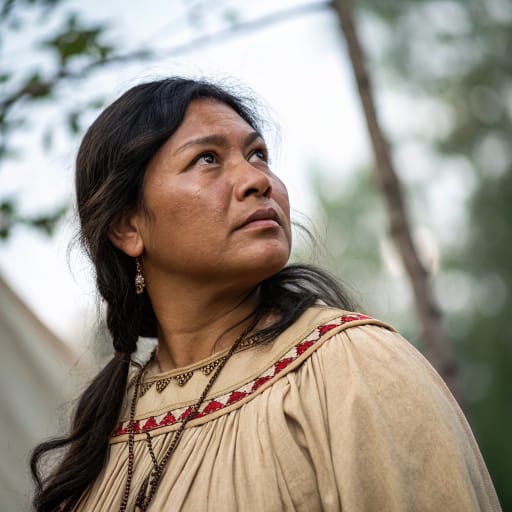
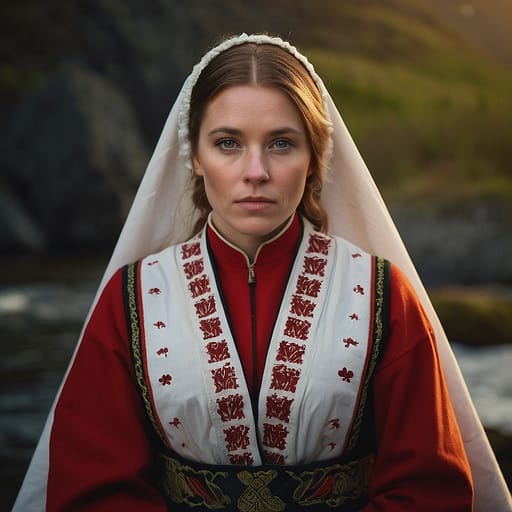
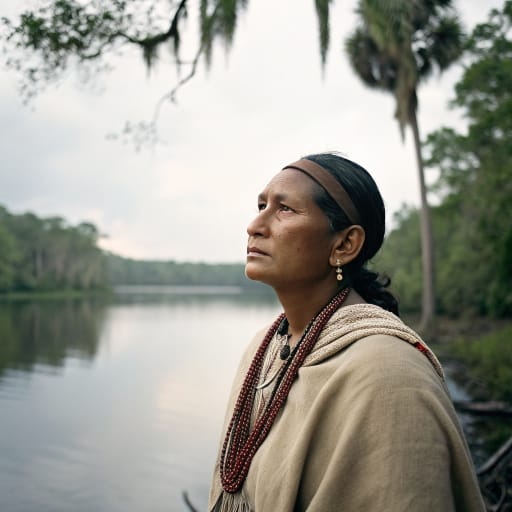
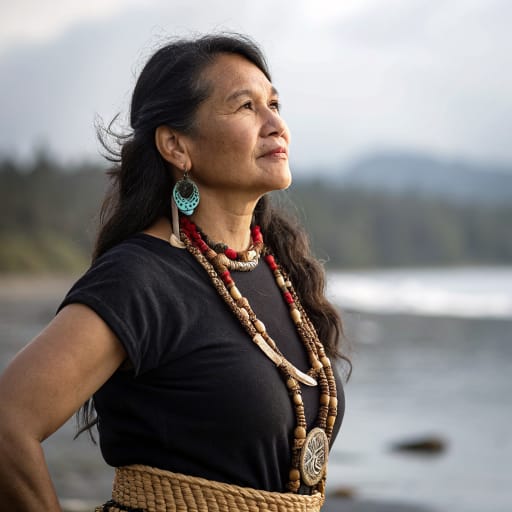
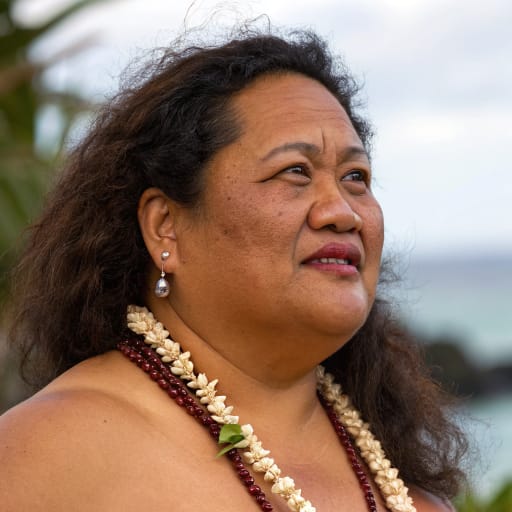
Typical Shakori Phenotypes
Reference for AI generation: hair, eyes, skin, facial structure, build
Shakori Body & Anatomy Reference
Per-feature anatomical profile for AI nude generation: Indigenous Northern American / Algonquian-Iroquoian phenotype
Shakori Boobs & Breasts
The typical Shakori bust is medium cup, moderate projection, in line with the wider Indigenous Northern American / Algonquian-Iroquoian pattern. Areolas usually fall in the 30-44mm range, with medium-brown areolar pigmentation against the copper-to-medium-brown skin tone. Compared with the smaller East Asian bust, Shakori breasts sit forward and are generally full and moderate projection. A faithful AI render of Shakori tits keeps that shape and areola size.
Shakori Ass & Hips
Butt shape among Shakori women: medium, moderate-to-full projection, over medium iliac crests. This follows Indigenous Northern American / Algonquian-Iroquoian ancestry and looks quite unlike the slim East Asian narrow-hip profile. An accurate Shakori ass in adult AI imagery keeps both the silhouette and the overall build (mesomorph, broader frame in northern Indigenous populations) instead of a generic average.
Shakori Vagina & Pussy
Vulvar anatomy among Shakori women: medium-brown labial pigmentation. Pubic hair tends to be straight medium-coarse texture, in the usual inverted-triangle pattern. Both follow Indigenous Northern American / Algonquian-Iroquoian pigmentation, which is why Shakori pussy renders should not fall back on a pale, sparse Western template.
Shakori Dicks & Penis
The Shakori cock profile, from Indigenous Northern American / Algonquian-Iroquoian anthropometric data: regional mean ~13cm erect; moderate girth; medium-brown shaft pigmentation. Pubic hair has a straight medium-coarse texture and forms the usual inverted-V pattern. Whether Shakori men are circumcised follows religious and cultural practice rather than phenotype.
Shakori Body, Curves & Build
Build and curves among Shakori women follow the Indigenous Northern American / Algonquian-Iroquoian pattern: mesomorph, broader frame in northern Indigenous populations, mean adult female BMI 25-28. Proportions matter as much as skin tone, so Shakori figures should keep their regional height and limb ratios.
Shakori Skin Tone & Hair Texture
The Shakori skin range is copper to medium-brown (Fitzpatrick III-V), and hair tends to be straight 1A, dark-brown to black, often thick and dense. That combination marks the Indigenous Northern American / Algonquian-Iroquoian phenotype, and skin tone is the trait AI generators most often get wrong for Shakori women.
Explore phenotype categories
Structured taxonomy with peer-reviewed scales · 22 anatomical categories
Erotic Poses & Sex Positions
From the pose catalog: 219 named positions with reference skeletons
Frequently asked questions about Shakori people
Where is the Shakori homeland?
The Shakori homeland is North Carolina Piedmont, United States: the Eno River valley near present-day Hillsborough and Durham, and possibly earlier around Shocco Creek in Warren County in North America.
What language do Shakori people speak?
Shakori people primarily speak Shakori, unrecorded and extinct (presumed Siouan, by analogy with neighboring Saponi and Tutelo).
What religion do Shakori people practice?
The predominant religion among Shakori people is Indigenous traditional beliefs; details unrecorded.






Make your own Shakori images
Five a day, free, no credits to buy. The studio starts from this group's phenotype data, so you can set body type, pose and style and keep the traits accurate.
Start with Shakori