Help us get this right
Does this portrait look right for Chatot?
Nobody has judged this one yet. You would be the first.
Chatot Erotic
Chipola River and upper Apalachicola River valleys in the Florida Panhandle, United States; later near Mobile, Alabama, and in central Louisiana
Chacato (unrecorded; possibly Muskogean)
Traditional Southeastern religion; part of the people converted to Roman Catholicism at Spanish Franciscan missions from 1674
Southeastern Woodlands people, neighbors and sometime allies of the Apalachee; later one of the refugee peoples settled around French Mobile
About Chatot People
The Chatot, known to the Spanish as the Chacato, were a Native people who lived along the Chipola River and the upper Apalachicola in what is now the Florida Panhandle during the 1600s. In the 1700s they were driven west to Mobile and then to Louisiana, and by the early nineteenth century they had faded into neighboring Native communities. No group carries the name today. Nearly everything known about them was written by outsiders: Spanish friars and governors first, then French officials on the Gulf Coast. Their language was never properly recorded. The few names that survive have led scholars to suggest it was Muskogean, related to Apalachee to the east and to the Creek languages to the north, but that is an informed guess, not a finding. They first appear in the written record in 1639, when Florida's governor reported a peace settled between the Apalachee and their western neighbors, the Chacato among them. Franciscans arrived in 1674 and founded two missions in Chacato country, San Carlos and San Nicolás de Tolentino. Within a year part of the population had turned on the friars, and the revolt of 1675 unsettled the whole effort.
Christian Chacato regrouped nearer the Apalachee missions, which put them squarely in the path of the English. The Carolina and Creek raids that gutted Apalachee in the first years of the 1700s caught them as well, and survivors fled west to the French at Mobile. There the Chatot spent more than half a century as one of several refugee and allied peoples settled near the colonial town. When France ceded the region to Britain in 1763, many of those communities crossed into Louisiana, and the Chatot went with them. An American agent's report in the early 1800s placed a small Chatot settlement on Bayou Boeuf in central Louisiana. After that the name thins out and disappears, and its people were absorbed into the mixed Native population of the region. Catholicism, at least for part of the people, runs through their documented history, carried from Spanish Florida to French Mobile to Louisiana. The records say little about how far it replaced the older ceremonial life they shared with other Southeastern towns. What remains now is a short paper trail and a stretch of river country near present-day Marianna. Their story is also a compact example of what the colonial fight for the Gulf Coast did to small nations caught between Spain, France and England.
Related ethnic groups
Groups that share Chatot's homeland, region, language, or religious tradition. These are likely candidates for comparative phenotype reference.
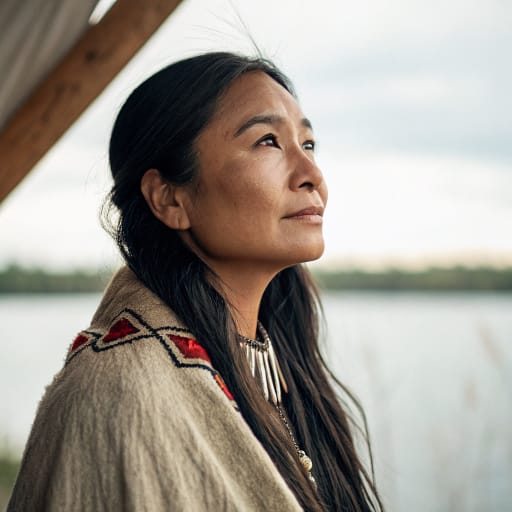
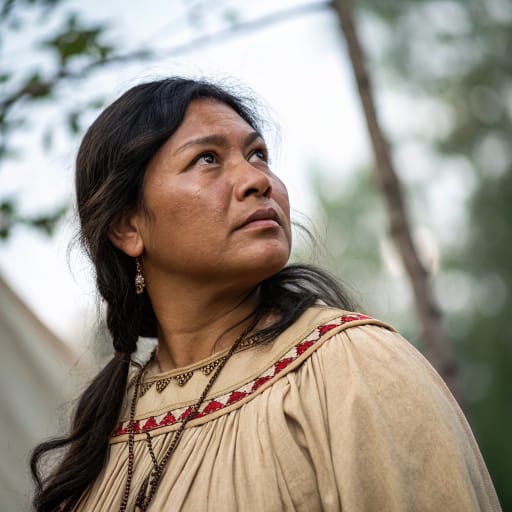


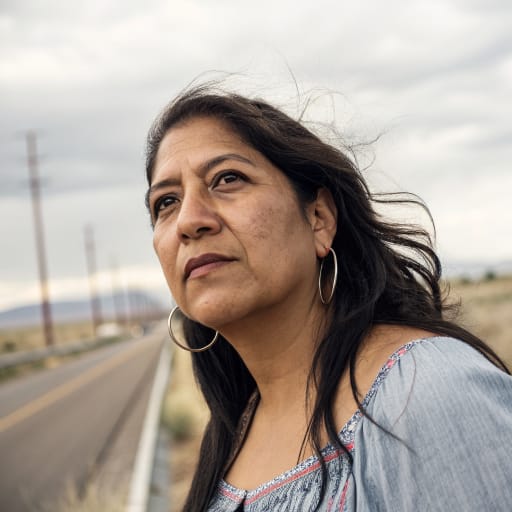
Typical Chatot Phenotypes
Reference for AI generation: hair, eyes, skin, facial structure, build
Chatot Body & Anatomy Reference
Per-feature anatomical profile for AI nude generation: Indigenous Northern American / Algonquian-Iroquoian phenotype
Chatot Boobs & Breasts
Bust reference for Chatot women: medium cup, moderate projection, which is typical of Indigenous Northern American / Algonquian-Iroquoian ancestry. Areolas measure about 30-44mm across, with medium-brown pigmentation. Body type (mesomorph, broader frame in northern Indigenous populations) shapes the bust as well, so Chatot tits are usually full and moderate projection. In AI imagery, keep the forward-set shape rather than drifting toward the smaller East Asian bust.
Chatot Ass & Hips
The Chatot ass is typically medium, moderate-to-full projection, which sets it apart from the slim East Asian narrow-hip profile. Underneath, the pelvis shows medium iliac crests, part of the Indigenous Northern American / Algonquian-Iroquoian skeletal pattern. For Chatot butt pics and AI renders, match that silhouette and the overall build (mesomorph, broader frame in northern Indigenous populations).
Chatot Vagina & Pussy
Chatot pussy and vulvar anatomy presents medium-brown labial pigmentation, consistent with the Indigenous Northern American / Algonquian-Iroquoian phenotype's pigmentation pattern. Chatot pubic hair is typically straight medium-coarse texture, in the inverted-triangle pattern. For anatomically accurate Chatot pussy renders the labial coloration should match the surrounding copper to medium-brown skin tone with a continuous gradient, and the hair should keep its straight medium-coarse texture.
Chatot Dicks & Penis
Chatot dicks follow the Indigenous Northern American / Algonquian-Iroquoian reference data: regional mean ~13cm erect; moderate girth; medium-brown shaft pigmentation. Shaft color should track the copper to medium-brown skin tone with a smooth change toward the glans, and Chatot pubic hair keeps its straight medium-coarse texture.
Chatot Body, Curves & Build
Chatot body type and overall build presents as mesomorph, broader frame in northern Indigenous populations, with mean adult female BMI 25-28: the characteristic Indigenous Northern American / Algonquian-Iroquoian habitus. Chatot curves and proportions should keep the regional skeletal frame (height, shoulder-to-hip ratio, limb proportions) rather than a generic mesomorph default.
Chatot Skin Tone & Hair Texture
Chatot skin sits in the copper to medium-brown (Fitzpatrick III-V) band. Hair is typically straight 1A, dark-brown to black, often thick and dense, in keeping with the Indigenous Northern American / Algonquian-Iroquoian phenotype. In nude renders the skin should stay one even tone from face to body, and body, pubic and head hair should match.
Explore phenotype categories
Structured taxonomy with peer-reviewed scales · 22 anatomical categories
Erotic Poses & Sex Positions
From the pose catalog: 219 named positions with reference skeletons
Frequently asked questions about Chatot people
Where is the Chatot homeland?
The Chatot homeland is Chipola River and upper Apalachicola River valleys in the Florida Panhandle, United States; later near Mobile, Alabama, and in central Louisiana in North America.
What language do Chatot people speak?
Chatot people primarily speak Chacato (unrecorded; possibly Muskogean).
What religion do Chatot people practice?
The predominant religion among Chatot people is Traditional Southeastern religion; part of the people converted to Roman Catholicism at Spanish Franciscan missions from 1674.






Make your own Chatot images
Five a day, free, no credits to buy. The studio starts from this group's phenotype data, so you can set body type, pose and style and keep the traits accurate.
Start with Chatot