No portrait yet
Nakoda Erotic
Northern Great Plains and the Rocky Mountain foothills: Saskatchewan, Alberta and Manitoba in Canada, Montana and North Dakota in the United States.
Nakoda, also called Assiniboine, and Stoney, two closely related Dakotan languages (Siouan)
Largely Christian, mostly Methodist and Catholic mission legacies, alongside continuing Sun Dance, sweat lodge and pipe ceremony
Assiniboine of the plains and Stoney Nakoda of the Alberta foothills, the latter comprising the Bearspaw, Chiniki and Goodstoney bands; part of the wider Dakotan or Sioux family
About Nakoda People
The Nakoda call themselves by a word that is closer to a claim than a label: it means something like the allies, the friends, and it is the same word that comes out as Dakota and Lakota further south, bent by the sound shift that marks their dialect off from their relatives'. Nobody else used it. The Ojibwe called them asinii-bwaan, stone Sioux, after the way they cooked, dropping fire-heated stones into a hide-lined pit or a buffalo paunch until the water boiled. English took that name in two directions at once and kept both: Assiniboine on the plains, Stoney in the Alberta foothills. The autonym only came back into official use within living memory. Its return also fixed a long-running error, since handbooks spent most of the twentieth century assigning the spelling Nakota to the Yankton and Yanktonai, who have never called themselves that.
They broke from the Yanktonai before 1640 and pushed north and west into the aspen parkland and the northern plains, across what is now Saskatchewan, Manitoba, Alberta, Montana and North Dakota. That placed them well for the fur trade, and for a century and a half they worked it as middlemen, allied with the Plains Cree in the arrangement traders called the Iron Confederacy, moving pemmican and pelts toward the Hudson's Bay posts. Smallpox broke it twice, in the 1780s and again in 1837, and the second epidemic hit the Assiniboine harder than almost anyone else on the plains. Then the bison were gone. In 1873 American wolf hunters attacked a Nakoda camp in the Cypress Hills over horses the Nakoda had not taken, and the killings were the immediate reason Canada raised the North West Mounted Police. Treaties Four, Six and Seven followed in the north; in Montana, reservations at Fort Peck and Fort Belknap, both shared with other nations. The Stoney bands, Bearspaw, Chiniki and Goodstoney, settled at Morley under the Rockies and became mountain hunters as much as plains ones, working elk and bighorn country that plains people rarely entered. Methodist missionaries reached them early and the Stoney remain visibly Christian, which has not displaced the sweat lodge, the pipe, the Sun Dance, or the winter stories about Inktomi, the spider who is never as clever as he thinks. The two languages are in very different shape: Stoney is among the healthier Siouan languages, taught and spoken daily, while Assiniboine is down to a small number of fluent elders and the immersion programs racing them.
Related ethnic groups
Groups that share Nakoda's homeland, region, language, or religious tradition. These are likely candidates for comparative phenotype reference.
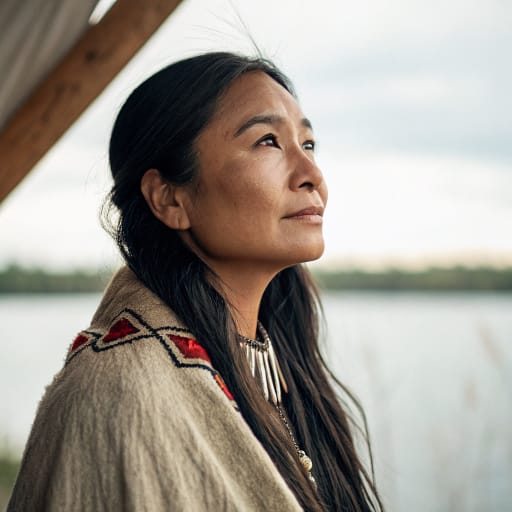
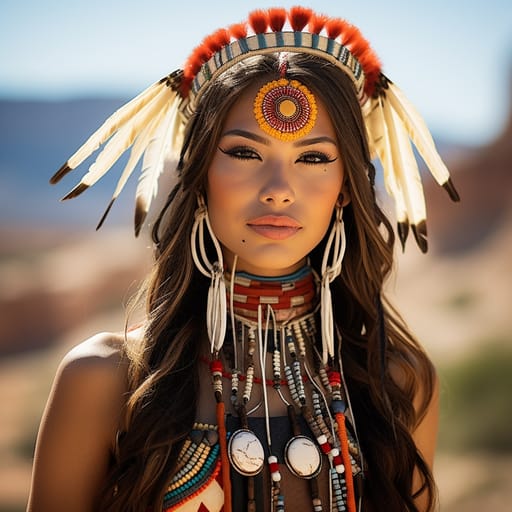
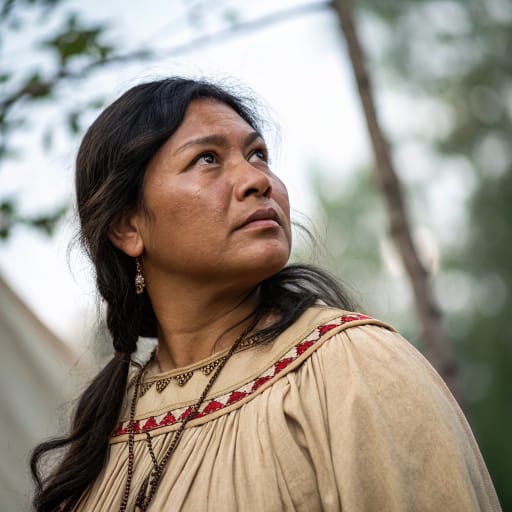
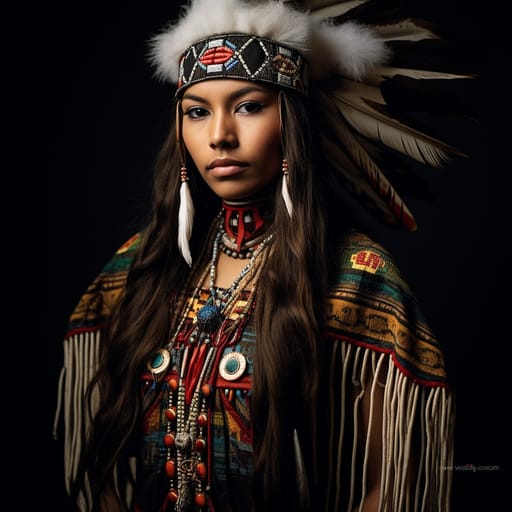
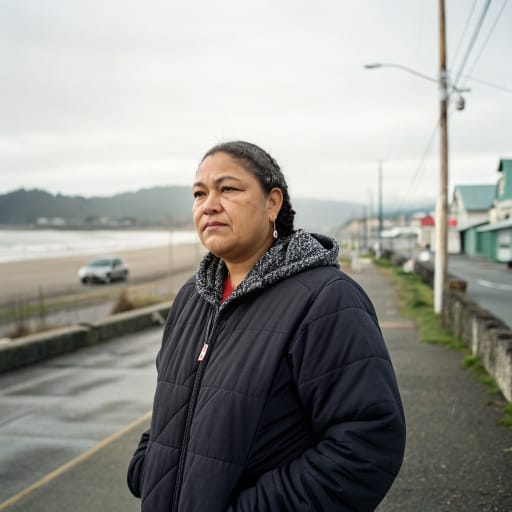
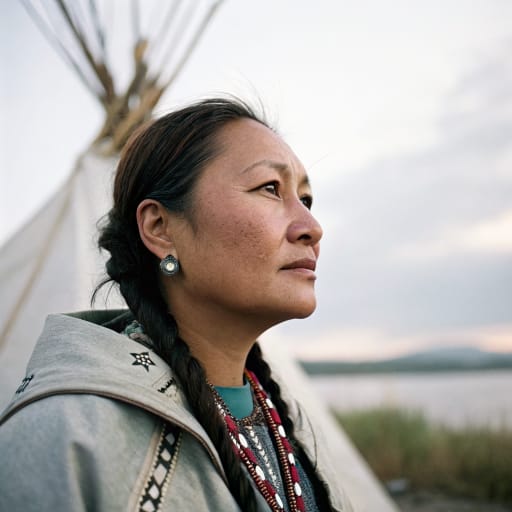
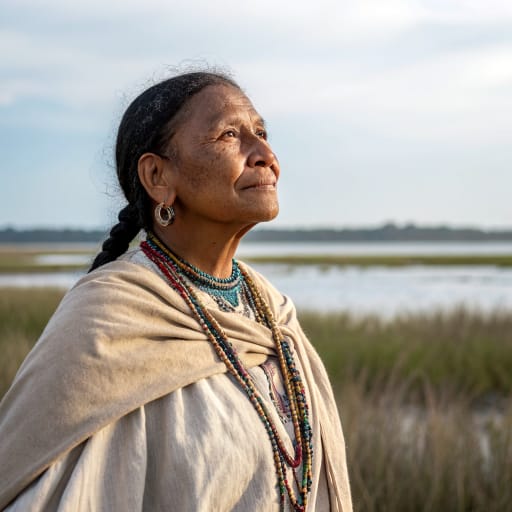
Typical Nakoda Phenotypes
Reference for AI generation: hair, eyes, skin, facial structure, build
Nakoda Body & Anatomy Reference
Indigenous Northern American / Algonquian-Iroquoian phenotype: anatomy reference for AI nude generation
Nakoda Boobs & Breasts
Nakoda boobs follow the Indigenous Northern American / Algonquian-Iroquoian profile: medium cup, moderate projection. Areolar diameter is usually 30-44mm, and the coloring is medium-brown areolar pigmentation against the copper-to-medium-brown skin tone. Breast shape tracks body composition (mesomorph, broader frame in northern Indigenous populations, mean adult female BMI 25-28), so Nakoda breasts tend to be full and moderate projection. Expect a forward-set shape, not the smaller East Asian bust.
Nakoda Ass & Hips
Nakoda ass and hip morphology presents as medium, moderate-to-full projection, distinctly different from the slim East Asian narrow-hip profile. The Nakoda pelvic profile shows medium iliac crests, anchored in the Indigenous Northern American / Algonquian-Iroquoian skeletal pattern. Nakoda butt shots in adult AI imagery should render the medium, moderate-to-full projection silhouette with the overall build (mesomorph, broader frame in northern Indigenous populations) and the fat distribution typical of the Indigenous Northern American / Algonquian-Iroquoian phenotype.
Nakoda Vagina & Pussy
Nakoda pussy anatomy typically shows medium-brown labial pigmentation. Pubic hair is usually straight medium-coarse texture. In AI-generated Nakoda nudes, labial color should blend into the copper to medium-brown skin with a gradual transition, and the hair should keep its straight medium-coarse texture.
Nakoda Dicks & Penis
Penis reference for Nakoda men: regional mean ~13cm erect, moderate girth. Coloring: medium-brown shaft pigmentation. An accurate Nakoda cock in AI imagery matches the surrounding copper to medium-brown skin rather than a generic porn default. Circumcision depends on religion and custom, not ancestry.
Nakoda Body, Curves & Build
The Nakoda figure is generally mesomorph, broader frame in northern Indigenous populations, with mean adult female BMI 25-28, characteristic of Indigenous Northern American / Algonquian-Iroquoian ancestry. AI image tools tend to flatten regional body types into a few stock shapes; here the Nakoda build is kept as its own reference.
Nakoda Skin Tone & Hair Texture
Skin: copper to medium-brown (Fitzpatrick III-V). Hair: straight 1A, dark-brown to black, often thick and dense. Both are typical of Indigenous Northern American / Algonquian-Iroquoian ancestry. The most common mistake in AI nudes of Nakoda women is a body rendered lighter than the face.
Explore phenotype categories
Structured taxonomy with peer-reviewed scales · 22 anatomical categories
Erotic Poses & Sex Positions
From the pose catalog: 219 named positions with reference skeletons
Frequently asked questions about Nakoda people
Where is the Nakoda homeland?
The Nakoda homeland is Northern Great Plains and the Rocky Mountain foothills: Saskatchewan, Alberta and Manitoba in Canada, Montana and North Dakota in the United States. in North America.
What language do Nakoda people speak?
Nakoda people primarily speak Nakoda, also called Assiniboine, and Stoney, two closely related Dakotan languages (Siouan).
What religion do Nakoda people practice?
The predominant religion among Nakoda people is Largely Christian, mostly Methodist and Catholic mission legacies, alongside continuing Sun Dance, sweat lodge and pipe ceremony.






Make your own Nakoda images
Five a day, free, no credits to buy. The studio starts from this group's phenotype data, so you can set body type, pose and style and keep the traits accurate.
Start with Nakoda