Help us get this right
Does this portrait look right for Clatsop?
Nobody has judged this one yet. You would be the first.
Clatsop Erotic
South bank of the Columbia River mouth and the northern Oregon coast from Point Adams and Youngs Bay to Tillamook Head, in present-day Clatsop County, Oregon, United States
Clatsop dialect of Lower Chinook (Chinookan), no longer spoken natively; English today
Traditional Chinookan guardian spirit beliefs; Christianity among many descendants
Lower Chinookan peoples of the Columbia estuary, closely related to the Chinook proper; represented today by the Clatsop-Nehalem Confederated Tribes and the Chinook Indian Nation
About Clatsop People
The Clatsop are the Chinookan people of the Oregon side of the Columbia's mouth. Their country is estuary shoreline, sand plain and tidal creek, running from Point Adams south toward Tillamook Head. The name is usually explained as a reference to dried salmon. That suits a people whose year was set by the fish runs, and whose place at the outlet of the Northwest's great river made them traders almost by default. Across the water on the Washington shore lived the Chinook proper, close kin who spoke nearly the same language. Tillamook country began to the south, where people spoke an unrelated Salishan language. The Clatsop married across that line often enough that later generations belonged to both.
Extended families shared cedar plankhouses and traveled by canoe. Salmon, sturgeon, smelt, elk, shellfish and wapato root filled the stores, and strings of dentalium shell served as both ornament and money. Society was ranked into leading families, commoners, and slaves who were captured in raids or bought through trade. A free-born baby was cradled with a padded board that slowly flattened the forehead, giving the sloping profile that marked free status. The children of slaves were not shaped. Spiritual life turned on guardian spirit power, which each person sought for themselves and expressed in song.
The Clatsop entered the American record in the winter of 1805 to 1806, when the Lewis and Clark expedition built a stockade on their land and called it Fort Clatsop. The headman Coboway and his people traded with the damp, underfed party through the season, and the journals fill up with Clatsop fish, roots, woven hats and canoes. On leaving, the Americans gave Coboway the fort and took a Clatsop canoe without paying for it. Change came fast after that: a fur post at Astoria in 1811, then epidemic disease that emptied lower Columbia villages in the early 1830s. In 1851 Clatsop leaders signed a treaty at Tansy Point that would have let them keep part of their home ground. The Senate never ratified it.
The Clatsop did not vanish with the treaty. Descendants stayed on around Astoria, Seaside and the Clatsop Plains, many tied by marriage to Tillamook and settler families. Today that heritage is carried by the Clatsop-Nehalem Confederated Tribes and by the Chinook Indian Nation, which counts the Clatsop among its five member tribes. Neither group has federal recognition, so land and formal standing remain unsettled. The Clatsop dialect of Lower Chinook has no native speakers left. Much Lower Chinook vocabulary lives on in Chinuk Wawa, the old regional trade language, which is being taught again.
Related ethnic groups
Groups that share Clatsop's homeland, region, language, or religious tradition. These are likely candidates for comparative phenotype reference.
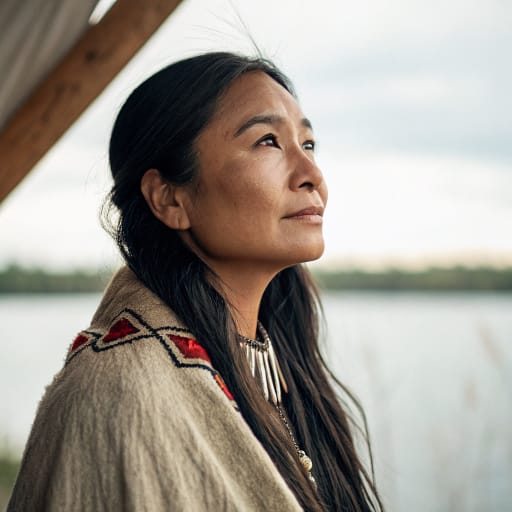
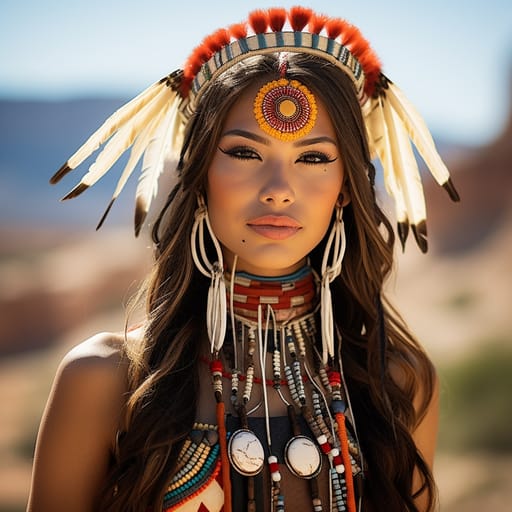
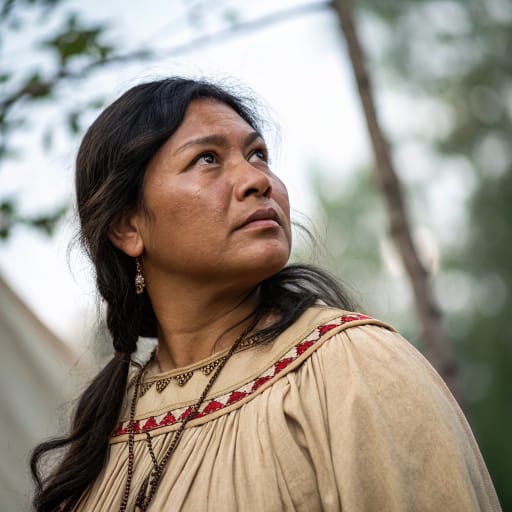
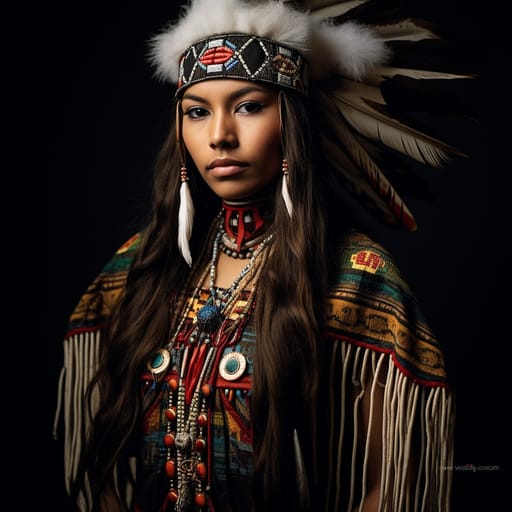
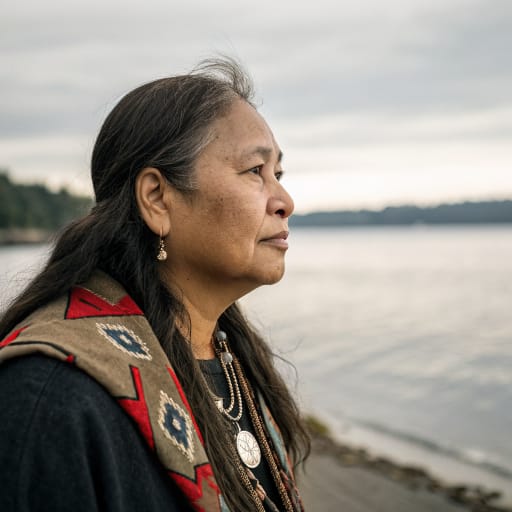
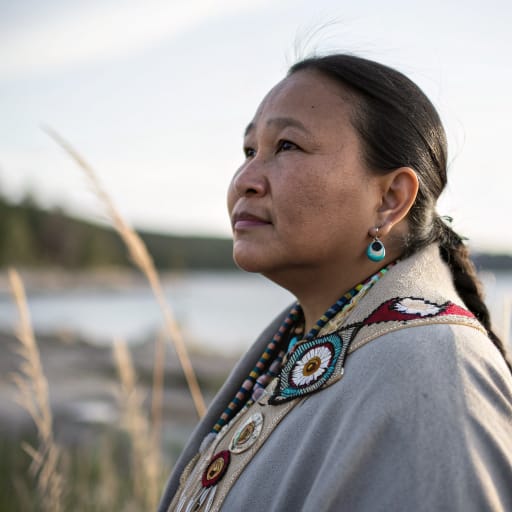
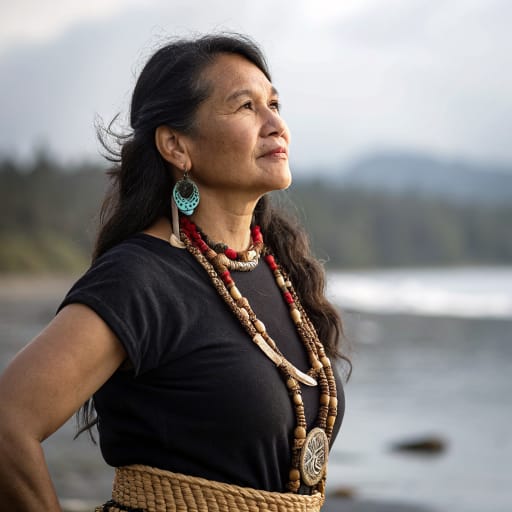
Typical Clatsop Phenotypes
Reference for AI generation: hair, eyes, skin, facial structure, build
Clatsop Body & Anatomy Reference
Anatomy by feature, Indigenous Northern American / Algonquian-Iroquoian phenotype
Clatsop Boobs & Breasts
Clatsop tits and boobs run medium cup, moderate projection, the classic Indigenous Northern American / Algonquian-Iroquoian bust profile. Clatsop nipples and areolas show medium-brown areolar pigmentation against the copper-to-medium-brown skin tone, with areolar diameter typically in the 30-44mm range and forward-set positioning rather than the smaller East Asian bust. Clatsop breasts trend full and moderate projection, a function of the mesomorph, broader frame in northern Indigenous populations body habitus and the mean adult female BMI 25-28. For anatomically accurate AI-generated Clatsop nudes the render preserves the medium cup, moderate projection shape, 30-44mm areolas with medium-brown pigmentation, and the torso proportions of the Indigenous Northern American / Algonquian-Iroquoian phenotype.
Clatsop Ass & Hips
Clatsop hips and butt usually read as medium, moderate-to-full projection. The skeletal base is medium iliac crests, the Indigenous Northern American / Algonquian-Iroquoian pattern. Set against the slim East Asian narrow-hip profile, the difference is easy to see, and the hip-to-waist ratio is often what identifies Clatsop women in photos.
Clatsop Vagina & Pussy
Expect medium-brown labial pigmentation on Clatsop women, in keeping with Indigenous Northern American / Algonquian-Iroquoian ancestry. The pubic hair is straight medium-coarse texture. Coloring should run evenly from the copper to medium-brown skin of the thighs to the labia, and Clatsop nude imagery should keep the hair's straight medium-coarse texture.
Clatsop Dicks & Penis
Clatsop dick and penile anatomy in adult AI generation should anchor on the regional reference data: regional mean ~13cm erect, moderate girth, and medium-brown shaft pigmentation. The Clatsop cock profile reflects the Indigenous Northern American / Algonquian-Iroquoian population's anthropometric measurements. The shaft pigmentation should track the surrounding copper to medium-brown skin tone, and the pubic hair should keep its straight medium-coarse texture in the typical inverted-V escutcheon.
Clatsop Body, Curves & Build
Clatsop body type: mesomorph, broader frame in northern Indigenous populations, with mean adult female BMI 25-28. This is the typical Indigenous Northern American / Algonquian-Iroquoian build. Height range, shoulder-to-hip ratio and fat distribution all follow from it, which is what an accurate Clatsop nude body should show.
Clatsop Skin Tone & Hair Texture
Clatsop skin tone falls in the copper to medium-brown (Fitzpatrick III-V) band, the surface signal most often miscalibrated by generic AI nude generators. Clatsop hair texture is typically straight 1A, dark-brown to black, often thick and dense, characteristic of the Indigenous Northern American / Algonquian-Iroquoian phenotype. In Clatsop nude renders the skin should hold that band consistently across the body.
Explore phenotype categories
Structured taxonomy with peer-reviewed scales · 22 anatomical categories
Erotic Poses & Sex Positions
From the pose catalog: 219 named positions with reference skeletons
Frequently asked questions about Clatsop people
Where is the Clatsop homeland?
The Clatsop homeland is South bank of the Columbia River mouth and the northern Oregon coast from Point Adams and Youngs Bay to Tillamook Head, in present-day Clatsop County, Oregon, United States in North America.
What language do Clatsop people speak?
Clatsop people primarily speak Clatsop dialect of Lower Chinook (Chinookan), no longer spoken natively; English today.
What religion do Clatsop people practice?
The predominant religion among Clatsop people is Traditional Chinookan guardian spirit beliefs; Christianity among many descendants.






Make your own Clatsop images
Five a day, free, no credits to buy. The studio starts from this group's phenotype data, so you can set body type, pose and style and keep the traits accurate.
Start with Clatsop