Help us get this right
Does this portrait look right for Kumeyaay?
Nobody has judged this one yet. You would be the first.
Kumeyaay Erotic
San Diego County and the surrounding mountains and desert of southern California, United States, and northern Baja California, Mexico
Kumeyaay, in northern (Ipai) and southern (Tipai) varieties (Yuman, Delta-California branch); English and Spanish in daily use
Catholicism from the mission period, some Protestant affiliation, alongside continuing Kumeyaay ceremonial practice including bird song cycles and mourning ceremonies
Ipai (north) and Tipai (south), with the Kamia to the east; part of the wider Yuman family alongside Cocopah, Quechan, Paipai and Kiliwa
About Kumeyaay People
The Kumeyaay are the people whose homeland has an international border running through the middle of it. Their country reaches from the Pacific shore near San Diego east across the coastal mesas, up into the Laguna and Cuyamaca mountains, down the far side into the Colorado Desert, and south well past the line into Baja California toward the Sierra Juárez. In 1848 the Treaty of Guadalupe Hidalgo drew a border across it. The families on either side did not become two peoples. They became Kumeyaay in the United States and Kumiai in Mexico, and they have gone on visiting, marrying and burying across that line ever since, with steadily more paperwork required to do it. They speak Kumeyaay, a Yuman language, which groups them with the Cocopah, Quechan, Paipai and Kiliwa and sets them clearly apart from the Uto-Aztecan Luiseño and Cahuilla immediately north: a hard language boundary in a short stretch of country. The language divides into northern (Ipai) and southern (Tipai) varieties, distinct enough that speakers at opposite ends of the range hear the difference. Diegueño, the older Spanish name taken from Mission San Diego, is falling out of use. Society was built on patrilineal clans, the shimull, each tied to particular ground and headed by a kwaaypaay, and clan lines still shape how families place themselves.
Calling them hunter-gatherers understates the work. The Kumeyaay burned grassland on a schedule, moved oak and mesquite stands into new country, tended agave, and ran a seasonal round from shellfish and coastal plants to mountain acorns to desert harvests below. Their pottery is paddle-and-anvil work, thin walled and brown; their coiled baskets use juncus rush and deergrass. In November 1775 Kumeyaay from the villages around Mission San Diego burned it and killed the priest there, the first serious revolt against the mission system in Alta California, and it is not a forgotten episode locally. Twelve federally recognized bands hold reservations in San Diego County today, several of them running gaming operations that fund everything else; the Baja communities at San José de la Zorra, San Antonio Necua and Juntas de Nejí are smaller and poorer. Bird songs, a long cycle sung in sequence with gourd rattles, are performed at gatherings on both sides of the border. First-language speakers are few and elderly, and the language is now taught on purpose, in tribal programs and at Kumeyaay Community College.
Related ethnic groups
Groups that share Kumeyaay's homeland, region, language, or religious tradition. These are likely candidates for comparative phenotype reference.
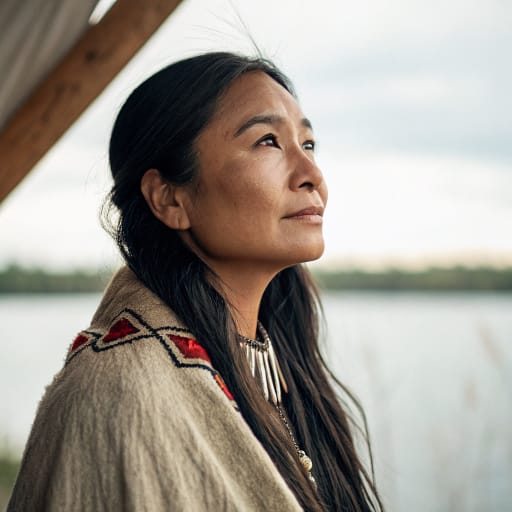
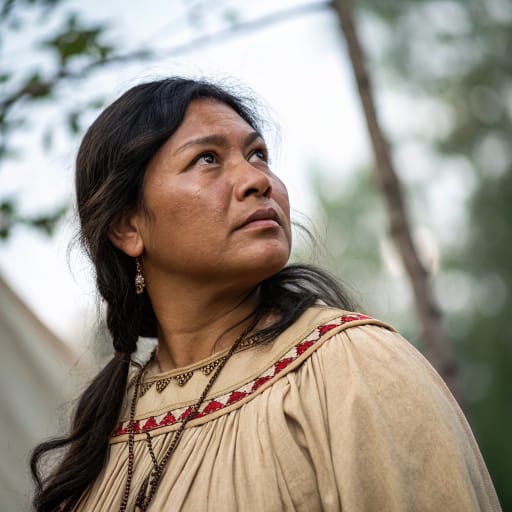
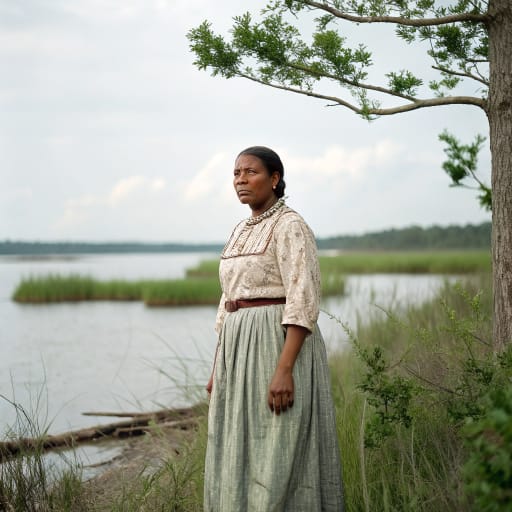
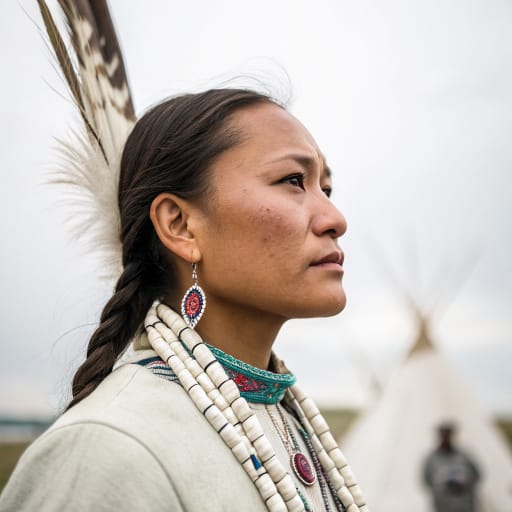
Typical Kumeyaay Phenotypes
Reference for AI generation: hair, eyes, skin, facial structure, build
Kumeyaay Body & Anatomy Reference
Per-feature anatomical profile for AI nude generation: Indigenous Northern American / Algonquian-Iroquoian phenotype
Kumeyaay Boobs & Breasts
Kumeyaay tits and boobs run medium cup, moderate projection, the classic Indigenous Northern American / Algonquian-Iroquoian bust profile. Kumeyaay nipples and areolas show medium-brown areolar pigmentation against the copper-to-medium-brown skin tone, with areolar diameter typically in the 30-44mm range and forward-set positioning rather than the smaller East Asian bust. Kumeyaay breasts trend full and moderate projection, a function of the mesomorph, broader frame in northern Indigenous populations body habitus and the mean adult female BMI 25-28. For anatomically accurate AI-generated Kumeyaay nudes the render preserves the medium cup, moderate projection shape, 30-44mm areolas with medium-brown pigmentation, and the torso proportions of the Indigenous Northern American / Algonquian-Iroquoian phenotype.
Kumeyaay Ass & Hips
Kumeyaay hips and butt usually read as medium, moderate-to-full projection. The skeletal base is medium iliac crests, the Indigenous Northern American / Algonquian-Iroquoian pattern. Set against the slim East Asian narrow-hip profile, the difference is easy to see, and the hip-to-waist ratio is often what identifies Kumeyaay women in photos.
Kumeyaay Vagina & Pussy
Expect medium-brown labial pigmentation on Kumeyaay women, in keeping with Indigenous Northern American / Algonquian-Iroquoian ancestry. The pubic hair is straight medium-coarse texture. Coloring should run evenly from the copper to medium-brown skin of the thighs to the labia, and Kumeyaay nude imagery should keep the hair's straight medium-coarse texture.
Kumeyaay Dicks & Penis
Kumeyaay dick and penile anatomy in adult AI generation should anchor on the regional reference data: regional mean ~13cm erect, moderate girth, and medium-brown shaft pigmentation. The Kumeyaay cock profile reflects the Indigenous Northern American / Algonquian-Iroquoian population's anthropometric measurements. The shaft pigmentation should track the surrounding copper to medium-brown skin tone, and the pubic hair should keep its straight medium-coarse texture in the typical inverted-V escutcheon.
Kumeyaay Body, Curves & Build
Kumeyaay body type: mesomorph, broader frame in northern Indigenous populations, with mean adult female BMI 25-28. This is the typical Indigenous Northern American / Algonquian-Iroquoian build. Height range, shoulder-to-hip ratio and fat distribution all follow from it, which is what an accurate Kumeyaay nude body should show.
Kumeyaay Skin Tone & Hair Texture
Kumeyaay skin tone falls in the copper to medium-brown (Fitzpatrick III-V) band, the surface signal most often miscalibrated by generic AI nude generators. Kumeyaay hair texture is typically straight 1A, dark-brown to black, often thick and dense, characteristic of the Indigenous Northern American / Algonquian-Iroquoian phenotype. In Kumeyaay nude renders the skin should hold that band consistently across the body.
Explore phenotype categories
Structured taxonomy with peer-reviewed scales · 22 anatomical categories
Erotic Poses & Sex Positions
From the pose catalog: 219 named positions with reference skeletons
Frequently asked questions about Kumeyaay people
Where is the Kumeyaay homeland?
The Kumeyaay homeland is San Diego County and the surrounding mountains and desert of southern California, United States, and northern Baja California, Mexico in North America.
What language do Kumeyaay people speak?
Kumeyaay people primarily speak Kumeyaay, in northern (Ipai) and southern (Tipai) varieties (Yuman, Delta-California branch); English and Spanish in daily use.
What religion do Kumeyaay people practice?
The predominant religion among Kumeyaay people is Catholicism from the mission period, some Protestant affiliation, alongside continuing Kumeyaay ceremonial practice including bird song cycles and mourning ceremonies.






Make your own Kumeyaay images
Five a day, free, no credits to buy. The studio starts from this group's phenotype data, so you can set body type, pose and style and keep the traits accurate.
Start with Kumeyaay