No portrait yet
Timucua Erotic
Northeast and north central Florida and southeastern Georgia, United States (historical, to the 1760s)
Timucua (language isolate, several dialects; extinct by the mid-18th century)
Indigenous animist practice led by shamans; nominal Roman Catholicism under the Spanish Franciscan missions from the 1590s
Eastern Timucua (Mocama, Saturiwa, Tacatacuru, Agua Dulce, Acuera) and Western Timucua (Potano, Northern Utina, Yustaga, Ocale)
About Timucua People
The Timucua were a historical people of northern Florida and southeastern Georgia, the largest native population in the region when Europeans arrived in the early 1500s and gone as a distinct people by 1763, when the last few dozen survivors sailed to Cuba with the departing Spanish. They were never one nation. What made them Timucua was language: some thirty-five chiefdoms, sorted by scholars into eastern and western clusters, all speaking dialects of a tongue with no proven relatives anywhere. The coastal Mocama, the Saturiwa chiefdom among them, lived on fish, shellfish and the tidal marshes around the mouth of the St. Johns River. The inland Potano, Northern Utina and Yustaga farmed corn, beans and squash across the uplands of north central Florida and had more in common with the Mississippian farming societies to their north. Descent ran through the mother's line, and a chief's heir was usually his sister's son.
Their misfortune was to live at the front door of the continent. Narváez and de Soto marched through in 1528 and 1539, French Huguenots built Fort Caroline among the Saturiwa in 1564, and the Spanish founded St. Augustine the following year and never left. Jacques Le Moyne sketched Timucua councils, hunts and burials for the French, and Theodor de Bry's engravings of those sketches remain the images most people have seen, whatever their accuracy. Franciscan missions spread west along the Camino Real from the 1590s, and the friar Francisco Pareja wrote a grammar and bilingual catechisms that make Timucua one of the best documented native languages of early colonial North America, better recorded than many that survived. Epidemics did most of the killing: a population reckoned at two hundred thousand fell below a thousand in under two centuries. A revolt against the governor in 1656 ended with its leaders executed and villages forcibly relocated, and Carolina raiders with Creek and Yamasee allies burned the remaining missions between 1702 and 1706.
A few things still surprise. Men and women carried tattoos over much of the body, more with higher rank, so a person's standing was legible at a glance. Councils opened with a shared cup of roasted yaupon holly, the caffeinated black drink of the Southeast. Pareja's confessional manual lists dozens of everyday rites the church was trying to stamp out: first fruits offerings, hunting charms, omens read from birds. No Timucua community survives. What remains is the name on the Timucuan Ecological and Historic Preserve outside Jacksonville, a shelf of seventeenth century texts in a language unspoken for two and a half centuries, and the mounds and shell middens along the St. Johns.
Related ethnic groups
Groups that share Timucua's homeland, region, language, or religious tradition. These are likely candidates for comparative phenotype reference.
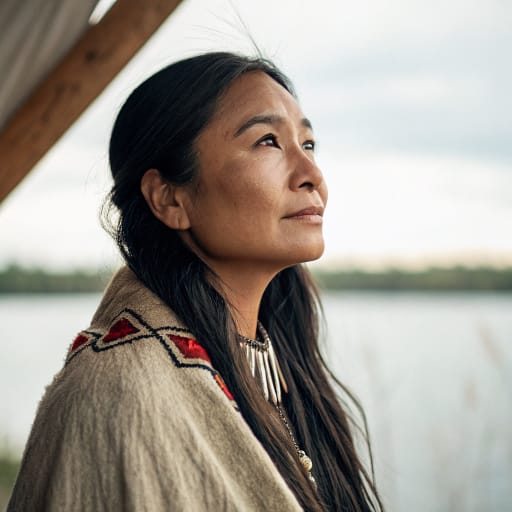
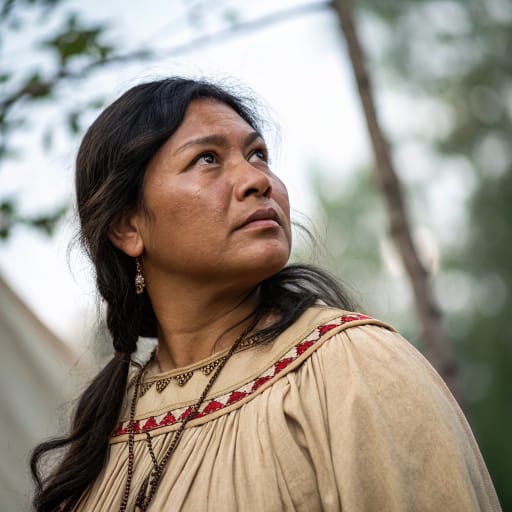

Typical Timucua Phenotypes
Reference for AI generation: hair, eyes, skin, facial structure, build
Timucua Body & Anatomy Reference
Anatomy by feature, Indigenous Northern American / Algonquian-Iroquoian phenotype
Timucua Boobs & Breasts
Timucua tits and boobs run medium cup, moderate projection, the classic Indigenous Northern American / Algonquian-Iroquoian bust profile. Timucua nipples and areolas show medium-brown areolar pigmentation against the copper-to-medium-brown skin tone, with areolar diameter typically in the 30-44mm range and forward-set positioning rather than the smaller East Asian bust. Timucua breasts trend full and moderate projection, a function of the mesomorph, broader frame in northern Indigenous populations body habitus and the mean adult female BMI 25-28. For anatomically accurate AI-generated Timucua nudes the render preserves the medium cup, moderate projection shape, 30-44mm areolas with medium-brown pigmentation, and the torso proportions of the Indigenous Northern American / Algonquian-Iroquoian phenotype.
Timucua Ass & Hips
Timucua hips and butt usually read as medium, moderate-to-full projection. The skeletal base is medium iliac crests, the Indigenous Northern American / Algonquian-Iroquoian pattern. Set against the slim East Asian narrow-hip profile, the difference is easy to see, and the hip-to-waist ratio is often what identifies Timucua women in photos.
Timucua Vagina & Pussy
Expect medium-brown labial pigmentation on Timucua women, in keeping with Indigenous Northern American / Algonquian-Iroquoian ancestry. The pubic hair is straight medium-coarse texture. Coloring should run evenly from the copper to medium-brown skin of the thighs to the labia, and Timucua nude imagery should keep the hair's straight medium-coarse texture.
Timucua Dicks & Penis
Timucua dick and penile anatomy in adult AI generation should anchor on the regional reference data: regional mean ~13cm erect, moderate girth, and medium-brown shaft pigmentation. The Timucua cock profile reflects the Indigenous Northern American / Algonquian-Iroquoian population's anthropometric measurements. The shaft pigmentation should track the surrounding copper to medium-brown skin tone, and the pubic hair should keep its straight medium-coarse texture in the typical inverted-V escutcheon.
Timucua Body, Curves & Build
Timucua body type: mesomorph, broader frame in northern Indigenous populations, with mean adult female BMI 25-28. This is the typical Indigenous Northern American / Algonquian-Iroquoian build. Height range, shoulder-to-hip ratio and fat distribution all follow from it, which is what an accurate Timucua nude body should show.
Timucua Skin Tone & Hair Texture
Timucua skin tone falls in the copper to medium-brown (Fitzpatrick III-V) band, the surface signal most often miscalibrated by generic AI nude generators. Timucua hair texture is typically straight 1A, dark-brown to black, often thick and dense, characteristic of the Indigenous Northern American / Algonquian-Iroquoian phenotype. In Timucua nude renders the skin should hold that band consistently across the body.
Explore phenotype categories
Structured taxonomy with peer-reviewed scales · 22 anatomical categories
Erotic Poses & Sex Positions
From the pose catalog: 219 named positions with reference skeletons
Frequently asked questions about Timucua people
Where is the Timucua homeland?
The Timucua homeland is Northeast and north central Florida and southeastern Georgia, United States (historical, to the 1760s) in North America.
What language do Timucua people speak?
Timucua people primarily speak Timucua (language isolate, several dialects; extinct by the mid-18th century).
What religion do Timucua people practice?
The predominant religion among Timucua people is Indigenous animist practice led by shamans; nominal Roman Catholicism under the Spanish Franciscan missions from the 1590s.






Make your own Timucua images
Five a day, free, no credits to buy. The studio starts from this group's phenotype data, so you can set body type, pose and style and keep the traits accurate.
Start with Timucua