Help us get this right
Does this portrait look right for Balobedu?
One tap. It takes a second and it is recorded.
2 say it looks right, 0 say it looks off.
Balobedu Erotic
Bolobedu, Limpopo Province, South Africa
Khelobedu (Niger-Congo, Bantu, Sotho-Tswana; related to Northern Sotho)
Ancestral veneration and rainmaking tradition; Christianity
Northern Sotho / Sotho-Tswana cluster; Modjadji royal house
About Balobedu People
The Balobedu (also Lobedu or Bolobedu) are a Sotho-Tswana people of Limpopo Province in northeastern South Africa, living in the Bolobedu area near Modjadjiskloof. They speak Khelobedu, a variety related to Northern Sotho (Sesotho sa Leboa), and are best known internationally for their hereditary female ruler, the Rain Queen or Modjadji.
The Rain Queen and society
Balobedu society is organised around chieftaincy and, distinctively, a royal line in which a queen is believed to hold power over rain and clouds, a reputation that historically brought tribute and respect from neighbouring peoples and even distant rulers. The Modjadji dynasty, dating to the early nineteenth century, is often said to have inspired the immortal queen in Rider Haggard's novel She. Subsistence rests on the farming of maize, sorghum and vegetables, with cattle and communal rainmaking rites tied to the queen's ritual role. Ancestral veneration remains important, now alongside Christianity. Succession traditionally passes through the female line, and the queen historically received symbolic wives from allied families as a way of binding communities to the royal house rather than as ordinary marriages. The dynasty has faced periods of uncertainty in modern times, including disputes over succession and long gaps between reigns, yet the office remains a powerful symbol of Balobedu identity. Khelobedu is closely related to but distinct from standard Northern Sotho, and community leaders have pressed for it to gain fuller official recognition.
Appearance and adornment
In daily life the Balobedu dress in modern clothing, with traditional attire reserved for ceremony and for the royal household. Customary dress features cloth wraps and, for women, beaded ornaments, layered necklaces and headscarves or beaded headbands. At royal rituals the queen and her attendants appear in patterned cloths and beadwork, and gifts of cattle and beer accompany requests for rain. Music, drumming and communal dance accompany the annual cycle of agricultural and rain ceremonies.
Related ethnic groups
Groups that share Balobedu's homeland, region, language, or religious tradition. These are likely candidates for comparative phenotype reference.
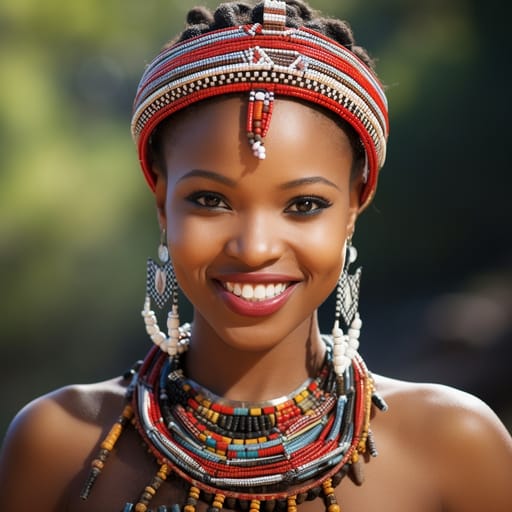
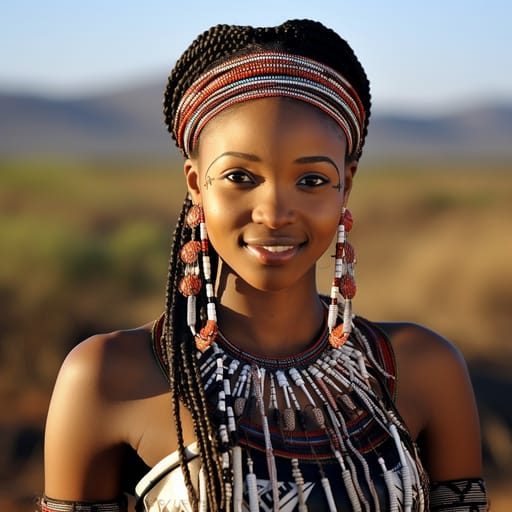
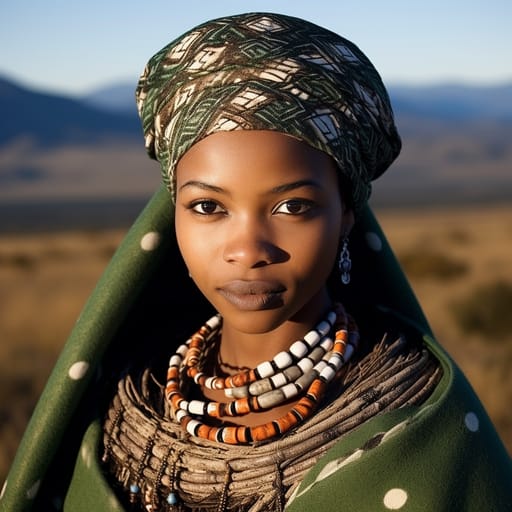
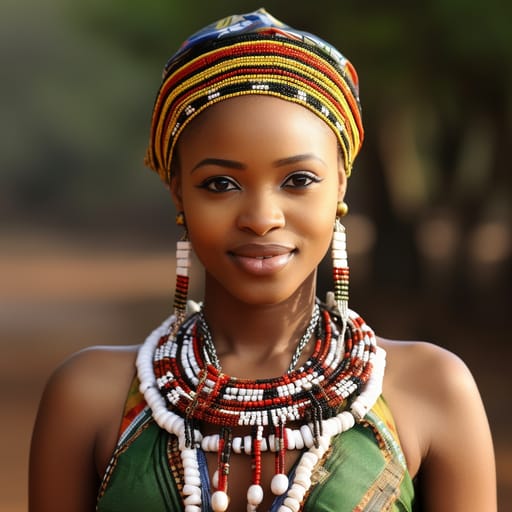
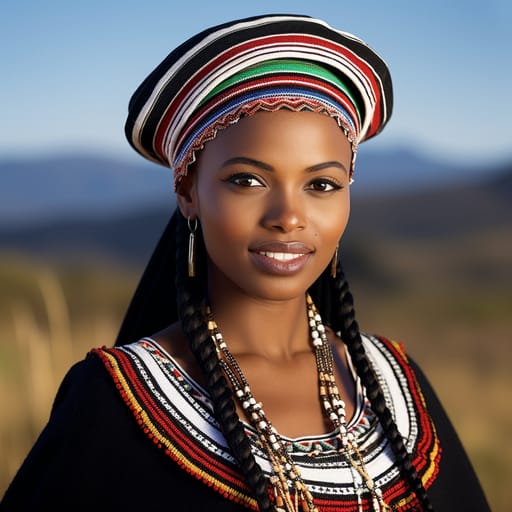

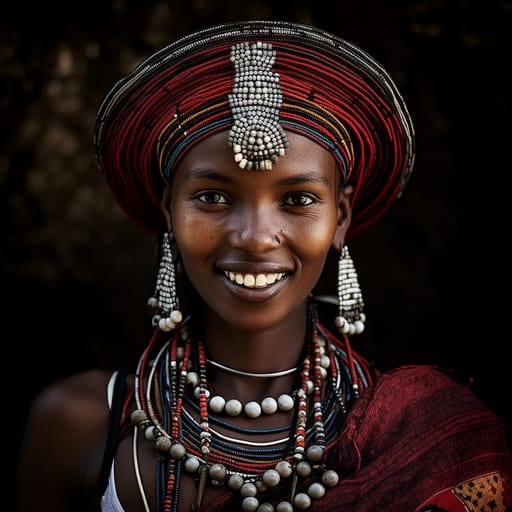
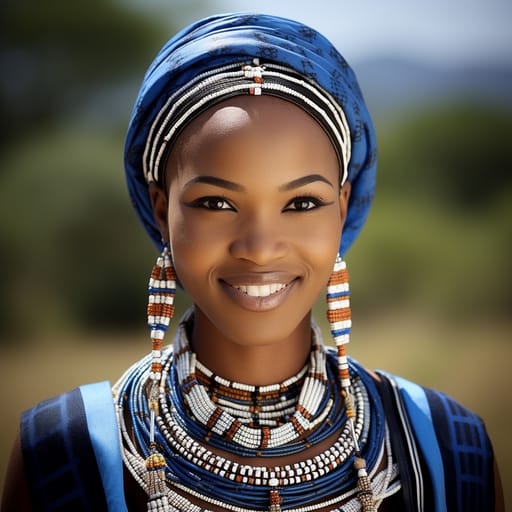
Typical Balobedu Phenotypes
Reference for AI generation: hair, eyes, skin, facial structure, build
Balobedu Body & Anatomy Reference
Anatomy by feature, Bantu / Khoisan Southern African phenotype
Balobedu Boobs & Breasts
Balobedu tits and boobs run medium cup, full but moderate projection, the classic Bantu / Khoisan Southern African bust profile. Balobedu nipples and areolas show medium-brown to deep-brown areolar pigmentation, with areolar diameter typically in the 30-44mm range and forward-set positioning rather than the heavier West African bust. Balobedu breasts trend moderately full; less projecting than West African norm, a function of the mesomorph; Khoisan-descended sub-populations show distinctive steatopygic fat deposition body habitus and the mean adult female BMI 24-28. For anatomically accurate AI-generated Balobedu nudes the render preserves the medium cup, full but moderate projection shape, 30-44mm areolas with medium-brown to deep-brown pigmentation, and the torso proportions of the Bantu / Khoisan Southern African phenotype.
Balobedu Ass & Hips
Balobedu hips and butt usually read as the distinctive Khoisan-influenced steatopygic profile in some sub-populations (San, Khoekhoe); broader gluteal projection in Bantu-speaking groups. The skeletal base is wide iliac crests with notable lordosis in Khoisan-descended sub-populations, the Bantu / Khoisan Southern African pattern. Set against the slim Cushitic East African profile, the difference is easy to see, and the hip-to-waist ratio is often what identifies Balobedu women in photos.
Balobedu Vagina & Pussy
Expect deep-brown labial pigmentation; the elongated labia minora documented in some Khoisan-descended populations on Balobedu women, in keeping with Bantu / Khoisan Southern African ancestry. The pubic hair is tightly-coiled coarse texture. Coloring should run evenly from the medium-brown to deep-brown skin of the thighs to the labia, and Balobedu nude imagery should keep the hair's tightly-coiled coarse texture.
Balobedu Dicks & Penis
Balobedu dick and penile anatomy in adult AI generation should anchor on the regional reference data: regional mean ~14cm erect, moderate-to-above-average girth, and deep-brown shaft pigmentation. The Balobedu cock profile reflects the Bantu / Khoisan Southern African population's anthropometric measurements. The shaft pigmentation should track the surrounding medium-brown to deep-brown skin tone, and the pubic hair should keep its tightly-coiled coarse texture in the typical inverted-V escutcheon.
Balobedu Body, Curves & Build
Balobedu body type: mesomorph; Khoisan-descended sub-populations show distinctive steatopygic fat deposition, with mean adult female BMI 24-28. This is the typical Bantu / Khoisan Southern African build. Height range, shoulder-to-hip ratio and fat distribution all follow from it, which is what an accurate Balobedu nude body should show.
Balobedu Skin Tone & Hair Texture
Balobedu skin tone falls in the medium-brown to deep-brown (Fitzpatrick V-VI); lighter in Khoisan-descended populations band, the surface signal most often miscalibrated by generic AI nude generators. Balobedu hair texture is typically tightly-coiled 4A-4C; the distinctive 'peppercorn' tight-spiral texture in Khoisan-descended populations, characteristic of the Bantu / Khoisan Southern African phenotype. In Balobedu nude renders the skin should hold that band consistently across the body.
Explore phenotype categories
Structured taxonomy with peer-reviewed scales · 22 anatomical categories
Notable Balobedu People
14 reference figures, sourced from Wikipedia
- Stanley Kgatla, former Platinum Stars defender; born in Ga-Ramotshinyadi village
- Candy Tsa Mandebele, musician
- Lebogang Manyama, Cape Town City FC midfielder
- Andrew Rabutla, former Bafana Bafana and Jomo Cosmos defender; born in Ga-Ramotshinyadi village
- Tebogo Monyai, former Mpumalanga Black Aces F.C., Moroka Swallows and University of Pretoria…
- Peta Teanet, born Teanet Peta XiTsonga, a disco musician born and raised in Thapane Villag…
- Mathole Motshekga, South African politician and former premier of Gauteng province
- Solly Mapaila, South African politician and leader of the Communist Party, an ally of the ru…
- Master KG, the Jerusalema song artist
- King Monada, Ska Bora Moreki Hitmaker
- Thabo Cecil Makgoba, Archbishop of Cape Town
- Evidence Makgopa, soccer player, bronze medalist at 2023 Africa Cup of Nations; born in born in…
- Raymond Mdaka, soccer coach, winner of 2025 U-20 Africa Cup of Nations; born in Ga-Mokgwathi…
- Makoma Mohale, actress, played the lead role of Rain Queen in Mzansi Magic cultural drama Qu…
Erotic Poses & Sex Positions
From the pose catalog: 219 named positions with reference skeletons
Frequently asked questions about Balobedu people
Where is the Balobedu homeland?
The Balobedu homeland is Bolobedu, Limpopo Province, South Africa in Southern Africa.
What language do Balobedu people speak?
Balobedu people primarily speak Khelobedu (Niger-Congo, Bantu, Sotho-Tswana; related to Northern Sotho).
What religion do Balobedu people practice?
The predominant religion among Balobedu people is Ancestral veneration and rainmaking tradition; Christianity.






Make your own Balobedu images
Five a day, free, no credits to buy. The studio starts from this group's phenotype data, so you can set body type, pose and style and keep the traits accurate.
Start with Balobedu