Help us get this right
Does this portrait look right for Venda?
One tap. It takes a second and it is recorded.
0 say it looks right, 1 says it looks off.
Venda Erotic
Vendaland (South Africa)
Christianity, Traditional African religions
About Venda People
The Venda live in the far north of South Africa, in the well-watered hill country between the Soutpansberg range and the Limpopo River. The land matters here in a way that shapes almost everything else: streams, sacred pools, and forested ridges figure into Venda cosmology directly, and places like Lake Fundudzi are not scenic features but ritual sites, governed by protocols about who may approach and how. Compared with the open grassland cultures further south, the Venda settled in terrain that rewarded smaller, defensible communities led by hereditary chiefs, and that political pattern persisted long after similar systems elsewhere had been flattened by colonial reorganization.
Tshivenda is a Bantu language, but it sits oddly among its neighbors — closer in some respects to Shona across the Zimbabwean border than to the Sotho and Tsonga languages spoken nearby, and carrying a distinct phonology that South Africans tend to recognize on first hearing. The Venda themselves are usually understood as a fusion: groups moving south from the Zimbabwean plateau in the 17th and 18th centuries, absorbing earlier residents and consolidating under the Singo dynasty around Dzata, the ruined stone-walled capital that still anchors Venda historical memory. Sub-groupings — Tavhatsindi, Ngona, Lembethu and others — reflect this layered settlement rather than a single origin.
Religious life runs on two tracks that most Venda navigate without much sense of contradiction. Christianity, mostly in Lutheran and independent African forms, is widespread; alongside it, ancestral veneration remains central, particularly the role of the makhadzi, the paternal aunt who holds ritual authority in family matters and historically in royal succession. The well-known domba, often described abroad as the "python dance," is the culminating phase of female initiation — a months-long instructional process about adulthood, marriage, and conduct, not a performance staged for visitors. Divination using the thangu bones, drum traditions tied to chieftaincy, and the careful etiquette around sacred groves all sit inside this same framework.
The Venda were one of the last South African groups to be brought fully under colonial administration, holding out into the late 1890s, and later were assigned the nominally independent Bantustan of Venda under apartheid — a structure dissolved in 1994. That late incorporation is part of why so much pre-colonial institutional life, from chieftaincy to ritual specialists, came through to the present in recognizable shape rather than as reconstruction.
Related ethnic groups
Groups that share Venda's homeland, region, language, or religious tradition. These are likely candidates for comparative phenotype reference.
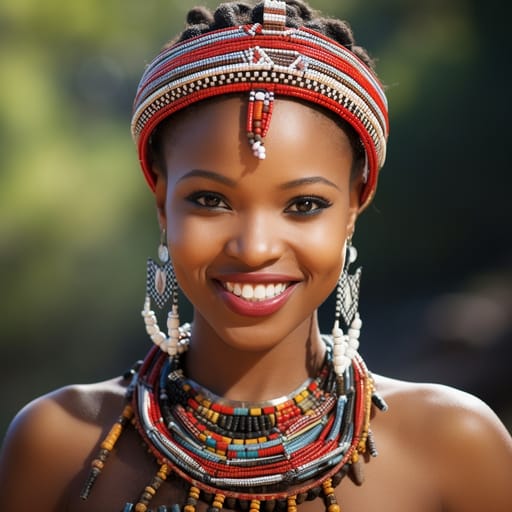
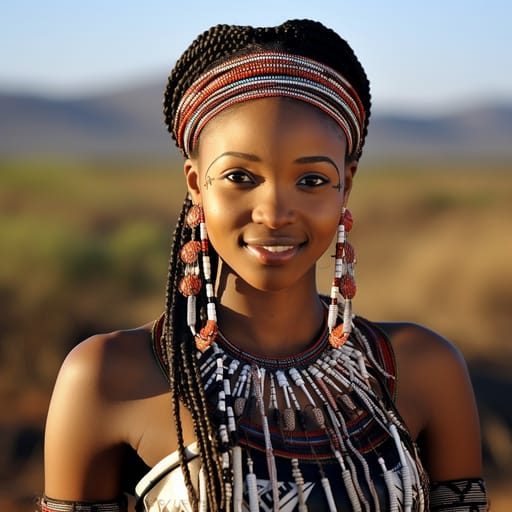
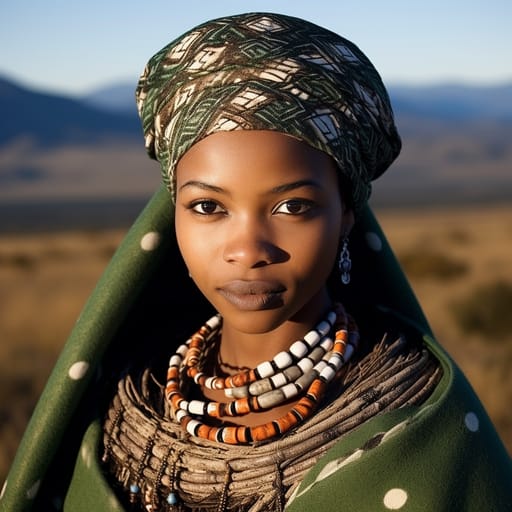
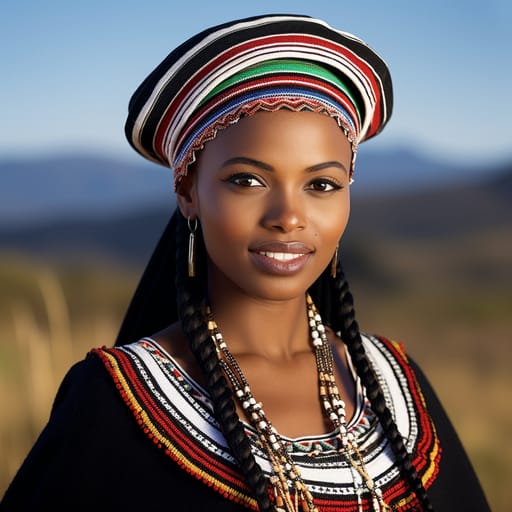
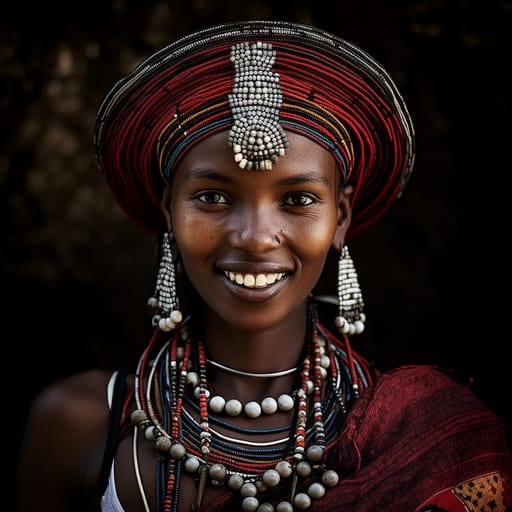
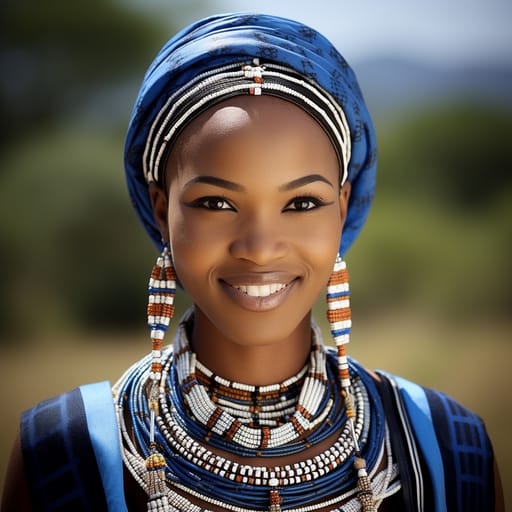
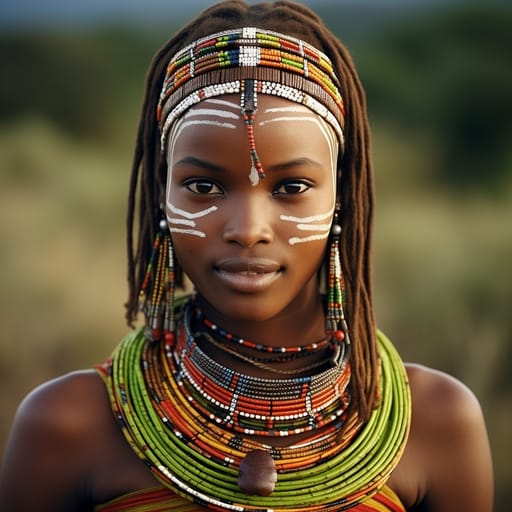
Geographic Distribution: Venda populations across 1 country
Each row is ranked by the group's share of that country's population, with the source citation drawn from published census and demographic surveys. Click through for the full per-country phenotype profile.
| Country | Share | Source |
|---|---|---|
| South Africa | 1.9% | South Africa 2022 Census; Venda / Vhavenda (~1.9%); Bantu / Tshivenda language, predominantly Limpopo |
Typical Venda Phenotypes
Reference for AI generation: hair, eyes, skin, facial structure, build
The Venda are a Bantu-speaking population of South Africa's Limpopo province, settled along the Soutpansberg range near the Zimbabwean border. Their phenotype sits within the broader Southeastern Bantu cluster but carries some distinctive markers, partly because Venda history includes substantial contact and intermarriage with Karanga-Shona populations to the north and earlier Khoisan-descended groups in the region.
Hair is almost universally Type 4 — tightly coiled, fine to medium in strand diameter, with the dense kink pattern typical across Bantu Southern Africa. Natural color is black, occasionally with a dark brown cast; gray comes in late and often retains a warm undertone rather than going stark white. Eyes are dark brown to near-black; lighter eye colors are vanishingly rare. Eyelids are open and almond-shaped without an epicanthic fold, with a noticeably full upper-lid platform.
Skin tone runs through the deeper end of Fitzpatrick V into VI, with warm red-brown to cool blue-black undertones. The Venda average reads slightly lighter and warmer than neighboring Tsonga or Zulu populations and tends toward a reddish-mahogany undertone — a feature visible in figures like actress Florence Masebe and Miss South Africa 2020 Shudufhadzo Musida.
Facial structure shows a moderately wide nasal base with a low-to-medium bridge, full lips with strong vermillion definition on both upper and lower, and high, broad cheekbones over a relatively short, rounded jaw. Foreheads are typically tall and smooth. The overall facial impression is softer and rounder than the more angular Nguni profile, with less prominent supraorbital ridging.
Build tends toward medium height — adult men commonly 168–178 cm, women 158–168 cm — with a mesomorphic frame, narrow-to-moderate shoulders, and a tendency toward steatopygia in women that is more pronounced than in Nguni-speaking groups, reflecting Khoisan-era admixture. Athletes like sprinter Clarence Munyai and middle-distance runner Mbulaeni Mulaudzi show the lean, long-limbed variant common in the younger male population.
Venda Body & Anatomy Reference
Anatomy by feature, Bantu / Khoisan Southern African phenotype
Venda Boobs & Breasts
Venda boobs follow the Bantu / Khoisan Southern African profile: medium cup, full but moderate projection. Areolar diameter is usually 30-44mm, and the coloring is medium-brown to deep-brown areolar pigmentation. Breast shape tracks body composition (mesomorph; Khoisan-descended sub-populations show distinctive steatopygic fat deposition, mean adult female BMI 24-28), so Venda breasts tend to be moderately full; less projecting than West African norm. Expect a forward-set shape, not the heavier West African bust.
Venda Ass & Hips
Venda ass and hip morphology presents as the distinctive Khoisan-influenced steatopygic profile in some sub-populations (San, Khoekhoe); broader gluteal projection in Bantu-speaking groups, distinctly different from the slim Cushitic East African profile. The Venda pelvic profile shows wide iliac crests with notable lordosis in Khoisan-descended sub-populations, anchored in the Bantu / Khoisan Southern African skeletal pattern. Venda butt shots in adult AI imagery should render the the distinctive Khoisan-influenced steatopygic profile in some sub-populations (San, Khoekhoe); broader gluteal projection in Bantu-speaking groups silhouette with the overall build (mesomorph; Khoisan-descended sub-populations show distinctive steatopygic fat deposition) and the fat distribution typical of the Bantu / Khoisan Southern African phenotype.
Venda Vagina & Pussy
Venda pussy anatomy typically shows deep-brown labial pigmentation; the elongated labia minora documented in some Khoisan-descended populations. Pubic hair is usually tightly-coiled coarse texture. In AI-generated Venda nudes, labial color should blend into the medium-brown to deep-brown skin with a gradual transition, and the hair should keep its tightly-coiled coarse texture.
Venda Dicks & Penis
Penis reference for Venda men: regional mean ~14cm erect, moderate-to-above-average girth. Coloring: deep-brown shaft pigmentation. An accurate Venda cock in AI imagery matches the surrounding medium-brown to deep-brown skin rather than a generic porn default. Circumcision depends on religion and custom, not ancestry.
Venda Body, Curves & Build
The Venda figure is generally mesomorph; Khoisan-descended sub-populations show distinctive steatopygic fat deposition, with mean adult female BMI 24-28, characteristic of Bantu / Khoisan Southern African ancestry. AI image tools tend to flatten regional body types into a few stock shapes; here the Venda build is kept as its own reference.
Venda Skin Tone & Hair Texture
Skin: medium-brown to deep-brown (Fitzpatrick V-VI); lighter in Khoisan-descended populations. Hair: tightly-coiled 4A-4C; the distinctive 'peppercorn' tight-spiral texture in Khoisan-descended populations. Both are typical of Bantu / Khoisan Southern African ancestry. The most common mistake in AI nudes of Venda women is a body rendered lighter than the face.
Data depth
62/100Coverage of image-grounded phenotype observations · drives AI generation diversity
- Sample size
- 25/40· 18 images
- Image quality
- 22/30· 44% high
- Confidence
- 15/20· mean 0.81
- Source diversity
- 0/10· wikipedia
- ·Modest sample (n<25)
- ·Wikipedia-only source, not population-representative
Observed Distribution: Image Sample
Empirical observations from analyzed photographs · supplementary signal, not population truth
Sample: 18 images analyzed (18 wikipedia). Quality: 8 high, 9 medium, 0 low, 1 very_low. Avg analyzer confidence: 0.81.
Skin tone (Fitzpatrick): V (17%), VI (83%)
Hair color: black (78%), gray/white (17%), unclear (6%)
Hair texture: coily (94%), covered (6%)
Eye color: dark brown (89%), unclear (11%)
Epicanthic fold: 0% present, 89% absent, 11% unclear
Caveats: Sample size 18 is modest, so secondary patterns may not be reliable. Sample is 100% Wikipedia notable people, which skews toward male, public-life, and modern figures, not population-representative.
Last aggregated: May 7, 2026
Explore phenotype categories
Structured taxonomy with peer-reviewed scales · 22 anatomical categories
Notable Venda People
67 reference figures, sourced from Wikipedia
- Benedict Daswa, South African school teacher beatified by the Roman Catholic Church
- Mulalo Doyoyo, South African engineer, inventor, and professor
- Thomas Gumbu, South African politician
- Mmbara Hulisani Kevin, South African politician
- Mavhungu Lerule-Ramakhanya, South African politician
- Noria Mabasa, Venda artist who works in ceramic and wood sculpture
- E. S. Madima, South African writer
- Tenda Madima, South African writer
- Joe Mafela, South African actor, film director and singer
- Makhado, 19th century King of the Venda people
- Milicent Makhado, South African actress
- Rudzani Maphwanya, South African Army officer
- Tshilidzi Marwala, Vice-Chancellor of the University of Johannesburg, South African engineer and…
- Florence Masebe, South African actress
- Michael Masutha, South African politician
- Rendani Masutha, South African naval officer and former military judge
- Shaun Maswanganyi, South African athlete
- Mark Mathabane, South African tennis player and author of Kaffir Boy
- Eric Mathoho, South African footballer
- Kembo Mohadi, Vice President of Zimbabwe.
- Patrick Mphephu, first president of the bantustan of Venda
- Daniel Mudau, South African footballer
- Khuliso Mudau, South African footballer
- Sydney Mufamadi, South African politician
- Fulu Mugovhani, South African actress
- Mukhethwa Mukhadi, South African singer, rapper, producer and director
- Elaine Mukheli, South African singer and songwriter
- Colbert Mukwevho, South African reggae singer
- Gumani Mukwevho, South African politician
- Collen Mulaudzi, South African long-distance runner
- Mbulaeni Mulaudzi, South African middle-distance runner
- Rhoda Mulaudzi, South African footballer
- Rotshidzwa Muleka, South African footballer
- Luvhengo Mungomeni, South African footballer
- Clarence Munyai, South African sprinter
- Marks Munyai, South African footballer
- Tshifhiwa Munyai, South African boxer
- Azwinndini Muronga, South African physicist
- Shudufhadzo Musida, Miss South Africa 2020 winner
- Faith Muthambi, South African politician
- Phathutshedzo Nange, South African footballer
- Phillip Ndou, South African boxer
- Lovemore Ndou, South African boxer
- Prince Neluonde, South African lawn bowler
- Fulufhelo Nelwamondo, South African engineer and computer scientist
- Tshilidzi Nephawe, South African basketball player
- Joel Netshitenzhe, South African politician
- Khumbudzo Ntshavheni, South African politician
- George Phadagi, South African politician
- Fred Phaswana, South African businessman
- Kagiso Rabada, South African cricketer
- Vhambelani Ramabulana, South African politician
- Rodney Ramagalela, South African footballer
- Cyril Ramaphosa, 5th President of the Republic of South Africa
- Gabriel Ramushwana, former head of state of the bantustan of Venda
- Phophi Ramathuba, South African politician and medical doctor
- Rudzani Ramudzuli, South African footballer
- Khume Ramulifho, South African politician
- Ndivhudzannyi Ralivhona, South African musician
- Rasta Rasivhenge, South African rugby union referee
- Frank Ravele, second president of the bantustan of Venda
- Riky Rick, South African rapper, songwriter and actor
- Gabriel Temudzani, South African actor
- Dan Tshanda, South African musician
- Mashudu Tshifularo, South African educator and medical specialist
- Jacob Tshisevhe, South African footballer
- Mpho Tshivhase, South African philosopher
Erotic Poses & Sex Positions
From the pose catalog: 219 named positions with reference skeletons
Frequently asked questions about Venda people
Where is the Venda homeland?
The Venda homeland is Vendaland (South Africa) in Southern Africa.
What countries do Venda people live in?
Venda populations are documented across 1 country: South Africa.
What language do Venda people speak?
Venda people primarily speak Niger-Congo / Bantu / Tshivenda.
What religion do Venda people practice?
The predominant religion among Venda people is Christianity, Traditional African religions.






Make your own Venda images
Five a day, free, no credits to buy. The studio starts from this group's phenotype data, so you can set body type, pose and style and keep the traits accurate.
Start with Venda