Help us get this right
Does this portrait look right for Pare?
One tap. It takes a second and it is recorded.
2 say it looks right, 0 say it looks off.
Pare Erotic
Pare Mountains (Tanzania)
Islam
About Pare People
The Pare take their name from the mountains they farm — two ranges, North Pare and South Pare, rising out of the dry plains of northeastern Tanzania between Kilimanjaro and the Usambaras. The land does most of the explaining: cool, forested ridges with deep volcanic soil, surrounded on all sides by hot lowlands. For centuries this verticality has shaped almost everything about Pare life, from where people build to what they grow to whom they trade with. They are sometimes called Wapare or Asu, and the language they speak — Chasu, also called Pare — is a Bantu tongue that sits comfortably alongside Chaga and the Taita languages of the hills further east.
Historically the Pare were ironworkers of considerable reputation. Smelters in the Pare hills supplied hoes, spears, and trade iron to neighboring peoples well before the colonial period, and the craft was hedged with ritual specialists who guarded the technical knowledge as carefully as the metallurgy itself. That older religious world — with its rainmakers, ancestor shrines, and powerful ritual experts known as waganga — has been overlaid, in most communities, by Sunni Islam, which arrived along the caravan routes that passed through the plains in the nineteenth century. Today the Pare are predominantly Muslim, though Christian minorities exist and older traditional practices persist in the texture of daily life rather than as a separate creed: in attitudes toward illness, in funerary observance, in how grievances within a lineage are settled.
The mountains are densely cultivated and have been for a long time. Pare farmers terraced steep slopes, dug irrigation furrows, and built a smallholder economy around bananas, maize, beans, cassava, and cardamom, with livestock kept lower down. This intensive hill farming, combined with limited land, means that out-migration is a steady fact — young Pare go to Moshi, Tanga, Dar es Salaam for schooling and work, then often return. The result is a people with a strong attachment to specific home villages and clan land, even when daily life is lived elsewhere. Pare identity tends to be expressed through that attachment: through dialect differences between North and South, through clan histories that everyone seems to know, and through a quiet pride in the mountains themselves, which outsiders tend to underestimate and Pare rarely bother to advertise.
Related ethnic groups
Groups that share Pare's homeland, region, language, or religious tradition. These are likely candidates for comparative phenotype reference.
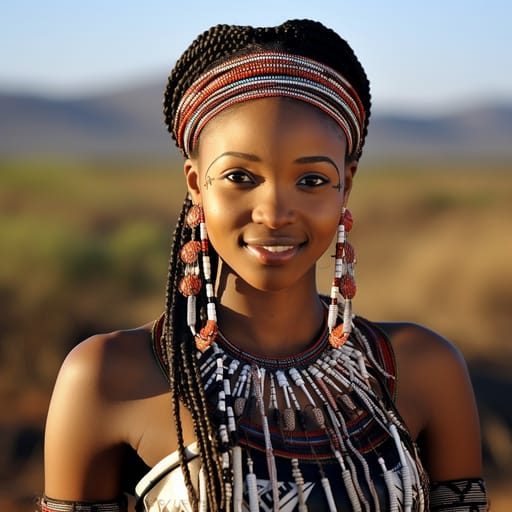

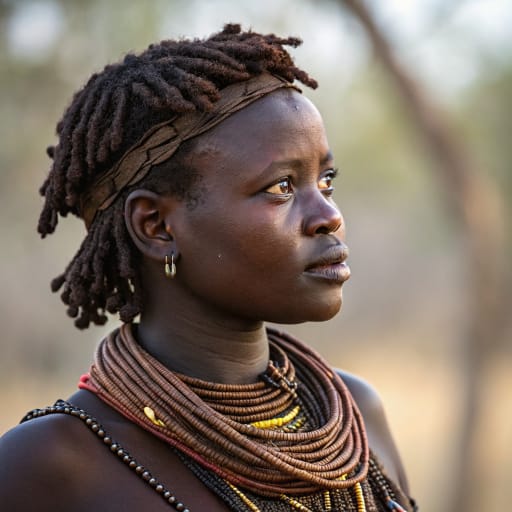
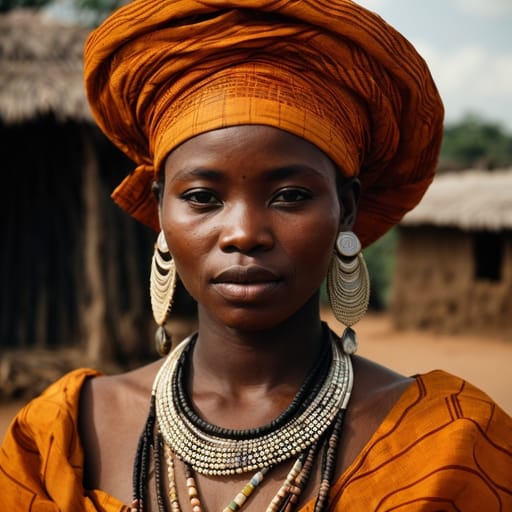
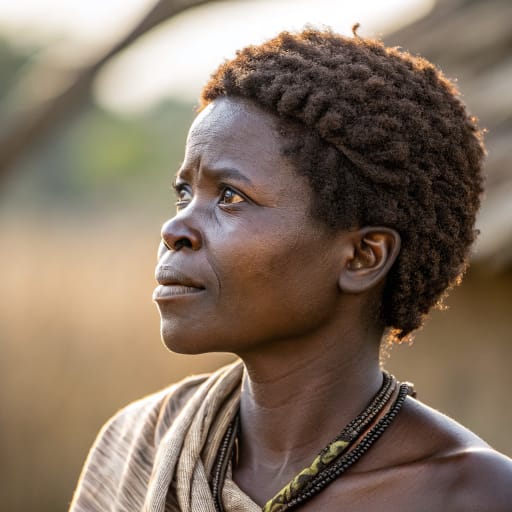
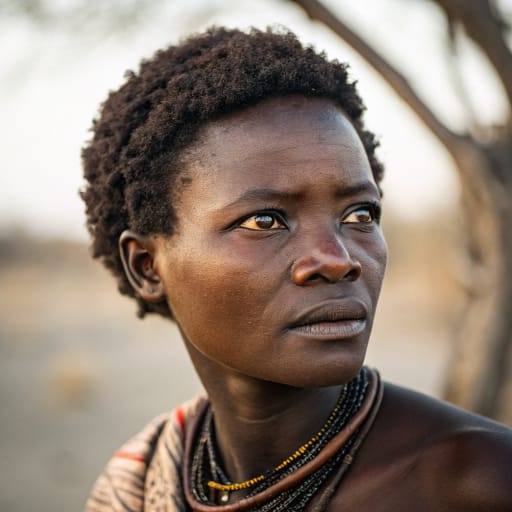
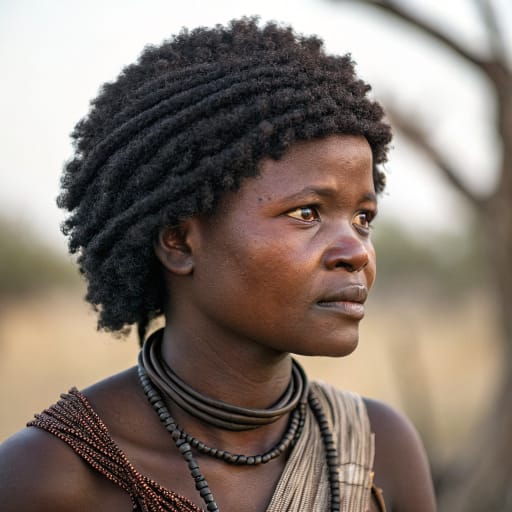
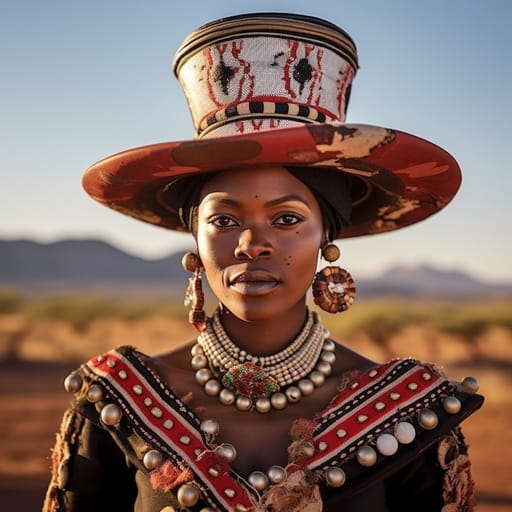
Typical Pare Phenotypes
Reference for AI generation: hair, eyes, skin, facial structure, build
The Pare are a Bantu-speaking population of the Pare Mountains in northeastern Tanzania, and their phenotype sits within the broader East African Bantu range — but with the lighter, leaner build typical of highland agriculturalists rather than the heavier morphology of lowland coastal groups. Skin tone clusters in Fitzpatrick V to VI, most often a deep cool-brown with red-mahogany undertones rather than the blue-black tones common further south; sun exposure on terraced mountain farms tends to deepen the upper face and forearms while leaving the torso noticeably lighter.
Hair is almost uniformly Type 4 — tightly coiled, fine-to-medium in strand diameter, dense at the scalp — and naturally jet-black, though sun-bleaching to a reddish cast is common on children and farmers. Greying tends to come late and concentrates at the temples. Eyes are dark brown to near-black, almond-shaped with a clean upper lid and no epicanthic fold; sclerae are often slightly warm-toned rather than bright white. Brows are full and straight rather than arched.
Facial structure is where the Pare read as distinct from neighboring Chagga and coastal Swahili populations: noses are typically medium-bridged with moderate alar width — narrower than West African averages but broader than Nilotic neighbors like the Maasai — and the philtrum is short. Lips are full but well-defined, with the upper lip carrying noticeable volume rather than being thin. Cheekbones sit high and forward, and the jaw tapers to a relatively narrow chin, giving the face a slight heart-shape rather than the squared mandible seen in many Bantu groups.
Build trends toward lean and wiry. Average male stature runs roughly 168–175 cm, female 156–162 cm, with long limbs relative to torso, narrow shoulders, and low subcutaneous fat — a body composition shaped by generations of mountain agriculture and walking terraced slopes. Sub-group variation between Asu (North Pare) and Gweno speakers is minimal in phenotype; the Gweno of the northern range tend slightly shorter and stockier, while South Pare populations average taller and more gracile.
Pare Body & Anatomy Reference
Per-feature anatomical profile for AI nude generation: Bantu / Khoisan Southern African phenotype
Pare Boobs & Breasts
Pare tits and boobs run medium cup, full but moderate projection, the classic Bantu / Khoisan Southern African bust profile. Pare nipples and areolas show medium-brown to deep-brown areolar pigmentation, with areolar diameter typically in the 30-44mm range and forward-set positioning rather than the heavier West African bust. Pare breasts trend moderately full; less projecting than West African norm, a function of the mesomorph; Khoisan-descended sub-populations show distinctive steatopygic fat deposition body habitus and the mean adult female BMI 24-28. For anatomically accurate AI-generated Pare nudes the render preserves the medium cup, full but moderate projection shape, 30-44mm areolas with medium-brown to deep-brown pigmentation, and the torso proportions of the Bantu / Khoisan Southern African phenotype.
Pare Ass & Hips
Pare hips and butt usually read as the distinctive Khoisan-influenced steatopygic profile in some sub-populations (San, Khoekhoe); broader gluteal projection in Bantu-speaking groups. The skeletal base is wide iliac crests with notable lordosis in Khoisan-descended sub-populations, the Bantu / Khoisan Southern African pattern. Set against the slim Cushitic East African profile, the difference is easy to see, and the hip-to-waist ratio is often what identifies Pare women in photos.
Pare Vagina & Pussy
Expect deep-brown labial pigmentation; the elongated labia minora documented in some Khoisan-descended populations on Pare women, in keeping with Bantu / Khoisan Southern African ancestry. The pubic hair is tightly-coiled coarse texture. Coloring should run evenly from the medium-brown to deep-brown skin of the thighs to the labia, and Pare nude imagery should keep the hair's tightly-coiled coarse texture.
Pare Dicks & Penis
Pare dick and penile anatomy in adult AI generation should anchor on the regional reference data: regional mean ~14cm erect, moderate-to-above-average girth, and deep-brown shaft pigmentation. The Pare cock profile reflects the Bantu / Khoisan Southern African population's anthropometric measurements. The shaft pigmentation should track the surrounding medium-brown to deep-brown skin tone, and the pubic hair should keep its tightly-coiled coarse texture in the typical inverted-V escutcheon.
Pare Body, Curves & Build
Pare body type: mesomorph; Khoisan-descended sub-populations show distinctive steatopygic fat deposition, with mean adult female BMI 24-28. This is the typical Bantu / Khoisan Southern African build. Height range, shoulder-to-hip ratio and fat distribution all follow from it, which is what an accurate Pare nude body should show.
Pare Skin Tone & Hair Texture
Pare skin tone falls in the medium-brown to deep-brown (Fitzpatrick V-VI); lighter in Khoisan-descended populations band, the surface signal most often miscalibrated by generic AI nude generators. Pare hair texture is typically tightly-coiled 4A-4C; the distinctive 'peppercorn' tight-spiral texture in Khoisan-descended populations, characteristic of the Bantu / Khoisan Southern African phenotype. In Pare nude renders the skin should hold that band consistently across the body.
Data depth
40/100Coverage of image-grounded phenotype observations · drives AI generation diversity
- Sample size
- 10/40· 3 images
- Image quality
- 30/30· 67% high
- Confidence
- 0/20· mean 0.00
- Source diversity
- 0/10· wikipedia
- ·Small sample (n<10)
- ·Low overall confidence
- ·Wikipedia-only source, not population-representative
Observed Distribution: Image Sample
Empirical observations from analyzed photographs · supplementary signal, not population truth
Sample: 3 images analyzed (3 wikipedia). Quality: 2 high, 0 medium, 1 low, 0 very_low. Avg analyzer confidence: 0.00.
Skin tone (Fitzpatrick): unclear (100%)
Hair color: unclear (100%)
Hair texture: unclear (100%)
Eye color: unclear (100%)
Epicanthic fold: 0% present, 0% absent, 100% unclear
Caveats: Sample size 3 is small, so the observed distribution should be treated as suggestive, not definitive. Low average analyzer confidence: many photos partially obscured or historical. Sample is 100% Wikipedia notable people, which skews toward male, public-life, and modern figures, not population-representative.
Last aggregated: May 7, 2026
Explore phenotype categories
Structured taxonomy with peer-reviewed scales · 22 anatomical categories
Notable Pare People
14 reference figures, sourced from Wikipedia
- Mwanga District, Msaragambo: The Pare people inherited a difficult land and a mountainous land…
- Dar es Salaam, Makange: Robert Makange was the pioneer of the popular Tanzanian food referre…
- Pare Mountains, Gonja where there is a waterfall known as NDURUMO of about 400 m along the Hi…
- Usangi, A rock in southern Usangi on the slopes of the hills toward the kwakoa villag…
- blue monkeys, Kindoroko Mountain with a natural rainforest (forest reserve) that is home to…
- South Korea, Togolani Edriss Mavura: Tanzania's ambassador to South Korea. A former Privat…
- University of Namibia, Elitabu Keto Mshigeni (Prof): A pioneer of botany research in Tanzania. He se…
- University of Dar es Salaam, Alfeo M. Nikundiwe (Prof): A distinguished researcher in Zoology and former H…
- Rwanda, John S. Mshana (Prof). Vice Rector for Academics at Kigali Institute of Scien…
- fall of Kampala, Ben Msuya (Major General): Led the 19th battalion in 1979 (as a Lieutenant Co…
- Zanzibar, Ahmed Msangi: The deputy director of criminal investigation in Zanzibar. A fo…
- Tanzania, Benedict Mberesero: Established one of the oldest and known bus companies in …
- Tanzanite, Erasto Msuya: The late gemstone dealer (notably, in Tanzanite) with high-end …
- Mwanga Hakika Bank, Ridhuan A. Mringo (Eng): Board Chairman of Mwanga Hakika Bank and CEO & Manag…
Erotic Poses & Sex Positions
From the pose catalog: 219 named positions with reference skeletons
Frequently asked questions about Pare people
Where is the Pare homeland?
The Pare homeland is Pare Mountains (Tanzania) in Southern Africa.
What language do Pare people speak?
Pare people primarily speak Niger-Congo / Bantu / Pare.
What religion do Pare people practice?
The predominant religion among Pare people is Islam.






Make your own Pare images
Five a day, free, no credits to buy. The studio starts from this group's phenotype data, so you can set body type, pose and style and keep the traits accurate.
Start with Pare