Help us get this right
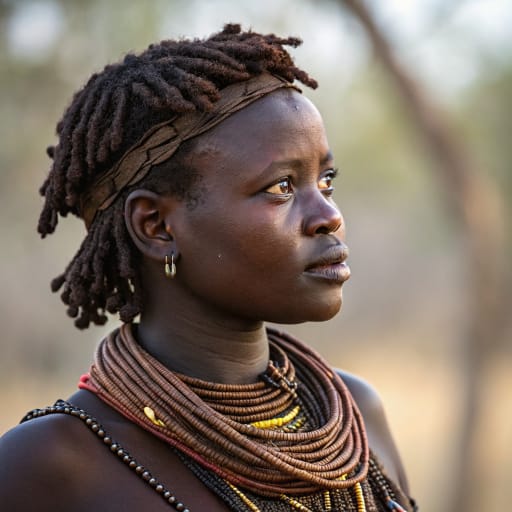
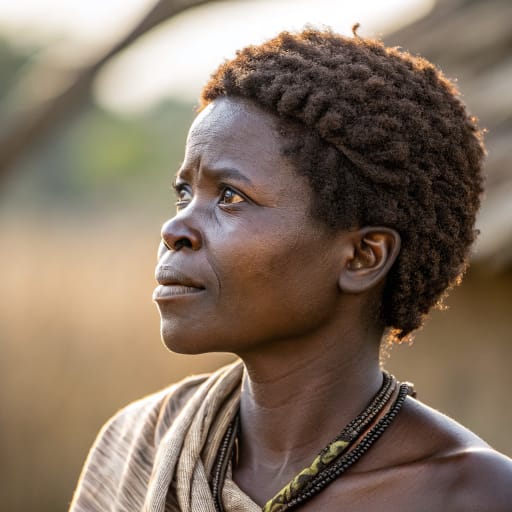
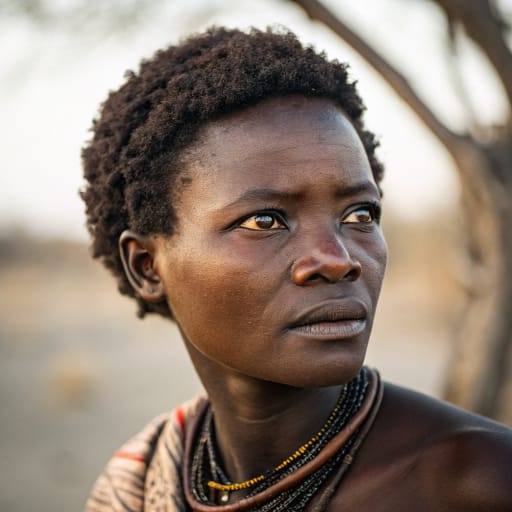
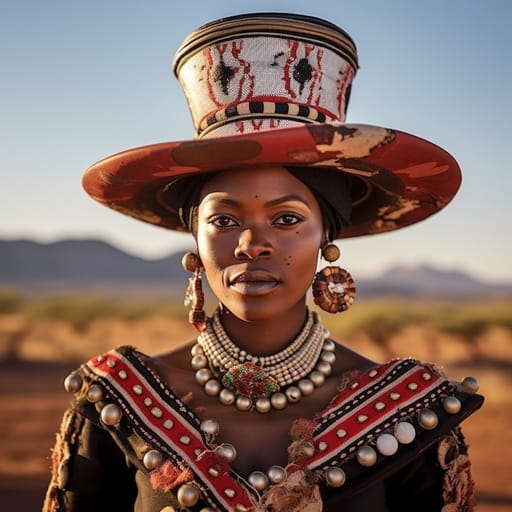
Does this portrait look right for Damara?
One tap. It takes a second and it is recorded.
2 say it looks right, 0 say it looks off.
Damara Erotic
About Damara People
The Damara are one of the genuine puzzles of southern African ethnography. They speak Khoekhoegowab — the same click language as the Nama and the Khoekhoe — yet they look nothing like their linguistic kin, and oral tradition places them in the region long before either the Nama herders or the Bantu-speaking farmers arrived. How a dark-skinned, historically hunter-gatherer-and-coppersmith population came to share a tongue with pastoralist neighbours is a question that has occupied linguists and archaeologists for a century without producing a clean answer. The Damara themselves have a more useful framing: they are simply the people who were already there.
Their homeland is the rough country northwest of Windhoek — granite inselbergs, dry river courses, the seam between the Namib and the central plateau — formally gazetted in the apartheid era as Damaraland and now folded into the Erongo and Kunene regions. Historically they worked copper at Tsumeb and the Brandberg, smelted iron, and moved between hunting, small-stock keeping, and trade with whoever passed through. They were repeatedly raided and displaced — by Oorlam commandos pushing up from the Cape in the nineteenth century, then by the Herero, then by German colonial administration — and a great deal of their pre-colonial economy did not survive contact. Many Damara families now live in towns, on commercial farms as labourers, or in the communal areas around Khorixas and Uis.
Religion is overwhelmingly Christian, mostly Lutheran by way of the Rhenish Mission, with smaller Catholic and Pentecostal followings. Older spiritual practice — ancestor veneration, the central role of the sacred fire, ritual specialists who handled rain and illness — has thinned but not entirely vanished, and bits of it surface at funerals and in the way elders are addressed. The clan system, /Nu-khoen organised into named kin groups with traditional leaders, still structures local politics in the communal areas even where it carries no statutory weight.
Damara material culture is quieter than that of their better-photographed neighbours: less beadwork than Himba, less leatherwork than Herero, more emphasis on song and on a distinctive a cappella vocal tradition that uses the click consonants of the language as percussive elements. The name Damara itself is exonymic — given by outsiders — and the preferred self-designation is ǂNūkhoen, meaning roughly "black people," a name that pointedly distinguishes them from the Khoekhoen who share their language but not their history.
Related ethnic groups
Groups that share Damara's homeland, region, language, or religious tradition. These are likely candidates for comparative phenotype reference.
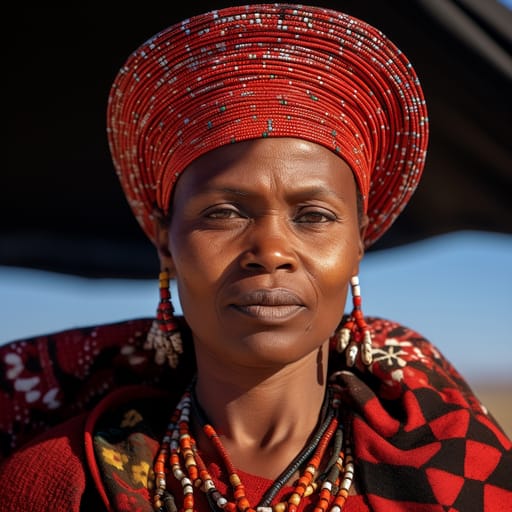

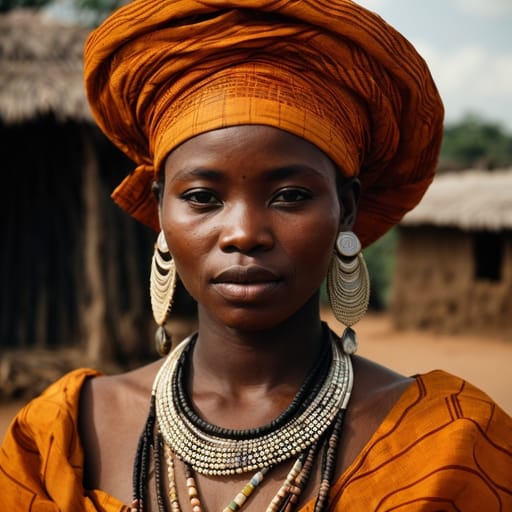
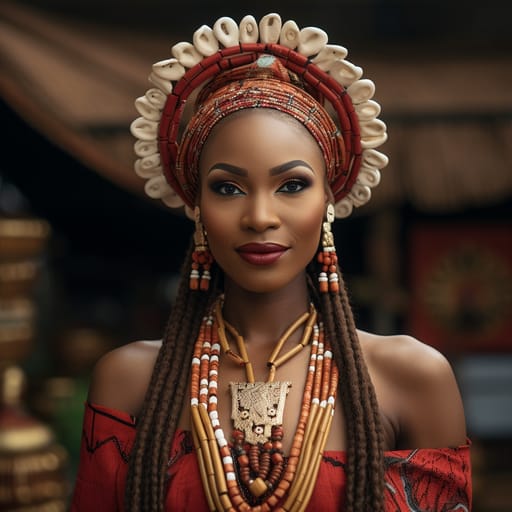
Geographic Distribution: Damara populations across 1 country
Each row is ranked by the group's share of that country's population, with the source citation drawn from published census and demographic surveys. Click through for the full per-country phenotype profile.
| Country | Share | Source |
|---|---|---|
| Namibia | 7.0% | Namibia 2023 Census; Damara (~7%); distinctive Bantu-Khoisan population speaking the Khoisan-language Khoekhoe / Nama |
Typical Damara Phenotypes
Reference for AI generation: hair, eyes, skin, facial structure, build
The Damara present one of southern Africa's genuine phenotypic puzzles: a population that speaks a Khoekhoe click language shared with the Nama and San, yet looks predominantly Bantu — dark-skinned, robust, and built unlike the smaller-statured Khoesan groups whose tongue they adopted. The result is a fairly cohesive sub-Saharan African appearance with subtle Khoesan undercurrents in a minority of individuals, particularly around the face.
Hair is almost uniformly black and tightly coiled — Type 4B to 4C in the modern typing system — with the small, springy curl pattern typical of populations indigenous to the region. The "peppercorn" tufting seen in San and some Nama is uncommon but not absent in older or more rural Damara. Graying tends to come late and concentrates at the temples.
Eyes are dark brown to near-black, set under a moderate brow ridge. Epicanthic folds are rare; the eye shape is generally open and almond, without the pronounced Khoesan eye-fold despite the linguistic kinship. Skin sits in the deeper end of the Fitzpatrick range — mostly V to VI — with warm, red-brown undertones rather than the yellow-olive cast common in Nama and San neighbors. This warm-brown coloring is one of the more reliable visual markers separating Damara from the lighter Khoesan-speaking groups they share territory with.
Facial structure leans Bantu: a broader nasal base with a low-to-medium bridge, full and well-defined lips, and a strong jawline. Cheekbones are present but less laterally projected than in Khoesan populations. Stature is medium to tall — adult men commonly 170–180 cm — with sturdy, muscular builds historically shaped by pastoralism and mining labor. Women tend toward fuller hips and thighs with a relatively narrow waist, the steatopygic tendency seen in some Khoesan women being uncommon here.
Sub-group variation is modest: the Damara are reasonably uniform compared to neighboring populations, with the clearest gradient running between more isolated Damaraland communities and urbanized Damara in Windhoek and Walvis Bay, where intermarriage with Owambo, Herero, and Coloured Namibians has softened some features.
Damara Body & Anatomy Reference
Per-feature anatomical profile for AI nude generation: Bantu / Khoisan Southern African phenotype
Damara Boobs & Breasts
Damara boobs follow the Bantu / Khoisan Southern African profile: medium cup, full but moderate projection. Areolar diameter is usually 30-44mm, and the coloring is medium-brown to deep-brown areolar pigmentation. Breast shape tracks body composition (mesomorph; Khoisan-descended sub-populations show distinctive steatopygic fat deposition, mean adult female BMI 24-28), so Damara breasts tend to be moderately full; less projecting than West African norm. Expect a forward-set shape, not the heavier West African bust.
Damara Ass & Hips
Damara ass and hip morphology presents as the distinctive Khoisan-influenced steatopygic profile in some sub-populations (San, Khoekhoe); broader gluteal projection in Bantu-speaking groups, distinctly different from the slim Cushitic East African profile. The Damara pelvic profile shows wide iliac crests with notable lordosis in Khoisan-descended sub-populations, anchored in the Bantu / Khoisan Southern African skeletal pattern. Damara butt shots in adult AI imagery should render the the distinctive Khoisan-influenced steatopygic profile in some sub-populations (San, Khoekhoe); broader gluteal projection in Bantu-speaking groups silhouette with the overall build (mesomorph; Khoisan-descended sub-populations show distinctive steatopygic fat deposition) and the fat distribution typical of the Bantu / Khoisan Southern African phenotype.
Damara Vagina & Pussy
Damara pussy anatomy typically shows deep-brown labial pigmentation; the elongated labia minora documented in some Khoisan-descended populations. Pubic hair is usually tightly-coiled coarse texture. In AI-generated Damara nudes, labial color should blend into the medium-brown to deep-brown skin with a gradual transition, and the hair should keep its tightly-coiled coarse texture.
Damara Dicks & Penis
Penis reference for Damara men: regional mean ~14cm erect, moderate-to-above-average girth. Coloring: deep-brown shaft pigmentation. An accurate Damara cock in AI imagery matches the surrounding medium-brown to deep-brown skin rather than a generic porn default. Circumcision depends on religion and custom, not ancestry.
Damara Body, Curves & Build
The Damara figure is generally mesomorph; Khoisan-descended sub-populations show distinctive steatopygic fat deposition, with mean adult female BMI 24-28, characteristic of Bantu / Khoisan Southern African ancestry. AI image tools tend to flatten regional body types into a few stock shapes; here the Damara build is kept as its own reference.
Damara Skin Tone & Hair Texture
Skin: medium-brown to deep-brown (Fitzpatrick V-VI); lighter in Khoisan-descended populations. Hair: tightly-coiled 4A-4C; the distinctive 'peppercorn' tight-spiral texture in Khoisan-descended populations. Both are typical of Bantu / Khoisan Southern African ancestry. The most common mistake in AI nudes of Damara women is a body rendered lighter than the face.
Data depth
0/100Coverage of image-grounded phenotype observations · drives AI generation diversity
- Sample size
- 0/40· 0 images
- Image quality
- 0/30· 0% high
- Confidence
- 0/20
- Source diversity
- 0/10
- ·No image observations yet
Explore phenotype categories
Structured taxonomy with peer-reviewed scales · 22 anatomical categories
Erotic Poses & Sex Positions
From the pose catalog: 219 named positions with reference skeletons
Frequently asked questions about Damara people
Where is the Damara homeland?
The Damara homeland is Damaraland (Namibia) in Southern Africa.
What countries do Damara people live in?
Damara populations are documented across 1 country: Namibia.
What language do Damara people speak?
Damara people primarily speak Khoe / Khoekhoe.
What religion do Damara people practice?
The predominant religion among Damara people is Christianity.






Make your own Damara images
Five a day, free, no credits to buy. The studio starts from this group's phenotype data, so you can set body type, pose and style and keep the traits accurate.
Start with Damara