Help us get this right
Does this portrait look right for Herero?
One tap. It takes a second and it is recorded.
1 says it looks right, 0 say it looks off.
Herero Erotic
About Herero People
The Herero are a Bantu-speaking people of the dry savannahs and semi-deserts straddling central and northern Namibia and southern Angola, cattle-herders by deep cultural inheritance even where modern life has moved many of them into towns. Their language, Otjiherero, sits within the southwestern Bantu cluster — closer to Himba and Mbanderu speech than to the Owambo dialects further north — and the kinship between branches is real, not metaphorical: the OvaHimba of the Kunene and the Ovambanderu of eastern Namibia and Botswana are not separate peoples so much as Herero who took different roads through the nineteenth century.
What distinguishes the Herero, in the eyes of outsiders, is often the dress: the long Victorian gown and horn-shaped headdress, the ohorokova, that married women wear as everyday clothing across much of Hereroland. It looks like a colonial relic and in a sense it is — the silhouette derives from German missionary wives of the late 1800s — but the Herero appropriated it, reshaped it, and turned the headdress into a deliberate echo of cattle horns, the animal at the center of their economic and spiritual world. It is now unmistakably theirs. The OvaHimba, by contrast, kept the older aesthetic: ochre-rubbed skin, leather, and elaborate hairwork that signals age, marital status, and lineage at a glance.
The defining historical wound is the 1904–1908 genocide under German colonial command, in which a majority of the Herero population was killed or driven into the Omaheke desert to die of thirst. The trauma is not historical in the distant sense — it shapes land claims, reparations politics, and the annual Otjiserandu commemorations in Okahandja, where descendants of the chiefly houses parade in red, green, and white uniforms tied to the regiments their ancestors fought in. Christianity, mostly Lutheran with some Catholic and Pentecostal presence, sits alongside an active ancestor cult: the holy fire, okuruwo, kept by the homestead head as the line of communication with the dead, has not been displaced by the church so much as braided into it. Cattle remain the measure of a man's standing even among Herero who haven't tended a herd in a generation, and clan membership — patrilineal oruzo, matrilineal eanda — still governs marriage, inheritance, and ritual obligation.
Related ethnic groups
Groups that share Herero's homeland, region, language, or religious tradition. These are likely candidates for comparative phenotype reference.
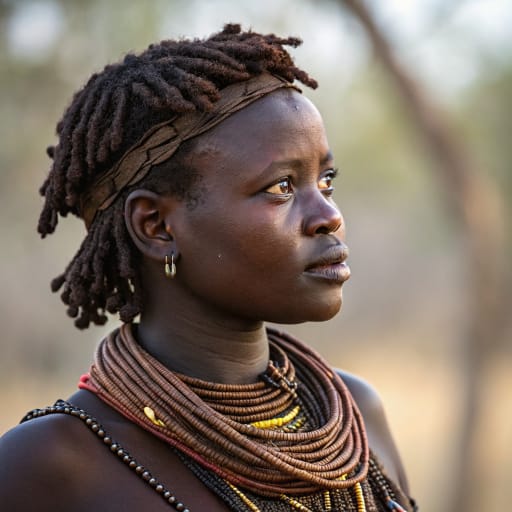
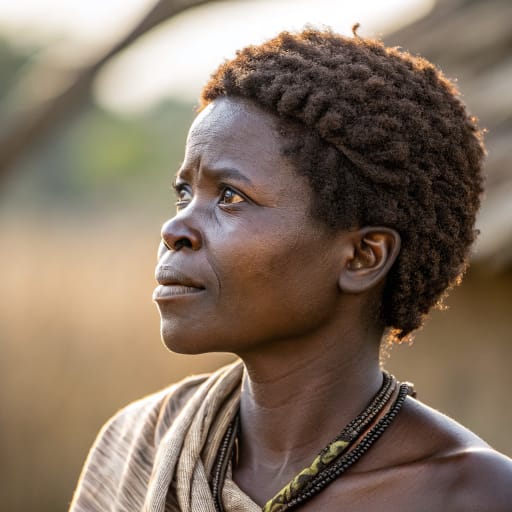
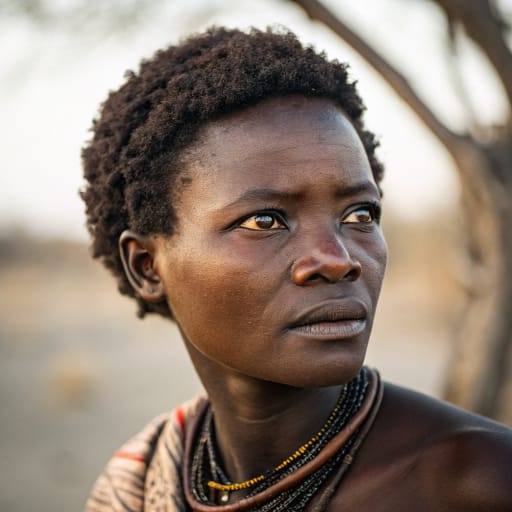
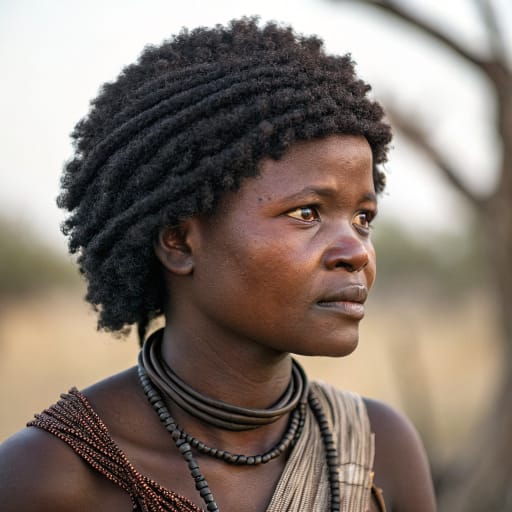
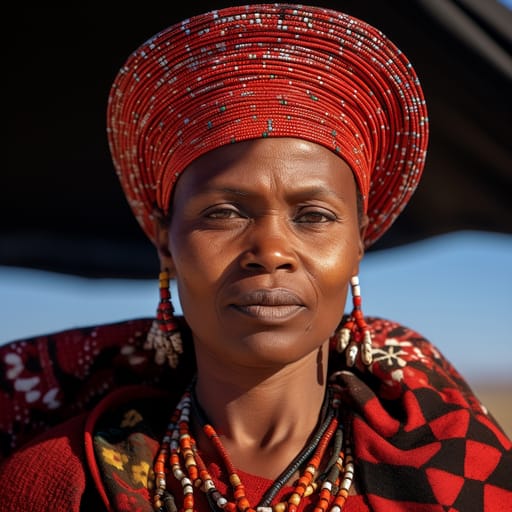

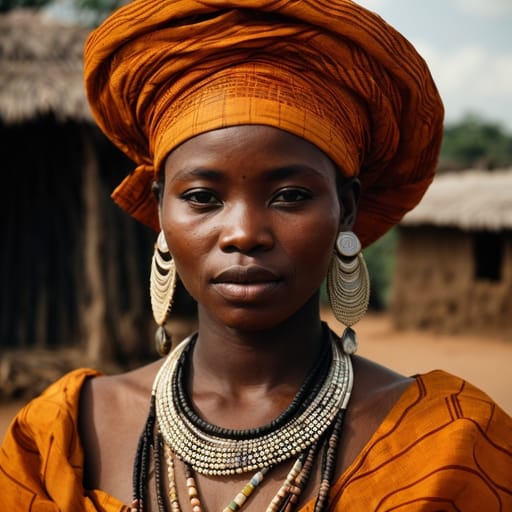
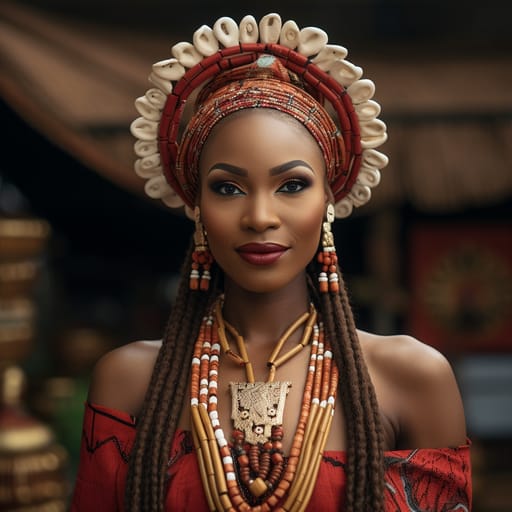
Geographic Distribution: Herero populations across 1 country
Each row is ranked by the group's share of that country's population, with the source citation drawn from published census and demographic surveys. Click through for the full per-country phenotype profile.
| Country | Share | Source |
|---|---|---|
| Namibia | 7.0% | Namibia 2023 Census; Herero (~7%); Bantu source population. The 1904-1908 Herero and Nama genocide by German colonial forces is one of the documented genocides of the 20th c. — approximately 65,000-80,000 Herero (~80% of the population) and 10,000+ Nama died. Cross-border with Botswanan Herero (~31,000+) |
Typical Herero Phenotypes
Reference for AI generation: hair, eyes, skin, facial structure, build
The Herero phenotype reads as classically Bantu-Southern African, but with a striking sub-group divergence that makes generalization difficult: the OvaHimba of the Kunene borderland have become one of the most photographed populations on earth precisely because their daily ochre-and-butterfat skin treatment produces a deep red-orange surface tone that is cultural, not genetic. Underneath the otjize, the baseline phenotype across Herero, OvaHimba, and Ovambanderu is broadly consistent.
Hair is uniformly Type 4 — tightly coiled, fine to medium in diameter, with high shrinkage. Natural color sits in the true black to very dark brown range; reddish casts seen on OvaHimba women are again the ochre paste binding the locked strands, not pigment. Eyes are dark brown to near-black, almond-shaped with no epicanthic fold, set under a moderately pronounced brow ridge. Eyebrows are dense and dark.
Skin tone falls in the Fitzpatrick V–VI range, typically a warm medium-to-deep brown with red or olive undertones rather than the blue-black register seen further west in Nilotic populations. Cheek and shoulder areas hold a slight reddish warmth that the otjize amplifies decoratively.
Facial structure tends toward broad, gently rounded foreheads, wide-set eyes, and noses with a low-to-moderate bridge and a moderately wide alar base — narrower on average than West African Bantu phenotypes and noticeably more refined in the OvaHimba, where high cheekbones and elongated necks are routinely remarked on by anthropometric surveys. Lips are full but proportionate, the upper lip often as full as the lower.
Build is tall and lean. Herero men commonly fall in the 175–185 cm range and women in the 165–175 cm range, with long limbs, narrow hips on younger adults, and the pronounced lumbar curve and gluteal projection documented across Khoe-adjacent Southern African populations. Pastoralist diet keeps body fat low into middle age. Ovambanderu, more sedentary and agricultural, trend slightly stockier; OvaHimba remain the leanest and tallest of the three.
Herero Body & Anatomy Reference
Per-feature anatomical profile for AI nude generation: Bantu / Khoisan Southern African phenotype
Herero Boobs & Breasts
Bust reference for Herero women: medium cup, full but moderate projection, which is typical of Bantu / Khoisan Southern African ancestry. Areolas measure about 30-44mm across, with medium-brown to deep-brown pigmentation. Body type (mesomorph; Khoisan-descended sub-populations show distinctive steatopygic fat deposition) shapes the bust as well, so Herero tits are usually moderately full; less projecting than West African norm. In AI imagery, keep the forward-set shape rather than drifting toward the heavier West African bust.
Herero Ass & Hips
The Herero ass is typically the distinctive Khoisan-influenced steatopygic profile in some sub-populations (San, Khoekhoe); broader gluteal projection in Bantu-speaking groups, which sets it apart from the slim Cushitic East African profile. Underneath, the pelvis shows wide iliac crests with notable lordosis in Khoisan-descended sub-populations, part of the Bantu / Khoisan Southern African skeletal pattern. For Herero butt pics and AI renders, match that silhouette and the overall build (mesomorph; Khoisan-descended sub-populations show distinctive steatopygic fat deposition).
Herero Vagina & Pussy
Herero pussy and vulvar anatomy presents deep-brown labial pigmentation; the elongated labia minora documented in some Khoisan-descended populations, consistent with the Bantu / Khoisan Southern African phenotype's pigmentation pattern. Herero pubic hair is typically tightly-coiled coarse texture, in the inverted-triangle pattern. For anatomically accurate Herero pussy renders the labial coloration should match the surrounding medium-brown to deep-brown skin tone with a continuous gradient, and the hair should keep its tightly-coiled coarse texture.
Herero Dicks & Penis
Herero dicks follow the Bantu / Khoisan Southern African reference data: regional mean ~14cm erect; moderate-to-above-average girth; deep-brown shaft pigmentation. Shaft color should track the medium-brown to deep-brown skin tone with a smooth change toward the glans, and Herero pubic hair keeps its tightly-coiled coarse texture.
Herero Body, Curves & Build
Herero body type and overall build presents as mesomorph; Khoisan-descended sub-populations show distinctive steatopygic fat deposition, with mean adult female BMI 24-28: the characteristic Bantu / Khoisan Southern African habitus. Herero curves and proportions should keep the regional skeletal frame (height, shoulder-to-hip ratio, limb proportions) rather than a generic mesomorph default.
Herero Skin Tone & Hair Texture
Herero skin sits in the medium-brown to deep-brown (Fitzpatrick V-VI); lighter in Khoisan-descended populations band. Hair is typically tightly-coiled 4A-4C; the distinctive 'peppercorn' tight-spiral texture in Khoisan-descended populations, in keeping with the Bantu / Khoisan Southern African phenotype. In nude renders the skin should stay one even tone from face to body, and body, pubic and head hair should match.
Data depth
0/100Coverage of image-grounded phenotype observations · drives AI generation diversity
- Sample size
- 0/40· 0 images
- Image quality
- 0/30· 0% high
- Confidence
- 0/20
- Source diversity
- 0/10
- ·No image observations yet
Explore phenotype categories
Structured taxonomy with peer-reviewed scales · 22 anatomical categories
Erotic Poses & Sex Positions
From the pose catalog: 219 named positions with reference skeletons
Frequently asked questions about Herero people
Where is the Herero homeland?
The Herero homeland is Hereroland (Namibia), Angola in Southern Africa.
What countries do Herero people live in?
Herero populations are documented across 1 country: Namibia.
What language do Herero people speak?
Herero people primarily speak Niger-Congo / Bantu / Herero.
What religion do Herero people practice?
The predominant religion among Herero people is Christianity.






Make your own Herero images
Five a day, free, no credits to buy. The studio starts from this group's phenotype data, so you can set body type, pose and style and keep the traits accurate.
Start with Herero