Help us get this right
Does this portrait look right for Pedi?
One tap. It takes a second and it is recorded.
1 says it looks right, 1 says it looks off.
Pedi Erotic
Limpopo (South Africa)
Niger-Congo / Bantu / Sotho-Tswana / Sepedi
Christianity
About Pedi People
The Pedi — also called the Northern Sotho — are the people of the Sepedi-speaking world in South Africa's northeast, concentrated in Limpopo province between the Olifants and Steelpoort rivers. They take their name and political identity from the Marota kingdom that consolidated under Thulare in the late eighteenth century, an upland polity that ran the iron and copper trade across the Lowveld until the Boer and British wars of the 1870s and 1880s broke its sovereignty. What survived the wars was the cultural core: a network of royal lineages, totemic clans, and chiefdoms still recognised in customary law, with the paramountcy at Mohlaletse continuing to mediate disputes the courts will not touch.
Sepedi belongs to the Sotho–Tswana branch of Bantu and is mutually intelligible, with effort, with Sesotho and Setswana — close enough that speakers can follow a conversation, distant enough that the vocabulary of ritual, kinship, and landscape diverges sharply. It is one of South Africa's eleven official languages and the primary medium of instruction in much of Limpopo's rural schooling. The naming conventions are dense: a person carries a clan praise (seboko) tied to an animal totem, and reciting another's praises correctly is still treated as a serious act of respect rather than performance.
Christianity is the dominant affiliation today — Lutheran missions arrived in the 1860s and reshaped much of the religious landscape — but the older cosmology has not been displaced so much as layered underneath. Ancestors (badimo) remain consequential; a successful church-going household will still slaughter for them, consult a ngaka when illness resists hospital treatment, and observe the rules around the family graveyard. Initiation schools — koma for boys, byale for girls — operate alongside the school calendar and are still, in many areas, the gate through which one becomes socially adult.
Daily life is shaped by the long century of labour migration to the Witwatersrand mines, which pulled men away and left women managing land, cattle, and household economies in patterns that persist after the mines have shrunk. The Pedi homestead remains recognisable: a horseshoe of round houses around a central kgoro where the household head receives visitors, with the kraal behind. Music carries the strongest public signature — the kiba men's drum-and-stamping ensembles, originally a migrant labourers' form, have circled back to the villages as the genre by which Pedi identity announces itself at funerals, weddings, and political rallies.
Related ethnic groups
Groups that share Pedi's homeland, region, language, or religious tradition. These are likely candidates for comparative phenotype reference.
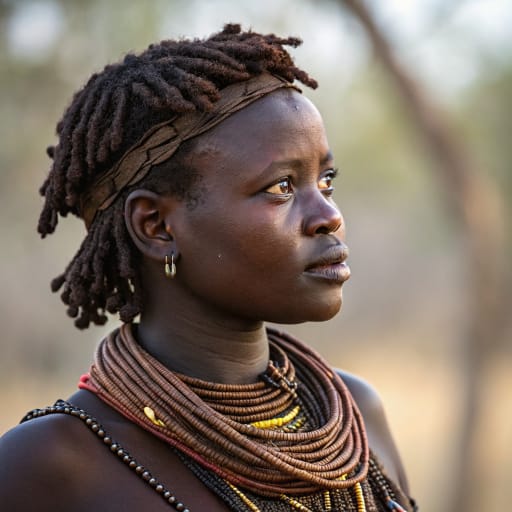
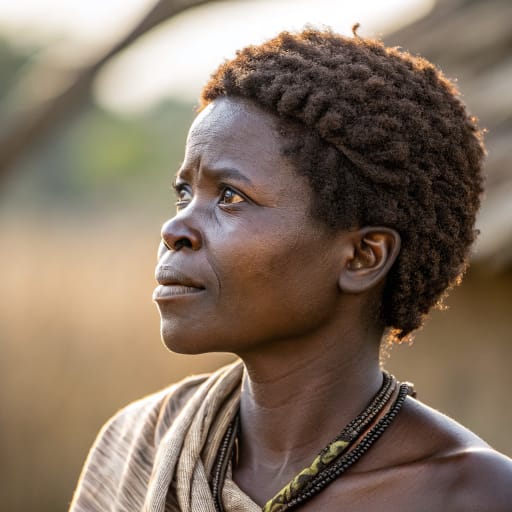
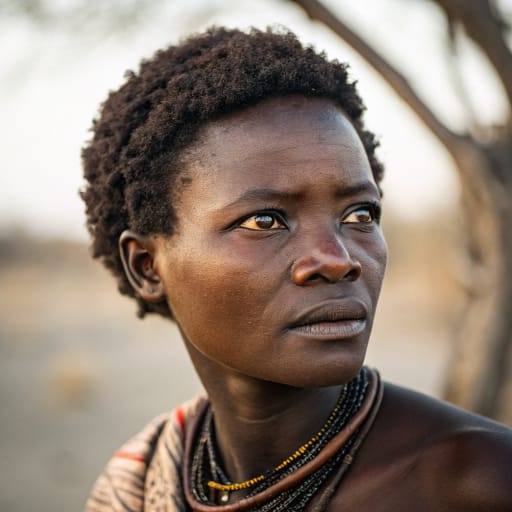
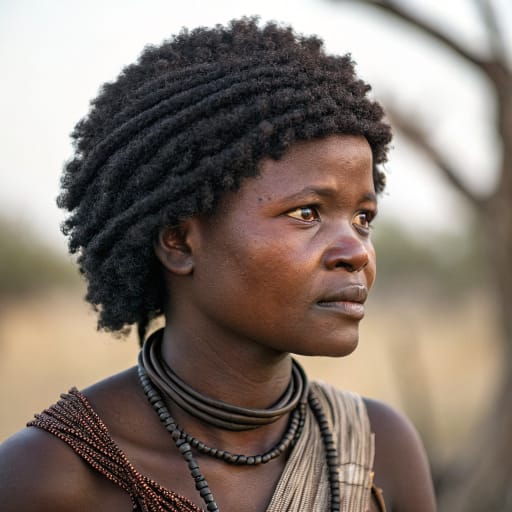
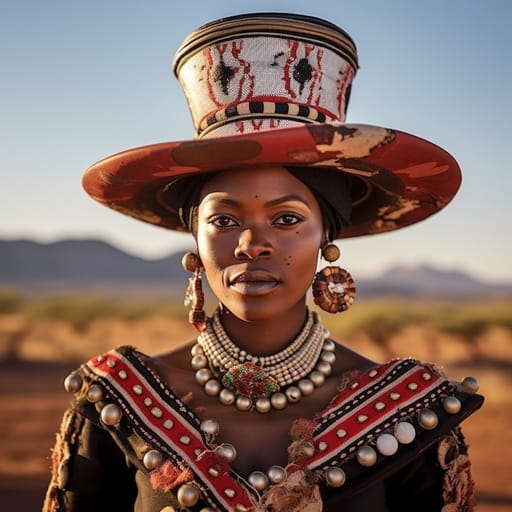
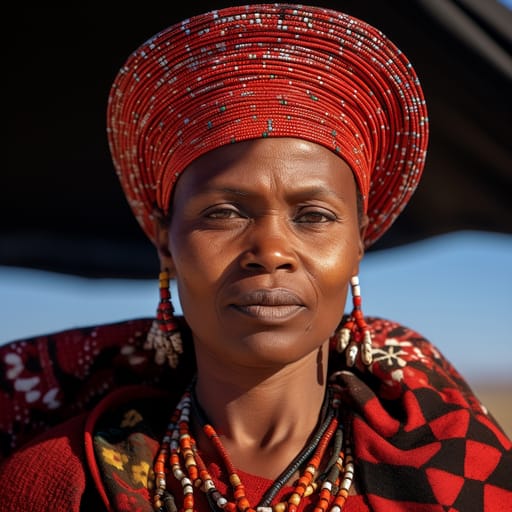

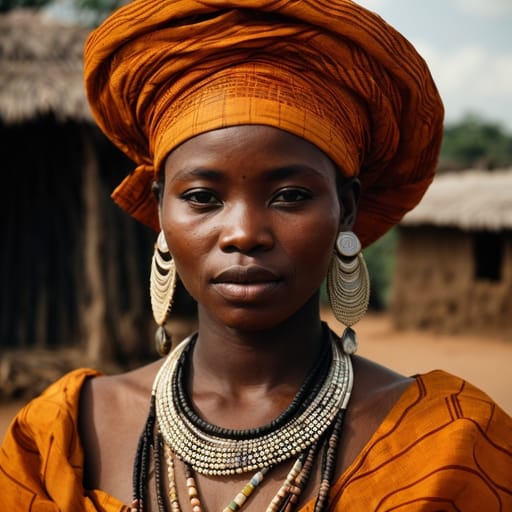
Typical Pedi Phenotypes
Reference for AI generation: hair, eyes, skin, facial structure, build
The Pedi (Bapedi) sit within the broader Sotho–Tswana cluster of Southern Africa, and their phenotype reflects that lineage rather than the Nguni populations to the south or the equatorial West African baseline. Skin tone runs predominantly Fitzpatrick VI — deeply pigmented brown to near-black with warm reddish-brown undertones — though a meaningful minority sit at deep V, especially among lineages with historic Tsonga or Khoisan admixture along the Limpopo lowveld. The undertone tends to read warmer and more coppery than the cooler, blue-black register common in some West African groups; jazz musician Don Laka and athlete Caster Semenya bracket the typical range well.
Hair is uniformly Type 4 — tightly coiled, with Type 4B and 4C dominating. The strand is fine but densely packed, forming defined Z-pattern coils that shrink dramatically when dry. Color is true black, occasionally with a brown cast in sun-exposed children that darkens with age. Premature greying clusters at the temples is common in middle age. Eyes are dark brown to near-black, set under a moderately heavy brow ridge; the eye opening is almond-shaped without an epicanthic fold, and sclera tend toward a slight bluish cast in youth.
Facial structure is the more distinctive marker. Pedi features typically show a broader, lower nasal bridge with wide alar flare, full and well-everted lips with a defined cupid's bow, and high, laterally projected cheekbones over a relatively short, wide jaw. The midface reads fuller than in Nguni neighbors, and prognathism is mild rather than pronounced. Foreheads are often broad and slightly rounded.
Build trends tall and lean — adult men commonly fall between 173–183 cm, women 160–170 cm — with long limbs relative to torso, narrow hips, and naturally low body fat that holds into middle age. Shoulders are typically narrower than in Nguni populations, and musculature reads sinewy rather than bulky, a build well-represented by middle-distance runners from the region. Sub-group variation between the eastern Sekhukhune Pedi heartland and the more admixed northern Limpopo communities is modest, mostly expressed in slightly lighter average tone and softer feature definition further north.
Pedi Body & Anatomy Reference
Anatomy by feature, Bantu / Khoisan Southern African phenotype
Pedi Boobs & Breasts
Pedi boobs follow the Bantu / Khoisan Southern African profile: medium cup, full but moderate projection. Areolar diameter is usually 30-44mm, and the coloring is medium-brown to deep-brown areolar pigmentation. Breast shape tracks body composition (mesomorph; Khoisan-descended sub-populations show distinctive steatopygic fat deposition, mean adult female BMI 24-28), so Pedi breasts tend to be moderately full; less projecting than West African norm. Expect a forward-set shape, not the heavier West African bust.
Pedi Ass & Hips
Pedi ass and hip morphology presents as the distinctive Khoisan-influenced steatopygic profile in some sub-populations (San, Khoekhoe); broader gluteal projection in Bantu-speaking groups, distinctly different from the slim Cushitic East African profile. The Pedi pelvic profile shows wide iliac crests with notable lordosis in Khoisan-descended sub-populations, anchored in the Bantu / Khoisan Southern African skeletal pattern. Pedi butt shots in adult AI imagery should render the the distinctive Khoisan-influenced steatopygic profile in some sub-populations (San, Khoekhoe); broader gluteal projection in Bantu-speaking groups silhouette with the overall build (mesomorph; Khoisan-descended sub-populations show distinctive steatopygic fat deposition) and the fat distribution typical of the Bantu / Khoisan Southern African phenotype.
Pedi Vagina & Pussy
Pedi pussy anatomy typically shows deep-brown labial pigmentation; the elongated labia minora documented in some Khoisan-descended populations. Pubic hair is usually tightly-coiled coarse texture. In AI-generated Pedi nudes, labial color should blend into the medium-brown to deep-brown skin with a gradual transition, and the hair should keep its tightly-coiled coarse texture.
Pedi Dicks & Penis
Penis reference for Pedi men: regional mean ~14cm erect, moderate-to-above-average girth. Coloring: deep-brown shaft pigmentation. An accurate Pedi cock in AI imagery matches the surrounding medium-brown to deep-brown skin rather than a generic porn default. Circumcision depends on religion and custom, not ancestry.
Pedi Body, Curves & Build
The Pedi figure is generally mesomorph; Khoisan-descended sub-populations show distinctive steatopygic fat deposition, with mean adult female BMI 24-28, characteristic of Bantu / Khoisan Southern African ancestry. AI image tools tend to flatten regional body types into a few stock shapes; here the Pedi build is kept as its own reference.
Pedi Skin Tone & Hair Texture
Skin: medium-brown to deep-brown (Fitzpatrick V-VI); lighter in Khoisan-descended populations. Hair: tightly-coiled 4A-4C; the distinctive 'peppercorn' tight-spiral texture in Khoisan-descended populations. Both are typical of Bantu / Khoisan Southern African ancestry. The most common mistake in AI nudes of Pedi women is a body rendered lighter than the face.
Data depth
68/100Coverage of image-grounded phenotype observations · drives AI generation diversity
- Sample size
- 23/40· 15 images
- Image quality
- 30/30· 73% high
- Confidence
- 15/20· mean 0.72
- Source diversity
- 0/10· wikipedia
- ·Modest sample (n<25)
- ·Wikipedia-only source, not population-representative
Observed Distribution: Image Sample
Empirical observations from analyzed photographs · supplementary signal, not population truth
Sample: 15 images analyzed (15 wikipedia). Quality: 11 high, 3 medium, 1 low, 0 very_low. Avg analyzer confidence: 0.72.
Skin tone (Fitzpatrick): V (47%), VI (40%), unclear (13%)
Hair color: black (47%), gray/white (40%), unclear (13%)
Hair texture: straight (7%), coily (73%), bald (7%), unclear (13%)
Eye color: dark brown (87%), unclear (13%)
Epicanthic fold: 0% present, 87% absent, 13% unclear
Caveats: Sample size 15 is modest, so secondary patterns may not be reliable. Sample is 100% Wikipedia notable people, which skews toward male, public-life, and modern figures, not population-representative.
Last aggregated: May 7, 2026
Explore phenotype categories
Structured taxonomy with peer-reviewed scales · 22 anatomical categories
Notable Pedi People
64 reference figures, sourced from Wikipedia
- Kgalema Motlanthe, 3rd President of South Africa
- Lesetja Kganyago, governor of South African Reserve Bank
- Edward Lekganyane, Zion Christian Church (ZCC) leader
- Engenas Lekganyane, founder of Zion Christian Church (ZCC),
- Sefako Makgatho, second President of the African National Congress, born in Ga-Mphahlele village
- Don Laka, South African jazz musician
- Thabo Makhanyo Madiye Makgoba, Anglican Archbishop of Cape Town
- David Makhura, Premier of Gauteng Province
- Julius Malema, former leader of the ANC Youth League and current commander in chief of the E…
- Mampuru II, King of the Pedi (1879-1883)
- Richard Maponya, a South African businessman and founder and first president of the National A…
- Cassel Mathale, third premier of Limpopo province
- Yvonne Chaka Chaka, born Yvonne Machaka, South African singer, songwriter and actress
- Lebo Mathosa, musician
- Kenneth Meshoe, politician
- Peter Mokaba, former leader of the ANC Youth League
- Lydia Mokgokoloshi, South African actress
- Sello Moloto, former premier of Limpopo province
- Trott Moloto, former South African National Soccer coach
- Mathole Motshekga, politician
- Aaron Motsoaledi, Minister of Health, South Africa
- Caroline Motsoaledi, political activist
- Elias Motsoaledi, anti-apartheid activist, one of the eight men sentenced to life imprisonment …
- Letlapa Mphahlele, former president of the Pan Africanist Congress (PAC).
- Gift Ngoepe, baseball player
- Lilian Ngoyi, anti-apartheid activist
- Maite Nkoana-Mashabane, Minister of Rural Development and Land Reform, South Africa
- DJ Spoko, South African record producer & DJ
- Gwen Ramokgopa, deputy Minister of Health, former MEC of Health in Gauteng Province
- Mamphela Ramphele, former director at the World Bank, former principal of the University of Cape…
- Shebeshxt, Lekompo artist
- Sello Rasethaba, businessman
- Thabo Sefolosha, American basketball player
- Hellen Motsuki, Skeem Saam actress
- Thabo Shokgolo, South African DJ and music producer, member of Liquideep
- King Matsebe Sekhukhune, son of King Sekwati; fought two wars: first successfully in 1876 against the …
- Caiphus Semenya, musician
- Poizen, South African Deep House DJ
- Tokyo Sexwale, former Premier of Gauteng.
- Caster Semenya, athlete and Olympic Games medal winner
- Judith Sephuma, musician
- Chymamusique, South African DJ & music producer
- Master KG, famous artist and composer of the popular song Jerusalema
- Kgosientsho Ramokgopa, former mayor of City of Tshwane Metropolitan Municipality
- Phuti Mahanyele, CEO of Shanduka Group
- Kamo Mphela, amapiano artist
- Bontle Smith, amapiano artist
- DJ Maphorisa, South African DJ & record producer
- Pabi Cooper, amapiano artist
- Shandesh, Lekompo singer
- Harriet Manamela, Skeem Saam actress
- Raymond Motadi, TV personality, known professionally as Mon-D
- Janesh, Lekompo singer
- Phobla on the beat, Lekompo singer & producer
- Naqua SA, Lekompo DJ & record producer
- DJ Cleo, South African DJ & Producer
- Kgaogelo Sekgota, South African Football Player
- Lesley Manyathela, Former South African Football Player
- Tlou Segolela, Former South African Football Player
- Clement Maosa, South African Actor, Lawyer and Lekompo Artist
- King Monada, Lekompo Artist
- Lerato Kganyago, South African Media Personality
- Kaycherlow Nll, Lekompo singer
- Kwena Maphaka, South African Cricket Player
Erotic Poses & Sex Positions
From the pose catalog: 219 named positions with reference skeletons
Frequently asked questions about Pedi people
Where is the Pedi homeland?
The Pedi homeland is Limpopo (South Africa) in Southern Africa.
What language do Pedi people speak?
Pedi people primarily speak Niger-Congo / Bantu / Sotho-Tswana / Sepedi.
What religion do Pedi people practice?
The predominant religion among Pedi people is Christianity.






Make your own Pedi images
Five a day, free, no credits to buy. The studio starts from this group's phenotype data, so you can set body type, pose and style and keep the traits accurate.
Start with Pedi